
BIZANTINA, LITURGIA. – This is the name given to the liturgy to which Byzantium imparted its distinctive character and imprint.
I. ORIGIN
Byzantium was not the cradle of the rite that bears its name, for it traces its origins to Antioch, the first capital of the East. Indeed, in the Antiochene rite we find its primitive nucleus, which, passing through Asia Minor, attained its completion on the shores of the Bosporus.Pontus and Cappadocia had in turn received the faith from Syria, and it was natural that the first missionaries should bring them, together with the teaching of the Gospel, the forms of worship in use in the mother Church. When, however, Constantinople became the capital of the Eastern Empire and, at the Council of Chalcedon (451), was recognized as the seat of a patriarchate, its position in relation to the other ecclesiastical provinces enabled it to achieve an ever more significant independence. This autonomy, together with the presence of a numerous clergy and of learned and influential men, manifested itself in the liturgical sphere through the formation of particular rites and the creation of a local calendar and festal cycle. This period of transformation and development extends from the 8th to the 12th century.
II. EXPANSION AND LITURGICAL LANGUAGES
The translation of the liturgical books into various languages is connected with the expansion of the Byzantine rite. Almost always the Greek original came first, but the principle according to which the faithful must participate actively in liturgical prayer meant that only the language spoken and understood by the people could have precedence.1) Greek language. It was in use in all the provinces dominated or influenced by the Byzantine Empire and conquered at different periods. Today all the Greeks scattered throughout Egypt, Syria, and Palestine, together with their colonies founded in the Old and New World, preserve the Greek language in which their rich liturgical repertory was composed. In Italy, the same may be noted of the southern provinces and Sicily, once dependent on the patriarchate of Constantinople, and later becoming a refuge for monks persecuted by the iconoclasts and the Arabs and, later still, for the Albanians and Greeks driven from their countries by the Turks. These new colonies, besides Sicily, Calabria, and Apulia, settled in several cities, especially in Naples and Venice, where they remained for a longer period. In Rome the Byzantine rite was practiced in numerous monasteries populated by Greek monks and nuns, of which the last surviving example is the cenobium of Grottaferrata. Nor should the Greek College of S. Atanasio be passed over in silence, founded by Gregorio XIII in 1576, in which young Hellenes and Greeks from the Turkish republic, the eparchies of Lungro and Piana dei Greci, Melchites, and Albanians are now received.
2) Armenian language. Christianity entered Armenia through two currents. First the Eastern Syrians, and then the Byzantines, sent their missionaries there, and with them brought their liturgical customs. Greek liturgical texts were translated into Armenian as early as the middle of the fifth century, followed by further infiltrations.
3) Syriac and Arabic languages. In 969 the Byzantines retook Antioch and Syria from the Arabs, retaining them until 1084. Their influence therefore extended to the patriarchates of Alexandria and Jerusalem. In those Churches, from the fifth century onward, the ecclesiastical hierarchy, together with the faithful dependent upon it, was divided into two branches: the Monophysites and the Melchites, that is, “imperials,” so called because they remained faithful to the emperors of Byzantium, who defended orthodox doctrine. At first these divisions in religious matters had no repercussions on the rite. Yet, under Byzantine influence, the Melchites gradually adopted the Byzantine rite. Since Syriac was the language commonly spoken in Syria, the Greek liturgical books were initially translated into that language; but when Syriac fell into disuse and was replaced by Arabic, the latter became the official or semi-official liturgical language. Nevertheless, Greek has not been entirely excluded, either among Catholics or among dissidents.
4) Slavonic language. It is used by the Bulgarians, the South Slavs (Serbs, groups in Dalmatia, Croatia, Slavonia, and Montenegro), the Ruthenians and Ukrainians, the White Russians (Belarusians) scattered throughout the eastern provinces of Poland and neighboring Russia, and the Little Russians and Great Russians who inhabit the remainder of the Soviet republics. The liturgical books of the Byzantine Church were translated in the tenth century into the language then spoken by most of these peoples, which is nevertheless preserved under the name of Old Slavonic. In the following centuries several revisions were made, allowing two somewhat different recensions to be distinguished. In the second half of the fourteenth century the metropolitan Cipriano undertook a new revision of the liturgical texts on the basis of the Greek, and finally, again on the basis of the Greek originals, the books were corrected under the direction of the patriarch Nicone (1654–55). Certain differences of language may be observed among the Ruthenians and the other Slavs.
5) Georgian language. Georgia, converted to Christianity in the fifth century by missionaries who came from Antioch, soon came within the sphere of influence of the patriarchate of Constantinople, from which it received its liturgical books. Greek remained in use until the Iberian monks who inhabit Mount Athos translated them into their national language around the tenth to twelfth centuries. However, following the conquest of Georgia by Russia, efforts were made by every means to introduce the Russian language.
6) Romanian language. In Dacia the light of the Gospel was brought by Western missionaries. In the seventh century Wallachia and Moldavia were invaded by the Bulgarians, who subsequently imposed their liturgy and the Slavonic language on the occupied countries. From the sixteenth century onward Byzantine predominance began, and the Greek language was held in honor in many churches and monasteries. Finally, in the seventeenth and eighteenth centuries, the Romanian version of the liturgical books was completed.
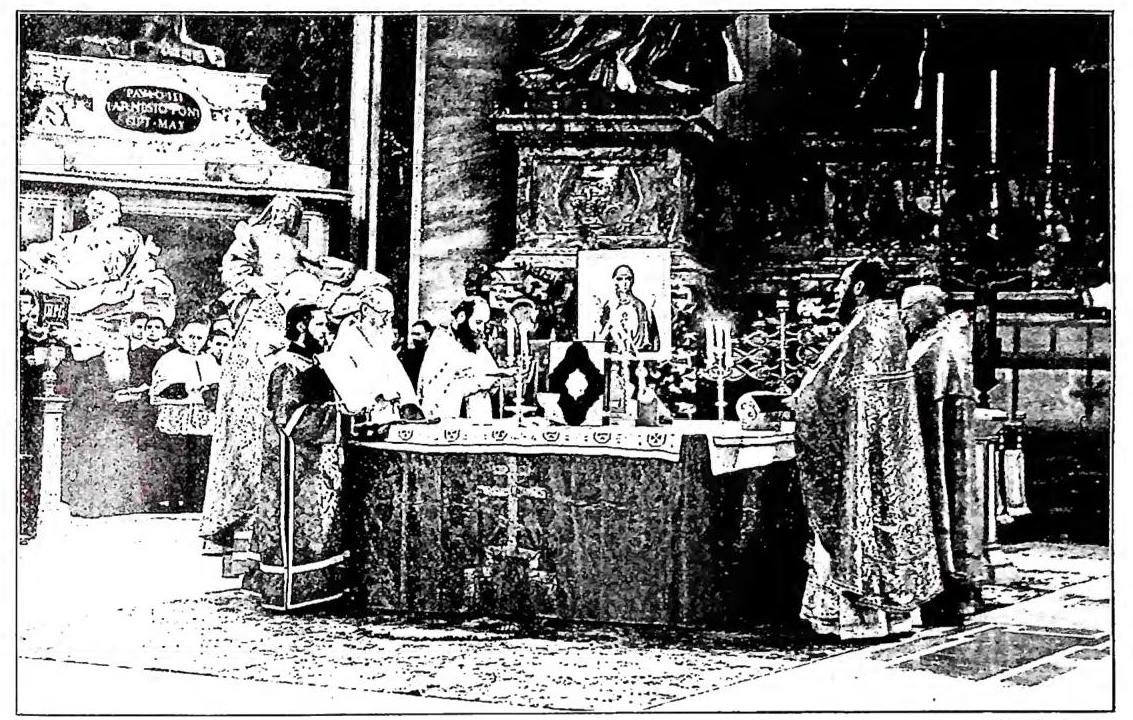
(phot. Giardani)
BIZANTINA, LITURGIA - Solemn Pontifical Mass in St Peter’s for the centenary of the conversion of s. Vladimiro (21 May 1939). Between the Consecration and Communion.
8) Albanian language. Since the metropolitan eparchies of Albania constituted themselves as an autocephalous Church in 1912, the movement in favor of adopting Albanian for the liturgy has steadily progressed. The promoter of these ideas and author of the Albanian version of several liturgical books is the priest Fan Noli, residing in America. The editions published to date have been printed partly in Boston and partly in Korçë.
9) Other languages. We find versions at least of the Eucharistic liturgies and the most common priestly and diaconal prayers, recited aloud, in the languages of the Baltic countries, especially since they constituted themselves as autonomous Churches. Without mentioning the use of modern languages such as French, English, etc., the Russian Society of the Missionaries of Kazan established a committee for the translation and dissemination of liturgical texts into the various languages of the Far East, from Tatar to Indian, Japanese, etc. These versions were used by the numerous Russian priests and monks sent by the Orthodox Church to all parts of the Middle and Far East.
III. BYZANTINE-ROMAN LITURGY
This name may be used to designate the Roman Mass framed within the structure of the b. l., which has received the designation of the Liturgy of St. Peter. We find it in several Greek, Georgian, and Slavonic versions. Different from this is the Liturgy of St. Gregory the Great, which is the translation of the Latin Mass into Greek with certain Byzantine infiltrations, or the Canon of that Mass simply adopted by the Catholic Armenians. This seems to have been in use in Constantinople, at least in some churches, after the conquest by the Crusaders in 1204, whereas the Liturgy of St. Peter is older, and the Greek text found great favor in southern Italy.IV. BYZANTINE LITURGICAL BOOKS
Here we shall note only the principal ones. Gospel (τὸ εὐαγγέλιον, evangelia, evangelia), divided into pericopes for each day of the year, followed by those proper to feasts or particular circumstances. — Apostle (ὁ ἀπόστολος, apostol, apostolul) contains the Acts of the Apostles and the Epistles. The division into pericopes is analogous to that of the Gospels. — Psalter (τὸ ψαλτήριον, psaltir, psaltirea), besides the psalms, contains the scriptural canticles. — Euchologion (τὸ εὐχολόγιον, euchologiu) contains the common prayers of Vespers and Orthros, the three liturgies, the Sacraments, the rites for the dead and for monks, and the consecrations and blessings. Not infrequently, especially among the Slavs today, the Eucharistic liturgy together with the prayers of Vespers and Orthros forms a special book, the Liturgary (τὸ λειτουργίαριον, Ἱερατικόν, slyzehnik, liturgiare,), while the other rites are contained in the Aghiasmatary (τὸ ἀγυασματάριον, trebnik, aghiasmatar). — Horologion (τὸ ὠρολόγιον, časoslor, orologiu), in which are found all the fixed parts of the canonical hours, together with certain excerpts from the temporal and sanctoral cycles and some commonly used devotional prayers. — Octoechos and Parakletike (ὁ ὑποκάλυψιον, ἡ παρακλητικὴ, oktoich, octoichul) contains the common parts of the temporal cycle, arranged in order according to the eight tones of the Byzantine musical system. — Triodion (τὸ τριώβιον, triodul) contains the parts proper to the period known as Great Lent. — Pentecostarion (τὸ πεντηκοστάριον, penticostarul), with the parts proper to the fifty days following the solemnity of Easter. — The Slavs, like all the Byzantines in former times, distinguish the “fasting triodion” (triodu postnaja) and the “flowered triodion” (triodu tsvetnaja), which correspond to the two preceding books. — Menaia (τὰ μηνεῖα, minea, mjclacnaja, mineiul) are twelve books corresponding to the twelve months of the year and containing the entire sanctoral cycle. — Typikon (τὸ τυπικόν, typik, tipicul) is the book that defines the rubrics of the sacred services and describes the sacred ceremonies.V. CARATTERI GENERALI DELLA LITURGIA BIZANTINA
First of all, one must note its conservatism and traditionalism, by virtue of whichthe liturgical prayers are for the faithful an instrument of dogmatic, ascetical, and moral doctrine. This does not exclude certain modifications and developments of various kinds that have occurred over the course of centuries.
In addition to the antiquity of most of the liturgical repertory, its social character must be emphasized. In a Byzantine church the entire assembly prays. The deacon, who stands between the sanctuary and the faithful, expresses the object of the supplications, and they—or the reader and cantor in their place—respond to each one
of his formulas inviting prayer. The priest, in the sanctuary, translates the people’s petitions into prayers recited in a subdued voice, raising it only when, at their conclusion, he glorifies the Most Holy Trinity or addresses the faithful with fervent and insistent exhortations. The role of each of the officiants is therefore significant, and each can easily be seen and heard. With regard to the office, the hours of Vespers and Orthros (dawn) are celebrated in the church and with the use of incense, as in the Eucharistic liturgy. The offices of midnight and of the other canonical hours are celebrated without
solemnity (with the exception of the Great Hours on certain days of the year and Great Compline during Lent). In monasteries they are recited in the narthex, in memory of the solitaries who went to church only for the major services. The administration of the Sacraments is always solemn, and the euchology abounds in blessings and prayers for all the spiritual and temporal needs of Christendom. The Byzantine rite takes pleasure in concelebration by numerous officiants (bishops, priests, deacons, and inferior ministers), and not only in the Eucharistic liturgy. Among the characteristics of the Byzantine rite, one must further mention the veneration of icons, prostrations, anointings with the oil of lamps, the blessing and eating of blessed bread (artoklasia, antidoron), etc.