
ALBANIA (alb. Shqipëria or Shqipnia). SUMMARY:
1. Geography
2. Christianity in Albania
3. Cultural History
4. The Greek-Albanian Rite.
4. GEOGRAPHY
It comprises the eastern Adriatic coast from the mouth of the Bojana to the Corfu channel and the hinterland up to the Albanian Alps and the lakes of Ochrida and Prespa. Its surface area (28.7 thousand sq. km) is roughly equal to that of Piedmont. It is a mountainous, rugged country, and malarial on the flat, marshy coasts; hence it is sparsely (38 inhabitants per sq. km) populated (1.1 million souls), with heavy emigration: over 1.5 million Albanians live outside the borders of the State (Serbia, Greece, trans-oceanic countries). The Albanians, who descend from the Illyrians, have well preserved their traditional characteristics, especially in the N. (Ghegs), where Muslim infiltrations have been fewer (the Tosks, in the S., are considered less pure). The population is divided into tribes and clans, proud and turbulent, often at war (brigandage, blood feuds). Linguistically compact, the Albanians are 69% Muslim, 20.7% Orthodox (in the S.) and 10.3% Catholic (in the N.).Animal husbandry (sheep, goats) is the predominant occupation (cheeses, skins, eggs exported); agriculture (12% of the total surface area) relies on arboriculture (olive, vine) rather than cereal cultivation. Mineral resources are not lacking (iron, copper, chrome), but only petroleum (100,000 tons annually) has industrial importance. The capital Tirana, and Scutari (30,000 inh. each) are the most notable populated centers. Railways are lacking; ordinary roads are also deficient.
Having remained for centuries under Turkish rule, A. was established as an independent principality in 1912; a republic in 1925, a kingdom in 1928, bound to Italy in a personal union after April 1939. Since Jan. 1946 it has been a republic once again under Soviet influence.
| Prefectures | Area in Sq. Km | Pop. Census 1941 | Density per sq. km | Capitals (pop. in 1,000 inh.) |
|---|---|---|---|---|
| Argirocastro (Gjinokastra) | 4,125 | 159,695 | 39 | Gjinokastra (11) |
| Berati (Berati) | 3,666 | 169,431 | 46 | Berati (10) |
| Corcia (Korça) | 3,750 | 169,234 | 45 | Korça (23) |
| Cossovo | 2,038 | 46,666 | 23 | Kukësi (0.2) |
| Dibra | 2,151 | 83,491 | 39 | Peshkopija (1) |
| Durazzo (Durrësi) | 1,550 | 90,243 | 58 | Durrësi (14) |
| Elbasan (Elbasani) | 3,549 | 110,447 | 31 | Elbasani (14) |
| Scutari (Shkodra) | 5,560 | 160,929 | 29 | Shkodra (30) |
| Tirana | 911 | 59,160 | 65 | Tirana (31) |
| Valona (Vlona) | 1,448 | 56,607 | 39 | Vlona (9) |
| TOTAL | 28,738 | 1,105,903 | 39 |
5. CHRISTIANITY IN A
Ancient Epirus and the southern part of Illyria, which form present-day A., had their own religion with local mythology, the continuation, transformation, or contamination of which can be seen in the cult of Greek divinities widely in evidence in the "Greek" numismatics of the country: Apollo, Diana, Asclepius. Imported divinities are: Hercules, whose club is seen depicted; Jupiter, who arrived there perhaps with the Macedonian domination, if he was not already indigenous (Jupiter Dodonaeus); Demeter.The date of Christian penetration is not attested with certainty. However, it is not improbable that it was
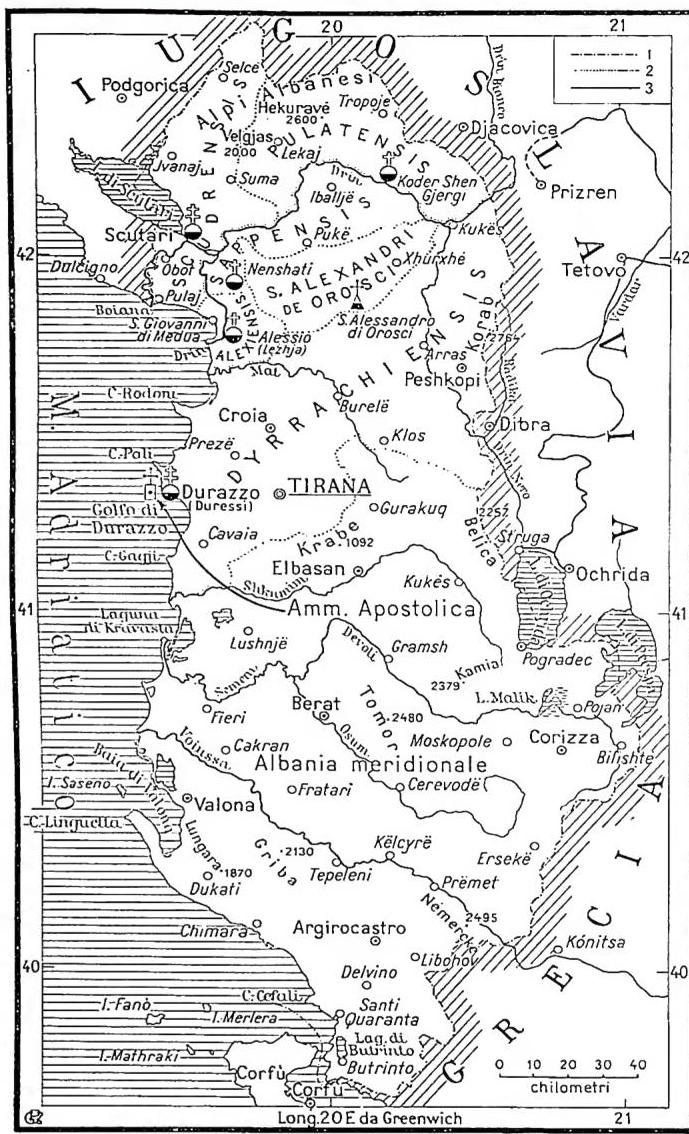
At the Council of Nicaea (325) we already find some bishops of Dardania and Macedonia Salutare, which correspond to present-day eastern ethnic A. Shortly after, at Sardica (343-44) we find 5 or 6 from the provinces of Dardania, Epirus Nova, Epirus Vetus, and perhaps Praevalitana. The same four civil provinces correspond to the ecclesiastical ones headed by the four metropolises of Scupi (mod. alb. Shkupi, sl. Skopje, II. Scopia), Dyrrachium (Durazzo, alb. Durrës), Nicopolis (mod. Preveza), and Scodra (mod. Scutari, alb. Shkodra), and lasted until the great barbarian invasion that finished turning the country upside down in the 7th century. But already at the end of the 4th century, besides the organization into provinces, another more extensive one was taking shape through some higher hierarchical organs around which the ecclesiastical provinces were polarizing. While in the south the "apostolic vicarship" was indeed granted by the Popes to the metropolitans of Thessalonica (mod. Thessaloniki) and later to those of Justiniana Prima (successor to Scupi), in the north there was a certain preeminence of the metropolitan of Salona (mod. Split), which did not fail to be felt in Praevalitana. In this province, moreover, the Roman Church owned landed property with an administrator cleric, who often acted now as the Pope's delegate, now as his inspector. To a large extent, thanks to the influence of such organs, not only the latinizing Praevalitana—never touched by either schism or heresy—but also the two culturally distinct provinces of Epirus remained substantially faithful to Rome, even during periods of swarms of heresies and despite attempts at Constantinopolitan interference. Only at the time of the Acacian schism (late 5th - early 6th century), supported especially by the emperor Anastasius, a native of Dyrrachium (491-518), was there, after a good resistance, a weakening in Dardania and Epirus Nova. But already at the beginning of 519 the papal legates, sent to the Dardanian emperor Justin to settle the dispute, received upon their passage through Epirus the obedience of all the bishops with the zealous support of the metropolitan of Scodra.
The Slavic invasion (7th century) seemed to submerge everything. The southwestern zone (Dyrrachium and Nicopolis), having remained immune to it, suffered not a little from the iconoclastic persecution (731-826). Furthermore, by autocratic decision of the Emperor Leo the Isaurian (731), the provinces of Illyricum were detached from the Western Patriarchate and assigned to Constantinople. This, if not for Praevalitana, certainly had its effect on Epirus, despite Rome's protests. Meanwhile, on the eastern borders of the country, the Bulgarians had appeared, who—having been baptized (ca. 864) and long oscillating between Rome and Constantinople—ended up following the Byzantine rite in the Slavic language under the guidance of disciples of SS. Cyril and Methodius, and founding an autocephalous archbishopric, later patriarchate, in Prespa and then in Achrida (mod. Ohrid, alb. Ohri), to which they annexed most of the ancient suffragan territories of Dyrrachium and Nicopolis. The reconquest by the Emperor Basil the Bulgaroctonus brought central and southern A. back under Byzantine rule (1019), but not entirely under the dependency of the patriarchate of Constantinople, because he deemed it appropriate to keep alive, indeed in full autocephaly with the title of archbishopric, the core of Achrida with its numerous suffragans. Meanwhile in the north
a barbarian state strongly imbued with Latinity was consolidating and refining itself: Dioclea, comprising more or less the ancient Praevalitana. While the ancient episcopal sees were reviving there, new ones were being created in the major Latin cities (Scutari, Dulcigno, Drivasto, Suecia) and in smaller ones (such as Pulati and Sarda) of the Albanian language. Placed initially under the metropolis of heavily Latin Ragusa and, at times, of Split (successor to Salona), they later obtained, after a long dispute, Antivari (v.), where in 1199 an important provincial council was convened, which reformed numerous abuses.
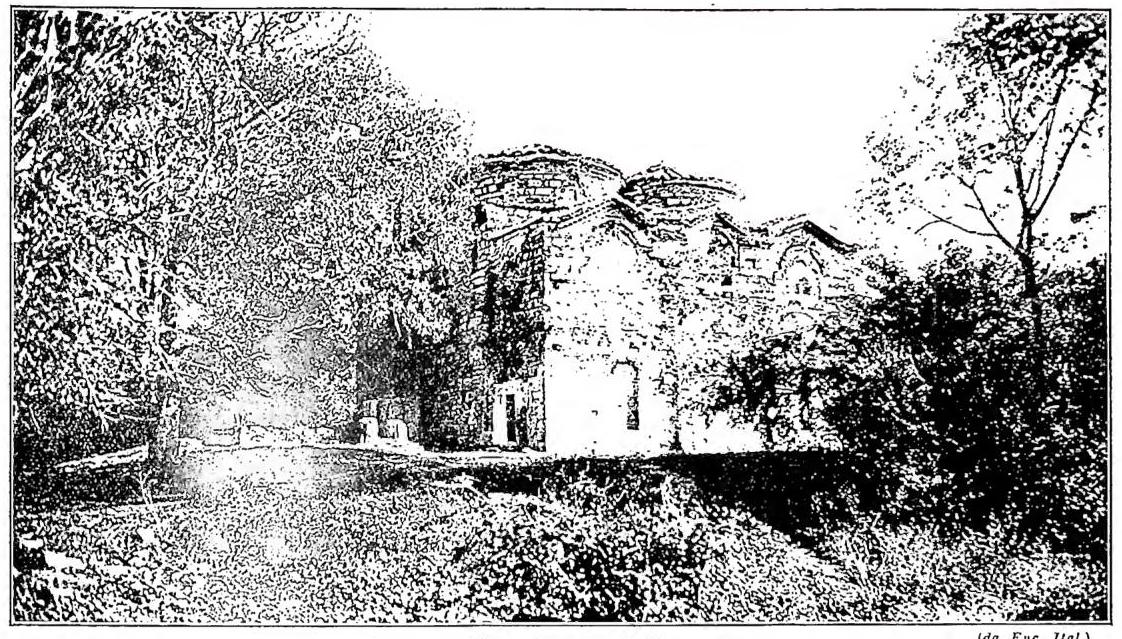
The 13th century brought a decisive eastern ascendancy. After a short-lived Venetian rule on the coasts (1204-12), a consequence of the Latin conquest of Constantinople, marked by the erection of a Latin archbishopric in Dyrrachium dependent on the Latin patriarchate of Constantinople, all Epirus formed an independent despotate under the Angelos-Comnenus dynasty (1212-59), which, for political reasons
(from Eur. Ital.)
This situation was maintained even in the 14th century when the Angeli-Comneni were succeeded in various regions and at different dates by the Angevins, the Byzantine Empire and that of the Nemanjas, and then by local dynasties in the center and south, while in the north the local principality of Balša with its center in Shkodër was formed. At the end of the century, faced with the Turkish threat, the bulwark of Venetian defenses was erected along the coast from Bar to Durrës, which, despite the religious tolerance of the Serenissima, certainly marked a strengthening of Latinism. Durrës itself had a Latin archbishopric from then on.
The central decades of the 15th century are occupied by the anti-Turkish struggle, led among the Albanians by Skanderbeg (v.), who was certainly a Christian, though of unknown rite. However, he was in close political as well as religious relations with Rome, which validly supported him, and it is probable that the other dynasties maintained the same attitude. The Turkish takeover (from 1479) initially brought, from the religious point of view, an infiltration of Turkish Muslim colonies in the cities abandoned by the Venetians and by the local population, and of small Turkish military feudal lords, but along with this came the much more dangerous phenomenon of the flight of Latin prelates and religious orders, except for the Franciscans. Strong groups of the population also emigrated to Italy, compact almost exclusively in the Kingdom of Naples, where they formed the "Italo-Albanian colonies", which long preserved, and in part still preserve today, their Byzantine rite, while increasingly emphasizing their loyalty to the Roman See. The leaders of the nation also disappeared at that time: the old dynasties, partly fled to Italy, partly converted to Islam and submerged, without leaving a considerable trace of themselves, in the Muslim world. From then on, the impossibility of regular relations with Rome left the churches of the north at the mercy of themselves and those of the south exposed to the influence of the Patriarchate of Constantinople, which then, as the recognized organ of the Christian civil community of the Turkish empire, was the only shield against the abuses of the dominators. Nevertheless, for another century and more, the population remained for the most part Christian, and continued to agitate to recover its independence, resorting to the help of Venice, the Empire, Spain, but especially the Pope—in this the southern populations and clergy themselves also agreed.
The same could be said of the 17th century, had the loss of the last coastal defenses by Venice, the strengthening of Turkish infiltrations, and the progressive rustication of the clergy not facilitated the beginning of a transition to Islam. Simultaneously, however, we note a praiseworthy beginning of recovery by the Catholic hierarchy and clergy; the main phenomena of this are seen in the re-establishment of the resident hierarchy, the provision of the secular clergy—which was the most tangible effect of the founding of the Sacred Congregation de Propaganda Fide with its Greek (1577), Urban and Illyrian colleges of Loreto (1627) and Illyrian of Fermo (1631)—and the beginning of the Italian Franciscan missions (1634).
The peak of the new rise was reached at the time of Pope Clement XI, Albani, who, recognizing himself as of Albanian origin, took a great interest, especially through the great reform-minded archbishop of Bar, Vincenzo Zmajevich, in the political and religious rebirth of his homeland of origin. The "first national Albanian council" (1703) was then held, which decisively marked the line of conduct of the clergy in dogmatic, moral, canonical, and pastoral questions. Meanwhile, novelties had occurred in the "Orthodox" sector as well. Various appeals by "Orthodox" prelates of A. to the political protection of the Pope had also led to a religious rapprochement, so that there came first a kind of union, then, as this was not very successful, the creation of archbishopric sees for Latins in Ohrid and Skopje. An Eastern-rite mission worked for a long time in Himara (1628-...?).
In the 18th century the recovery work continues. The armed autonomy of the mountain tribes, by now secured, and the flourishing of large and rich Christian merchant communities in the city seemed to guarantee its result. Instead, while the causes that would later lead to the stagnation of defections were being consolidated and developed, the latter continued, indeed intensified throughout that century as a delayed effect of old and new causes. The clergy, however, was too scarce to be able to counter the religious indifference brought by too many civil contacts with the Muslim environment, so that even futile motives were enough to decide individuals, families, and villages upon defection. The Turkish empire increasingly opened the door to spectacular civil and military careers for Albanians provided they were Muslim. To the sporadic fanaticism of Turkish governors was added the apostate fanaticism of certain strong local families that had become hereditary feudal lords. However, it should not be believed that this was immediately a pure and simple transition to Islam; often it was the assumption of a Turkish personal name to be used in relations with the dominant environment; often of a family only a single member was circumcised to obtain rights and exemptions. In vast north-eastern and central areas, the phenomenon of crypto-Christianity occurred, which lasted until our days; even of those who embraced Islam, many preferred its most heterodox and least distant sects from Christianity, such as the Bektashi.
The 19th century was marked by a slowdown in persecution, especially as a result of the official protection of Catholicism in A., which Austria assumed as the heir to Venice and exercised also by granting subsidies to the clergy and to Catholic works, and through the improved culture of the clergy and laity. Already from the 17th century there had been various attempts to erect local seminaries; but it was only in 1856 that a national pontifical college was founded in Scutari, entrusted to the Jesuits, which from then on provided all the secular clergy and the episcopal sees themselves. At the same time, the Franciscans began to open elementary schools, and in 1877 the Jesuits opened the first secondary school in Scutari; in 1870 they had also opened a printing press. At the end of the century, while the Franciscans reinforced the parishes entrusted to them with excellent elements, including native ones, the Jesuits began the "flying mission" for popular missions, especially in the mountains, which succeeded in spreading education and the fervor of religious life everywhere. The "Orthodox" part did not proceed at an equal pace; having now remained fully in the power of the Patriarchate of Constantinople, which moreover cared nothing about it, it saw the disappearance of that learned clergy who in the 18th century had made the school and printing press of Moscopoli flourish. Having initially relied on the fraternal aid of resurrected Greece, it finally had to detach itself from it with regret due to the chauvinism that wanted to Hellenize everything. Thus the South, while progressing civilly and culturally, remained religiously uncultivated.
In the 20th century, national independence (1912) had the effect of the almost absolute cessation of apostasies; however, during the regime of King Zog, the law on religious "communities" dealt a severe blow to ancient ecclesiastical immunities, and Catholics remained excluded from the allocations of the cult fund, thus being forced to always rely on the subsidy that Italy continued to grant, as Austria had done previously. Furthermore, the suppression of private schools (1933) deprived the Catholic community of flourishing institutions and provoked a dangerous propaganda of atheist communism, which the government was subsequently unable to curb even with a limited restitution of the suppressed institutions. During the regime of "union" with Italy, the Catholic part, without enjoying a privileged status, had equal rights with the other communities. Faced with a felt "Orthodox" movement of return "to the religion of Scanderbeg," the problem of union was studied, but the erection of small missions scattered here and there seemed to disappoint the expectations of the "Orthodox," who saw in it a fragmentation rather than the salvation of their own bloc as they had hoped.
Currently, for the Catholic portion, there is in A. an Apostolic Delegate (since 1921, but never accredited to the local government), an archdiocese in Scutari with suffragans Alessio, Pulati, and Sappa, an archdiocese without suffragans in Durazzo, and an abbazia nullus with a titular holding episcopal rank and immediately dependent on the Holy See at S. Alessandro dei Mirditi (Orosh). The ancient archdiocese of Antiwari, which remained first with Montenegro and then with Yugoslavia, although composed of almost exclusively Albanian parishes, lost its suffragans, which passed to Scutari, restored to its ancient rank (1867). Skopje, which also remained with Yugoslavia with its largely Albanian parishes, is now reduced to episcopal rank. The "Orthodox" community, after a long struggle for its own autocephaly, which dates back to 1912 and was accompanied by patriarchal excommunications, finally had it recognized by a patriarchal tomo of 1937; it also has Albanian as its liturgical language and counts, in addition to the metropolis of Durazzo-Tirana, the eparchies of Korça (Corizza), Berati, and Gjirokastër (Argiocastro). Catholic A. is divided into two parts by an ideal line passing south of Tirana; the north is under the jurisdiction of the S. Congregation of Propaganda, while the south forms an eparchy under the competence of the S. Congregation for the Oriental Church. The Muslim community, at least since the abolition of the caliphate, forms an autonomous national group, with a chief mufti and various muftis in the provincial capitals, a general medrese (seminary) in Tirana, and various students also in the Islamic universities of El-Azhar in Cairo and Lahore in India.
The period of Albanian state autonomy deprived the Catholic community of the somewhat privileged position it enjoyed latterly under Turkish rule, under a concessionary regime and Austrian protection, and stripped the ecclesiastical hierarchy of various canonical privileges (ecclesiastical court, freedom of education, etc.); nevertheless, by virtue of the merits acquired in the long struggle for national liberation and its higher cultural standing, the Catholic part was able to enjoy an absolutely exceptional prestige compared to the other numerically predominant religions. On the other hand, the progressive spread of culture had caused a large part of the ancient prejudices regarding Catholicism and the Papacy to disappear among the Catholic population and especially in the ruling classes, so that it was permissible to hope for a considerable progress of the Catholic cause in the near future. Instead, the regime established at the beginning of 1945 under the name of the Albanian Republic, with an increasingly Marxist-Bolshevik and tyrannical orientation, has led to a veritable persecution against the religious idea, from which every religious community has suffered materially, and in a particularly acute way the Catholic one, due to the very high percentage of victims especially among the clergy and the complete destruction of all its organizations, including the seminaries.
6. CULTURAL HISTORY
The Albanian nation, linguistically and culturally the heir of the Thraco-Illyrian stock, gave no clear signs of an autonomous cultural life of its own until the 16th century, contenting itself with fitting into the culture of the empires that dominated the region. But from then on, the need to keep religious culture alive in a people isolated from the rest of European culture due to the Turkish conquest prompted the Latin Catholic clergy to publish translations of liturgical texts and catechisms in the Albanian language (G. Buzuku, Missal, 1555; Pietro Budi, b. 1566, d. 1623, various works; que-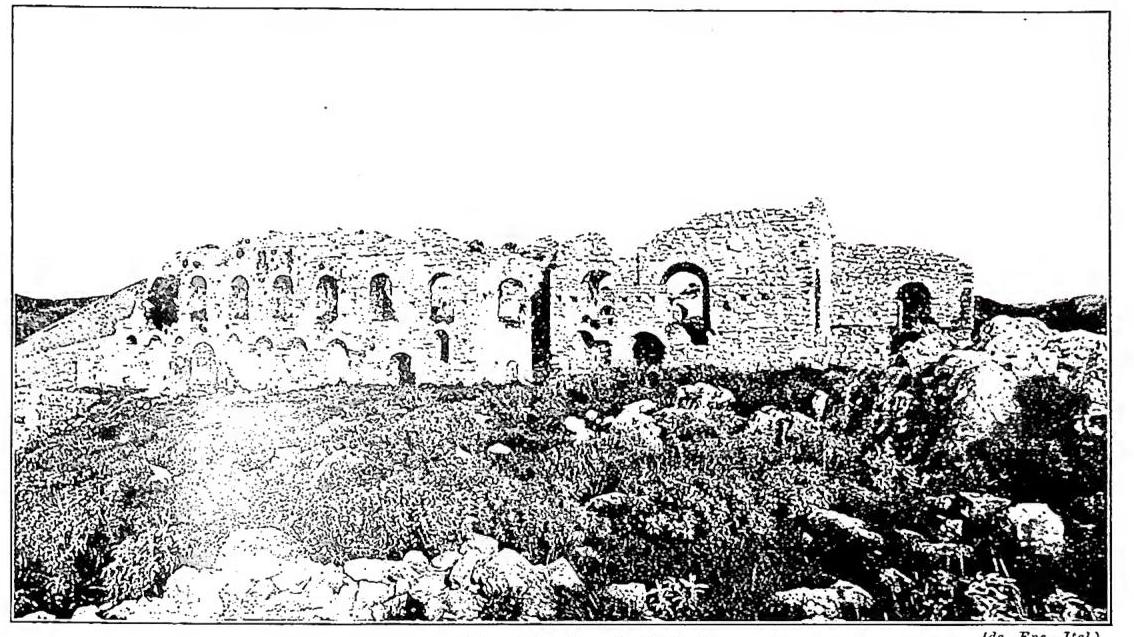
(from Enc. Ital.)
the highest importance for national culture, cultivated almost exclusively by the Catholic clergy, is also that of the highly original legal customs (Kanûn) which, although preserved for centuries only orally, manifest a vigorous national legal sense in their organic and logical nature; Father Stefano Gjeçov O.M. (1874–1929) distinguished himself particularly in this field; alongside him was the Italian Msgr. Ernesto Cozzi (d. 1925), and subsequently numerous living figures. On the other hand, original philosophical and scientific production has remained scarce, limited so far to periodical publications, among which the Franciscans' Hylli i Dritës, the Jesuits' Leka, and F. Konitsa's Albania distinguished themselves.
7. THE GREEK-ALBANIAN RITE
So called because in A. the dissidents used Greek books until the granting of autocephaly (Apr. 12, 1937). From that time onwards, the Albanian liturgical language was increasingly introduced; but even earlier, it was in use among the Albanians of Romania and America. The following books are known:1) Service of Holy Week (1908); 2) Book of Sacred Services: it is a small Aghiamatarion, containing only the liturgy of St. John Chrysostom (1909); 3) Book of Great Feasts (1911); 4) Small Triodion (1913); 5) Small Pentecostarion (1914); 6) Prayer Book: chants taken from the Octoechos and the Paraklesis (1914). These books were translated from the Greek by the work of Fan Noli and published in Boston. Furthermore: 7) Book of Sacred Services (reprint, Korçë 1930); 8) Evangeliary (Tirana 1930); 9) Apostolos, epistolary (Tirana 1931). Alfonso Raes