
SCANDERBEG, GIORGIO CASTRIOTA so called. — Albanian national hero, born ca. 1404, died 17 January 1468, repeatedly described by the Popes of his time by the title of athleta Christi. Son of Giovanni, lord of Arbano and of part of the Matja Valley, he spent his childhood and youth as a hostage at the court of the Turkish Sultan in Adrianople, where he was made a Muslim and embarked upon a military career in which he achieved outstanding successes, whence his Turkish nickname S.: “Iskander-Beg: Prince Alexander.”
But in 1443, after his father’s death and the seizure of his possessions by the Turks, he took advantage of the opportunity offered by the battle fought at Kunovica near Niš in Serbia, abandoned the field with his men, thereby causing panic and defeat, returned to his paternal possessions, adding the commanding Croja as a fortress, and returned to Christianity (28 November 1443). He immediately made an impression on the other Albanian lords and succeeded in concluding an anti-Turkish league with them at the assembly held at Alessio in Venetian territory (1 March 1444). From then on there was an uninterrupted succession of battles, including pitched battles, with the Turkish armies, among them especially memorable the two sieges of Croja (1450, under the personal command of Murād II, and 1466, with Maometto II), both of which were victoriously resisted. He was not always so fortunate, at times overwhelmed by overwhelming enemy forces, at times betrayed and left without aid; but overall he was able to maintain his position and most often emerge victorious thanks to his mobile and daring cavalry tactics and his extraordinary personal courage and influence. Even allowing that his biographers exaggerated the figures, his success over a quarter of a century remains ever remarkable, in the face of battle-hardened armies certainly superior in number and of an Empire possessing inexhaustible supplies. The resonance achieved by his deeds in Europe, the emphatic enthusiasm of his biographers, the success enjoyed by their works (the numerous editions and translations of Barlezio’s work), and the richness and continuity of the popular tradition among the Albanians who took refuge in Italy—and to some degree also among the Albanians who remained Catholic in Albania—are therefore understandable. In reality, due allowance must be made for the panegyrical style of the biographers and for the necessity in which they found themselves of translating into Latin terms matters familiar to them.
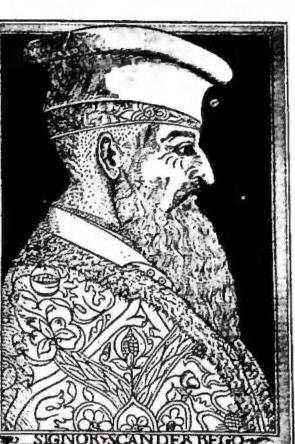
SCANDERBEG, GIORGIO CASTRIOTA so called — Portrait. Sixteenth-century engraving, after M. Barletius, De vita et rebus gestis S., Rome 1506 — Copy in the Vatican Library.
The promise of the title of king, which according to the biographers was made to him by Pio II, is not attested by documents, nor could it have been made without offending Venice and Naples, at a moment when their cooperation was necessary—desired by Pio and solicited by Castriota—for the Crusade; rather, it should be remembered that in Albanian historical and popular tradition little importance is attached to titles.
II. FEUDAL RELATIONS
In S.’s time, the power that, through purchases, had established itself in a large part of the Albanian coast was Venice; but previously the Hohenstaufen kings of Naples had possessed the central and southern part of it as the dowry of Manfred’s wife, daughter of the despot of Epirus; the Angevins had retained it for some time, while the Aragonese left it in the hands of their feudal lords or of other rulers of Byzantine origin and, in practice, lost interest in it at the time of the first Turkish invasions (late fourteenth and early fifteenth century); only Alfonso V revived the old Neapolitan eastern policy and once again took an active and effective interest in it, not without jealousy on Venice’s part. On his return to Albania, S. maintained an obsequious attitude toward Venice; then, for reasons concerning possessions that have not yet been fully clarified, he came into conflict with it and into open war (1447–48); having made peace, although he did not obtain what he demanded, he received renewed recognition from it, but remained bound to Naples, acknowledging its sovereignty and accepting a garrison at Croja; after Alfonso’s death, he went to the Kingdom with a small army to support Ferdinand’s rights, but, having thus discharged his obligations to Aragon and obtained fiefs from it in the Kingdom, he no longer felt either bound or protected by the Neapolitan crown and fully resumed his original relations with Venice, of whose Great Council he was a nobleman and in whose name commander of the troops at his disposal; at his death, he entrusted his son to the protection of the Republic.III. RELIGIOUS SITUATION
According to the prevailing view, central Albania as far as the Matja in the north, and perhaps somewhat beyond, remained of the Greek rite throughout the Middle Ages, even if it was not always schismatic; Venice, which had founded a Latin archbishopric in Durazzo during its brief rule in 1204, restored it upon its return at the end of the fifteenth century, but it may be estimated that the region of Arbano largely retained the old rite, although governed by Latin bishoprics and united with Rome; Giovanni Castriota appears as a Catholic; it is therefore natural to think that, on returning to his homeland and to his family possessions and traditions, S. returned to Catholicism, while some doubt remains as to the rite he followed; moreover, the political idea that dominated him, the anti-Turkish defense of Albania, could suggest nothing else to him, given that theSCANDERBEG GIORGIO - SCARAMELLI GIOV. BATTISTA
his greatest support, if not military, at least moral, he could obtain—and did obtain—from the Holy See. Indeed, he came to Rome in December 1466, and in 1467 Paul II granted him a considerable sum of money. The question of his ethnic origin now remains, since this has at various times been claimed by the Serbs; in fact, nothing is known about the origin of the Castriota family. The question is not resolved by the fact that its earliest known members were in the service of the Serbian Empire, nor by the occurrence of Slavic names in the family, which resulted from prevailing custom and from intermarriage with Slavic dynasts or persons of Slavic culture (for example, S.’s mother belonged to a family of dynasts from Polog, on the border between present-day Albania and Serbia); the fact remains that both Giovanni and Giorgio Castriota always considered themselves Albanian.