
CALLISTO III, POPE. — Alfonso di Borgia (Borja), born at Canals near Xàtiva (Valencia) on 31 December 1378, studied at the University of Lérida in Catalonia, where he received a doctorate in both laws and then a canonry from Benedetto XIII (Pietro di Luna), and was much favoured by King Alfonso of Aragon, whose wise counsellor he became. Having broken with the obstinate antipope after the proceedings of the Council of Constance, he fearlessly defended the cause of Pope Martino V. Twenty years later, as a reward for a highly successful legation between the shrewd King Alfonso and Pope Eugenio IV, finally recognised by the former against the antipope Felice V, he obtained the cardinal’s hat, which he wore with the utmost dignity, and in the Conclave of April 1455 succeeded Niccolò V under the name of C. III.
Three principal questions occupied this pontificate: the Crusade against the Turks, the defence of the Papal States, chiefly against King Alfonso of Naples, and the preservation of Catholic doctrine. It is above all the first aspect that distinguishes the pontificate of C. III more than any other. He was not a great patron of the arts and sciences, like his predecessor; but neither can he be called an enemy of the humanists. For Pope Borgia, who had lived in an environment of seven centuries of struggle against the Crescent, everything that did not serve to avert the Turkish threat, made more dangerous by Maometto II, seemed of no account. Moreover, there was no lack of reasons for grave concern. On 29 May 1453 Constantinople had fallen under Turkish rule, and all the Christian nations were filled with the utmost fear, since they now saw the roads to the West opened and the conquest of the Catholic countries made easy. Maometto was in fact planning to attack Hungary immediately. In the face of so terrible a threat, C. III had made a public and solemn oath that he would employ all his forces, and, if necessary, his life as well, in the struggle against the Turks, until they were defeated and the way to the Holy Land opened. He undertook to preach a Crusade, sending cardinals and other legates to the principal princes of Europe to form a Christian league, and appointed as preachers of the great enterprise the Franciscans Giovanni da Capestrano and Giacomo della Marca, the celebrated orator Roberto da Lecce, and others. But the great powers did not heed him; Venice and Genoa wanted peace with the Porte, while little could be expected from the other nations. The aged Pontiff nevertheless did not lose heart; after fitting out a fleet at his own expense, he entrusted it to Cardinal Trevisan, while encouraging the individual Crusaders. It was partly owing to him that the three Giovanni—that is, the warrior Hunyadi, the legate Carvajal, and the saint from Capestrano—achieved the double naval and land victory of Belgrade in July 1456. C. wished to exploit that great triumph, but unfortunately the internal divisions of Hungary and the deaths of the two heroes, G. Hunyadi and G. da Capestrano, prevented any success in central Europe, and the Pope had to content himself with aiding Scanderbeg, invited to lead the Albanian Catholics, and the Genoese defenders of the Crimea, while continuing to urge the King of Castile to defeat the Moors of Granada.
Although C. gave the «Catalans» too much influence in the government of the Papal States, it must be acknowledged that he firmly maintained his authority before everyone, seeking sincere understanding with the other lords of the peninsula, also in order to avoid internal wars capable of weakening the Crusade against the Turk. For this reason he readily answered the appeal of the Republic of Siena, invaded by the discontented Count Piccinino, sending the crusading army against the audacious condottiero. But since the excommunicated warrior was protected by King Alfonso of Naples, a clash arose between the latter and the Pope. In any case, the old friendship between the two had considerably cooled since C.’s election, as he showed himself the defender of the Church’s rights over the Neapolitan kingdom, while Alfonso claimed to rule it on his own authority and to extend his hegemony over the other Italian states. Nevertheless, since the Pope needed that king for the success of the Crusade, he tolerated many abuses; but when Alfonso’s ill will subsequently became clear, and, on the other hand, C. refused to renew the investiture of Naples, Terracina, and Benevento, as well as to recognise a possible succession by the bastard Ferrante, matters came almost to a breach.
C.’s zeal for the preservation and propagation of Catholic doctrine was great, and his pru-
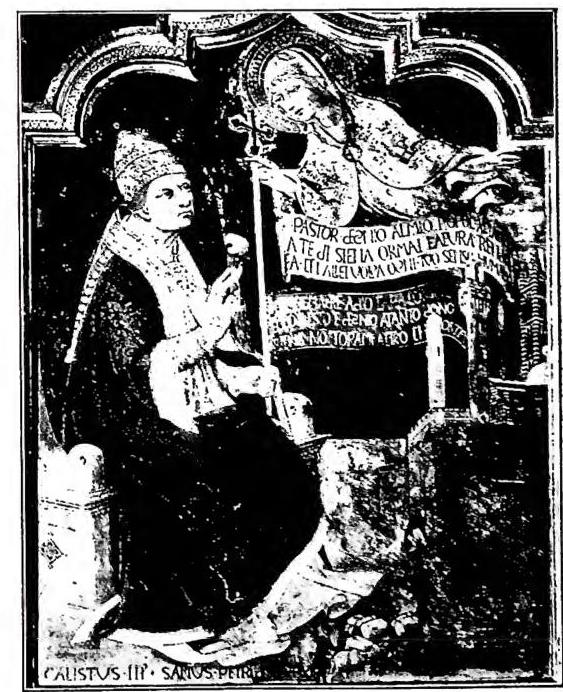
He died on 6 August 1458, the feast of the Transfiguration of the Lord, which he had instituted. His body rests in a poor tomb in the church of S. Maria di Monserrato in Rome. His memory might perhaps be more venerated had he not summoned too many Borgia relatives to Rome, among them his nephew Rodrigo, whom he made a cardinal in 1456 and who later became Alessandro VI.