
CATALONIA. – A historical Spanish region corresponding to the present-day provinces of Lérida, Tarragona, Gerona, and Barcelona, situated between the Mediterranean, the Pyrenees, and the lower Ebro valley.
I. GEOGRAPHY
The territory (32,197 sq. km.) alternates between areas of markedly different appearance, constituting minor regional units (valleys on the reverse side of the Pyrenees, concas and planas of the foothill sector, camps and costas of the coast, etc.), and often preserving historical names (Pallars, Cerdaña, Ampurdan, Vallés, Panadés, Priorato, Noguera, Segarra), as well as quite clearly differentiated forms of economy and culture. Overall, C. has a Mediterranean character, with winters considerably milder and summers less extreme than in the nearby meseta, and with sufficient rainfall for the needs of agriculture.On barely 1/16 of Spanish territory, C., with its 2,900,000 inhabitants, contains more than 1/10 of the population of the State. Its density index (92 per sq. km.) is, among those of the Spanish regions, one of the highest; but while it reaches the absolute maximum in the province of Barcelona (251 inhabitants per sq. km.), it falls to scarcely 25 inhabitants per sq. km. in that of Lérida (inland and mountainous). The originality of the Catalan region is attributable in large part to the character of its population, distinguished from the neighboring Castilians, more than by ethnic type and dialect (related to Provençal), which has long risen to the dignity of a true national language, by a more energetic temperament and a greater inclination toward action. It is almost entirely Catholic.
The Catalan economy presents flourishing agriculture (wine, oil, fruit, and above all citrus fruits) and flourishing livestock raising (especially horses), which already permit active exportation; but its characteristic feature, within the national whole of which it forms part, is the development of industry, among which textiles (above all cotton), chemicals, and mechanical industries predominate.
The larger urban centers are for the most part of modern origin and concentrated near the coast: Hospitalet (60,000 inhabitants), Badalona (54,000), Sabadell (52,000), Tarrasa (45,000), in the vicinity of Barcelona, whereas the old historic cities have remained almost stationary (Lérida with 41,464 inhabitants, Tarragona with 35,648, Gerona with 29,632). Above all stands Barcelona, the indus-
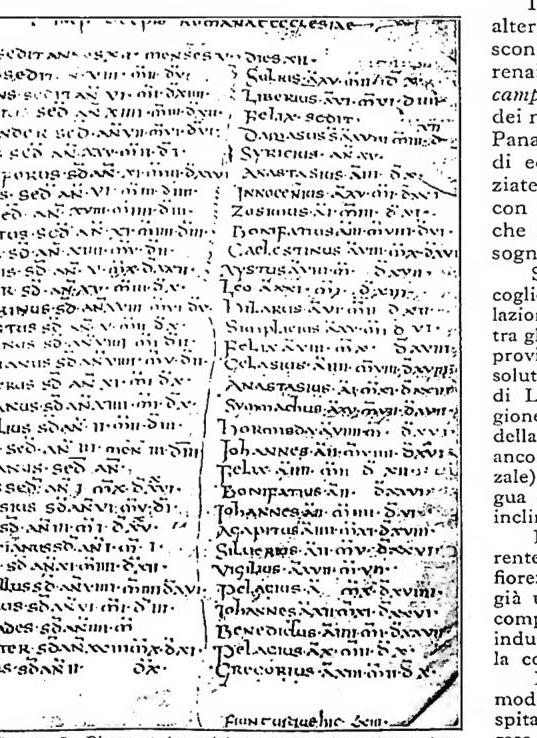
CATALOGHI DI PAPI – Catalogue of the first bishops of Rome written at Corbie (8th century) – Paris, National Library, lat. 12205, fol. 157;
II. HISTORY
C., whose name is encountered only in the 12th century, comprises the territory of the Carolingian Spanish March as it had existed during the 9th–10th centuries; from that period onward it became the principality of C. The origin of this name is disputed; the most credible hypotheses are that it derives from the word “castle” or from “land of the Goths”; the latter would be more probable. When, at the beginning of the 9th century, the territory was wrested from Muslim rule, Barcelona became the seat of a county and gradually succeeded in gathering around itself the other counties into which the Spanish March had been divided; thus the counties of Gerona, Vich, and Barcelona formed a compact nucleus that was the basis of the unity of C.For the impetus he gave to the Reconquest, Wilfredo was regarded as the first count of Barcelona. After important successes, Barcelona fell once more into Muslim hands, until Count Borrell II reconquered it; from then on, the March was able to begin a cultural revival and to bring the Western world into contact with a new current of civilization. Indeed, Gerberto, later Pope Silvester II, brought from the Spanish March to France and Italy what he had learned there. This cultural current in reality derived from the fusion of Visigothic and Muslim culture, which matured in the monastic school of S. Maria di Ripoll when it reached its apogee under Abbot Oliva in the 11th century. Beginning in this century, the tendency toward union with the other counties was already constant and led in the following century to union with Aragon, thanks to the marriage of Raimondo Berengario IV, the last count of Barcelona, with Petronilla of Aragon, daughter of King Ramiro and heir to the throne. From that moment their descendants called themselves kings of Aragon and counts of Barcelona, but the title of kings of C. was not used.
Despite its union with Aragon, and although, after the reconquest of the kingdom of Valencia, it formed one of the three states of the Crown of Aragon, C. preserved its particular identity as the principal agent, in collaboration with the Aragonese, of the Mediterranean empire that subsequently passed to Spain; C. was likewise the region that, in the 15th century, welcomed and assimilated the great literary and philosophical movement of Humanism and the Renaissance. When, in this same century, the Crown of Aragon was united with that of Castile through the marriage of King Ferdinand and Queen Isabella, when America was discovered and the Turks began to dominate the Mediterranean, C. found itself displaced and distant from the political center of the peninsula, transferred to Castile, and from the commercial movement concentrated in the Atlantic.
In the modern age C. has proved to be one of the Spanish regions most distinguished in the fields of industry and culture: it is in fact home to major industrial centers and has attained a dense cultural development, expressed throughout the ages either in the Catalan language (one of the three Romance languages of the peninsula) or in the Castilian (Spanish) language. V. BARCELLONA and the other dioceses of C.
III. LITERATURE
This comprises the whole body of works in Catalan, a language which modern philology clearly distinguishes from Provençal, Spanish, and Galician-Portuguese, and which, having taken shape in the eastern Pyrenees during the reconquest of the Hispanic March, had an area of diffusion limited on the west by the counties of Pallars and Ribagorça, on the south by the course of the Segura, and on the east by the Balearic Islands. The Aragonese expansion into Italy introduced this language into the political spheres of Sicily (end of the 13th century) and Naples (15th century); in Sardinia it prevailed in writing from the mid-14th century to the beginning of the 16th. After the annexation of the states of the Crown of Aragon (the Catalan counties, the kingdom of Aragon, and the Muslim kingdoms of Majorca and Valencia, subjugated by James I) to the kingdom of Castile under the Catholic Monarchs, Catalan continued to be used officially in the principality of C. and in the kingdoms of Majorca and Valencia until Philip V of Bourbon (1714), but it became an increasingly rare instrument of literary expression, until it was reduced to an almost exclusively spoken language.Words in the Catalan vernacular already appear in 9th-century Latin documents, and texts of some length in the 11th; but the first literary monument, the Homilies d'Organyà, dates from about 1200, displaying nearly all the characteristics of the new linguistic organism.
Reasons of territorial contiguity and political relations with southern France and, above all, of linguistic similarity led the poets of C. to prefer refined Provençal, initiating, in the second half of the 11th century, that Occitan-Catalan dualism which would last until the middle of the 15th century. In Provençal sang Ot de Montcada (1050-1100), Berenguer de Palou (1150-85), Alfonso I of Barcelona (II of Aragon, 1152-96), Guillem de Cabestany (1160-1220), Guillem de Berguedà, and Ramon Vidal de Besalú (1160?-1210?), whose Razós de trobar already constitute a code of poetic decline. In them the religious theme is absent; only the Doctrinal of Ramon de Castellnou (1220-70?) and the Proverbis rimata of Guillem de Cervera (1165-1245) offer some moralizing interest. Cerveri de Girona (1250?-80?) was the first to treat religious subjects (the Canzó de Madona Santa Maria, Lo vers de Din) and moral ones (Lo plant de rey En Jaume and Lo plant d'En Ramon de Cardona). Toward the end of the 13th century, in the time of the troubadour kings Peter II of C. (III of Aragon) and Frederick III of Sicily, there worked Jofre de Foixà, a Franciscan and later a Benedictine, an epigone of Vidal de Besalú in the Regles de trobar and a cultivator of love poetry, gourmande poetry, and, at times, Marian poetry, as in Coral e voluntat.
From the end of the 12th century, alongside the predominantly worldly poetry in Provençal, religious poetry developed in pure Catalan or in Catalan permeated with Provençalisms. Marian poems hold pride of place, especially the Virolai to Our Lady of Montserrat, « Rosa plasent, soleyl de resplandor ».
The creators of Catalan prose were Llull, de Vilanova, and Muntaner. The 13th century already offers numerous literary monuments in prose: lively ones, such as the Libre dels feyts of the reign of James I, attributed to him, although certainly written by an anonymous author; or sober ones, such as the Chronica of Bernat Develot, historiographer of Peter II; proverbial ones, such as Lo libre de saviessa, likewise attributed to the conquering king, and the Dits de savis e de philosophes of the Jew Fafuda Bonsengor. It is only in the final decades of the 13th century and the first of the 14th that writers worthy of the name of classics are encountered. The first arose in Majorca (Llull) and Valencia (Arnau), whereas in the principality of C. history and law would preferably be cultivated: one may think of the Usatges, begun by Count R. Berenguer I, the Libre de Consolat de Mar, the juridical work of s. Ramon de Penyafort, and the Catalan jurists of the 14th and 15th centuries, who generally made use of Latin.
Ramon Llull (v. LOCULO) raised Catalan to a perfect instrument of philosophical-theological speculation and mystical experience through his more than two hundred writings, securing for the literature of C. a considerable place in medieval Europe. He was worthily accompanied by Arnau de Vilanova (b. around 1240; V. ARNALDO da VILANOVA), whose Catalan treatises (Confessió de Barcelona, Lió de Narbona, Rahonament d'Avinyó, and a pamphlet addressed to King Frederick III) combine logical structure with impetus and a humorous sense of the picturesque. Ramón Muntaner (d. 1336) narrated in his Chronica, as an eyewitness, the Catalan expedition to the East, with nationalistic exaggeration and in a language by then definitively formed.
In the 14th century poetry continued to be written in Provençal, varied by abundant Catalanisms. Worthy of mention are: the aforementioned Muntaner in his Sermó per lo passatge de Sardenya; James II, whose Dansa on the sorrowful state of the Church was commented upon by Arnau; two followers of the school of Toulouse founded in 1324; Llorenç Mallol, singer of the Cross; and Joan Blanch, author of Marian poems.
King Peter III (IV of Aragon) was a poet; in prose, he is responsible for the Ordinacions of his court, which earned him the epithet the Ceremonious. Founded in 1395 by John I, the Jochs florals of Barcelona enabled the Barcelona school to transmit the conventionalism of Toulouse until the mid-15th century, with Arnau March, Lluís de Vilarrasa, the Masdovelles, and others.
In a language purer of Provençalisms, the popular narrative poetry of a religious character expresses itself: Biblia rimada by Siviglia; De la vinguda de l'Anticrist; Epistola, sent from heaven; Questió entre l'ànima e'l cors; Cant de la Sibilla; Passio; poems on ss. Nicola, Giorgio, Margherita, Caterina; Lansors de la Divinitat by Aimó de Cescars; Libre del romiatge del venturós pelegrí, concerning Purgatory; Cobles de la mort.
Idiomatic infiltrations from northern France, on the other hand, predominate in the secular narrative poetry of Joan Basset, Pere March, Francesco Ferrer, Pere and Guillem Torroella, Bernat de So (Visió en somni), and the anonymous authors of Frare de Joy and Sor de Plaser and of the Storia del amat Frondino e de Brianna.
Among the narrative poems, religious interest is displayed by the anonymous Dispensació de la senyora de Moxent (Gregory XI, in 1371, permits the marriage of two cousins); a diabolical fabliau on an ecclesiastical subject; the social and religious satires Planys del cavaller En Materó (anonymous); the Libre de fra Bernat by Francesco de la Via; the Testament d'En Bernat Serradell de Vich and the Sermó del bisbetó; and the moralizing poems Libre dels set savis de Roma (anonymous) and Debat entre Honor e Delit by Jaume March.
The most significant historical work of 14th-century Catalan literature is the Crònica de Pere III by Bernat Descoll (d. 1391). Almost all artistic prose is reduced to reworkings from French (such as the novellas La filla del rey d'Hongrie, la contessa fidei, etc.), as is religious prose (versions of the Legenda aurea and of the Grail legend, Viatge al purgatori by Ramon Perellós, Libre de Gamaliel, Història de Llàtzer, Destrucció de Jerusalem), with the exception of the writings of Francese Eximenis and s. Vincenç Ferrer.
The former, born in Girona around 1340, a Franciscan and later bishop of Elna and patriarch of Jerusalem, composed the vast encyclopedia Lo crestià (1381-86), of which Books II, I, II, III, and XII survive; the last is a true political treatise (Regiment de princeps e de comunitats) which, together with the Regiment de la cosa pública, reflects the Catalan democratic ideal. As a religious author he wrote a Vida de Jesuchrist, the Doctrina compendiosa, and the Libre dels àngels. A less prolific writer, but one of more elevated spiritual character, was Vicenç Ferrer, a Dominican of Valencia
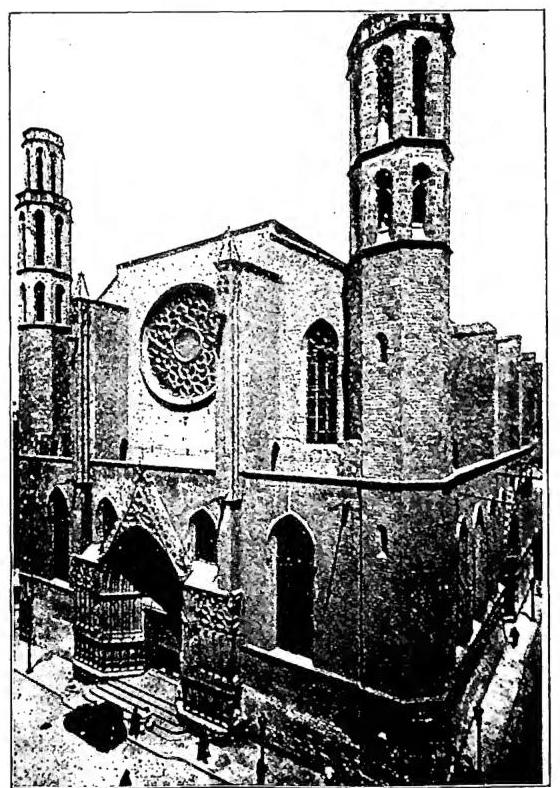
(from J. de Contreras, Història del art hispanico, II, Barcelona 1901) CATALOGNA – Church of S. Maria del Mar (14th century) – Barcelona.
(1350–1419), of whom there remain in the vernacular the Contemplació molt devota and two series of Sermons. His brother Bonifacio, a Carthusian, translated the Bible with great excellence.
C., for geographical, political, and commercial reasons, was the first Hispanic region reached by the influences of Italian Humanism, which penetrated it in the time of Giovanni I and Martino I and established itself, among other ways, through the coexistence of Catalans and Italians in Naples during the reign of Alfonso the Magnanimous. Versions of Cicero, Sallust, Livy, Ovid, Quintus Curtius, Seneca, and Boethius multiplied. The Històries Troyanes, translated by Jaume Conesa between 1367 and ’74, also enjoyed wide circulation.
Chronologically, the first great humanist of C. was Bernat Metge (1350–1413?), secretary to Giovanni I, but thrown into prison by Martino I, where he wrote Lo somni (1398), the first humanist work in Catalan. In it the author converses with the spirit of King Giovanni about the schism of the Church and the spirituality of the soul, with irony concerning the good and bad qualities of women. He reveals familiarity with the Latin classics, with Petrarch and Boccaccio (of whose Griselda tale he translated a version), as well as an undercurrent of skepticism and sensuality, also discernible in his poetic Sermó, a humorous collection of bad thoughts and counsels. In his Libre de Fortuna e Prudència, Italian currents intersect with French and native ones.
The Dominican of Valencia Antoni Canals (died in 1419) oscillates between the medieval spirit of his doctrinal works—Expositions devotes, Recull d'eximplis, Tractat de confessió, a version of an apocryphal Carta de s. Bernat a s. Germana—and the humanism of his translations from Valerius Maximus and Seneca (De providentia) and of the poem Scipió e Annibal, a reworking of Petrarch’s De Africa.
The Barcelonese poetic school was soon overtaken by the Italian one, which drew its inspiration from Dante and especially from Petrarch, and sought a language increasingly free of exoticisms. Andreu Febrer translated the Divina Commedia; Leonard de Los moralized in verse; Joan Fogassat essayed religious and political subjects; Jordi de Sant Jordi, one of the last to write verse in Provençal, surpassed the medievalism of his Ennuigs in the «lament» Desert d'amichs, de béns e de senyor, a document of profound humanity written in captivity after the defeat in Sardinia (1423), in the time of the Magnanimous. Also worthy of mention are Huch Bernat de Rocaberti, Antoni Vallimanya, and Romeu Llull; but above them MARCHE (v.), the greatest writer of C. after Llull and the most illustrious follower of the new school. His Cant espiritual marks one of the highest peaks of Catalan religious literature.
In the second half of the century, literary primacy was assumed by Valencia, whose poetic school alternated satirical subjects, often of uninhibited obscenity, with religious themes, equally deeply felt and experienced. Let us recall: Bernat de Fenollar, Jaume Gaçull, Narcís de Vinyoles, Joan Escrivà (also a poet in Castilian, author of the celebrated «letrilla» Ven muerte tan escondida...), Joan Roig de Corella (Lahors de la Vierge Marie), and Jayme Roig (Spill o Libre de les dones).
The humanist tendency is also evident in prose, especially in universal histories, such as the Compendi historial of Antoni Genebreda (died in 1395), bishop of Athens, and of G. Jaume Domènech, and in the national chronicles of Gabriel Turell, Pere Tomich, and the anonymous author of
Le fidel compte d'Urgell. A modern outlook, on the other hand, informs the Chròniques d'Espanya of Pere Miquel Carbonell, from the time of the Catholic Monarchs. Narrative literature boasts, alongside translations from Italian, two notable chivalric romances: Curial e Guelfa, a fine expansion of the Novellino, and Tirant lo Blanch by the Valencians Joanot Martorell and Martí Joan de Gualba, grafting a Breton subject onto the literary tradition of C. Religious prose moves from the Memorial del pecador remut, a transitional work by Felip de Malla (died in 1431), to the Baroque affectations of the Valencians Roig de Corella and Miquel Pérec. The Vita Christi of Sister Isabel de Villena (died in 1490), a masterpiece of Catalan prose, is spontaneous, by contrast.
The sixteenth century marks the general decline of Catalan life; only Valencia persisted in its cultural traditions, sending humanists to Paris (Joan Lluís Vives and Pere Joan Perpinyà) and Barcelona (Pere Joan Nunyes), and developing, between the sixteenth and seventeenth centuries, a dramatic and novella-writing school in Spanish: this was the age of Guillem de Castro, Timoneda, and the Nocturnes. C. and Majorca, on the other hand, either limited themselves to cultivating religious literature for practical purposes—manuals of piety, goigs, popular dramas modeled on the medieval mysteries with some Renaissance framing—or shut themselves up in nostalgia for the past. Such is the meaning of the historical works of Cristòfor Despuig, Pere Gil, Jeroni Pujades, and Andreu Bosch, and of the two great seventeenth-century forgeries: the Feysts d'armes de Catalunya, attributed to Bernat Bodes by the minor Joan Gaspar Roig i Jalpi, and the heraldic Trobes, disseminated by a Valencian nobleman under the name of the supposed fifteenth-century versifier Jaume Febrer. A poet of vigorous religious inspiration, despite the corrupt language and satirical abuses that made him popular, was Vicenç Francesc Garcia, better known as the Rector de Vallfogona (died in 1623), whose Cant d'agonia surpasses the lyric poetry of Ausias Marchian imitation cultivated in Barcelona in the preceding century (for example, Pere Serafí, 1565).
Two facts prepared the revival of Catalan literature: the formation, in the eighteenth century, of humanistic and centers of higher culture through the work of Josep Finestres, the Marquis of Llió, and Antoni de Capmany in C., of Gregori Mayans and Francesc Pérez Bayer in Valencia, and of Bonaventura Serra in Majorca; and the traditional and historical orientation assumed in C. by Romanticism, chiefly under the influence of Manzoni and Scott.
In 1833 Bonaventura Carles Aribau published the Oda a la Pàtria, which found an immediate response in C. (Joaquim Rubió i Ors), in Valencia (Vicents Bois), and in Majorca (Marian Aguiló). These figures and Manuel Milà i Fontanals secured, through their historical research, the traditional and medievalist character of the new Catalan culture, which drew extensively on popular poetry, diligently studied and brought to prominence.
The conventionalism of the Jochs florals, restored in Barcelona in 1859, was immediately surpassed by Jacinto Verdaguer (1845–1902; v.). The transition, however, from post-Romanticism to modern poetry was due chiefly to the poets Joan Maragall, a Catalan (1860–1911), singer of the Pyrenean solitudes, Goigs a la Verge de Núria, and of the presence of God in the spirit and in the world, Cant espiritual, LIBERIA (v.), a Majorcan (1854–1922). Worthy of note as religious poets are Joan Alcover (Poemes bíblics), J. M. López-Picó (described by Valbuena as the Paul Claudel of Spain), Miquel Ferrà, Josep Carner (Nabi, a poem about Jonah), and the priests Llorenç Riber, Antoni Navarro, Bartomeu Guasp, Pere Ribot, Camil Geis, and Miquel Melendres.
In learned prose, the following stand out: Antoni Rubió i Lluch (1856–1937), who through his studies on Catalan Greece and medieval culture gave Catalonia directions comparable to those which his great friend Menéndez y Pelayo gave to the whole of Spain; Iordi Rubió i Balaguer, J. Puig i Cadafalch, J. Massó i Torrents, Fr. Anselm M. Albareda, Manuel de Montoliu, F. Valls i Taberner, F. Soldevila, Joan Estelrich, etc.
In religious doctrinal literature, the following stand out: Josep Torras i Bages, bishop of Vich, the Capuchin Miquel d'Esplugues, the Jesuit Ignasi Casanovas, and the canon Carles Cardo.
Now, with the crisis of the decade 1936–45 overcome, it is legitimate to hope that Catalan literature will secure the place which, by virtue of its history, belongs to it within the cultural framework of Spain.