
SILVESTRO II, PAPA. - He reigned from 2 April 999 to 12 May 1003. Probably native to Auvergne, Gerberto entered as a monk the Benedictine abbey of St-Géraud d'Aurillac (Cantal). Borrel, count of Barcelona, esteemed his learning and took him with him to Catalonia around 967. Atton, bishop of Vich, initiated him into the mathematical sciences. The young monk made such progress that his protector presented him as a celebrity at the court of Ottone I, who was then in Rome (970). He did not settle in that city and went to Reims, where a school of dialectic was flourishing (972).
Having become a master in this discipline, he taught with great renown; this gained him the title of scholasticus and the favour of Archbishop Adalberone. Ottone II, who was present at a philosophical disputation with the German Otric of Magdeburg at Ravenna—reported by the monk Richero—rewarded him by giving him the abbey of Bobbio (980). Political events arising in Italy compelled him to resume teaching at Reims in 983.
Two treatises remain concerning the philosophical doctrines of S.: De rationali et ratione; De Corpore et Sanguine Domini. It is not certain whether he actually adhered to the exaggerated realism suggested by some texts (cf. De Corp. et Sang. Dom.: PL 139, 189 B). Besides his teaching of dialectic, Gerberto was renowned for his knowledge of geometry and astronomy. The construction of a celestial globe enabled him to explain to his listeners the movement of the stars and planets in a new way. The invention of a device that marked the hour during the night caused a sensation, since until then only the sundial had been used. Gerberto simplified the art of calculation and composed the first thirteen chapters of a treatise De Geometria (PL 139, 95-152 and the ed. by N. Bubnov, Gerberti opera mathematica, Berlin 1899).
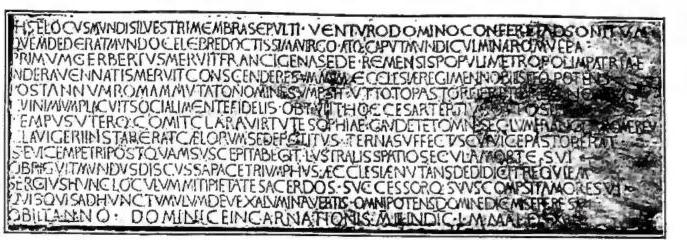
(from A. Silvani, Monumenta epigraphica Arist., I. Roma, Città del Vaticano [M2, pl. 1, 2])
SILVESTRO II, PAPA - Epitaph of S. II - Rome, basilica of S. Giovanni in Laterano.
the enigmatic shorthand notes that abound therein; nevertheless, M. J. Lair (Etudes critiques sur quelques textes des Xᵉ et XIᵉ siècles, 2 vols., Paris 1899) proposed certain corrections. Thus, both as a scientist and as a man of letters, Gerberto exercised considerable influence in the 10th century. Politics caused him tribulations. After contributing to the success of Ugo Capeto and the elimination of Carlo di Lorena, he might have aspired to the see of Reims following the death of Adalberone (23 Jan. 989), but Capeto preferred Arnoul, who betrayed him and facilitated Carlo di Lorena’s entry into Reims. The King wished to punish the traitor and secure his deposition. Having obtained no satisfaction from Pope Giovanni XV, he convened a Council at Saint-Basle de Verzy (June 991), where Arnoul, bishop of Orléans, on the basis of arguments supplied by Gerberto, upheld a delicate thesis according to which the Gallican episcopate possessed the requisite qualities to take a decision (v. the minutes drawn up in 995 by Gerberto himself: PL 139, 287-88 and in MGH, Script., III, pp. 658-86). Arnoul having been deposed and degraded, Gerberto was elected archbishop of Reims. Giovanni XV did not tolerate this affront to his authority. Since two summonses of the Gallican clergy to a council to be held at Aix-la-Chapelle or Rome had no effect, he announced reprisals. An assembly of the Gallican clergy held at Chelles dared to confirm the sanctions adopted against Arnoul and the election of Gerberto. Nevertheless, the latter appeared at the Council of Mouzon-sur-Meuse convened by the legate Léon and delivered an able defence (June 995). Subsequently, before another Council, he delivered a discourse whose text is still preserved: PL 139, 345-50. No decision was reached, but Gerberto could no longer
reside at Reims; in 996 he joined the retinue of Ottone III, who was visiting Italy, then went once more to France, where he attended the Synod opened in March 997 at St-Denis. Having returned to the Emperor’s court, he obtained, through him, the see of Ravenna. A profound change took place in him: from being a supporter of distinctly Gallican theories, as he had previously been, he became an ardent defender of the omnipotence of the Holy See. On 2 April 979 the Emperor placed the tiara upon him.
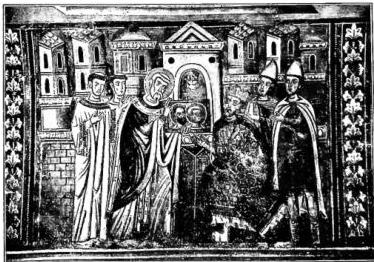
(photo Alinari)