
BOBBIO, DIOCESE of. — In Lombardy, province of Piacenza, suffragan of Genoa. It comprises municipalities belonging to the provinces of Genoa, Piacenza, Pavia, and Parma. The diocese has an area of 613 sq. km.; with 35,000 inhabitants, distributed among 60 parishes, grouped into 13 rural deaneries; 79 diocesan priests (1948) and its own seminary. The town centre (in the province of Pavia) has 6,000 inhabitants. It venerates as diocesan patron St. Colombano, whose feast is celebrated on 24 November; the Cathedral is dedicated to Mary Assumed into Heaven and to St. Peter the Apostle.
The diocese was established only in 1014; suppressed at the time of the French invasion (1803), it was annexed to the diocese of Casale Monferrato; Pius VII restored it within its original boundaries in 1817, at the request of King Vittorio Emanuele I.
B., in the Trebbia valley, owes its origin
to the Irish monk St. Colombano. Having taken refuge in 612 with the Lombard king Agilulf, who had recently converted to Catholicism, he received permission to settle as a hermit in a mountainous place where there was an ancient ruined oratory dedicated to St. Peter. Colombano restored it and made it the centre of the monastic life that he intended to establish there. He placed the monastery under the protection of the Virgin Mary; and monks flocked to it, attracted by the abbot’s reputation for holiness. Around the new monastery and along the Bobi stream, from which the settlement took its name, increasingly numerous dwellings arose. After Colombano’s death (615), his companion St. Attala of Burgundy was made abbot; he brought distinction to the monastery through his learning and virtue, and died there around 622. The third abbot, St. Bertolfo, had the earlier Lombard donations confirmed by King Adaloald, and in 638 obtained a bull from Honorius I that placed the monastery under the immediate authority of the Holy See, exempting it from all episcopal jurisdiction. He was succeeded as abbot by St. Boboleno, to whom Pope Theodore I confirmed the monastery’s rights of exemption in a new bull. The Scot Cumian, having relinquished the episcopal see
At the urging of the emperor Henry II, Benedict VIII established the episcopal see there in 1014. The bishopric, formerly directly dependent on the Holy See, became suffragan to Genoa when that city was raised by Innocent II to metropolitan rank (1133). Around and under the authority of the principal monastery of St. Colombano, other monasteries arose in the Bobbiese area, of which, however, no trace remains.
The first bishop was Attone (1014–27), succeeded by Sigefredo. Bishop Luizo received the title of count of the city (1046), while the abbots retained that of count of the territory. Alberto Avogadro (1184–85), transferred there from Vercelli and later sent to Jerusalem (1205), distinguished himself for holiness; he suffered martyrdom at Acre on 8 April 1214. During the episcopate of Marliano Buccarini, the abbey of B., by then in decline, was entrusted by Nicholas V to the Cassinese Benedictines of the Congregation of St. Giustina of Padua (1449). A considerable number of the bishops belonged to religious Orders. Giovanni Mondani (1477–82) solemnly transferred the body of St. Colombano from the monastery church (cf. Ughelli, IV, p. 943). He died in the odour of sanctity on 15 December at Piacenza and was buried there in the Cathedral. Cardinal Augusto Trivulzio administered the diocese from 1522 to 1524. Francesco Abbondio Castiglioni governed the diocese from 1562 to 1568, and in 1565 was elevated to the cardinalate. The bishops also had serious disagreements with the town government, which sought to free itself from the bishop’s temporal jurisdiction. The Dal Verme family subsequently opposed episcopal jurisdiction; Duke Filippo Visconti of Milan had granted B. to it as a fief.
(phot. Gab. fot. nec.)
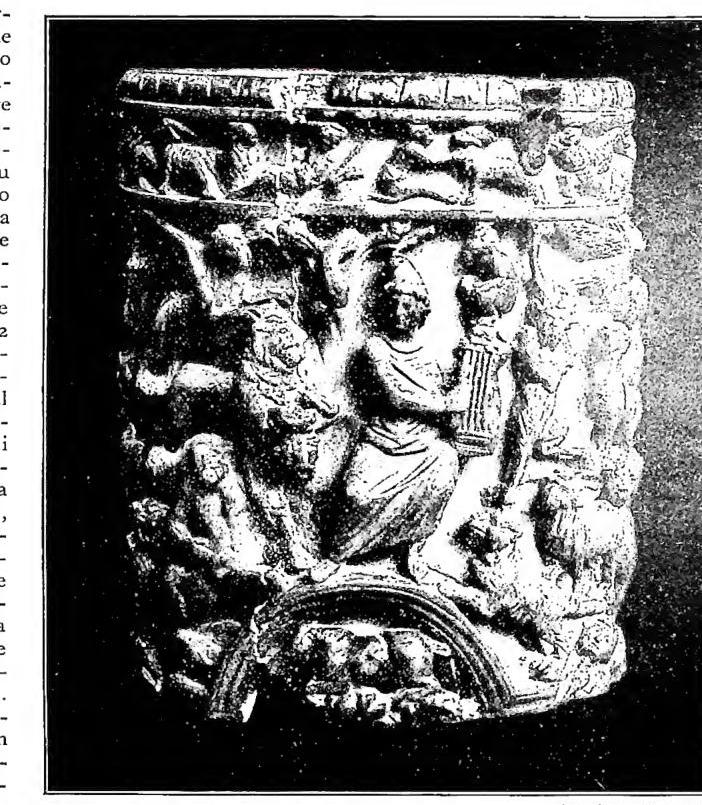
BOBBIO – Ivory vessel in relief with the scene of Orpheus (6th century), reused as a pyx. – Treasury of the church of S. Colombano.
In 1748 the Bobbiese was detached from the duchy of Milan and incorporated into the Sardinian States. The monastery declined until its suppression and the final dispersal of the library (1795). The monastery buildings, modernized in the 17th and 18th centuries, were converted into residences for the clergy and into schools.
B. was one of the most important and wealthiest abbeys in Italy. Particularly characteristic and of the greatest importance was its “scriptorium,” which, together with that of Monte Cassino, has the distinction of having been at the forefront in preserving and transmitting the cultural heritage of antiquity. Its library was among the richest, although, following recent studies, especially those of Cardinal Mercati, the hitherto prevailing opinion can no longer be maintained that it was the heir and repository of Cassiodorus’s Vivariense library. Just as there was a “custos chartarum qui omnia praevideat monasterii monumenta,” so a librarian presided over the “scriptorium” and the book collections.
From B. come Cicero’s De republica; Rutilius Namatianus’s De reditu suo; Lucan’s Pharsalia; the Medicean Virgil, etc. In the 15th and 16th centuries, unfortunately, the emigration of codices and documents began; during the time of Carlo Emanuele I, an initial group went to Turin; through the efforts of Federico Borromeo, many codices passed to the Ambrosiana (1606), and others to the Vatican Library through the efforts of Paolo V (1618). Mabillon and Muratori found the library already pillaged; in 1720 only about a hundred codices remained there. The final dispersal took place when Dr. Buthler bought the remainder at auction (1801–1803).
At the request of the Piedmontese government, A. Peyron traced about a hundred Bobbiese codices for the Turin library; half of this collection, however, was destroyed in the fire of 1904. A. Mai, while studying the Ambrosiana collection, made extremely important discoveries concerning the palimpsests. Important documents are still preserved in the archive of the cathedral of B.
Among the sacred artistic monuments, in addition to the remains of the monastery, there is the church of S. Colombano, which was rebuilt by the Benedictines in the second half of the 15th century and completed in the 17th century. The façade, divided into three sections corresponding to the three interior naves, has a single portico in front. The main nave was frescoed in 1576 by Bernardino da S. Colombano. Worthy of note are the carvings and inlays of the choir, the work of Domenico da Piacenza (1488). In the crypt (restored in 1910 according to the lines of the 15th century, through the initiative of Cardinal Logue and the Irish), there is the sarcophagus of S. Colombano, with the figure of the reclining saint, sculpted by Giovanni Patriarca, a Milanese (1480). On the side walls are Romanesque-style tombstones of the abbots Attalo and Bertolfo. In a section enclosed by a wrought-iron grille are relics and fragments of the primitive church and a tombstone of S. Cumiano (8th century). The bell tower dates from the 11th century; among the sacred furnishings are a 15th-century silver reliquary bust of S. Colombano and an illuminated choir book from the same century. The monastery church is simply a parish church.
The Cathedral, rebuilt in 1436, likewise has three naves; the presbytery is raised; the octagonal crypt rests on brick pillars (13th century); the transept and presbytery were rebuilt and frescoed by Pozzi in 1725. The building, in the form of a Latin cross, is 63 m long and 22 m wide.
In the underground part of the church of S. Maria dell’Aiuto (erected in 1621), on a pier, there is a noteworthy fresco representing the Madonna and Child (16th century). The churches of S. Maria delle Grazie, S. Lorenzo, and S. Francesco (the latter now deconsecrated) date from the 17th century. The bishop’s residence and the seminary were built in several stages during the 16th–18th centuries; among the relics are a
series of metal, historiated ampoules (v.), brought from the Holy Places; terracotta medals likewise commemorating them; medieval seals; an Agnus Dei of Alessandro VI; and a pastoral staff from 1479.