AGNUS DEI, BENEDIZIONE DEGLI

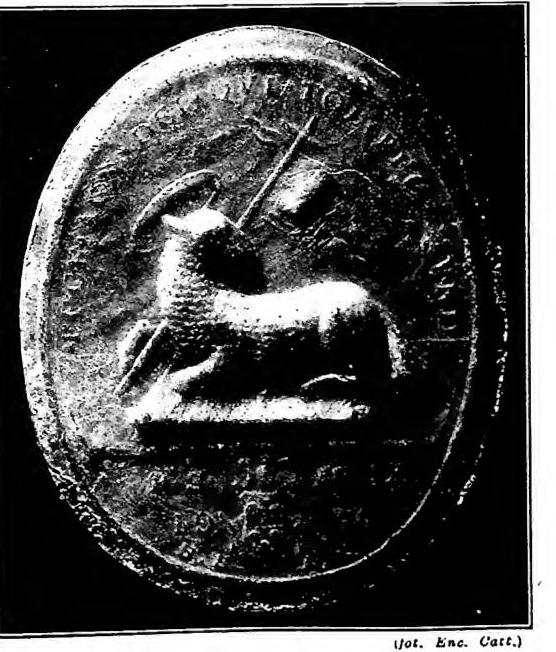
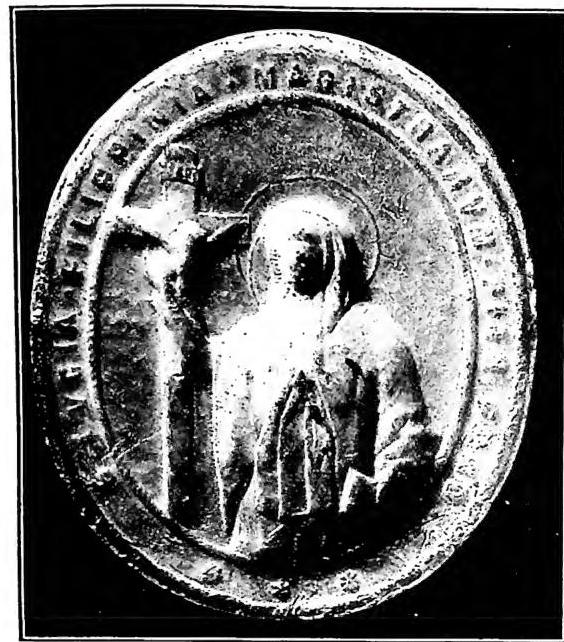
A. D. (Agnus Dei), blessing of. — The Agnus Dei medals currently in use are oval wax medallions of varying size, white in color, blessed by the Supreme Pontiff on certain occasions. On one side they bear the image of the Paschal Lamb with the cross and the inscription *Ecce Agnus Dei qui tollit peccata mundi*, and on the other the image of a saint or of some special event.

Scholars disagree as to their origin. It seems unlikely that they derive from the practice among the faithful of preserving fragments of the Paschal candle, to which special protective powers were attributed. What can be stated with certainty is their Christian, probably Roman, origin, and that they cannot be traced back beyond the 9th century: indeed, an Ordo Romanus of that period clearly mentions them, and Amalarius and the pseudo-Alcuino allude to them. In ancient times, the blessing of the Agnus Dei was performed at the Lateran by the archdeacon on Holy Saturday. In the presence of the Pope, the archdeacon, vested in a dalmatic, received from the Pontiff the holy chrism in a silver ampulla, which he poured into a cauldron of melted wax. With this wax the Agnus Dei medals were made, and they were distributed to the faithful on the Sunday in Albis (Low Sunday) after the Agnus Dei of the papal Mass. The oldest known specimens date from the time of John XXII (1316–34) and Gregory IX (1227–41). Subsequently, the Supreme Pontiffs reserved the blessing of the Agnus Dei to themselves and granted the Cistercian monks of Santa Croce in Gerusalemme the privilege of preparing them.

In the current rite, which dates back to the 16th century, holy water, chrism, and balsam are used for the blessing. The Supreme Pontiff, in the first year of his pontificate, during the Octave of Easter, performs the solemn blessing of the Agnus Dei, and renews it every seven years. The ceremony consists of three prayers said in a low voice, followed by the sprinkling with holy water and the incensation of the Agnus Dei. The Pope then distributes them to the cardinals, bishops, and other dignitaries present.

Article illustration
(fol. Enc. Gatz.)
Agnus Dei - Recto: Paschal Lamb (1930).

(vol. Enc. Catt.)

I. THEOLOGICAL WRITINGS

1) *Liber adv. dogma Felici Urgellensis*, against Spanish adoptionism; dedicated to Emperor LUDOVICUS PIUS, occasioned by a writing found among the papers Urgel (v.), who died at Lyon in 818; 2) *De imaginibus Sanctorum*, or *Liber contra eorum superstitionem qui picturis et imaginibus Sanctorum adorationis obsequium deferendum putant*, in which A. reveals himself, not as an iconoclast, but as the victim of a widespread misunderstanding then current in Gaul (v. CARIOCINESI, LIBRI: there are points of contact with the thought of Claudius of Turin [v.]).

Of interest also for theology and biblical exegesis are the *Epistola to Bartholomew, bishop of Narbonne*, *De quorumdam inlusione signorum*, concerning portentous events that had occurred in the church of St Firminus of Uzès; the *Liber contra obiectiones Fredgesii* (the abbot of St Martin of Tours, disciple and successor of Alcuin), a self-defense in which A. also touches on the nature of biblical inspiration, denying its mechanical verbal character («corporalia verba»: PL 104, 166); the *Epistola to Ebbo of Reims*; *De spe et timore*, a pamphlet of ascetical value, unfortunately mutilated.

II. WRITINGS AGAINST SOME SUPERSTITIONS OF HIS TIME

1) *De grandine et tonitruis*, against the foolish popular belief that storms were the work of sorcerers and that animal plagues were the effect of certain powders scattered in the kingdom by sorcerers sent by Duke Grimoald of Benevento; 2) *Adversus legem Gundobaldi*, against trial by ordeal, sanctioned by the ancient Burgundian laws; 3) *De divinis sententiis*, against ordeals.

III. ANTI-JEWISH WRITINGS

At Lyon, where the Jews (whom the Emperor had taken under his protection) were particularly powerful, Jewish proselytism constituted a danger to Christians. Since, moreover, pagan slaves of the Jews who converted to Christianity had the right to freedom, it was decided, to prevent abuses, that baptism could not be conferred upon them without the consent of their master. Against such provisions A. protested in the writing *Consultatio et supplicatio de baptismo iudaicorum mancipiorum*, addressed to high court officials. And when an imperial decree reaffirmed the harmful prescription, A. renewed his protest with the memorandum *Contra praeceptum impium de baptismo iudaicorum mancipiorum*. As the situation did not change, A. addressed a third writing to the Emperor himself, *De insolentia iudaicorum*, and shortly thereafter a learned collective letter, his and those of other bishops, *De iudaicis superstitionibus*. To Nebridius, bishop of Narbonne, he sent the exhortatory letter *De cavendo convictu et societate iudaica*.

IV. PASTORAL WRITINGS

Intended to instruct the people and defend the rights of the clergy: 1) *De privilegio et iura sacerdotum*, to Bernard, bishop of Vienne, an interesting pamphlet based on Scripture; 2) *De dispensatione ecclesiasticarum rerum*, a letter in which he vindicates the Church’s right to possess property; 3) *De modo regiminis ecclesiastici*, to the clergy and monks of Lyon: contains excellent advice; 4) *De Fidei veritate et totius boni institutione*, a sermon to the people, of moral character; 5) The «deploratory» letter *De iniustitiis*, to the court councillor Matfred, against the abuses of lords against ecclesiastical goods.

V. POLITICAL WRITINGS

Besides the *Liber apologeticus*, mention should be made of the «febilis epistola» *De Divisione imperii* and the notable *Cartula de poenitentia Ludovici*, the public penance to which the deposed Emperor, after the Council of Compiègne, had to submit at Soissons (Oct. 833). When, in that same year, Pope Gregory IV had gone to France hoping to prevent the fall of the Carolingian empire, A. wrote to Louis the letter *De comparatione regiminis ecclesiastici et politici*, to illustrate the superiority of ecclesiastical power over civil.

VI. LITURGICAL WRITINGS

Of those published among the works of A., only one circular, *De correctione Antiphonarii*, addressed to the clergy of Lyon and issued about 1839 as a preface to the new Antiphonary, which was to replace the Roman-Metensian one introduced by Amalarius, seems certain. A., a rigid conservative, admitted no liturgical texts other than liturgical ones. The violent polemical pamphlet *De Divina Psalmodia* is instead by Florus (v.), to whom Wilmart thinks to attribute also the other, *Contra libros IV Amalarii*, which is in fact more restrained: cf. Rev. Bénéd., 9 (1892), p. 346 sq.; 36 (1924), p. 327 sqq.

Article illustration
(Int. Enc. Catt.)
Agnus Dei — Reverse: S. Lucia Filippini.

Finally, two poetic compositions are attributed to A.: the epitaph of Charlemagne and the hymn for the translation of relics, *Rector magnificus*. The latter is certainly by Florus (cf. MGH, *Poetae*, II, Hanover 1884, p. 544); for the epitaph and the acrostic poem in his honor (*Agobardus pax*), which is interesting for its meter, cf. ibid., p. 118.

A.’s works possess the strengths and weaknesses of polemical writings; yet many of his pamphlets, particularly those against superstition and against the Jews, are valuable sources for the history of civilization. His style, lively and vigorous, recalls that of Tertullian, whom he seems to have emulated, as is suggested by the best manuscript of the works of the African Father (excluding the *Apologeticum*) in his possession, the *Codex Agobardinus* (now in the Bibliothèque Nationale in Paris, lat. 1622). Though he often exceeded as a man of action, he was nonetheless a great pastoral figure and merits recognition for defending the purity of the faith against Adoptionism and genuine piety against superstitious deviations. The *Codex of Confraternities* of Reichenau shows that he had forged an intimate union of prayers between his diocese and that abbey (MGH, *Libri Confraternitatum*, Hanover 1884, p. 257).

BIBL.: For the chronology of A.’s life cf. *Annales Lugdunensis*, in MGH, *Scriptores*, I, Hanover 1826, p. 110; PP. Maurini, *Histoire littéraire de la France*, IV, 2nd ed., Paris 1846, pp. 567–83; P. Chevallard, *L’Église et l’État en France au IXe siècle: Saint Agobard*, Lyon 1860; R. Enge, *De Agobardi archiep. Lugdunensis cum Iudaeis contentione*, Freiburg 1888; K. Eichner, *Agobard, Erzbischof von Lyon*, in *Zeitschrift für wissenschaftliche Theologie*, 41 (1898), pp. 526–88 (cf. *Analecta Bollandiana*, 18 [1899], pp. 74–75); G. Mercati, *A. e Ireneo*, in *Studi e Documenti di Storia e Diritto*, 21 (1899), pp. 116–25; M. Manitius, *Gesch. der lat. Lit. des Mittelalters*, I, Munich 1911, pp. 381–90; A. Gastoué, *Le Graduel et l’Antiphonaire Romains*, Lyon 1913, pp. 98–110; S. Greelwski, *La réaction contre les Ordiales en France depuis le IXe siècle: Agobard et Yves*, Rennes 1924; A. Bressoles, *La question Juive au temps de Louis le Pieux*, in *Revue d’Hist. de l’Église de France*, 28 (1942), pp. 51–64.

AGONALIA (Agonalia, Agonia)

Roman festivals that occurred four times a year: January 9, March 17, May 21, and December 11. These dates are drawn from calendars, which, however, provide little else. From them and from ancient writers we know that on January 9 the *rex sacrorum* sacrificed a ram to Janus; that March 17 was sacred to Mars; that May 21 was sacred to Veiovis; and that the festival on December 11 was dedicated to Sol Indiges.

BIBL.: G. Wissowa, s.V. *Agonium*, in *Pauly-Wissowa, Real-Encycl. der klass. Altertumswissenschaft*, I, 1, cols. 369–70; E. De Ruggiero, *Diz. Epigr.*, s.V. *Agonia*, I, p. 365.

Paolino Mingazzini, *Agonia*. — From ἀγωνία = struggle, anguish, distress; “the final struggle of the body against death” (cf. *Vocab. lingua ital. della R. Accad. d’Ital.*, s.v.). It presents differing aspects of duration and intensity according to the length of the illness, the organic resistance, and the patient’s age. It is rapid and burning in violent traumas, poisonings, and acute infections; prolonged, sometimes lasting days, when the organism has become almost accustomed to difficult living conditions through slow, chronic wasting (tuberculosis, tumors, long‑running heart disease); it is entirely absent in cases of sudden death, where the cause is so violent or abrupt that life is snuffed out without any struggle. Given such variety in its manifestations, it can be difficult—especially for non‑medical observers—to determine its onset and course; yet it is of great importance for the priest to recognize these extreme conditions of the patient in order to provide particular assistance at the “moment of death.” The state of *a.* can best be discerned by observing the three principal functions of the organism: two of vegetative life—respiration and circulation—and one of relational life—the activity of the nervous system.

Respiration, which during the course of the illness has already shown marked variation in its characteristics, undergoes the most severe alterations at the onset of *a.* in frequency, intensity, and rhythm; the rhythm in particular marks the time and undergoes the deepest modifications as death approaches. The so‑called Cheyne‑Stokes respiration is characterized by a series of respiratory acts that first increase in intensity to a maximum and then gradually become more shallow until they cease; this is followed by a pause of apnea, more or less prolonged (up to many seconds), and then a new series of respiratory acts with the same crescendo and diminuendo pattern. During the apneic pause the patient loses consciousness entirely or in part; the pupils contract and no longer react to light, the eyes close, the pulse becomes smaller and more rapid, the head falls back, and the individual takes on the appearance of death. The resumption of a new cycle of respiratory acts causes these signs to recede, while the patient regains consciousness and, as if awakening from sleep, resumes interrupted speech, tries to sit up in bed, and is seized by the anxiety of an approaching end, imploring help from those around him. The definitive cessation of breathing, which corresponds to the passage into death, coincides with one such pause. Though Cheyne‑Stokes respiration may in particular cases last for days or even weeks and sometimes cease altogether, it is ordinarily to be regarded as a sign of extreme gravity, with death following within a few hours. Respiration often assumes a noisy, gurgled character (*death rattle*) in *a.* as air passes through phlegm accumulated in the trachea and laryngopharynx; its frequency, which increases during the illness in relation to rising fever, toxic state, or possible bronchopulmonary complications, becomes slow and labored.

Circulation can provide important signs of the onset and progression of the agonal state. As the heart weakens, the pulse becomes smaller (i.e., it beats with less force under the examining finger) and more rapid, so that as the patient’s condition deteriorates it exceeds 110–120 beats per minute, reaching 130–140 in the final moments—often barely perceptible to palpation or only detectable in less perfect arteries closer to the heart (the temporal artery in front of the tragus of the ear; the external carotid beneath the angle of the jaw, adjacent to the anterior border of the sternocleidomastoid muscle). A high pulse rate is significant only if accompanied by other signs of the patient’s grave condition, since there are cardiac rhythm disorders in which a transient, very high rate (180–250 beats per minute) may occur even when the individual is otherwise in normal health. Irregularity of the pulse (arrhythmia, intermittent beat), especially if it replaces a previously regular rhythm and is joined by other signs of deterioration, is of grave significance.

Peripheral circulatory insufficiency brings cooling of the extremities (hands, feet, tip of the nose, ears), which take on a pale, bluish tint (cyanosis) owing to concurrent respiratory failure.

The condition of the nervous system is of great importance in determining the severity of the agony, whether one considers the higher nervous activity (specific sensitivity of the sensory organs, consciousness, mental lucidity) or the lower (general sensitivity, vegetative reflex activity). At the onset of agony, the first to be impaired is the activity of some sensory organs; foremost among these is sight, which dims until it is extinguished. Hearing, however, persists, though with individual variations—sometimes becoming duller, sometimes retaining its full strength or even becoming unusually acute. This fact must be kept well in mind when speaking in the presence of gravely ill patients who appear to be unconscious.

The behavior of consciousness varies from case to case: some patients are entirely unconscious from the beginning of the agony, while others remain lucid almost until the final moments. Delirious ideas not infrequently agitate the dying.

It would be of great practical importance to know whether the dying person, even if giving the impression of being completely cut off from the external world due to the functional deficit of their sensory organs, nonetheless retains an inner lucidity of thought and in some way remains connected to the external environment—having some sensation of what is happening around them—even though they cannot communicate their thoughts to those present or manifest their will through actions. The problem is of the utmost interest from affective, juridical, and theological perspectives.

To discuss this, let us consider separately in man the faculties of sensitivity, intelligence, consciousness, and will—which, under normal conditions, coexist and cooperate. While sensitivity and intelligence presuppose consciousness—that is, the knowledge the soul has of its acts—it is questionable whether consciousness, in the mixed state proper to human nature, can exist without sensitivity and intelligence, by which man is capable of knowing the relationships between facts and ideas and among ideas themselves.

We must admit as certain that in man, given his particular mixed nature, even the highest spiritual operations are impossible without the anatomical and functional integrity of the nervous centers. Therefore, in all those cases where clear signs of severe injury or grave functional suffering of the nervous system are present (which we can discern by noting the complete deficit of general and specific sensitivity and of reflex activity), we can be certain not only of the extinction of intelligence but also of the individual’s consciousness.

On the other hand, in those cases where, despite the patient’s apparent lack of intelligence and unconsciousness, signs of some activity in the central nervous system persist (automatic movements, groaning, reflexes whose processing centers lie in the encephalic portion of the nervous system: coughing, sneezing, sucking, swallowing, blinking), we cannot exclude some elementary activity of the cerebral hemispheres and, correspondingly, a glimmer of inner consciousness that could still allow the dying person to benefit from the affective and religious assistance of those around them.

Apart from the symptoms detectable through examination of respiration, circulation, and the nervous system, the dying person, even at first glance, presents a bodily posture and facial expression that clearly announce the approach of death. Hippocrates was the first to describe this in a depiction still known by his name (*facies hippocratica*): a sharpened and cold nose with drooping alae that move with each breath; concave temples and prominent cheekbones; sunken eyes with half-closed lids, clouded corneas, and wandering gaze; dry and cold ears; a half-open mouth with dry, soot-colored lips; the skin of the forehead and entire face tense, of a pale yellowish or bluish hue, covered in cold, clammy sweat.

If the dying person represents the most pitiable object of human charity’s utmost care, they are likewise a tender object of religious assistance for the Catholic priest, who, after the last sacraments, still offers the dying the final aids of the prayers for the dying, while “mysterious relations unfold between the brain and consciousness and between the soul and God in the moments when death itself becomes serene, when it is accompanied by the illumination of the soul as it plunges into the bosom of God” (A. Carrel, p. 331).

A misguided pity for the dying, judged beyond hope of recovery, may lead to the desire to spare them the terror and suffering of agony, prompting the practice of “euthanasia” (q.v.), aimed at ending life painlessly or at least employing an anesthesia (q.v.) so profound as to abolish not only the sensation of pain but also awareness itself. This is condemned both by natural and divine positive law, as it constitutes a direct killing or, at the very least, deprives the dying of the possibility of supernatural aid until the final moments, stripping them of the expiatory benefit of suffering.

Given the uncertainty we may harbor regarding the possible persistence of consciousness in the dying, and in any case about its potential, it is incumbent upon us to fulfill the social (settlement of legal matters) and religious (administration of the sacraments) duties owed to the dying before they enter agony.

For the religious aspect, see ANIMA, raccomandazione della.

BIBL.: M.-F.-X. Bichat, *Recherches physiologiques sur la vie et la mort*, Italian trans. from the 3rd French ed., Pavia 1823; L. Luciani, *Fisiologia*, s.V. Milano 1924; A. Carrel, *L'uomo, questo sconosciuto*, Italian trans., Milan 1937; H. Bon, *Medicina e religione*, Turin 1946; R. Biot, *A servizio della persona umana*, Turin 1939; P. G. Payen, *Deontologie medicale*, Zi-la-wei (Chang-hai) 1922. Giuseppe de Ninno