
PASCHAL CANDLE. – This is a large candle, artistically decorated, blessed on Holy Saturday, and placed on a candlestick (often an artistic one, called the paschal candlestick) on the Gospel side of the high altar until the feast of the Ascension. It is also used in the rite for blessing the baptismal font on the vigils of Easter and Pentecost. The paschal candle must be lit at solemn Masses and at Vespers during the Easter season; it is extinguished after the Gospel of the solemn Mass of the Ascension.
ORIGIN AND HISTORY OF THE PASCHAL CANDLE. — The derivation of the paschal candle from the daily custom of the synagogue of lighting a lamp at nightfall with a formula of blessing, or from the analogous practice in force in the basilica of the Anastasis in Jerusalem and described by the pilgrim Egeria (ca. 383–88), or, in any case, from the lighting of a lamp at the beginning of the primitive evening liturgical office (lucernare), has not been proved.
The use of the paschal candle forms part of, and derives directly from, the solemn illumination of the churches on the vigil of Easter, called by St Augustine the « mater omnium vigiliarum » (Sermo 219), as can be seen from Exultet (v.), which recent investigations attribute to St Ambrose. From Eusebius we know that Constantine had not only the church but the entire city illuminated on this vigil (De vita Constantini, IV, 22), and St Augustine movingly describes the magnificent effect of the vigil illumination at Easter. The utilitarian needs of the liturgy—that is, the need to have in the presbytery a light that would last throughout the night—led to the use of a candle of extraordinary size, placed in the middle of the choir, which, from as early as the fourth century, was the object of a particular blessing framed by a poetic praise of its material and symbolism. Testimonies to this Laus cerei (Carmen cerei, Praeconium paschale) are found in St Jerome (letter to the deacon Praesidius of Piacenza, 384) and in St Augustine (De civitate Dei, XV, 22), who is said to have composed a similar praise. From this it may be concluded that the particular use of the paschal candle was widely established in Italy, and perhaps in Africa, toward the end of the fourth century. It is subsequently found in Spain and Gaul.
It is not easy, however, to outline its concrete history, since customs and rites varied according to the Churches. It will suffice for us to follow the paschal candle through Roman usage. The Lib. Pont. (I, p. 225) attributes to Pope Zosimus a constitutum according to which he granted the suburban Churches the faculty of blessing the paschal candle, which suggests that in Rome the practice of blessing the candle had not been introduced. Indeed, the Ordo Romanus attributed by Fr Silva-Tarouca to John, «archicantor» of the Vatican basilica (680), does not mention the paschal candle, but simply speaks of «cerei» to be blessed, perhaps identical with the two torches mentioned by the Ordines known as those of St-Amand and Einsiedeln (ninth century). These two Ordines likewise make no mention of the paschal candle, but only of two torches (faculae) which, as the Ordo of St-Amand attests, throughout the year always and everywhere accompany the pope in his functions. They are carried by two regional subdeacons who, on Holy Saturday, leave the sacristy with the pope, take their places during the readings beside the pulpit, then descend to the font, where, at the proper time, they immerse them in the baptismal water, and thereafter follow the pope to the consignatory and to Mass.
The Ordo Romanus I (nos. 32 and 39, in a section revised in the ninth century) speaks of the fire to be stored on Holy Thursday and preserved in a lamp until Holy Saturday (in the time of Pope Zacharias there were three lamps). On Holy Saturday, the great paschal candle was then immediately lit from this lamp, carried in procession into the church without singing, and placed before the altar on a large candlestick. The Praefatio, that is, the paschal proclamation, followed; then the two torches were lit from the great paschal candle, and thereafter accompanied the pope in the various rites. The appendix (no. 9) repeats the matter more concisely, but assigns two notaries as bearers of the two torches. Sacramentaries of the same period (ninth century) inform us that the paschal candle was blessed with the prayer Veniat, currently used for the blessing of the five grains of incense. Yet the text itself still reveals, despite certain unfortunate adaptations, that it was intended to bless the great lighted candle (incensum = lighted), which, once the rite was completed, was broken into pieces and distributed to those present as a sign of blessing. When the word incensum in ecclesiastical language came to be used exclusively for incense in the strict sense, the formula Veniat served in the early Middle Ages for blessing the five grains.
Meanwhile, the practice arose of lighting outside the church a great fire kindled from a stone, with which the paschal candle was then lit. Indeed, in the Ordo XII of Cencio the chamberlain (1188, later Honorius III), we learn that the new fire was placed atop a long reed and carried in procession, while Lumen Christi was sung three times, to the paschal candle, which was immediately lit and placed on its candlestick. In the Ordo XIV of Cardinal Gaetano Stefaneschi (1311), the harundo, 3½ cubits high, with the triplex candela, appears for the first time.
The so-called Roman Pontifical of the twelfth century likewise contains the rite of the Ordines Romani XII and XIV, but with one particular feature: before singing the paschal proclamation, the deacon inscribed on the candle a cross, the letters alpha and omega, and the year. This seems to have been a particular custom of the Lateran basilica, as appears from the Ordo of Cardinal Prior Bernardo (before 1176). In other churches, especially in France, the list of the feasts of the year was inscribed. In Rome, however, according to the Venerable Bede, the festal calendar was customarily inscribed on a great candle that then remained on display throughout the year, on the occasion of Holy Christmas. The dimensions of the paschal candle have always been considerable: the Exultet calls it «columna», but in the Middle Ages it was sometimes so enormous that it had to be lit from the ceiling.
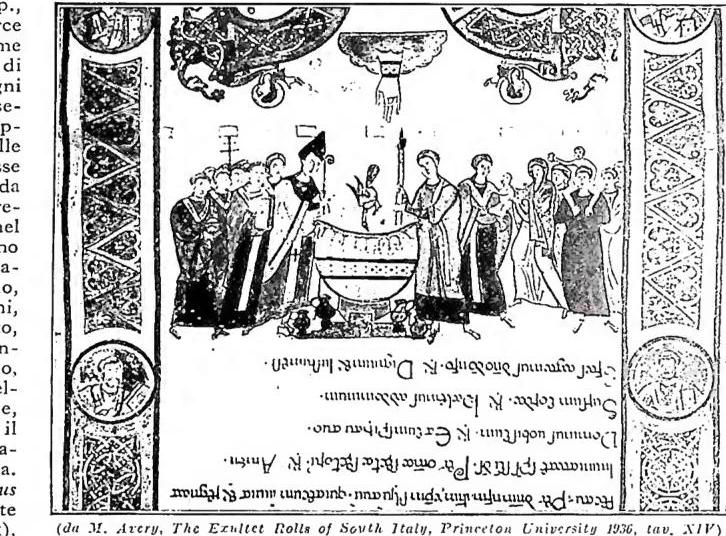
The practice of inserting the five grains of incense into the paschal candle is of medieval origin; they are mentioned in the Sacramentary of Ratoldus (tenth century), and by the time of the Micrologus (after 1086) their use was already common.
Giovanni Belethe, in his Divinorum officiorum explicatio (chaps. 105–109), written after 1165, refers to the inscription of the five grains of incense in the paschal candle, but does not speak of their blessing; instead, he mentions, in addition to the blessing of the paschal candle, the blessing of two other smaller candles, to symbolize the two Testaments. Guglielmo Durando (d. 1296), who in his celebrated Rationale divinorum officiorum (VI, 80) summarizes the entire liturgical and symbolic doctrine of the Middle Ages, still knows nothing of the blessing of the grains of incense, symbols of the aromatic spices used by the pious women and of the five wounds of the Lord. — Vedi Tav. LXXXII.