
RED SEA (Gr. Ἡ Ἔρυθρά Θάλασσα; Heb. Jām Sūph). - A large stretch of sea extending from the entrance of Bāb el-Mandeb, between southwestern Asia to the east and the coasts of northeastern Africa to the west, as far as Cape Mohammed to the north, where it forks into the two branches of the Gulf of Suez (Sinus Arabicus) to the west, and the Gulf of el-'Aqabah (Sinus Aelanticus) to the east. The Hebrew name jām sūph, "sea of seaweed" or "of reeds" (Ex. 10, 19; 13, 18; 15, 4), is of uncertain origin; but the identification is not in doubt, since its extremity is indicated (Ex. 23, 31; I Kings 9, 26; Jer. 49, 21) as the Elanitic Gulf, or Gulf of el-'Aqabah.
The general opinion, supported by the biblical texts, is that the miraculous passage of the Hebrews through the R. S. (Ex. 15, 4-22) took place in the Gulf of Suez, which at that time, by means of natural channels, was joined to the basin of the Bitter Lakes. Reeds still grow there today, and it is not excluded that they also abounded there at the time of the Exodus, thus justifying the Hebrew name.
The precise point of the crossing has been variously determined: by the Serapeum between Lake Timsāh and the Bitter Lakes; by Šaluf between the Bitter Lakes and Suez; or by the ford that in ancient times joined Clysma (= Suez) to el-Šatt. The most probable opinion, presented by Bourdon and based on geography, archaeology and the study of the papyri, places the crossing between Gebel Geneffef and Gebel Hasan, along the track that led to the ford situated in the southern part of the Little Bitter Lake.
The Hebrews, forced to change direction in their march toward Palestine, turned from the Serapeum along the road west of the Great Bitter Lake that led to Suez and, leaving on their right the marshy ground that extends between the road and the lake, called in a papyrus by the Egyptian name equivalent to Phihahiroth (= marshes +), encamped at the foot of Gebel Hasan, where, from the time of Seti I, there was a small fort (Magdal) facing the stele of Beelsephon (Ex. 14, 1-2), with a garrison to guard both the road leading to Suez and the track to the ford of the Bitter Lakes.
(phot. Sananini)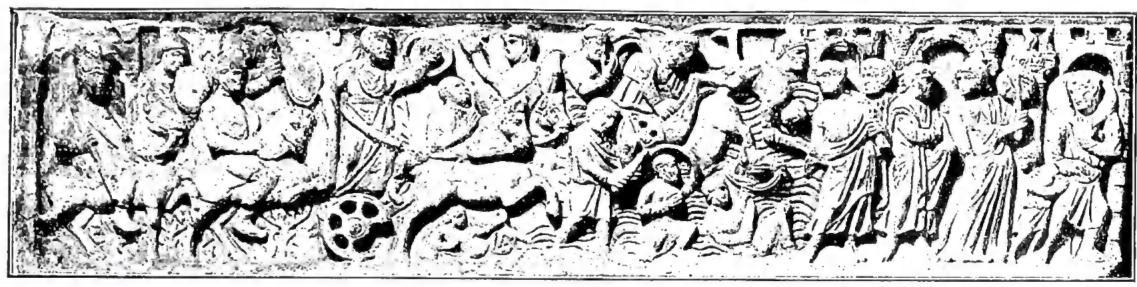
BIBL.: sources
ARCHAEOLOGY
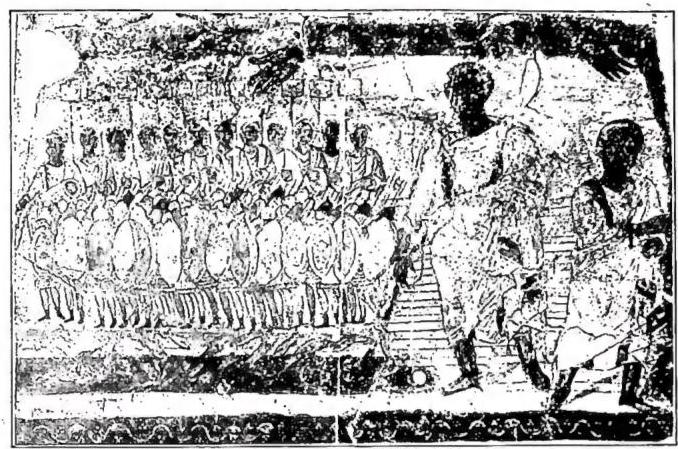
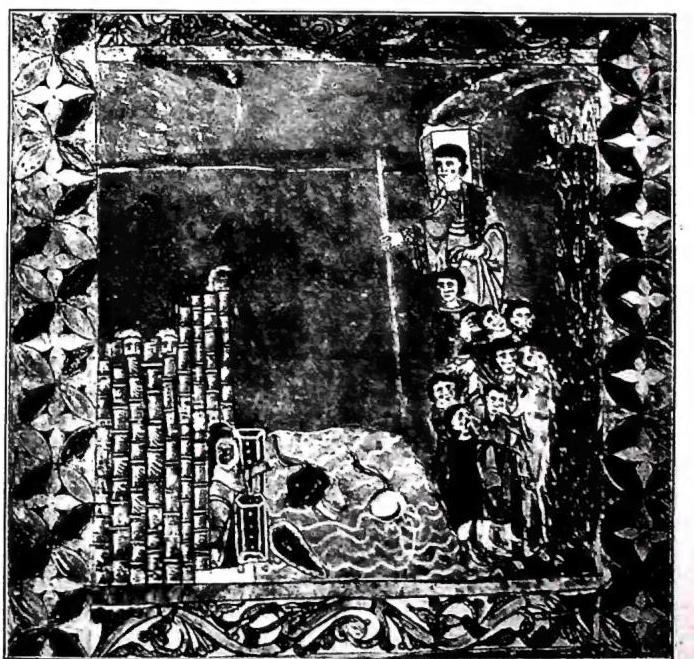
Christian art depicted the scene of the crossing of the Red Sea (Ex. 14:21-36; 15:1-6) in the 4th century, on the front of certain sarcophagi: there, for the most part, from a great door on the left come horsemen and foot soldiers, preceded by Pharaoh on his chariot, in the act of pursuing the Hebrews. Beneath the horses, two or three symbolic figures represent Egypt, the earth, the Red Sea. There follows the moment of the clash: men and horses struggle in the waves, drowning. On the right is the group of the Hebrews, freed together with Moses, a beardless youth, who strikes the sea with his rod, contrary to the scriptural text, according to which the prophet had opened the sea with the rod and, stretching out his hand, at God's command, made it fall back upon the Egyptians. Of the Hebrews, some observe the destruction of the enemy, others are on the march, holding children either by the hand or on their shoulders; others carry in their folded cloak the unleavened kneaded dough. The company is preceded by the sister of Moses, who plays the small drum and follows the column of fire, represented by a twisted column with a Corinthian capital, with a burning brazier on top.
Thus on a sarcophagus lid, discovered in S. Lorenzo al Verano, belonging to a certain Gorgonius (end of the 4th century). Of the other representations of the crossing on sarcophagi, seven are Roman, thirteen Gallic. The famous sarcophagi are the Lateran no. III, those of the Museums of Split, of Arles, of Bellegarde, of Avignon and of the church of St. Trophimus in Arles, used as an altar frontal.
Other reproductions of the scene are found in a panel of the door of S. Sabina and in one of the mosaics of the basilica of S. Maria Maggiore (5th century), in which the Hebrew people, together with Moses, witness the drowning of the Egyptians.
Finally, the crossing of the Red Sea is frequently found depicted in miniatures, as, for example, in the codex of the homilies of St. Gregory of Nazianzus (end of the 9th century) and in a Psalter of the 10th century (H. Omont, Les miniatures des manuscrits grecs de la Bibliothèque nationale, Paris 1902, pls. 42 and 9); in Octateuchs of the 11th and 12th centuries, such as the Greek Vaticani nos. 746 and 747 (Wilpert, Mosaiken, p. 455), etc.
In this scene G. Wilpert held that the invocation was symbolized: "free the soul of your servant as you freed Moses from the hands of Pharaoh"; E. Becker sees instead an allusion to the battle of the Milvian Bridge with the defeat of Maxentius; F. I. Dölger a symbol of Baptism, according to St. Paul (1 Cor. 10:2).
BIBL.: sources