
SPALATO (SPLIT), DIOCESI of. — City and diocese of Croatia (Yugoslavia). The diocese has an area of 3,668 sq. km., with a population of 306,340, of whom 285,400 are Catholics; it is divided into 7 deaneries comprising 146 parishes and 6 independent chaplaincies served by 153 diocesan priests and 94 religious priests; it has one seminary, 14 male and 31 female religious communities (Ann. Pont. 1952, p. 385).
S. arose, Salona (v.), not far from it, and the beginnings of S. are to be sought in the municipal life that developed within the perimeter of Diocletian’s Palace, which, after the Emperor’s death, became public property and was inhabited by a population coming largely from nearby Salona. The dethroned Emperor Julius Nepos lived within its walls. Some of the refugees from S. took refuge by crossing into the nearby
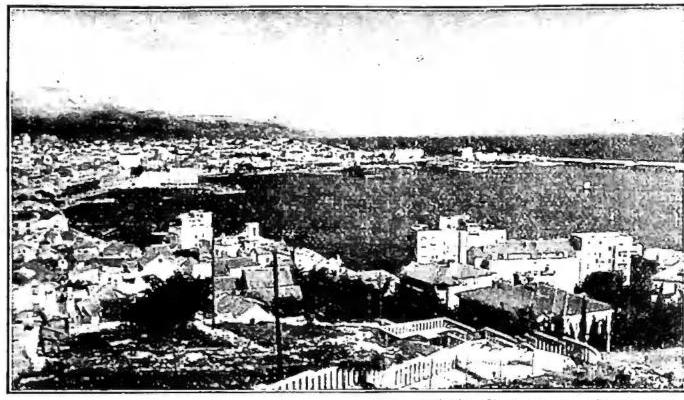
At this period S. formed part of the Byzantine theme of Dalmatia. The Byzantine city, whose population was likewise Roman, or Romanized Illyrian, was surrounded by the Croatian population, which in Dalmatia, over the course of the following two centuries, had organized a strong independent state. Thus, a beneficial process of assimilation soon began between the population of the Byzantine city and the Slavic population of the adjacent territories, resulting in the gradual but constant transformation of the city’s ethnic composition. Once the Byzantine cities of Dalmatia had been incorporated into Croatian territory, S. too became part of the Croatian state in the 10th and 11th centuries (with an interruption in the first half of the 11th century, when it was taken over by Doge Pietro II Orseolo). During this period S. enjoyed an autonomy similar to that of the cities of Roman Dalmatia and was presided over by a prior.
With the extinction of the Trpimirovići dynasty and the death of the last Croatian king, Zvonimir, after bitter struggles with Hungarian invaders that ended in negotiations (the so-called Pacta conventa of 1102), the Croatian throne passed to the kings of Hungary in personal union. S. then recognized the authority of the kings of Hungary and Croatia, while continuing to enjoy complete autonomy in its municipal organization, which took the form of the now-classical medieval Dalmatian communities. This was the period of the city’s greatest prosperity with regard to economic life (the small silver coins minted at S., commonly called “spalatini,” deserve mention), art, building activity, and so forth. In 1420 S., together with another part of the Dalmatian territory, passed under Venice and remained there until the fall of the Republic in 1797, governed by a Venetian nobleman. Many Venetian families then settled in S. and its surroundings, and to them the embellishment of the city, by then extended beyond the Palace, is owed. An entire series of palaces in the flourishing Gothic style, still largely preserved today, adorned the streets and squares of the old and new parts of the city. Under the Treaty of Campoformio (1797), S. was occupied by Austria; in 1806 Napoleon first incorporated it into the Kingdom of Italy (1806–1809), and afterward into the
Illyrian Provinces (1809–1813). A second Austrian occupation ended approximately a full century later (1813–1918); the city then became part of the new state of the Southern Slavs (Yugoslavia).
The Church of S. is the heir of Salona, which, before the destruction of that city, was the metropolitan see for all Dalmatia. Organized by Giovanni da Ravenna, who was the first archbishop of S., during the 7th century, it inherited and maintained primacy among the other dioceses of Dalmatia until 1828, when, by the bull of Leo XII Locum Beati Petri, it became a simple suffragan diocese of Zara.
The Church of S. must have played a considerable role in the conversion of the Slavic population of Dalmatia, thanks to its relations with the early princes. After the two Councils held at S. (in 925 and 928), whose agenda concerned the question of primacy over Croatian territory, in competition with the Croatian bishop of Nona,
the archbishop of S. secured metropolitan jurisdiction and began to call himself Primas Dalmatiae et Croatiae. The territory dependent upon the archdiocese of S. gradually diminished with the creation of several new dioceses (Antivari and Ragusa, in the 11th century) and the establishment of other archdioceses (Zara), under whose jurisdiction certain suffragans of the archbishop of S. (Veglia, Ossero, and Arbe) passed. Finally, the creation of a new diocese at Lesina (in 1147) further reduced the diocese of S. itself, through the loss of the two Dalmatian islands, Lesina and Brazza. A further reduction took place during the Turkish incursions into Dalmatian territory; when these ceased, S. regained the territories it had lost.
By means of the aforementioned bull of 1828, the diocese of Traù was suppressed, most of whose territory was annexed to the diocese of S. The diocese of Macarca, however, was, on the basis of the same bull, joined to the diocese of S., so that from that time the bishop of S. was also bishop of Macarca (episcopus Spalatensis et Macarensis, olim Salonitanni).
The mausoleum of Diocletian (v. SALONA), converted into a Christian church as early as the 7th century, immediately after the organization of the Church of S., is today the Cathedral dedicated to the Blessed Virgin Assumed into Heaven. The patron of the diocese and city of S. is St. Doimus, bishop and martyr, whose feast falls on 7 March. The most important churches and convents of the city of S. are: the church and convent of S. Francesco alla marina (whose foundation tradition attributes to the Saint himself), the church of Madonna delle Grazie at Paludi, with the Franciscan convent, the church of Madonna della Salute, with the Franciscan convent (parish church), the church of Madonna del Carmine, with the Capuchin convent (parish church), the church of S. Domenico, with the Dominican convent, and the church of S. Croce (parish church); as well as other churches of great historical and artistic interest. Finally, the Episcopal Seminary and the theological seminary complete the series of ecclesiastical institutions in the city.
Among the most important and renowned archbishops of S. are: Giovanni da Ravenna, organizer of the Church of S.; Lorenzo il Dalmata, friend and trusted confidant of the Croatian king Zvonimir (11th century); Lorenzo Zane, nephew of Pope Eugene IV and titular patriarch of Antioch; Marcantonio de Dominis, physicist, later a heretic (17th century); Stefano Cupilli, whom Innocent XII called “another St. Francis de Sales”; and P. Bizza, a well-known collaborator of Riceputi (Illyricum sacrum).
The most notable artists of S. are: the sculptor A. Buvina, author of the doors of the Duomo; T. Arcidiacono, a medieval chronicler and author of the Historia Salonitana (13th century); and Marco Marulić (Marulo), humanist philosopher and poet. Many Dalmatian and foreign artists worked in S., leaving vivid traces of their activity.
S. possesses numerous monuments and works of art from various periods and styles, in addition to Diocletian’s Palace, the first
fra tutti l'imponente campanile romanico. S. ha moltissime istituzioni scientifiche e culturali, come l'Istituto di oceanografia, l'Alta Scuola per gli insegnanti di scuole medie, vari musei (archeologico, delle antichità croate, etnografico, civico, della Marina, di storia naturale), e gallerie (d'arte, di Meštrović, del Tesoro del Duomo). Importantissimo è il Museo archeologico, fondato nel 1821, contenente i monumenti e il materiale proveniente dagli scavi di Salona. A S. nel 1894 fu tenuto il I Congresso internazionale di archeologia cristiana. - Vedi tav. LXXIII.