
ZARA (ZADAR), ARCHDIOCESE OF. — A city and archdiocese of northern Dalmatia in Croatia (Yugoslavia). It covers 2,989 sq. km., with a population of 130,480, of whom 125,480 are Catholics distributed in 100 parishes served by 70 diocesan priests and 25 regular clergy (Ann. Pont. 1953, p. 462). The patrons of the diocese are St. Anastasia the Martyr and St. Simeon the Prophet; the patron of the city is St. Grisogono.
The Illyrian and Greek Iádora, the Byzantine tà Diádora, and the Latin Inder or Indero (Italian Zara, Croatian Zadar), is mentioned as early as 384 BC. Built on a rectangular peninsula (later cut off from the mainland, with which it was later connected by a bridge), it faces the Zara Channel, “the Adriatic’s garden.” After the fall of Salona (c. 614), it became the capital of Dalmatia and remained so until 1918. At the end of the 5th century, Zara came under Gothic rule and, around 540, under Byzantine rule; in the 8th century, Zara became the capital of the Byzantine Theme of Dalmatia and the seat of the imperial strategos. During the Byzantine–Frankish conflicts, Zara sought to preserve its autonomy. The Doge of Venice and the Bishop of Zara, Donatus, went to Constantinople as intermediaries for peace between Charlemagne and the Byzantine Emperor Nicephorus. Shortly afterward, Donatus, together with the imperial strategos Paul, was sent to Charlemagne at Thionville. Through Bishop Donatus, Zara received from Emperor Nicephorus the relics of St. Anastasia the Martyr of Sirmium. With the Peace of Aachen (812), Zara was recognized as belonging to Byzantium.
In the 10th century, Zara was under the Croatian rulers who controlled Dalmatia, and in 1000 it submitted to Venice, though by 1204 it had established its autonomy. Subsequently, it changed hands repeatedly until, in 1105 (not 1107), it was taken by the Hungarian-Croatian King Coloman. During the Fifth Crusade, Zara was captured in 1202 by the Crusaders on behalf of Venice, which incurred the interdict of Pope Innocent III for this act. After prolonged disputes between Venice and the Hungarian-Croatian rulers, the Peace of Zara (1358), concluded between King Louis the Great of Hungary and Venice, saw the latter renounce the city and all of Dalmatia in favor of the former; however, in 1409, Zara returned once more to Venetian rule and remained under Venice until 12 May 1797. During the wars against the Turks (16th–17th centuries), Zara was completely cut off from its hinterland, and Venice sought to hold it despite all difficulties due to its great strategic and commercial importance.
From 1797 to 1918, Zara was under Austrian rule, except for the brief period of French domination from 1805 to 1813. From 1815 to 1918, the regional Dalmatian government and, from 1848, the Dalmatian Diet had their seat there. The Treaty of Rapallo (12 November 1920) assigned Zara to Italy, while the Treaty of Paris (10 November 1947) assigned it to Yugoslavia.
From the relatively democratic system under Byzantium and the Croatian rulers, Zara in the 12th–13th centuries, under Venetian influence, transitioned to an aristocratic system in which the count, regularly appointed by Venice, wielded supreme authority. Meanwhile, the bourgeoisie developed its own “universitas” as a counterbalance to the “communitas” of the nobles.
Within the territory of the present archdiocese of Zara, there was once also the diocese of Zaravecchia (Biograd), where in 1059 the ancient see of Scardona had been transferred. In 1125, Zaravecchia was destroyed by the Venetians, and the see was moved to Scardona, while part of the diocese, especially the islands, passed to Zara. The territory Nona (v.) or Nin, established in the 9th century and a suffragan of the Patriarch of Aquileia, is now part of the diocese of Zara. The Bishop of Nona bore the title of “episcopus Chroatorum” or “regalis episcopus.” The 10th-century Bishop Gregory of Nona is known for the controversy surrounding the Old Slavonic liturgical language and the dispute with the Archbishop of Spalato over jurisdiction. The diocese was definitively suppressed and annexed to the archdiocese of Zara on 30 June 1828, when the bull Locum beati Petri established a new ecclesiastical division of Dalmatia, whereby the Archbishop of Zara became metropolitan of all Dalmatia, while the archdioceses of Spalato and Ragusa became simple dioceses. After Zara’s annexation to Italy (1920), from 1922 the part of the diocese remaining under Yugoslavia was entrusted to the Bishop of Sebenico as Apostolic Administrator. The metropolitan see was abolished on 22 August 1932. After the Second World War, the territory of the archdiocese was reunited. To this day, it remains immediately subject to the Holy See.
Among the Archbishops of Zara, Ottaviano Garzadori (1624–39) stands out as Apostolic Visitor of Dalmatia in 1624–25. Archbishop Vincenzo Zmajević (1713–45) founded in 1727 the “Seminarium Zmajoillyricum,” which was only opened in 1748 by his successor, Matteo Karaman; in 1828, the seminary became regional for all Dalmatia. In a large part of the archdiocese, especially on the islands, the Old Slavonic language has been used in the liturgy since time immemorial.
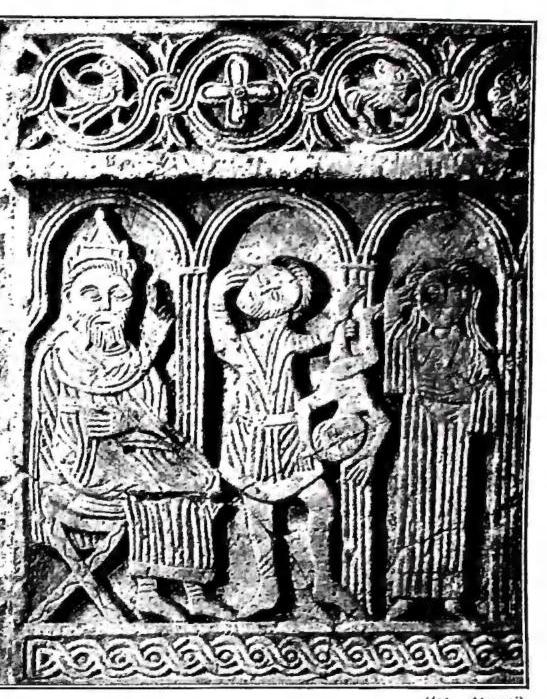
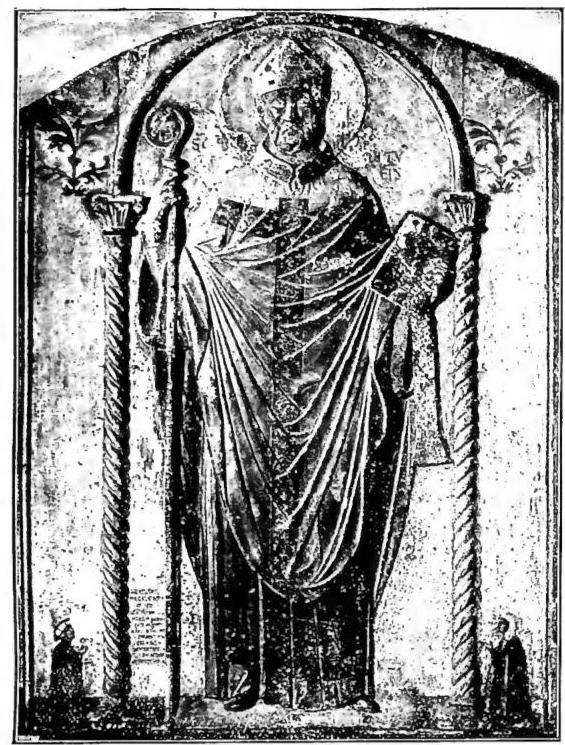
Zara is rich in monuments, though its ancient walls have disappeared and traces of Greco-Roman monuments are rather scarce. The most famous architectural monument of Zara, as well as of all Dalmatia, is the church of St. Donatus, built in the 9th century on the site of a Roman forum. Nearby stands the 12th-century cathedral, dedicated to St. Anastasia, which preserves the relics of the martyr brought from Sirmium by Bishop Donatus. Other notable monuments include the 13th-century church of St. Chrysogonus, the 11th-century pluteus with the Judgment of Solomon (now in the Zara Museum), and the 14th-century wooden relief of St. Donatus and two donors (now in Murano).
(photo Alinari)
ZARA, ARCHDIOCESE OF — The Judgment of Solomon. Detail of a pluteus (11th century) — Zara, Museum.
G. BONELLI
ma but the most famous architectural monument of Z. as well as of all northern Dalmatia for the early Middle Ages is the church of St Donatus, now transformed into a museum. Built on a circular plan, it was originally dedicated to the Most Holy Trinity. The date of its construction is uncertain, but tradition places it in the time of Bishop Donatus (early 9th century), and some (C. Iveković) even attribute it to the end of the 6th–beginning of the 7th century, with the baptistery near the cathedral of St Anastasia. Both buildings rank among the contemporary Byzantine-Ravennate structures. The Romanesque cathedral of St Anastasia, dating from the 13th century, stands on the same site as the ancient basilica of St Peter, destroyed by the Crusaders in 1202, and contains many paintings by various masters (6 works by Carpaccio). The relics of St Anastasia are preserved in a marble urn (early 9th century, or late 8th). In the Treasury, among other things, there is the reliquary casket of St Grisogono (1326). The basilica of St Grisogono (12th century), once a Benedictine abbey, is also in Romanesque style. The church of St Mary in the Benedictine nunnery (with its bell tower bearing the name of King Coloman in the year 1105) is a Renaissance construction. The monastery possesses a collection of ancient documents. In the church of St Simeon the Prophet the saint’s cypress-wood ark, covered in silver with decorations, is preserved. The church of St Francis of the Franciscans dates from the 13th century (later remodelled) and contains paintings by Carpaccio, Palma il Giovane, S. Ricci and others. Notable is the Byzantine cross dating at least from the 11th century. There are also preserved ten illuminated manuscripts from the 13th–15th centuries. Among the secular buildings of Z. many Venetian-style palaces are to be noted. The museum of St Donatus (founded in 1877) has a collection of Roman glassware found in Dalmatian tombs. The Paravia Library, now the Scientific Library, possesses numerous manuscripts. Many of the aforementioned artistic buildings were severely damaged or destroyed during the bombing in the Second World War.
Z. is the birthplace of many writers and artists, including Georgius Dalmaticus (known as Giorgio da Sebenico) and Pietro Zoranić. — Vedi tav. CLX.
ZARA (Heb. Zerah). — Names of various personages in the Old Testament.
1. A “Cushite” king who invaded Palestine in the time of King Asa (cf. v.), suffering a severe defeat near Mareshah (2 Chron 14:9–15).
In this account an army of a million soldiers with 300 war chariots is utterly routed; the number, if critically exact, must be taken in the sense of “a great multitude.”
Given the tone of the narrative and the fact that it appears only in the little-quoted Chronicler, not a few rationalists (beginning with Wellhausen, Stade, Maspero, etc.) deny the historicity of the event. Those who accept its historical reliability, guided by a certain onomastic affinity, think of an Osorkon or Serakon of the 22nd Egyptian dynasty. The silence of profane sources is explained by the scant knowledge of this dynasty (c. 930–730 BC), which was beset by Libyan and Ethiopian invasions and had Bubastis as its centre. In this case the term “Cushite” or “Ethiopian” is explained by a certain analogy with the Pharaoh Taharqa (cf. v.). Others, with greater likelihood, think of an adventurer at the head of Arab hordes coming from the shores of the Red Sea, i.e. from ancient Chus (cf. v.).
2. Grandson of Esau and son of Reuel (Gen 36:13, 17; 1 Chron 1:37).
3. Son of Judah who went down to Egypt with Jacob (Gen 38:3, 46:12; 1 Chron 2:4; 1 Chron 4:1, 7:17, 24).
4. Son of the patriarch Simeon (Num 26:13; 1 Chron 4:24).
5. A Levite, son of Addo and father of Iethrai (1 Chron 6:21).
6. Father of Jobab, an Edomite king descended from Esau (Gen 36:33).