
YUGOSLAVIA. - A state in southern Europe comprising the central and northwestern parts of the Balkan region, with the addition of more or less extensive strips of the neighboring Alpine, sub-Alpine, and Pannonian zones.
CONTENTS:
I. Geography
II. History
III. Legal Status of the Church
IV. Ecclesiastical Organization
V. Liturgy
VI. Literature
VII. Art
VIII. Educational System.I. GEOGRAPHY
The Federativna Narodna Republika Jugoslavija (F. N. R. J.) consists of 6 Republics, of which Serbia includes two autonomous provinces: Voivodina and Kosovo-Metohija. The official statistics of 15 March 1948 are as follows: | Federated Republics and Autonomous Regions | Area in km² | Population | Capital (and relative population in 1,000 inhabitants). | |
|---|---|---|---|---|---|
| absolute (in 1,000 inh. Jan. 1948) | relative (per sq. km) | ||||
| Serbia | 55903 | 4134 | 74 | Belgrade (388) | |
| Voivodina | 22302 | 1662 | 74 | Novi Sad (77) | |
| Kosovo-Metohija | 10561 | 727 | 69 | Priština (20) | |
| Croatia | 56485 | 3749 | 66 | Zagreb (290) | |
| Slovenia | 20445 | 1389 | 68 | Ljubljana (121) | |
| Bosnia-Herzegovina | 51348 | 2562 | 49 | Sarajevo (118) | |
| Macedonia | 36790 | 1152 | 32 | Skopje (91) | |
| Montenegro | 13967 | 377 | 27 | Titograd (12) | |
| F. N. R. J. | 267801 | 15752 | 61 |
Yugoslavia comprises territories highly diverse in physical, climatic, phytogeographic, and other characteristics, as well as in economic value: the rugged limestone massifs (karst) of Croatia, Bosnia, and Herzegovina contrast with the fertile plains along the Danube and its tributaries, just as the forested Alpine foothills have nothing in common with the basins of the Vardar and Morava rivers, where small basins alternate with narrow gorges; a distinct place within the country is occupied by the Adriatic coastline, fringed with islands, rich in ports, but separated from the interior by the high wall of the Dinaric Alps. More than four-fifths of the country is occupied by mountains and hills, where population density remains rather sparse; the rest consists of valley floors and lowlands, predominantly in the northern and northeastern sectors. Over three-quarters of the territory drains into the Danube; this continental character is also evident in the climate, which overall exhibits strong temperature variations, with winters becoming harsher, summers hotter, and precipitation less abundant as one approaches the Pannonian Basin. In this context, the coastal strip and Istria stand out from the rest of Yugoslavia for their more or less distinctly Mediterranean character.
The population, according to official statistics (15.8 million inhabitants), is highly heterogeneous: beyond the four fundamental Slavic groups—Serbs (41.5%), Croats (24%), Slovenes (9%), Macedonians (5.1%, ethnically Bulgarian)—the statistics also report two other Slavic groups, the Orthodox Montenegrins (2.7%) and the Muslims of Bosnia-Herzegovina (5.1%), the former ethnically Serbian, the latter Croatian. Minorities (12.6%) include: Albanians (4%), Hungarians (3.1%), Vlachs (in Serbia: 0.7%), Turks (0.6%), Italians (0.5%), Slovaks (0.5%), Roma (0.5%), Romanians (in Voivodina: 0.4%), Bulgarians (0.4%), Germans (0.4%), Czechs (0.2%), Ukrainians (0.2%), Russians (0.1%), Jews (0.04%), Poles (0.03%), etc. The proportion of non-native populations decreased after 1945, particularly due to the mass expulsion of Germans, but increased with regard to Italians following the annexation of Istria by Yugoslavia. Of the cities, only five exceed 100,000 inhabitants (beyond those listed in the table, Subotica, with 113,000), and just seven others have more than 50,000 inhabitants.
Slightly less than one-third of Yugoslavia is covered by forests (Carniola, Styria, Slavonia, Dinaric Alps, Bosnia), converted to roughly the same extent into arable land (30.8%), and about one-quarter is covered by natural meadows and pastures. Agriculture, livestock breeding, and forestry are the predominant occupations of the population. The former yields cereals (more maize than wheat), potatoes, fruit (plums and apples), wine (Dalmatia), and products destined for industry (tobacco, sugar beet, hemp, hops, etc.), and the latter is no less varied, with sheep (6.4 million head), pigs (2.8 million), and cattle (2.5 million) prevailing. Forests (7.8 million hectares) represent another substantial source of income, supporting a range of flourishing industries (sawmills, paper mills, furniture factories, distilleries, etc.). Among mineral resources, coal, iron (Bosnia), and copper (Serbia) stand out, but petroleum (Croatia and Montenegro), lead, zinc, bauxite, manganese, etc., are also present. The hydroelectric potential is also considerable. Industry, still disproportionate to the country's potential, has made significant progress, especially in the metallurgical-mechanical sector; the most active branches are those processing food products. Communications (11,200 km of railways) also await a decisive boost, which would enhance the country's excellent position at the crossroads of the major north-south (Pannonia-Morava-Aegean) and east-west (Sava-Danube) routes.
II. HISTORY
Upon the fall of the Austro-Hungarian Empire, the Sabor (the Croatian Diet) dissolved, with the act of 29 October 1918, the historical relations and legal ties that until then had bound Croatia, Slavonia, and Dalmatia to Austria and Hungary, proclaiming over their respective territories the State of Slovenes, Croats, and Serbs. A group of politicians, the Narodno Vijeće, using a delegation from the Sabor that was not entirely constitutional or parliamentary, carried out the union of the new State with Serbia and Montenegro (1 December 1918) under the Karadjordjević dynasty.The new formation, named the Kingdom of Serbs, Croats, and Slovenes (S.H.S.), was later internationally recognized by the Treaty of Versailles, despite the protest sent by the Croatian people to the Peace Conference. The elaboration and promulgation of the Vidovdan Constitution (28 June 1921) failed to reconcile the initial Serbo-Croatian contrast, which instead worsened. Alongside the claims of the Macedonians and Montenegrins, the Croats, seeing the solemn commitments made by the Serbs (Declaration of Corfu of 20 July 1917) violated,
felt betrayed in their centuries-old religious and national aspirations and continued to reject the idea of state coexistence with the Serbs. The Slovenes, on the contrary, were less hostile to collaboration with the Serbs. The Croatian leader Stjepan Radić sought to bring the issue to its true ground, that is, before the League of Nations. The incomprehension of international circles pushed him in 1925 to attempt collaboration with Belgrade. On 20 June 1928, a Serbian deputy shot and killed two Croatian deputies in Parliament and wounded Radić, who later died (8 August). This was followed by the abrogation of the Constitution, the name of the State was changed to Yugoslavia, and King Alexander established a dictatorial regime (1929). After the King was assassinated in Marseille (9 October 1934), the regency was assumed by Prince Paul. In March 1941, following the coup d'état by General Simović, directed against the Tripartite Pact, the hereditary Prince Peter was proclaimed king. In April 1941, the collapse of the Yugoslav army before the Axis forces and the uprising of the Croats led to the political and legal disintegration of Yugoslavia. The artificial organism dissolved into its constituent elements. The Croats restored the Independent State of Croatia. After the Second World War, the leader of the Yugoslav Communist Party, J. Broz Tito, proclaimed on 29 November 1945 the Federal People's Republic of Yugoslavia (F.N.R.J.). Hostile currents to communism were partly suppressed during the partisan struggle, partly silenced after the end of the war. During 1948, the Yugoslav communist regime entered into a harsh conflict with the Cominform and the government of the U.S.S.R., which exerted strong pressure on Yugoslavia to reduce it to obedience. The clash between the U.S.S.R. and Yugoslavia pushed the latter to draw closer, in terms of foreign policy, to the Western powers, though without deviating, in terms of domestic policy, from the fundamental lines of all the communist regimes of Eastern Europe.
For the history prior to 1918, V. CROAZIA; MACEDONIA; MONTENEGRO; SERBIA; SLOVENIA.
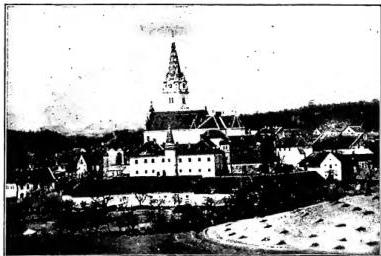

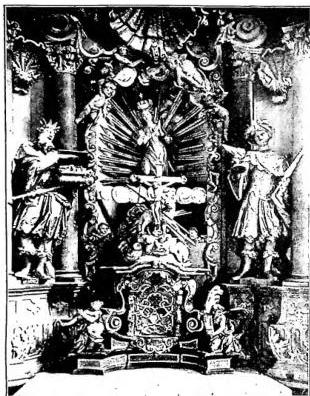
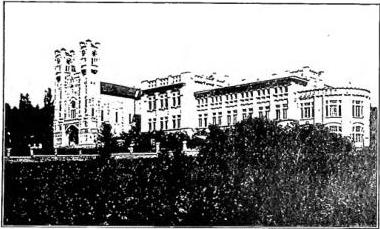
(courtesy of Fr. S. Sakač S.J.) JUGOSLAVIA - Croatian Sanctuary of Maria Bistrica.
In reality, the principle of religious freedom, affirmed in the article, must be understood in the context of other constitutional provisions that in various ways contradict it, and above all must be interpreted in light of the facts. These clearly prove that the regime of separation, proclaimed in the constitutional charter, has transformed, from the very beginning of the new Republic, into a regime of persecution.
The personal freedom of clergy and religious has been continuously threatened and violated. The trial and sentencing to forced labor of the Archbishop of Zagreb, Mons. A. Stepinac, in October 1946, were particularly notorious. But while he is the most illustrious victim, he is not the only one. The Bishop of Mostar, Mons. P. Čule, was also sentenced to prison. The Bishop of Ljubljana, Mons. Gr. Rožman, and the Archbishop of Sarajevo, Mons. G. Šarid, exiled from their homeland, cannot reach their sees. The Apostolic Administrator of Banja Luka, Mons. Čekada, was expelled from the territory of Bosnia-Herzegovina, where that episcopal see is located. The other bishops, now reduced to eight from the original nineteen, are systematically prevented from contacting the faithful. In the first months of 1950, the number of arrested priests exceeded 400.
Furthermore, government authorities interfere in the internal life of the Church, claiming, for example, the right to intervene in the appointment of bishops and the provision of all ecclesiastical offices. In many dioceses, parish registers have been confiscated, and authorities refuse to issue certificates of baptism, marriage, etc., even when they are needed within the borders of the Republic. Most major and minor seminaries have been occupied or confiscated. The government has supported or even inspired secessionist movements among the clergy, such as the Secretariat for the Promotion of Slovenian Priests, adherents to the Liberation Front, whose official bulletin was condemned by the Holy See.
The condition of religious education is extremely grave. In state schools, religious instruction is formally abolished in upper classes and practically suppressed in lower ones. Between 1945 and 1947, all Catholic elementary and secondary schools were also suppressed. The situation of the Catholic press is serious, as all its printing presses have been confiscated.
As early as 20 September 1945, in a collective letter to the faithful, the bishops lamented, among other things, the forced expropriation of Church property without any compensation. The application of agrarian reform to ecclesiastical properties in the years 1945-46, accompanied by the suppression of all government subsidies or municipal contributions, has impoverished parishes to the point of making it difficult to sustain priests and impossible to reconstruct churches damaged or destroyed during the war, or even to furnish them with the sacred furnishings that were looted or lost. Seminaries, insofar as they have not been suppressed, and episcopal tables have been reduced to extreme poverty. Enormous taxes are sometimes imposed on ecclesiastical buildings and properties, making payment impossible; hence the pretext for expelling priests and religious and confiscating the few remaining assets. The confiscation of religious houses has continued unabated over these years.
In regard to the very freedom of worship, it must be recalled that many churches have been closed or transformed into people's houses. In Herzegovina, Catholic inhabitants have been violently deported from their villages, where churches were destroyed, to be transferred to regions inhabited by heterodox populations, where no church exists and priests were not permitted to follow their faithful. Furthermore, due to the killing, imprisonment, and exile of many priests, the exercise of worship has become impossible in a large number of churches, especially in Croatia.
The sacrament of Matrimony does not escape anti-religious pressure. In the Yugoslav Federal Republic, civil marriage is compulsory, and only afterward is the religious rite permitted. It is not uncommon for the contracting parties, after civil marriage, to be pressured into forgoing the religious ceremony under insinuation and open threats that the regime could not trust those who insisted on the sacred rite. Other sacraments, such as Baptism and Confirmation, as well as assistance to the sick, are also targets of this campaign of intimidation.
The Yugoslav Federal Republic is the only nation among the Eastern European countries under communist rule that maintains diplomatic relations with the Holy See.
IV. ECCLESIASTICAL ORGANIZATION
The ecclesiastical organization of Yugoslavia comprises 21 dioceses, listed here according to the Annuario Pontificio of 1951:1. Immediately subject
Archdioceses: Antivari, Bar; Belgrade, Beograd; Zadar. Dioceses: Cattaro, Kotor; Fiume; Lavant, Maribor, Marburg; Lesina, Hvar; Ljubljana, Laibach; Ragusa, Dubrovnik; Scopia, Skopje, Üsküb; Sebenico, Šibenik; Spalato, Split; Macarsca, Makarska; Veglia, Krk.2. Metropolitan
a) Vrhbosna, Sarajevo, with the suffragan sees: Banjaluka, Mostar (with the united title of Duvno) and with the administration of the united sees of Marcana and Trebinje; b) Zagreb, Agram, with the suffragan sees: Crisio, Križevci, Körös, Kreutz (for Catholics of the Byzantine rite), Segna, Senj, Zengg, with the perpetual administration of Modruš, Sirmio, Srijem (with the united title of Bosnia, Đakovo, Djakovo).3. Bishoprics
Parenzo and Pola (united sees) is suffragan to Gorizia and Gradisca in Italy.4. Apostolic Administrations
Bačka; Yugoslav Banat.V. LITURGY
In Yugoslavia, several liturgical differences existed and still persist, concerning both the rites themselves and sacred languages. Beyond the Byzantine-Slavic rite—used, with ethnic and liturgical variants, by dissident "Orthodox" and Greek-Catholics—Roman Catholics, particularly Croats, also exhibit numerous originalities and liturgical varieties. The majority of Croats belong to the Roman-Latin rite, but since the time of SS. Cyril (d. 869) and Methodius (d. 885), the Roman-Slavic or Glagolitic rite also took root among them, spreading over the centuries with varying fortune and intensity almost everywhere Croat Catholics lived.In the Roman-Slavic rite, the ceremonies of the Roman rite are conducted in the Croatian recension of the Old Church Slavonic language, written in Glagolitic characters (v. SCRITTURA). Today, this rite is practiced in the dioceses of Segna and Veglia (except the Cathedral), in many parishes of the Dalmatian dioceses, and in the Croatian province of the Third Order Regular of St. Francis. In the final protocol of the Concordat with Yugoslavia of 25 July 1935, the Holy See confirmed the use of Glagolitic "within the scope and forms recognized by Popes Leo XIII and Pius X" and "did not oppose" the bishops' ability to permit its extension "in Slavic-language parishes... where this corresponds to the unanimous desire of the faithful." However, the Concordat was never ratified. Pius XI approved (9 March 1927) the new edition of the Roman-Slavic Missal in Latin characters; only in the canon is the old Glagolitic script also preserved. Glagolitic priests recite the Roman Breviary in Latin.
Regarding the Roman-Latin rite, the following particularities are noteworthy: 1) the diocese of Zagreb had, from its inception (1904) until 1800, its own rite, with interesting liturgical books; some remnants of the rite persist here and there; 2) ab immemorabili, in several Croatian dioceses, the Epistle and Gospel were chanted in Croatian during solemn Masses, and furthermore, a Croatian version of the Roman Ritual, translated by B. Kašić and published in 1640 by the Sacred Congregation de Propaganda Fide, was in use. Benedict XV (17 April 1921) permitted these two liturgical usages to be extended to all Croatian and Slovenian dioceses. The new official Croatian version of the Roman Ritual appeared in Zagreb (1929), and the Slovenian version in Ljubljana (1932).
VI. LITERATURE
5. Croatian Literature
From its very origins, Croatian civilization received a Christian imprint that shaped its entire national and political-cultural identity; consequently, literature, as part of its broader culture, reflects the deeply rooted religious sentiment of the people.The beginnings of literature among the Croats are linked to the activity of SS. Cyril and Methodius, who in the 9th century invented the Slavic script (Glagolitic) and conferred literary dignity upon an ancient Macedonian dialect, generally called Old Church Slavonic. The work of the Slavic apostles was continued among the South Slavs by their disciples after they were expelled from Moravia. Other contemporary influences, particularly for early Croatian literature, likely came from Macedonia through present-day Montenegro (the Croatian V. Jagić, a renowned Slavist [1838-1923], devoted particular attention to Cyrillo-Methodian questions, and his works are fundamental for these issues). The transition from Old Church Slavonic to the Croatian national language began to be felt as early as the 12th century; soon thereafter, various prayer manuals were translated into the pure vernacular. The Baška tablet (Baščanska ploča, ca. 1100) is perhaps the oldest monument of the Croatian national language.
Alongside this translation activity, the first anonymous Croatian versifiers appeared.
It should be noted that Croatian literature until the literary revival was written in three dialects: Čakavian, Kajkavian, and Štokavian (the three Croatian dialects are characterized by the interrogative pronoun "what" — ča, kaj, and što), and thus had a regional character (Croatian littoral with Istria, Dalmatia, Ragusa, Bosnia, Slavonia, northern Croatia). Religious poetry, written primarily in the Čakavian dialect and in Latin characters, connects to the Dalmatian-Ragusan period of Croatian literature and later to that of other regions. Three factors were particularly decisive for its development: the legacy of Croatian-Glagolitic literature, folk poetry, and foreign influences, predominantly Italian and classical. One of the most interesting figures of this period is Marko Marulić of Split (1450-1524), philosopher, poet, theologian, painter, and historian—a typical representative of authentic Christian universalism. His Judith marks the birth of artistic Croatian literature; it is an epic work of heroic-religious character, inspired by the defense of the Christian world against the Turks. Furthermore, under the name Marcus Marullus, he wrote several works in Latin, with which he transcended the modest boundaries of his homeland: the poet’s greatest effort was directed toward teaching Christian virtues.
While the poets of the 16th century approached the joys of worldly life in their pastoral compositions (P. Zoranić, The Mountains; P. Hektorović, Fishing), poems (N. Nalješković), and dramas (M. Držić, Uncle Maroje; A. Lučić, The Slave), they not only tempered their somewhat frivolous conception of life with patriotic and social consciousness but, overcoming their amorous disappointments, ultimately spiritualized their poetry by turning to divine infinite goodness.
The most notable writer of this period is the Benedictine Mavro Vetranović (1482-1576), who in ecclesiastical dramas, religious poems, and especially in the poem Pilgrim addressed didactic-moral themes, allegorically explaining Christian truths and the mysteries of faith.
The subjects most frequently treated in Croatian literature during the Catholic Restoration were the vanity of earthly life and the process the sinner must undergo to regain lost grace. Particularly suitable examples for such themes were the Prodigal Son from the Bible (M. Magdalenić), the Penitent Magdalene (S. Djordjić), the penitential psalms (S. Budinić), the Four Last Things (G. Jurjević), and Christian virtues in general (Kavanjin and others). Other poets of this era intensified the work of nationalizing consciousness, language, and literature (B. Kašić, a Jesuit and author of the first Croatian grammar [1604]; J. Mikalja) and preached Crusades against the Turks (Vl. Menčetić, P. Zrinjski). However, the Catholic Restoration, alongside the program outlined by the Council of Trent—aiming to imprint a Christian vision on all public and private life—had also imposed upon the Croats the difficult task of bringing the Orthodox Balkans and, if possible, all of Russian Orthodoxy closer to the Roman Church, thereby uniting all Slavs into a single Catholic family. Thus arose an abundant literature addressing the Eastern Question (J. Križanić, A. Kanižić). Yet the figure who best embodied this period is Ivan Gundulić (1588-1638 of Ragusa), the greatest poet of old Croatian literature. He composed works of profound religious inspiration, pervaded by the sentiment of the nullity of worldly joys (Lament of the Prodigal Son), the vanity of earthly glory, and the struggle against the Turks (Osman), surpassing all his predecessors and contemporaries with his spontaneous inspiration and vigorous dedication, enlivened by the dynamism of sincere sentiment. In this noble endeavor, the Franciscans of Bosnia, Slavonia, and Dalmatia (S. Matijević, P. Posilović, L. Ibršimović, I. Bandulović, I. Ančić) particularly distinguished themselves as writers of Christian edification works. Among them, Fra Matija Divković (1563-1631) holds first place, with his popular tales of didactic-religious character, written in the pure vernacular, aimed at keeping alive the faith of the ancestors during the painful period of Turkish slavery. Fra Andrija Kašić-Miošić (1704-1760), poet and philosopher, in his successful collection of popular-style poems, sought to create a golden legend of the heroism of the Slavic peoples (primarily the Croats) in their centuries-long struggle against the Crescent.
The literary and political-cultural revival of Croatia, already promoted by P. R. Vitezović, historian and poet (1652-1713), and accomplished in the first half of the 19th century through the work of T. Brezovački, P. Štos, I. Derkos, J. Drašković, and L. Gaj, aimed to merge the various provincial literatures and establish the national unity of all Croatian ethnic regions (Bosnia, Herzegovina, Croatia, Dalmatia, and Slavonia, Baška), thus laying the foundations of modern and contemporary Croatian artistic literature. This was a movement consistent with Christian principles. The poet who best interpreted this organic program for achieving a vigorous spiritual community of his people was Ivan Mažuranić (1814-90), author of the epic poem The Death of Smail-aga Čengić, a true jewel of Croatian literature. The poem is entirely permeated by the most vivid religious sentiment: its author saw in Christianity the solution to metaphysical, moral, and social problems. Among Mažuranić’s great contemporaries (D. Demetar, A. Nemčić, S. Vraz, M. Bogović, L. Botić, G. Martić), P. Preradović excelled for the depth of his thought and feeling and the plasticity of his style. In the poem The First Men, he expressed his philosophical-religious ideas, and in his other poems, he developed his patriotism into Pan-Slavism, ultimately arriving—according to his optimistic vision—at universal Christian brotherhood. The creator of the Croatian historical novel, A. Šenoa (1838-81), though he sometimes replaced pure Christian belief with romantic imagination, remained nonetheless faithful to the traditional faith of his ancestors, enthusing over idealized figures of priests and exalting religion as the guardian of truth and humanitarian spirit.
After Šenoa’s death, a pleiad of notable Croatian realists followed, offering a varied and interesting panorama of their homeland: Ka. S. Gjalski, called the Croatian Turgenev, described the petty nobility of his native province; E. Kuničić and V. Novak, realists and romantics at the same time, narrated the struggles between the morally pure local civil life of the homeland and the dangerous spread of political passions and anti-national germs; J. Kozarac, a keen observer, was concerned with the moral torpor of wealthy and fertile Slavonia; A. Kovačić and J. Leskovar depicted the life of urban and rural bourgeois classes. Among Muslim writers, Safvet beg Basagić and Edhem Mulabdić stood out. At the end of the 19th century emerged the rebellious figure of S. S. Kranjčević (1865-1908): this restless poet of universal sorrow, who opened the way "beyond good and evil," was nevertheless in some way a Christian spirit. After the poetry of freedom by Harambašić, the artistry of Matoš and Vidrić, the dramas and novels of Ogrizović, Begović, Vojnović, Šimunović, Krleža, and Cesarec—characterized by religious indifference as well as ardent nationalism (or socialism)—the bishop A. Mahnić, literary critics Lj. Maraković and P. Grgec asserted themselves in the first decades of the 20th century to stem the anti-religious currents, founding journals (Hrvatska Straža, Lečić, Hrvatska Prosvjeta) and mobilizing numerous young Croatian writers with the aim of strengthening the Catholic spirit in all spheres of national life. Gjuro Arnold, who in the struggle between the "moderns" and the "conservatives" openly declared himself for a Christian culture, was a poet distinguished by the spontaneity of his affective lyricism. To the same group belonged the priest J. Hranilović, a poet of simple and sincere sentiments, to which corresponded a clear versification. A convert, Marin Sabić, though he emerged from Kranjčević’s school, later turned to mysticism: his sincerity is moving, especially when he sings of quiet family life. Religious and patriotic sentiments are at the center of the poetry of the Croatian bishop I. E. Šarić, who drew inspiration from biblical, classical, and popular motifs. The greatest representative of contemporary Croatian poetry, Vladimir Nazor (1876-1949), a highly prolific and versatile poet, in opposition to "decadence" in literature, exalted the healthy energies of his ancestors (Slavic Legends) and, after giving an aura to Croatian history (The Croatian Kings), turned to scrutinizing his own spiritual world, ultimately drawing inspiration from a clear Christian sentiment in the search for Franciscan humility. His political and literary collaboration with communism in the last years of his life (1942-49) can hardly be reconciled with the ideological conceptions upheld in his earlier works. In contrast to Nazor’s vital poetry, D. Domjanić is calmer, more cordial, and suggestive, writing in the sweet dialect of his native land delicate and musical poems expressing the pure and simple faith of his countrymen. Equal to Nazor in artistic qualities, a profound analyst, M. Cihlar Nehajev (1880-1931) expressed in the monumental psychological novel The Wolves a lofty word on the mission of Croatia. A writer of witty aphorisms and ingenious sketches is F. Mažuranić. The representative of the modern novel of Catholic inspiration was V. Deželić senior. Like Sienkiewicz, he sought to exalt the heroic and Christian past, also dedicating his activity to the Christian education of youth. He was followed by M. Kovačević, author of realistic novels of healthy vigor, and two literary critics inspired by Brunetière: C. Jakša and A. Petravić. Full of mystical ardor and superior to all his contemporaries, perfect in form and biblical in content, is the priest I. Poljak, to whom the expansive poet-priest M. Pavelić approaches, masterfully combining the mystical and patriotic elements. The impressionist current is represented by F. Galović, poet of fields and woods. Furthermore, G. Kostelnik, D. Dujmušić, B. Škarica, F. Rožić, A. Čičić, and P. Tvrtković are all poets of great significance in modern literature, but all are surpassed by Z. Šprajcer with the melancholic harmonies of his poems full of longing for celestial joys. Entirely melody is the poetry of L. Knežević, serene and sincere that of J. Benac and Fra Bono Zec. Of flowing verse and spontaneous inspiration are the songs of T. Alaupović, who, with Christian tolerance, invites Bosnian Croats of different religious confessions to concord. Delicate in body as in soul, Djuro Sudeta left extremely suggestive verses; he seraphically loved life and transformed the regret of having to leave it soon into the joyful vision of eternal youth.
Contemporary lyric poetry is characterized by intimate reflection and the primacy of the spiritual element (T. Ujević, Lj. Wiesner, A. B. Šimić, V. Majer, V. Vlaisavljević, O. Delorko, A. Bonifačić, D. Cesarić, G. Krklec, S. Trontl, D. Tadjianović, F. Alfirević, N. Šop, A. Kokić, C. Škarpa, I. Horvat, I. Lendić, V. Kos, and many others).
Contemporary Croatian prose seeks its expression in a clear and constructive vision of the world, analyzing the psychological dimension and the nation’s problems. As for drama, its development is linked to the founding of the National Theatre of Zagreb, whose organization and function owe much to S. Miletić and A. Šenoa. The most prominent names in the dramatic field are primarily I. Vojnović (Dubrovnik Trilogy), followed by M. Begović and M. Krleža; alongside them, M. Ogrizović (Hasanaginica), A. Muratbegović, and others should be mentioned. Modern Catholic-inspired short stories are represented by V. Violić, V. Blažinčić, L. Katić, A. Matasović, N. Subotić, J. Andrić, but above all by Fra E. Matić (pseud. Narcis Jenko), vigorous in conception, assured in conducting the action, and a master of style. Beautiful pages on the life of the poet and saint of Assisi have been left by the Franciscan soul of I. Kršnjavi, while V. Deželić junior takes as subjects of his novels the lives of Cyril and Methodius and St. Jerome, aiming to demonstrate the traditional attachment of Croats to the Christian civilization of Rome. In the modern Croatian novel, some women also stand out: J. Truhelka, who introduces an autobiographical note in her works dedicated to the Christian education of youth; Š. Jurkić, an excellent talent from Bosnia, who has captivated the female world with her novels and legends of exquisite beauty and delicacy, enlivened by a high conception of moral and Christian principles; S. Košutić, a sensitive soul of refined taste, who sees the highest purpose of personal activity in intimate recollection with God with particular grace; I. Brlić Mažuranić, who has left the best children’s stories in all of Croatian literature. The realistic and psychological short story is cultivated by A. Nametak, V. Kaleb, L. Perković, and the novel by A. Bonifačić, Z. Remeta, M. Švel, E. Čolaković, S. Kolar, A. Nizeteo. But Mile Budak (1889-1945) surpasses all contemporary prose writers in his elemental creative force, linguistic richness, and his contemplation of human existence within the perspective of eternal light.
The literary life of Croatia, after its 19th-century revival, is closely tied to national institutions: Matica Hrvatska (1842), Jugoslavenska Akademija (1867), Društvo sv. Jeronima (1868), Društvo Hrvatskih Književnika, and several others. The main literary journals include Hrvatska Kolo (review), Vienac, Savremenik, Hrvatska Prosvjeta, and Hrvatska Revija. Among the most notable critics and historians...
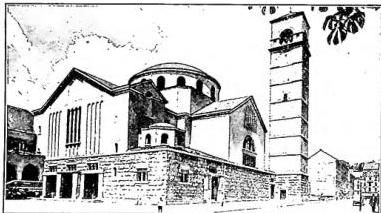
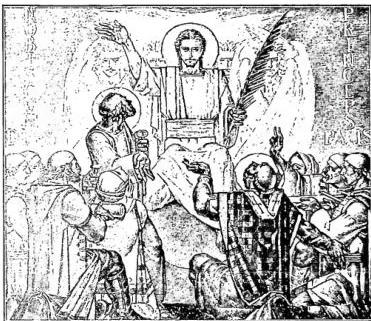
JUGOSLAVIA - Church of St. Blaise, architect Victor Kovačić - Zagreb.
The most notable literary critics and historians include: M. Reščar, B. Vodnik, F. Fancev, B. Livadić, M. Nehajev, M. Kombol, A. Haler, A. Barac, Lj. Moraković.
6. Serbian literature
While the Croats oriented themselves toward Western-Catholic culture, the Serbs adhered to Orthodox-Byzantine civilization; they adopted the Cyrillic alphabet as their national script and maintained the Old Slavonic language in literary production, which until the 18th century remained tied to the Church, so that literature became religious culture. Serbian literature begins with Sava Nemanjić (d. 1235), the founder of the autocephalous Serbian Church, who wrote a warm biography of his father Stefan. The religious and cultural life of Serbia in this period is generally an expression of the old Byzantine orthodoxy, and literary production is reduced to the imitation of Sava in the composition of arid biographies of national "saints," chronicles, translations, and transcriptions of sacred texts.Humanism and the Renaissance had no repercussions in Serbia and were ignored. Only the European Enlightenment, with the learned adventurer D. Obradović (1742-1811), marked a turning point in Serbian culture and literature; he wrote various works of intellectual edification and left a highly interesting autobiography full of humanity and evangelical love. However, Church Slavonic was still maintained in the poems of two good moralists, J. Vujić and L. Mušić, who considered literature a means of instruction. It was left to Vuk S. Karadžić (1787-1864), a brilliant autodidact and famous collector of folk poetry, to banish the old and consecrated (but by then incomprehensible) Slavonic language from literature and replace it with the living popular language; to consolidate it, he wrote a grammar, compiled a dictionary, and translated the New Testament into II. In the spirit of Vuk’s linguistic reform and the spirit of Romanticism, which fostered a particular Serbianism, P. P. Njegoš (d. 1851) composed his masterpiece and epic poem The Mountain Wreath, in which he magnificently described the "St. Bartholomew’s Night" of the Montenegrin Muslims. Less profound but more spontaneous and heartfelt is B. Radićević, who, a lyricist at heart and inspired by folk poetry, created enchanting goliardic poems, not without a dark melancholy. In the lyrical and patriotic poetry of G. Jakšić, the fiery nature and sensitivity of the poet are reflected. The most renowned lyricist of Serbian Romanticism is Z. J. Jovanović (1833-1904), a poet of delicate sensibility, deep intuition, and fluent expression, who particularly succeeded in expressing the joys and sorrows of family life; his poems for children are no less appreciated.
The leader of Serbian realism, J. Ignatović, is an ironic yet indifferent observer of life; his socially themed novels lack depth in analyzing spiritual conflicts. He is followed by K. Trifković, a writer of well-crafted humorous comedies, and M. Glišić, the creator of realistic short stories and a staunch defender of patriarchal morality. Both realist and Romantic, L. Lazarović left few novellas, but among the finest in Serbian literature; they are written in perfect form and colored with delicate lyricism. J. Veselinović also idealizes the healthy and honest rustic life. Through numerous short stories and a humorous novel, S. Matavulj describes the Montenegrin and Belgradian worlds. Among the Serbian realists who gaze with jealous enthusiasm upon the old forms of life consecrated by tradition, lashing out with biting irony and satire at new progressive ideas, is the greatest Serbian humorist, S. Sremac. S. Ranković, a realist and pessimist with a lofty conception of the psychological novel, describes provincial life without closing his eyes to the moral and social ills it contains. Without broad scope but serene and immediate, S. Čorović distinguished himself in his novellas as an excellent portraitist of national types and characters. M. Uskoković, of a sensitive nature and characterized by a typically Slavic sentimentalism, successfully treated characters drawn from the modern Serbian intellectual world. But the most original and representative narrator of Serbian realism is B. Stanković (1876-1927); born at the crossroads of the Greek, Turkish, and Slavic worlds, he managed to infuse his characters with all the defects and virtues arising from the intersection of these different racial elements, in a predominantly erotic tone. An excellent short story writer was also P. Kočić, who achieved particular success in political and social satires. I. Čipko, an enthusiast of primitive life and an admirer of wild nature, poetically describes the elemental forces of nature and man with lyrical intensity. B. Nušić tried his talent in the most varied literary genres but ultimately—and brilliantly—affirmed himself in comedy. The reformer of modern Serbian poetry, V. Ilić, enamored of classical beauties, introduced personal intimacy and formal elegance into his melodious poems, thereby freeing Serbian poetry from its excessive attachment to folk poetry. The Serbian nationalist A. Šantić became the most popular modern bard not only through his patriotic poems with social and Christian themes but especially as a poet of nostalgic harmonies for youth that passes, taking with it the optimism and idealism of life. Two Serbian poets who assimilated Western art, turning their backs on the predominant Russian influence, were J. Dušić and M. Rakić.
7. Croatian and Serbian folk poetry
The pride of Serbian and Croatian literature is its extremely rich epic and lyrical folk poetry. While many elements are shared, there is nevertheless a Croatian folk poetry (written in all three dialects) and a Serbian folk poetry. The first to inform European literary circles about it was Abbot Alberto Fortis in his Viaggio in Dalmazia (1774), who published the Croatian text and Italian translation of the beautiful ballad Hasanaginica (The Wife of Hasan-aga), of Croatian origin (Ikavian dialect group). A certain number were translated into Italian by N. Tommaseo in his anthology Canti toscani, corsi, greci, illirici (Venice 1841). Published in part in the 19th century, these songs immediately circulated the world; indeed, after the classical poems of antiquity, nothing so spontaneous had perhaps been seen. The candor of the popular lyrical poems finds only some analogy with certain passages of the Greek anthology. The general epic theme of the struggle against the Turks, however, did not give rise to a true and proper epic, ordered and complete, but to a series of detached songs celebrating individual moments of this centuries-long struggle, grouped according to their subject and principal characters into various cycles. Among the cycles of Serbian folk poetry, the most beautiful and widespread is that which deals with the Battle of Kosovo. The songs of the Kraljević Marko cycle are all of genuine and powerful inspiration, both wild and gentle. His actions are informed by the ideas and sentiments of his people, of whom he possesses to a high degree both vices and virtues. The songs that have as their subject the deeds of the ajduks are imbued with a mixture of humanity and violence, generous loyalty and daring deceits. This is the richest of all cycles; particularly distinguished are those poems that sing the romantic-heroic exploits of the Uskoks of Senj (Segna), then those dedicated to the famous warrior Mijat Tomić and to Sibinjanin Janko.The most complete collections are those of V. Karadžić, Srpske Narodne Pjesme, 9 vols., Belgrade 1891 ff.; and those published by Matica Hrvatska under the title Hrvatske Narodne Pjesme, 10 vols., Zagreb 1896 ff.
BIBL.:
Per la letteratura croata: M. Kombol, Povijest hrvatske književnosti do preporoda, Zagreb 1945; F. Fancev, Hrvatska književnost, Zagreb 1938; A. Barac, Hrvatska književnost, I-II, Zagreb 1952-54; V. CROAZIA.
Per la letteratura serba: J. Skerlić, Istorija nove srpske književnosti, 3a ed., Belgrado 1921; P. Popović, Pregled srpske književnosti, 3a ed., Belgrado 1931; V. SERBIA.
Per la poesia popolare: V. Karadžić, Srpske narodne pjesme, Belgrado 1891 sgg.; Matica Hrvatska, Hrvatske narodne pjesme, Zagabria 1896 sgg.; A. Fortis, Viaggio in Dalmazia, Venezia 1774; N. Tommaseo, Canti toscani, corsi, greci, illirici, Venezia 1841.
F. Šišić
9ª ed., Belgrado 1931: M. Desnović, Les influences italiennes sur l'ancienne littérature yougoslave du litoral adriatique, in Rev. litt. comparée, 1934; A. Cronia, Antologia serbo-croata, Milano 1934; L. Salvini, Poeti croati moderni, Zagabria 1942; S. Ježić, Hrvatska književnost od početka do danas (1900-1941), Zagabria 1944; M. Kombol, Povijest hrvatske književnosti do narodnog preporoda, Zagabria 1945; A. Cronia, Poesia popolare serbo-croata, Padova 1949; F. Trogrančić, Letteratura medievale degli Slavi meridionali, Roma 1950. Franjo Trogrančić
8. La letteratura slovena
La cultura degli Sloveni è strettamente connessa con la loro cristianiz-zazione. I primi missionari cristiani fra gli Sloveni furono tuttavia stranieri. I primi documenti scritti sloveni sono i cosiddetti Monumenti di Frisinga (971-1025 d. C.). Essi comprendono una formola generale di confessione che era recitata ad alta voce dal sacerdote durante la predica e che il popolo ripeteva, una predica sul peccato e sulla penitenza ed una formola di confessione generale pubblica.
In the 16th century, Luther’s Reformation reached the Slovenes as well. Protestants were not concerned with the development of the Slovenian language but rather with the spread of their religion.
Primož Trubar (1508-86), a disciple of the Bishop of Trieste, Pietro Bonomo, was the principal propagator of Protestantism among the Slovenes. In 1551, he published the first two Slovenian books: the Abecedarium and the Catechismus. The books were printed in Gothic script. In 1555, Trubar reprinted the two books in Latin script. His subsequent works were also of a religious nature.
Trubar aimed to provide the Slovenes with as many texts as possible, perhaps at the expense of their form. Greater attention to form was instead given by a writer of broader vision and greater sensitivity: Sebastian Krej (1538-67). In 1566, he published his Bible for Children. The following year, his Slovenian Postilla appeared, contributing significantly to the improvement of Slovenian orthography. Krej’s linguistic reforms were further developed in the most important work of the Protestant period: Dalmatin’s Bible. Jurij Dalmatin was born around 1547 and died in 1589. In 1576, he published his first work, Passion, to which he added a sermon translated from German and a poem on the Passion. In 1578, he completed the translation of Holy Scripture. The entire Bible, his most important work, was published in 1584.
From this period, the Slovenes have only one Catholic work: the Catholic Catechism, translated by Leonhard Pachernecker. The book was printed in Graz in 1574.
Despite the intense cultural activity of the Protestants, Catholicism was too deeply rooted among the people to be eradicated. A notable figure in the Slovenian Catholic sphere was the Bishop of Ljubljana, Tomaž Hren (1560-1630). The Jesuit Janez Čandik composed the book Gospels and Epistles, published in 1613. Janez Svetokrižki (Johannes a Sancta Cruce, 1645-1714) was a learned and renowned preacher, drawing large crowds. Finally, in the first half of the 18th century, numerous Slovenian priests dedicated themselves to literary activity.
The end of the 18th century, with its revolutionary events, revitalized Slovenian literary life.
The monk Fr. Marko Pohlin (1735-1801) is noteworthy for his intense literary activity. Among his religious works, the Prayer Book and Lenten Gospels are remembered. Pohlin is also important for his grammatical works. He laid the foundations for secular Slovenian poetry. His monastic companion, Fr. Janez Damascen (born Feliks Dev, 1732-86), is also remembered.
The literary work of the Jesuit Ožbalt Gutsman (1727-90) is notable for his grammatical activity and his sermons. This period also saw the emergence of the first Slovenian playwright, Anton Tomaž Linhart (1756-95), who wrote the comedy The Happy Day or Matiček Gets Married, inspired by Beaumarchais but filled with typical scenes of Slovenian rural life.
Omitting other names, the first poet of the Slovenian Renaissance, the Franciscan Fr. Valentin Vodnik (1758-1819), a valuable publicist, is remembered. The Happy Craguolian, Rebirth of My Countrymen, My Monument, and others are among his most notable poems. Historically important are the poems Illyria Reborn and Illyria Redeemed.
In the 19th century, the Slovenes increasingly aligned with European culture. Within the climate of Romanticism, the first truly European poet, Francè Prešeren, emerged. Early Romantics were still primarily enthusiastic about scientific research. It is thus natural that a linguist, Jernej Kopitar (1780-1844), initially stood out. He studied law and devoted himself to Slavic studies in Vienna. His first work was a scientifically based grammar: Grammar of the Slavic Language in Carniola, Carinthia, and Styria, published in 1808 and 1809. His research in the field of Old Church Slavonic is also notable.
During this period, part of the Slovenes lived under French administration in so-called Illyria. It was then that the Slovenian language gained free expansion in primary and secondary schools. The other Slovenes lived under Austria, which, seeking to win their sympathies, established a chair of Slovenian at the Faculty of Letters of the University of Graz in 1811.
After a demanding series of grammars, dictionaries, and linguistic studies, the young generation, emerging in the climate of literary revival and early Romanticism, began to turn its interest increasingly toward poetry. In 1830, an anthology of poems titled Slovenian Bee was published. The anthology was republished in 1831, then again in 1832, 1834, and 1848. The editor and contributor of the anthology was Miha Kastelić (1796-1868), librarian of the Ljubljana Lyceum Library. Among the main contributors to Slovenian Bee was Matija Čop (1797-1835), well-versed in European literatures. However, the greatest figure of the anthology was the poet Francè Prešeren (b. 1800 in Vrba in Upper Carniola, d. 1849 in Kranj). An autobiographical tone is present in his love sonnets: Of Our Fathers, Upon the Sun, etc., which echo Petrarch’s sonnets. The disappointment and pain experienced by the poet in the years when he confronted the harsh realities of life found expression in his immortal sonnets of sorrow: longing for his beloved native village, fear of an uncertain future, the unequal struggle with adverse fate, and the desire for death. The second part of Prešeren’s work begins with the publication of The Garland of Sonnets in the Illyrisches Blatt in 1834. With The Garland of Sonnets, Slovenian poetry was enriched by a true masterpiece. In honor of his deceased friend Čop, the poet wrote The Baptism at the Savica. The work includes an introduction in terza rima (79 verses) and the rest in stanzas (424 verses), evoking the Christianization of the Slovenes. From unrequited love, the poet turns to his poetic mission (To the Poet). His other immortal poems include The Sailor, The Illegitimate Mother, etc.
Prešeren was too original and innovative a spirit to be fully understood by his contemporaries; however, subsequent generations of poets have drawn from his work to a greater or lesser extent.
What Prešeren accomplished for Slovenian poetry, his contemporary Anton Martin Slomšek (1800-62) achieved for Slovenian culture. In 1851, he founded the society Družba Sv. Mohorja; several of his poems are of popular inspiration.
The year 1848 is a very important date in Slovenian literary and political history. With the fall of Metternich’s absolutism, censorship was abolished. Many cultural associations emerged, and the technical-professional newspaper Agricultural and Artisan News was published. As the only existing Slovenian newspaper, News began to publish literary, linguistic, ethnological, and historical articles as well. Among its contributors were Jovan Vesel-Koseski (1798-1884), the priest Franc Svetličić (1814-81), Miroslav Vilhar (1818-71), and Luka Jeran (1818-96), a priest who sought to initiate a distinctly Catholic-oriented Slovenian literature.
BIBL.:
F. Kidrič, Zgodovina slovenskega slovstva, I, Ljubljana 1929; J. Glonar, Zgodovina slovenskega slovstva, Ljubljana 1936; F. Vodnik, Slovenska književnost, Ljubljana 1938; A. Slodnjak, Zgodovina slovenskega slovstva, Ljubljana 1958; V. anche SLOVENIA (letteratura).
A. L.
Still cited are L. Toman (1827-70), who sang of freedom, homeland, and God; Franc Cegnar (1826-91), who, among other works, translated Schiller’s dramas into Slovene; Matija Valjavec (1831-97), who wrote poetry under the strong influence of folk songs and composed some of the most beautiful Slovene legends and fables. Janez Trdina was a critic, storyteller, and collector of folkloric material. Anton Janežič (1828-69) was a man of letters who contributed significantly to the Slovene national awakening.
Meanwhile, the younger generation became increasingly demanding in its national and cultural claims, while the “elders” were instinctively more conservative and thus content to express their views in accordance with the maxim “everything for religion, for the homeland, and for the emperor.” In literature, the young rejected utilitarianism and didactic tone, demanding pure art and a severe, combative criticism in national matters. The leader of this youthful current in the literary world was Fran Levstik (1831-87), who established himself as a storyteller and, in a certain sense, became the head of Slovene literary life.
Levstik exerted great influence on the literary circle of the so-called “Vajevci.” Among them, Simon Jenko (1835-69) stands out; his love poetry is delicate, his patriotic poems full of sincerity; he is above all the poet of sorrow that rises to implore God’s help and consolation. His poetic collection concludes with an epic cycle (Treasure, Winter Evening, etc.). His poem Forward became the Slovene national anthem. Fran Erjavec (1834-87) is a keen observer of nature. Among his stories are The Terrible Ravine or the Woodcutter’s Adopted Son and All That Glitters Is Not Gold. Josip Stritar (1836-1923) is one of the most notable figures in Slovene literature, especially as a critic; he edited the first exclusively literary journal, Zvon (1870, 1876 to 1880). He educated the younger generation. As a writer, he oscillated between Romanticism and Realism. Among his stories is Mr. Mirodolski, a kind of Slovene Vicar of Wakefield transplanted to Slovene soil.
Josip Jurčić (1844-81) is the classic of the Slovene folk tale. His work An Evening Among Hunters for Dormice characterizes the Romantic-Realist tendency in Slovene literature. His stories later intertwined with historical motifs (The Castle of Rojinje, The Soldier of the Monastery, etc.). Also remembered are his novel The Tenth Brother and the drama Veronika of Desenice.
In the second half of the 19th century, the conflict between the young and old Slovene generations sharpened, and in a certain sense, two literary currents formed; yet there were points of intersection between them, as in the case of the priest and poet Simon Gregorčić (v.). The young writers founded the journal Ljubljanski Zvon (The Bell of Ljubljana) in 1881. Almost simultaneously, the journal Dom in Svet (Home and World, 1888-1945) began publication in Ljubljana, a newspaper intended for the people but which later began to compete with Ljubljanski Zvon. During this period, the activity of two publishing organizations was very intense: the Mohorjeva družba (Society of St. Hermagoras), founded by Bishop Martin Slomšek, and the Slovenska matica (Slovene Hive), with its excellent yearbooks of historical, philological, and cultural studies.
The successor to Janežič and Stritar as organizer of Slovene literary life was Frančišek Levec (1864-1916). Of Janko Kersnik (1852-97), his Sunday Letters, Lenten Reflections, The People of Luther, Death in the Countryside, The Two Councilors, etc., are remembered.
Ivan Tavčar (1851-1925), a liberal, was particularly drawn to the Lutheran period, which serves as the backdrop in his work Vita vitae meae (1882). He also found inspiration in his native environment. In the novel Dead Hearts, Tavčar describes contemporary society. The best—
Also worthy of mention is the poet and priest Anton Medved (1869-1910), an excellent lyric and dramatic writer. He belonged to the group of Catholic poets who collaborated on the literary journal Dom in svet. The same group included the priest Mihael Opeka (1871-1936). Many of his poems were inspired by his stay in Rome. Another figure to note is the priest J. E. Krek (1865-1917). His best stories are From the New Life and The Three Sisters.
Slovenian literature received a great impetus from the group known as the Slovenska moderna, whose leading figures are Ivan Cankar, Oton Župancič, Dragotin Kette, and Josip Murn-Aleksandrov. Cankar's (1876-1918) work marks the rise of Slovenian literature to a truly European level. The Slovenian language achieved remarkable expressive power through him. A writer concerned with modern social issues and opposed to all hypocrisy, he increasingly emancipated himself from narrow contentism and grew more attuned to national and religious values. From this point onward, it would be impossible to list all the notable names in Slovenian literature. O. Župancič, the greatest modern Slovenian poet, echoed in an original manner some themes common to early twentieth-century Western lyric poetry, deeply feeling the charm of youthful memories and the bitterness of life. D. Kette and J. Murn-Aleksandrov were two highly gifted lyric poets who died young. Among the most notable figures of modern Slovenian literature, many others include V. Molé, whose work reflects a return to classical taste; St. Majcen, a playwright, poet, and storyteller; the expressionist J. Lovrenčič; the prose writers I. Pregelj and F. Bevk; and Izidor Cankar, a critic of considerable merit. In M. Kranjec and T. Seliškar, a naturalistic, materialistic, and social orientation is evident. In the decades between the two world wars, the number of translations from foreign literatures increased significantly. The war years interrupted this promising cultural development. Under the new regime established in Yugoslavia, literature—like in other Eastern European countries—has been increasingly subjected to the pressures of the dominant ideology.
VII. ART
In the regions that form the Yugoslav state, artistic manifestations assumed very different aspects in the past depending on political events and geographical position.The very close relations that the art of the Dalmatian coast had with Italy, and particularly with Venice, have been treated separately (v. arte).
1. Croatian art. — The secular development of Croatian art can be followed and studied according to three main zones: Dalmatia, Bosnia and Herzegovina, and Pannonian Croatia between the Sava and Drava rivers.
From an artistic standpoint, Bosnia-Herzegovina was poorer in the past; however, numerous remains of Paleochristian basilicas (e.g., Zenica) are noteworthy, as are many funerary monuments, called steći or mramori, from the period preceding the Turkish occupation.
In Pannonian Croatia, after the arrival and Baptism of the Croats, art developed in various forms over several centuries under the influence of the Catholic West. Artistic monuments from before the Gothic period are scarce, mainly due to the political turmoil of the era and the continuous wars against the Ottoman invader. Romanesque remains and those from the period of ornamental tress decoration, characteristic of the Croatian dynasty era (9th–11th centuries), are found in various locations. No traces remain of the original cathedral of Zagreb (late 11th century), as they have completely disappeared. The Gothic period created several monuments of great value, including the Cistercian abbey of Topusko, the church of St. Mark in Zagreb (restored to its former splendor in 1937), and numerous other churches (Lepoglava, Remete, Crikvenica, etc.). The Renaissance passed without leaving lasting traces, and thus the Baroque succeeded the Gothic without transition. From this period are the church of St. Catherine in Zagreb (17th century) and many parish and conventual churches; noteworthy is that of Belec. Much later, Croatia also went through a period of unfortunate Neoclassicism, against which, among others, Bishop Strossmajer reacted by commissioning, after lengthy studies, the monumental cathedral of Đakovo, where he successfully fused Romanesque with Byzantine styles, symbolizing the union between the Catholic West and the Orthodox East. Also notable from this period is the cathedral of Sarajevo (architect Vancaš).
Among ancient paintings, the frescoes of the Zagreb cathedral (13th century) stand out, and among the more recent ones, those of the churches of Belec and Hrašćina (painters: L. Margrot, B. Bobić, and the most talented, J. Ranger). The transition from the old to the modern is represented by the painters V. Karas (d. 1858) and F. Quiquerez (d. 1893). They are followed by painters of value such as V. Bukovac (1855–1922), an excellent portraitist; C. Medović (1859–1920), known for his seascapes and historical and religious subjects; B. Čikoš (1864–1931), of academic manner; O. Iveković (d. 1932), with historical subjects; I. Tišov (d. 1924), with rustic motifs; M. Cl. Crnčić (d. 1930), a skilled landscape painter, as was F. Kovačević (d. 1929); and S. Raška (d. 1906). With more modern concepts and techniques, J. Račić (d. 1908) and M. Kraljević (d. 1913), both of whom died prematurely, later asserted themselves, and V. Bečić (1886–1950) may also be included.
Several contemporary Croatian painters have positively established themselves beyond the borders of their homeland, exhibiting successfully in various European capitals. The most eminent to be noted are: E. Vidović, J. Kljaković (whose splendid musicians adorn the northern façade of the Collegio di S. Girolamo in Rome), T. Kouman, M. Uzelac, Lj. Babić, K. Hegedušić, J. Miše, O. Mujadžić, and then the even younger artists with very modern orientations: Režek, Tiljak, Šimunović, Parać, Motika, Likan, Kopić, Crnobori, Plančić, Postružnik, Šimat, Dučmelić, etc.
In sculpture, after I. Rendić (1849–1932), the Nestor of modern Croatian sculpture, follow several sculptors of great stature, such as R. Frangeš-Mihanović, R. Valdec, I. Kerdić, T. Rosandić, F. Kršinić, A. Augustinčić, but above all stands the towering figure of Ivan Meštrović (b. 1883), a sculptor and architect of worldwide fame.
In the field of modern Croatian architecture, V. Kovačić is worthy of note, whose best work is the church of St. Blaise in Zagreb.
In Croatian music, the extremely rich musical folklore, carefully collected by various musicians (F. Kuhać, V. Žganec, B. Širola, I. Matečić), is first to be noted. Since 1827, Croatia has had its Conservatory in Zagreb, and since 1846, the Opera Theater. Since 1906, the journal of sacred music Sveta Cecilija has been published. Among the best Croatian musicians are: Lukačić (16th century), V. Lisinski (d. 1854), composer of the first Croatian opera Ljubav i zloba (Love and Malice), performed in Zagreb in 1846; F. Pintarić, I. Zajc, author of some of the most popular Croatian operas; Bersa, Odak, Lučić, J. Gotovac, author of the most renowned modern Croatian opera (Ero, The Skyfallen Bridegroom), performed in almost all capitals; K. Baranović, B. Papandopulo, K. Kolb, and others.
(courtesy of Fr. S. Sakac S. I.)
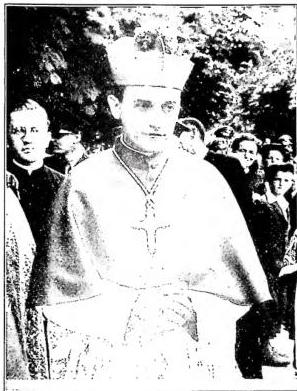
JUGOSLAVIA - H.E. Msgr. Luigi Stepinac, Archbishop of Zagreb.
The Gothic period is marked by monuments of great value, such as the church of the Minorites in Pruj (Petrovium), unfortunately destroyed today. From the same period, in various parts of Slovenia, artistic churches remain (Crngròb); however, the true development of Slovenian art occurs only during the Baroque, of which almost the entire city of Ljubljana, with its majestic cathedral, and many other churches and palaces, provides a magnificent example. During the Neoclassical period, a phase of decline is observed until the second half of the nineteenth century, when a revival in the artistic field in general is recorded. The most notable names of this period are: Fabiani, a follower of Viennese Secessionism; J. Plečnik, a distinguished architect and modern master, also appreciated abroad (restoration of the Hradčany in Prague).
In Slovenian painting and sculpture, too, a development is observed that moves from primitive forms toward increasingly artistic ones. Already in the second half of the fourteenth century, the Slovenian painter I. Akvila of Radgona was creating valuable religious paintings for the churches of his region. With the Baroque, Slovenian painting reached its full development, greatly contributed to by the famous Layer school of Kranj, with frescoes and canvases scattered throughout Slovenia. With the national awakening of the nineteenth century came an artistic revival as well, with more modern trends led by A. Ažbej (1862-1905) and R. Jakopič, the foremost exponent of Slovenian artistic activity in the twentieth century. Among modern artists, the best known are: Jama, I. Grohar, and a long line of young talents, including Š. Šantel, T. Kralj, B. Jakac, M. Maleš, the Vidmar brothers (N. and D.), Trstenjak, and others.
Sculpture kept pace with sacred architecture. Among the sculptors of recent decades, L. Gangl and I. Zajec are notable, as are many disciples of the Croatian Meštrović, such as Loboda, Gorše, Dolinar, the Kralj brothers, and T. Kos.
Slovenian music is also rich. Slovenian national songs are appreciated for their liveliness and warmth. The Slovenian composer J. Petelin (Gallus, sixteenth century) stands at the level of his contemporaries. For several decades, Ljubljana has also had an Opera Theatre with a highly regarded orchestra. Among musicians worth mentioning are Garbić, Hajdrich, Ipavec, Jenko, Aljaš, Hladnik, Hribar, and the priests Satner, Premrl, Kimovec, and others.
9. Serbian art
In Serbia (Rascia, Macedonia), the greatest artistic flourishing in the Middle Ages coincides with political power under the Nemanjić dynasty. The region, situated at the border of the Byzantine world, is dominated by that culture, not without Western influences filtering through the Dalmatian coast. The numerous monastic constructions that arose between the twelfth and fourteenth centuries show strong Eastern influences, especially in Macedonia, where the iconography of churches predominantly features the Byzantine cruciform type with five domes (church of Staro Nagoričino, 1312-13); these influences are less pronounced in Rascia, where the longitudinal plan is more frequent (monastery of Studenica, late twelfth century; church of Žiča, early thirteenth century; church of Gračanica, completed before 1321, modeled after the church of the Holy Apostles in Thessaloniki), and where Western forms prevail in the church of Visoki Dečani, built by a friar, Vito of Kotor, in 1327. However, these various influences are elaborated with particular characteristics: compactness of masses, despite iconographic complexities, and greater vertical thrust, due to the firm imposition of domes on square bases. Sculpture was entirely subordinate to architecture, limited to the decoration of ornamental bands with interlacing, animals, and human heads; here, too, Byzantine influences prevail in the area closest to Macedonia.Of exceptional importance are the documents of painting from this period, some of which, discovered about twenty-five years ago by Okunev, have shed new light on the knowledge of Byzantine-Slavic culture. The fresco cycles of the monasteries of Mileševo (1236) and Sopoćani (ca. 1250), with their lively impressionistic technique and dramatic animation of scenes, skillfully composed with a sure sense of space, connect to that neo-Hellenistic movement that already in the twelfth century spread from Macedonia (Nerez monastery) to central Russia (Vladimir). An increasing dramatic intensity is found in other fourteenth-century frescoes (at Gračanica, frescoes with illustrations of the liturgical calendar; at Staro Nagoričino, from 1317, where the signature of the Greek Eutychino appears; at Markov Manastir, where local artists translate those characteristics with popular fervor); while the older ones from the monasteries of Studenica and Žiča (twelfth century) instead reflect the traditional direction of the Comnenian era.
This splendid flourishing was cut short by the fall of Serbian independence in the Battle of Kosovo (1389), followed by the long Turkish domination. Painting, confined to monasteries, became a traditional craft; the architecture of the new rulers had no relation to local forms, though they engaged in intense construction activity and left in Macedonia (Skopje, minarets of Sultan Murat, 1430, and of Gazi-Isa-Beg, 1476) and Bosnia (Sarajevo, the so-called Bey Mosque, 1529) some of the most important Islamic monuments in Europe.
The first attempts at a rapprochement with European art in Serbia began in the north, in the Vojvodina region, at the end of the eighteenth century, and intensified in the nineteenth century alongside movements for political independence. Neoclassicism and Romanticism penetrated from the West without leaving notable works or establishing a school with local characteristics. The best-known modern painter, U. Predić, painted religious subjects and portraits. A highly renowned portraitist was also P. Jovanović. At the end of the nineteenth century, N. Petrović, B. Popović, Glišić, Stefanović, and the etcher Lj. Ivanović emerged. Among sculptors, Ubavčić, Jovanović, and Roksandić are worthy of mention. After the First World War, a great influence was exerted by the Parisian school, which manifested particularly in P. Dobrović and M. Milunović. Before the Second World War, Šumanović, Ličenovski, Martinovski, Bijelić, and Radović distinguished themselves, and among contemporary architects, especially Brašovan, Milić, Zloković, and Kojić.
In the musical field, in the nineteenth century, Stanković and Mokranjac stood out as composers and collectors of folk songs. Among the best-known contemporary figures are P. Konjović, Hristić, Paunović, Manajlović, and Tajčević.
VIII. EDUCATIONAL SYSTEM
Yugoslav education is overseen by six Ministries of Public Education, located in Slovenia, Serbia, Montenegro, Croatia, Bosnia-Herzegovina, and Macedonia. Their aim is to eradicate illiteracy entirely through vocational courses, people's universities, and special courses for illiterates, of which there are 4,806 in Bosnia-Herzegovina and 2,109 in Macedonia.The teaching of Marxism is compulsory in all Yugoslav schools and forms the foundation of education. The Yugoslav Constitution recognizes the rights of ethnic minority groups, permitting them to establish "ethnic minority schools."
Yugoslav education is divided into Serbian, Slovenian, Croatian, Montenegrin, Macedonian, and Bosnian-Herzegovinian systems, and is compulsory, free, and based on the principle of coeducation.
Preschool education includes 413 kindergartens; school education comprises 9,920 elementary schools, 2,903 middle schools, 87 teacher training schools, 265 science-based high schools, 321 agricultural schools, 29 industrial technical institutes, and 125 vocational secondary schools. Post-school education includes "apprentice schools," which are mandatory for industrial workers. These schools offer "courses for work innovators" and "courses for shock workers." Higher education is provided at the Universities of Belgrade, Zagreb, Ljubljana, Sarajevo, Subotica, and Skopje, as well as at 2 higher schools of pedagogy, 2 academies of fine arts, the Academy of Music, the School of Commercial Sciences, and the State Conservatory.
The education of the secular Catholic clergy takes place in 10 major seminaries and 12 minor seminaries; the education of the Catholic clergy of Slavic rite is conducted at the Seminary-Boarding School of Zagreb. - See plates XXXIX-XL.