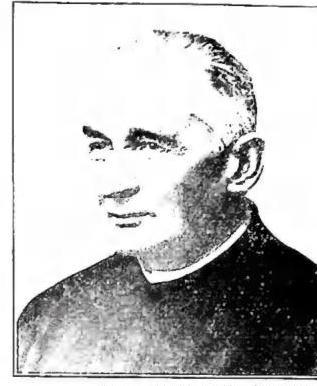
SCHILLER, FRIEDRICH. — German lyric poet and dramatist, born in Marbach, Württemberg, on 10 November 1759, died in Weimar on 9 May 1805. His father served for a long time in the army; his mother, of humble origin, possessed an education and a religion of the heart. Having completed his early studies with great distinction, Friedrich was admitted to the military school at Solitude in 1773, where he studied law and later medicine; but neither these studies nor the rigid discipline of the institution suited his temperament and aspirations. Impatient of every restriction and every specialized course of study, he preferred to devote himself to reading the classics and the greatest modern poets, thus nourishing that vocation for poetry which soon revealed itself with overwhelming force.
After several lyrical and dramatic attempts, at only eighteen years of age, amid the astonishment and admiration of his companions, he wrote his first great tragedy: Die Räuber, filled with undisciplined impetus and powerfully overflowing lyrical fervor, which, amid exaggerations and improbabilities, displays a disordered aspiration to individual freedom above, and indeed against, every moral law. This was followed by the historical tragedy Die Verschwörung des Fiesho and the bourgeois tragedy Luise Millerin, later entitled Kabale und Liebe, two dramatic works belonging, like the first, to the Sturm und Drang period, in which the reflection of the literary conditions of the time is evident.
After several years, Don Carlos, S.’s most tormented work, appeared. Initially conceived as a family tragedy—the Infante’s unhealthy passion for his stepmother, Queen Elisabeth—it gradually transformed itself into an exaltation of political faith, in which the figure of the Marquis of Posa towers above all, as the representative of the poet’s political-humanitarian ideal. With the publication of this work, a broad parenthesis opens in S.’s dramatic production, lasting until 1797. This period produced, besides many lyrics, a series of theoretical writings, in which the principles of a moral aesthetic are expounded, and historical works, the latter lacking, however, a rigorous method with regard to the investigation and criticism of sources.
The series of dramatic masterpieces begins with the trilogy of Wallenstein, in which the poet gives mature expression to his genius, achieving, in accordance with the artistic principles on which he had long meditated, a human representation idealized by historical elements. In the two subsequent tragedies, Maria Stuard and Die Jungfrau von Orléans, the dramatic action moves still farther away from historical reality, while in the latter there is also that marvelous and supernatural element which in Greek tragedy is represented by fate. In both works the poet is chiefly concerned with portraying human characters. Die Braut von Messina may be defined as a Schichsalstragödie, but here S. does not proceed to the desolate consequences contained in such dramas, so as not to deny free will. His final tragedy is Wilhelm Tell—Demetrius remained unfinished—which achieved a complete triumph from its first performance (1804). Tell, an imaginary character, loves only his family, his country, and his freedom, and represents the defender of natural law; only when this is violated does he rebel and kill the tyrant who denies and tramples upon that law. In this work the two great loves of S. are admirably synthesized: love for the beauties of nature and love of freedom.
S.’s lyrics, too, are inspired by an ethical idealism, from the youthful poems written during his Sturm und Drang period, in which, even amid the outbursts of an impassioned and rebellious temperament, one can already sense the aspiration toward a higher ideal of humanity, to the much-celebrated Lied von der Glocke. After the poet’s death it received an epilogue, written by Goethe, in which the latter affirmed that the light which had illuminated the spirit of his incomparable lost friend had long since become the faith of thousands of men.
The whole of Schiller’s work summarizes and expresses within itself the aspiration of the German soul toward an ideal of a higher life and humanity. The dramas and lyrics are dominated by an ethical principle, by one and the same moral idea. It would be difficult to deny in the poet instinctive impulses of sympathy for his heroes who transgress moral law, especially for Maria, guilty of every sin, and even for Karl Moor, driven beyond the limits of every form of wickedness and depravity; but even in this murky tragedy there is a prefiguration of the idea that inspires the later dramas: the Marquis of Posa’s dream of political and human redemption, Wallenstein’s inner conflict, Maria’s stirring moral conscience, Joan’s yearning for sacrifice and resurrection: heroes and heroines all closely united by one and the same ethical reality. Man—according to S., whose thought proceeds in Kant’s footsteps—attains the true conquest of freedom, that is, the full possession of humanity and harmony of spirit, only through the complete revelation of the categorical imperative of his own conscience. But this conquest necessarily entails struggles and suffering. All Schiller’s heroes struggle and suffer for their own freedom and for that of others, because