
IRELAND. - Officially called, from the Gaelic, Eire.
SUMMARY:
I. Geography
II. Civil and Religious History
III. Legal Status of the Church and Educational System
IV. Literature
V. Art.### I. GEOGRAPHY.
In terms of size (82,500 km²; more than three times Sicily), Ireland is the third-largest island in Europe and the second-largest in the British archipelago.
As the westernmost outpost of the continent (from Valencia the submarine cables depart for America), it consists of a broad plateau of ancient rocks, roughly quadrangular in shape, depressed at the center and flanked to the northeast and southwest by two belts of similarly ancient uplands, intensely worn by normal erosion and Pleistocene glaciation (nowhere exceeding 1,200 meters in elevation). The climate is characterized by mild temperatures, weak thermal variation, constant humidity (rainfall year-round), and frequent cloud cover. The central plain, largely limestone, is waterlogged, with water stagnating in lakes and marshes, fostering the formation of peat over vast areas. Nearly half of the territory is occupied by natural meadows and pastures, supporting significant livestock farming (primarily cattle); agriculture, industry (due to the lack of mineral resources), and even maritime activity are of limited importance. Consequently, the country is relatively sparsely populated (2.9 million inhabitants; 43 per km²), with substantial emigration (over the past century, the population has more than halved). Only the capital, Dublin (510,000 inhabitants), exceeds 100,000 residents; overall, the population is dispersed across the countryside. The Irish are 93% Catholic, with the remainder Protestant. Since 1921, Ireland was part of the British Commonwealth, except for the northern region (13,600 km², 1.3 million inhabitants, with Belfast as its capital), which enjoyed and continues to enjoy its own autonomy. As of April 1949, the ties binding it to England were abolished, and Ireland became a sovereign and independent republic.
I. PRE-CHRISTIAN ERA
Ireland was originally inhabited by a short-statured, dark-haired people, termed by palaeoethnologists as Iberian, Ligurian, or Mediterranean, who populated all of Western Europe during the Neolithic period and left as evidence of their presence in Ireland, particularly in the western counties of Kerry and Sligo, megalithic constructions (dolmen and cromlech). The Celts (v. CELTI), who in Ireland are called Scoti or Scotti, Gaels, and who still constitute the ethnic foundation of the country, of Indo-European stock, tall and blond, bearers of Bronze Age civilisation, penetrated Ireland in the 6th century B.C., driving the dark-haired race westward. They lived under a tribal system, considering themselves the owners of the territory, grouped under a chief in villages within wooden houses enclosed by palisades.The tribes were distributed into five great provinces: Ulster, Leinster, Connaught, Desmond (northern Munster), and Thomond (southern Munster), each subject to a provincial king (righ), and all recognising the more nominal than effective authority of a high king (ard righ), who resided on the Hill of Tara in the county of Meath, northwest of Dublin, the centre of pagan tradition that found itself facing Christianity established on the same hill by St. Patrick against the druidic priesthood of King Loegaire.
The juridical and social life of Ireland was governed by a traditional legislation called the "Law of the Brehons" (= jurists) and also the "Law of Nature," which Christianity later replaced with the "Law of the Letter" (Senchus Mor). Every three years, an interprovincial festival (fais) was held at Tara, where the unity of the race was affirmed against tribal particularism.
The imagination has greatly embellished the historical origins of the country, of which the Irish had no precise memory.
The deities worshipped by the pagan Irish were Dana, the ancestress of the gods; Bilé, corresponding to the Dis Pater of the continental Celts, who with Dana forms the Irish divine generative couple; Lir, the sea god; Lug, the luminous god, physician, and artist; Ogma, the god of eloquence;
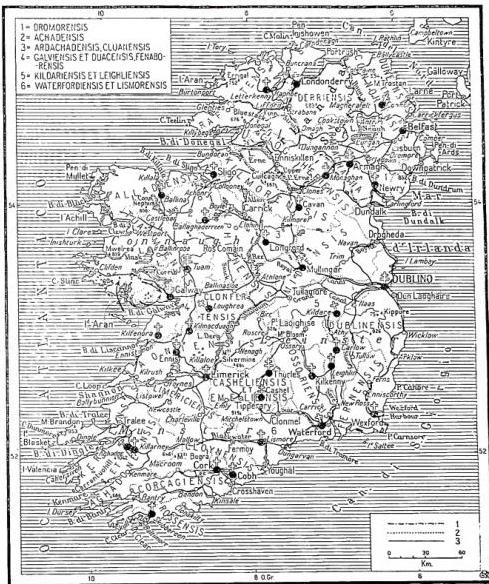
IRELAND - 1) Regional boundaries; 2) boundaries of ecclesiastical circumscription; 3) railways.
Angus, goddess of love; Brigit, goddess of poetry and wisdom. A priesthood of druids (v. DRUIDI), learned in medicine and divination, oversaw the education of youth.
II. CHRISTIAN IRELAND
Although Pope Celestine had sent Palladius to Ireland as bishop in 431, the introduction of Christianity into the country is entirely attributed to St. Patrick (v.), who in 432 landed at Downpatrick (County Down) from his native Wales; in 1938, a colossal statue of the Saint was erected there to commemorate his momentous arrival.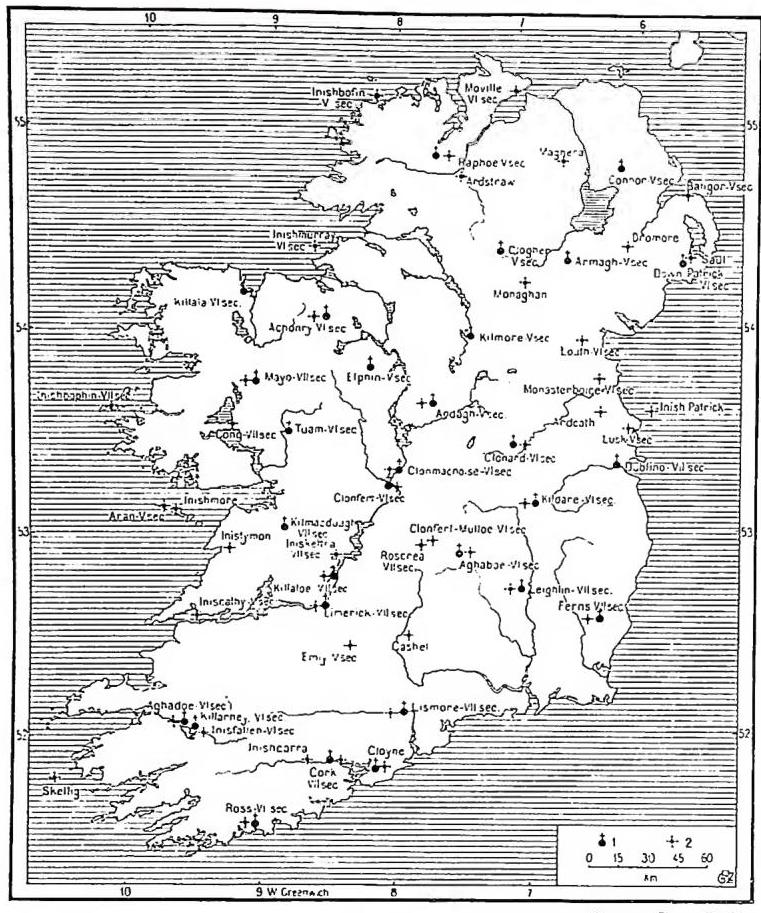
IRELAND - Historical Map (5th-7th centuries): 1) Dioceses; 2) Monasteries.
and characteristic devotional practices (assiduous prayer with daily recitation of the entire Psalter, daily prostrations repeated up to three hundred times, repeated signs of the Cross, baths in icy water, prayers recited standing with arms outstretched in that position called crosfigill, "vigil or prayer of the Cross," still practiced during the pilgrimage to St. Patrick’s Purgatory at the sanctuary of Lough Derg) they dedicated their time to transcribing and illuminating codices, to working with chisels, creating compositions in which exuberant fantasy often ran free at the expense of grace and harmony.
The names of the country’s principal monasteries are well known: Kilkenny, on the island of Aran, founded by St. Enda; Clonard, founded around 520 by St. Finian; Moville, founded by another St. Finian around 540; Ossory, founded in 549 by St. Kieran; Clonmacnoise, founded by another St. Kieran in 544; Iona, on the homonymous island off the Scottish coast, founded in 563 by St. Columcille or Columba (v. SANTO) to whom the Irish monasteries of Derry and Durrow are also owed; Glendalough, founded in 541 by St. Kevin; Clonfert in 544 by St. Brendan; Bangor, in 558 by Comgall, where St. Columbanus (v. SANTO) and St. Gall were trained. The 6th and 7th centuries were the golden age of Irish Christian and cultural formation.
III. THE IRISH EXPANSION
These monasteries, in addition to being centres radiating light throughout Ireland, were also the starting points of a missionary expansion in Europe that constitutes the glory of Irish Christianity during the early Middle Ages and has earned it the title of "insula sanctorum." This expansion took place especially in the 8th and 9th centuries. "Consuetudo peregrinandi jam poene in naturam conversa" affirms Walafrido Strabo of the Irish missionaries (MGH, Poet. lat. nov. Carol., II, 30), above all because this pilgrimage was undertaken, as one reads in the lives of these industrious missionaries, "pro Dei amore," "pro Christo," "pro remedio animae," "pro adipiscenda in coelis patria," in short, out of a desire to immolate themselves, in fulfilment of their own vocation and in imitation of the Apostles of Christ, with the aim of attaining eternal salvation.England was the first region where the Irish apostolate unfolded. St. Aidan (mid-7th century), first bishop of Lindisfarne, was the apostle of Northumbria, an important centre of Christian irradiation in the Anglo-Saxon land: St. Cuthbert, bishop and apostle of Durham (mid-7th century); St. Fursey, apostle of East Anglia; St. Kentigern, first bishop of Glasgow in Scotland.
After England, France and Germany saw these missionaries arrive in their lands, dressed in rough wool with a white tunic over it, tonsured transversely from one ear to the other in the manner of the druids (except for a semicrown on the forehead) and with long hair falling behind the nape; they proceeded on foot, in groups, often of twelve in imitation of the Apostles, armed with a staff and at their side a flask for water and a satchel with provisions and writing materials.
For France, the central place of expansion was Luxeuil, along with the other two of Fontaines and Annegray, founded by St. Colombano. Charlemagne made great use of the Irish element for the religious and cultural reform of his Empire. For Germany, the monastery of St. Gall, a disciple of Colombano, constituted the nucleus of the present-day Swiss city of that name, and from it the founders of the various Irish monasteries in Germany dispersed. Here one should recall St. Kilian, who evangelised Franconia and Thuringia and founded the church of Würzburg, where he suffered martyrdom in 680; the monks Tuban and Altus, who founded the monasteries of Honau (Strasbourg) and Altomünster (Freising); Virgil, abbot of Aghaboe, who became bishop of Salzburg; St. Colman, apostle of southern Austria; St. Fridolin, first bishop of Alsace; Marianus Scotus, founder in Regensburg of a monastery from which twelve others sprang.
The Irish diaspora also reached Italy beneficially. Already in the mid-6th century, St. Orso in the Aosta Valley is remembered; St. Frediano, bishop of Lucca; in the 7th century, St. COLOMBA (v.), Bobbio (v.); St. Cataldus of Lismore, bishop of Taranto, who had been cast ashore by a storm on its coast on his return from Jerusalem; in the 9th century, St. Donatus, bishop of Fiesole, contemporary of the learned Irishman Dungal, appointed by King Lothar to the University of Pavia.
The Irish monastic diaspora brought with it, given the particular form of hierarchy linked to tribal constitution rather than to a territory centred on a cathedral church, an excessive number of prelates, true "episcopi vagantes," who claimed to exercise episcopal powers even in the dioceses of the continent, causing disturbances that various local councils sought to remedy.
Furthermore, the Irish Church followed special liturgical customs that differed from those of continental Europe. The most discordant was that concerning the celebration of Easter, which the Irish still fixed according to the old computation that placed the spring equinox on 25 March and made the day of Easter oscillate between the 14th and 20th day of the moon, that is, between 25 March and 21 April, while the Church of Rome, accepting the calculation of Dionysius Exiguus based on the Alexandrian 19-year cycle, to avoid coincidence with the Jewish Passover if the 14th day of the moon fell on a Sunday, had established the spring equinox on 21 March, the celebration of Easter on the following Sunday between the 15th and 21st day of the moon, that is, between 22 March and 25 April. The second point of discord was the form of the tonsure of the Irish, performed transversely in the manner described above and not entirely according to the Roman usage. The third point, more common among the Celts of Britain than the Irish, was to have episcopal consecration celebrated by a single bishop rather than by three.
Ireland lived peacefully within its inviolate borders until the Danish invasion (792-1014), which first occurred along the coasts—Limerick, Dublin, Waterford, Cork, Wexford—and then penetrated inland, damaging churches and monasteries until the high king Brian Boru, on 23 April 1014, put an end to Danish predominance, though he was killed in the Battle of Clontarf.
But this victory, which was also achieved against Irish elements allied with the Danes, did not quell the internal disputes that lasted until Dermot, king of Leinster, in conflict with the high king Rory O'Connor, sought help from Henry II, king of England of the Tudor house, who first sent Welsh and English troops to Ireland (1169) and then went there himself (1171), establishing himself in Dublin.
From this time begins the transformation of Ireland according to the economic, social, and hierarchical system of the West.
Already in 1118, Gilbert, bishop of Limerick and papal legate, in the Synod assembled at Rath Breasail had established two metropolitan sees, one in the north, at Armagh, which was the ancient primatial see of Ireland, with 12 suffragan sees, and the other in the south, at Cashel, with an equal number of dependent sees.
The measures of this Synod were advocated by St. Malachy, primate of Ireland and friend of St. Bernard, a proponent of a reform of the Irish Church in the Roman sense. In the Synod held at Kells in 1152, under the presidency of Cardinal G. Paparone, legate of Eugene III, four metropolitan provinces were established: Armagh, with the title of primatial; Cashel; Dublin, removed from the dependence of the English archbishop of Canterbury; and Tuam, under which the suffragan bishoprics were grouped: this arrangement remains in place today.
BIBL.:
J. F. Kenney, The Sources for the Early History of Ireland, New York 1929; L. Gougaud, Les Chrétientés celtiques, Paris 1911; P. Grosjean, Catalogus sanctorum Hiberniae, Bruxelles 1965; J. Ryan, Irish Monasticism, Dublin 1931; H. Zimmer, Die keltische Kirche in Britannien und Irland, Berlin 1909; A. Gwynn, The Irish Church in the Eleventh and Twelfth Centuries, Dublin 1992; F. J. Byrne, Irish Kings and High-Kings, London 1973; M. Richter, Medieval Ireland: The Enduring Tradition, Dublin 1988.
A. MERCATI
IV. THE ENGLISH IN IRELAND
Henry II, who had landed in Ireland with the authorization of Pope Adrian IV, an Englishman, who charged him (bull Laudabiliter, 1155) with settling ecclesiastical matters and eradicating vices from the Lord’s field, completed the work of previous councils in disciplinary matters (election of bishops, episcopal mensa, tithes to the clergy, Peter’s Pence) at a new Council held in Cashel (1172), under the presidency of the pontifical legate Cristiano O'Conairche.But as soon as the King departed, having left in the Pale—a fortified trench from Dublin to Dundalk under exclusive English dominion—his representative, two hostile groups immediately formed in the country: the Irish and the Anglo-Normans. Thus began approximately three hundred years of more or less open hostility, which intensified during the "War of the Roses" between the houses of York and Lancaster, as the Irish supported the Yorkists against the Lancastrian King Henry VII Tudor, who ascended the throne in 1485. To put an end to the island’s perpetual conflicts, he sent Sir Edward Poynings to Ireland, who enacted two laws (Poynings Acts, 1494) by which laws passed by the Irish Parliament had no validity without the sanction of the King of England, while laws enacted in England were to apply to Ireland as well.
Henry VIII began by styling himself King rather than Lord of Ireland, introduced Protestantism into the country by appointing Anglican bishops who established the Established Church at the expense of expelled Catholic bishops and confiscated monasteries. His son Edward followed the same path; his daughter Mary, a Catholic, partially remedied the damage suffered by the Church but inaugurated the system of plantations, which involved granting land ownership to English settlers while dispossessing its rightful occupants—a policy that aimed to eradicate Ireland’s tribal system and the traditional Brehon law that governed II. His other daughter, Elizabeth, relentlessly maintained the system of social dispossession and upheld her father’s anti-Catholic measures, yet she faced three rebellions: one in the north, another in the south, and a third, again in the north and more formidable, led by Hugh O’Neill, Earl of Tyrone in Ulster, who defeated the English at Yellow Ford, sparking an anti-English uprising across the island and having himself proclaimed supreme king of Ireland. Despite Spanish aid, Hugh was defeated at Kinsale and forced to renounce his title and any further anti-English action.
But once again, internal divisions arose, this time between "the Old Irish," advocates of uncompromising resistance—
(per cortesia di mons. A. P. Frutaz)
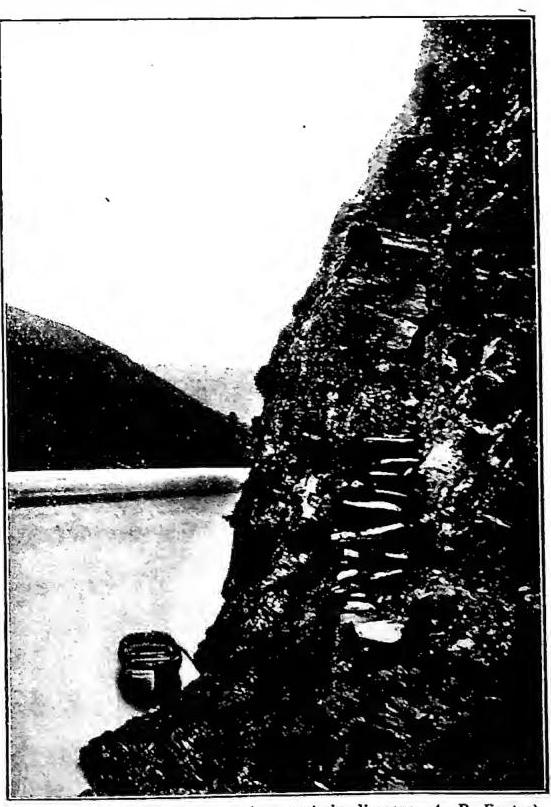
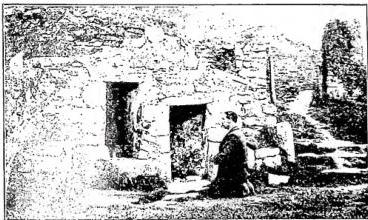
IRELAND - Path leading to St. Kevin’s bed. Glendalough, County Wicklow.
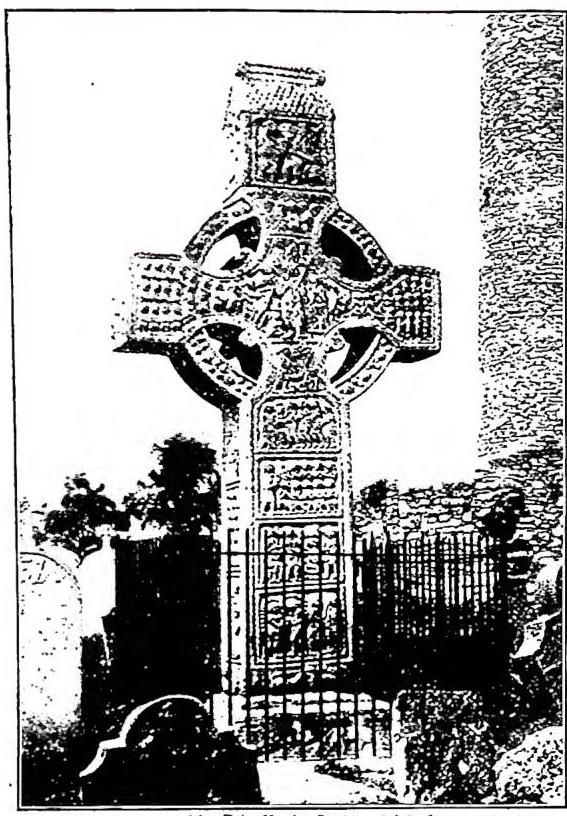
IRELAND - Muiredach's Cross (10th century) - Monasterboice.
hatred and the "Anglo-Irish," descendants of the first invaders and favorable to a compromise with the English crown, prevented a peaceful solution, even after approximately seven years of rule by the Irish Confederation, and despite King Charles I—then in conflict with the London Parliament—having guaranteed religious freedom in exchange for an Irish army to be sent to England.
To resolve the issue by force, Oliver Cromwell landed in Ireland after the king's execution (1649). After massacring the Irish at Drogheda and Wexford and capturing Kilkenny and Clonmel, he returned to England, leaving his lieutenants to subdue the country. The conquest was completed in 1652; the conquered lands were distributed to Cromwell's soldiers (Act of Settlement, 1653), and the remaining landless Irish were confined to Connaught.
Under Charles II, conditions improved slightly, as he took care to settle the various planters, distinguishing between the families of the old Anglo-Normans, the planters of Elizabeth and Charles I, and the Cromwellian planters (Act of Settlement, 1663). His successor, James II, seeking to reclaim the English throne he had lost (1688)—being Catholic and hostile to Parliament—relied on the France of Louis XIV and on Ireland.
V. IRELAND UNDER THE PENAL LAWS
At that time, his son-in-law William III of Orange landed with an army on the island and defeated the royal army at the River Boyne (30 June 1690). The consequence of this defeat for Ireland was a new plantation of Orangists, who occupied the places of the outlawed Jacobites, and a period of clear Protestant predominance, with the enforcement of "penal laws" and the complete disappearance of the tribal regime due to the final expropriation and the subsequent Act of Resumption (1700). According to this act, all lands confiscated or granted in Ireland after 1689 had to revert to the State, which then resold them at public auction. Meanwhile, the wool industry was uprooted from the country to benefit England, without the introduction of the linen industry—from which only the Orangist Ulster profited—serving as adequate compensation.
The suppression of the tribal regime, by removing the cause of internal disputes, facilitated the rise of the idea of unity among the Irish, who were equal in their status as Catholics (except for the Orangists of Ulster), against the English and Protestant dominator. At the same time, the ideas of tolerance characteristic of the 18th century, the Age of Enlightenment, led the English to ease the penal laws. The Protestant Henry Grattan was responsible for proposing to the English Parliament the equalization of Catholic rights with those of Protestants. The American War of Independence, which led to the formation of an Irish volunteer army of 42,000 men (later growing to 100,000), contributed to lightening the heavy hand of the English. Meanwhile, a national uprising (1798), quickly suppressed and inspired by the French Revolution, persuaded the English Prime Minister Pitt to proclaim (1800) the union of Great Britain and Ireland into a single kingdom, with a single Parliament residing in London.
VI. THE UNION OF IRELAND WITH GREAT BRITAIN
The union, opposed by Irish Protestants who saw it as a diminution of their privileged status, did not displease Catholics, as they considered it a means to facilitate their emancipation, bringing them out of isolation and enabling them to make their voices heard in the English Parliament.The 19th century was indeed the period in which the solid foundations of Ireland’s independence were laid. However, the path ahead was still long and arduous because: 1) the Protestant Church still held a privileged position, not only in honor but also economically, due to the tithes the population was obliged to pay; 2) the land was largely in the hands of English landlords (landlords) who were resistant to any modification of the system from which they benefited to the detriment of the entire country.
Thus, immediately after the union, the struggle for emancipation began, led by D. O'CONNEL, DANIELE (v.), who, by organizing the peasants, obtained from Parliament the approval of the Emancipation Act (1829), which equalized Catholics and Protestants in rights.
The terrible famine that struck Ireland in 1848, following poor harvests, causing the death of hundreds of thousands of people and the emigration to America of over a million and a half, due to the government’s lack of foresight, persuaded the Liberal government led by Gladstone to abolish (1870) the privileges of the Protestant Church, to put land reform up for discussion, and to consider the opportunity of granting Ireland the right to self-government (Home Rule). This movement, initiated by S. Butt and championed by the Irish patriot C. S. Parnell, failed twice (1886 and 1893) due to opposition from the Conservatives. It would have failed a third time (when proposed by the deputy Redmond) due to the opposition of Ulster Protestants, who feared their privileged position would be compromised and threatened civil war, had not the First World War (1914-18) broken out, in which Ireland sided with England, temporarily suppressing the causes of conflict. The ideological struggle was kept alive by the political association of the Sinn Feiners, "those who do it themselves," founded by A. Griffith. This group participated in the 1916 uprising, in agreement with Germany and bloodily repressed by England. It triumphed in the 1918 elections and established itself permanently with the formation of an Irish Republican Army. In 1919, the Sinn Feiners constituted themselves as the "Assembly of Ireland" (Dáil Éireann) and proclaimed the country’s independence under the presidency of E. De Valera.
VII. INDEPENDENT IRELAND
The British Prime Minister Lloyd George eventually negotiated with them, recognizing (6 December 1921) Ireland’s status as a dominion, subject to the oath of allegiance to the King of England and the payment of an annual fee as compensation to English landlords for the lands returned to Ireland. Ireland was given the title of Free State (Irish Free State, Saorstát Éireann), comprising the 26 Catholic counties of the centre and south, while the six Protestant counties of Ulster remained united with England. Irish extremists did not approve of this arrangement, and a conflict ensued in which A. Griffith and M. Collins were killed, succeeded by W. Cosgrave. Order was restored in 1923, but the dispute led to the emergence of a new party called Fianna Fáil, "soldiers of destiny," founded by De Valera, which aimed to amend two points of the 1921 Constitution: abolishing the oath of allegiance to the King of England and the annual sum to be paid to English landlords.The new Constitution, approved by Parliament and confirmed by a popular plebiscite, came into force on 29 December 1937. With it, Ireland achieved the goal of its independence as a sovereign state, so much so that it could declare its neutrality toward England at the outbreak of the Second World War (2 September 1939). However, to make independence complete, the annexation of the six counties of Ulster is still lacking from a territorial and political standpoint. In the 1948 elections, Thomas O'Kelley succeeded E. De Valera as President of the Irish Republic.
VIII. ECCLESIASTICAL ORGANIZATION
The Church in Ireland comprises 4 ecclesiastical provinces, including 4 metropolitan sees and 23 suffragan dioceses (Ann. Pont., 1931).Metropolitan sees: 1) ARMAGH with 8 suffragan dioceses: Ardagh (united with the title of Clonmacnoise); Clogher; Derry; Down and Connor (united sees); Dromore; Kilmore; Meath; Raphoe; 2) CASHEL with 8 suffragan dioceses: Cloyne; Cork; Emly (under the perpetual administration of Cashel); Kerry and Aghadoe (united sees); Killaloe; Limerick; Ross; Waterford and Lismore (united sees); 3) DUBLIN with 3 suffragan dioceses: Ferns; Kildare and Leighlin (united sees); Ossory; 4) TUAM with 6 suffragan dioceses: Achonry; Clonfert; Elphin; Galway and Kilmacduagh (united sees); Kilmacduagh (under the perpetual administration of Galway); Killala.
### III. LEGAL STATUS OF THE CHURCH AND EDUCATIONAL SYSTEM.
The Constitution of 1937, although it did not abolish the preceding legislation in accordance with the principles of English law, nonetheless produced, in its application, the effect of granting the Church a privileged position and regulating the most important matters according to the Church’s own doctrine. It can even be affirmed that the legal regime currently in force in Ireland regarding ecclesiastical matters is similar to that existing in
(courtesy of Mons. A. P. Frutaz)
### IRELAND - Sacred spring of St. Declan - Ardmore, County Waterford.
The legal system in force in Ireland regarding ecclesiastical matters is similar to that existing in England before the "Reformation." However, this system does not apply in the northern counties, which, although constitutionally part of the Irish national territory, are de facto separate and have their representatives in the British Parliament. In these counties, the application of English legislation tends to be distinctly unfavorable to the Church, though tempered by the practice of the courts.
Article 44 of the Constitution expressly affirms that public worship is due to God, while recognizing the special position of the Catholic Church as the guardian of the faith professed by the great majority of citizens. However, the Church as such is not granted legal personality, which could be obtained through a parliamentary resolution, but which the Church itself, at least up to this point, has not deemed necessary to request.
No limitations on rights exist for those who do not profess the Catholic religion.
Diplomatic relations are maintained through the Apostolic Nuncio in Dublin and the Irish ambassador accredited to the Holy See.
Regarding marriage, it is considered a contract producing civil effects. Every minister of worship is simultaneously a public official in regard to the celebration of marriage. Divorce is prohibited, and Parliament could not even enact a law aimed at introducing II. Whoever, even a foreigner, has obtained abroad the dissolution of marriage in accordance with civil laws cannot contract marriage in Ireland during the lifetime of the first spouse.
Article 42 establishes the following guidelines for school education:
1) The State recognizes that the child's first natural educator is the family and guarantees respect for the inalienable right and duty of parents to provide, according to their means, for the religious, moral, intellectual, physical, and social education of their children.
2) Parents are given full freedom to educate their children at home, or in private schools, or in schools recognized or established by the State.
3) The State, taking into account the conscience and legitimate preference of parents, does not compel them to send their children to state schools but, as guardian of public welfare, requires that children, according to their social conditions, receive a minimum of moral, intellectual, and social education.
4) The State provides free primary education and seeks to assist, with adequate subsidies, private and corporate educational initiatives and, when public demand requires, provides other facilities and educational institutions, always respecting the rights of parents, especially in matters of religious and moral formation.
5) Only in exceptional cases, as guardian of the public good, will the State substitute itself for parents if they, for moral or physical reasons, fail in their duty toward their children. The State will always respect the natural and imprescriptible rights of children.
The Irish people achieved these results through a struggle that began in 1612 with the founding of the Royal Free Schools, followed by the Penal Laws, which proscribed Catholic education in Ireland. The clandestine Hedge Schools were then founded, legalized by the Relief Act in 1797. Catholic emancipation in 1829 favored private Catholic schools. When Protestants founded the national school in 1831, Catholics strove to obtain equality, which was granted to them in 1860. In 1869, with the Irish Church Act, the Anglican Church was denationalized, and the founding of the first national seminary for the formation of the Catholic clergy was permitted. In 1883, colleges run by Catholics were allowed, and from 1900, they had obtained the right to choose their own teachers. In 1921-22, the "Christian Brothers Schools" were recognized by the State.
School education comprises primary schools, secondary schools, and universities. Primary schools include 4,912 state schools and 466 Catholic primary schools. Secondary schools are divided into 300 intermediate schools, 77 technical schools, and 1,168 technical reintegration schools. The universities are: Trinity College, founded in 1591 in Dublin as a stronghold of Anglicanism; Queen's University, founded in 1845 in Belfast as a stronghold of Presbyterians; the Catholic University in Dublin, founded in 1850; and the National University of Ireland, composed of three colleges—Dublin, Cork, and Galway—founded in 1909 (non-denominational, but in which all professors and students are Catholic).
The education of the Catholic clergy is provided in 21 seminary-colleges, 3 complete seminaries, 5 major seminaries, and in 3 seminaries abroad: Collegium Hibernicum de Urbe in Rome, Collegium Parisiense in Paris, and Collegium Salmaticense in Spain.
#### IV. LITERATURE.
The oldest written literary manifestations of Ireland were in the Latin language. The Confessio of St. Patrick and his letter to Coroticus date back to the mid-fifth century; the biography of Adamnan of St. Columba is from the end of the seventh century, and there are many other Hiberno-Latin writings in prose and poetry, produced from the sixth to the ninth centuries. These should be mentioned here as a reminder of the pure Latin and the ecclesiastical influence rivaling the ancient indigenous Irish tradition, whose hereditary custodians were the fili: a class of literati who transmitted, first orally and then in literary form, ancient laws, annals, genealogies, dindsenchas (topographies), heroic tales, and other Irish poems.
With the rise of Irish monasteries in the sixth and seventh centuries, it was inevitable that the old oral and mnemonic tradition would give way to the new form of written literature. The monks applied themselves to unraveling the tangled threads of legend, annals, and chronicle within the framework of universal history dominant in the Latin Church. The oldest literature of Ireland dates back to the end of the seventh or the beginning of the eighth century, but it is the heir to an older oral tradition.
The evolution of written Irish (Gaelic) literature has been conventionally divided into three periods: Old Irish (700-1100); Middle Irish (1100-1550); Modern Irish (1550 to the present).
I. ANCIENT PERIOD
The earliest examples of primitive Irish prose are fragments of a homily known as the Cambrai Homily (7th-8th centuries); the Messale of Stowe (8th-9th centuries) and some commentaries in the Book of Armagh (9th century). From the 10th century onward, ecclesiastical literature tends to be written in Irish rather than in Latin. The Tripartite Life of St. Patrick is the masterpiece of prose from this period; but there are also numerous Irish homilies, Rules, lives of saints, etc. Irish hymns are found in the Liber hymnorum: among the most beautiful are the hymn to St. Brigida, the hymn to the Holy Spirit by Mael-Isu, and St. Ita’s hymn to the Infant Jesus.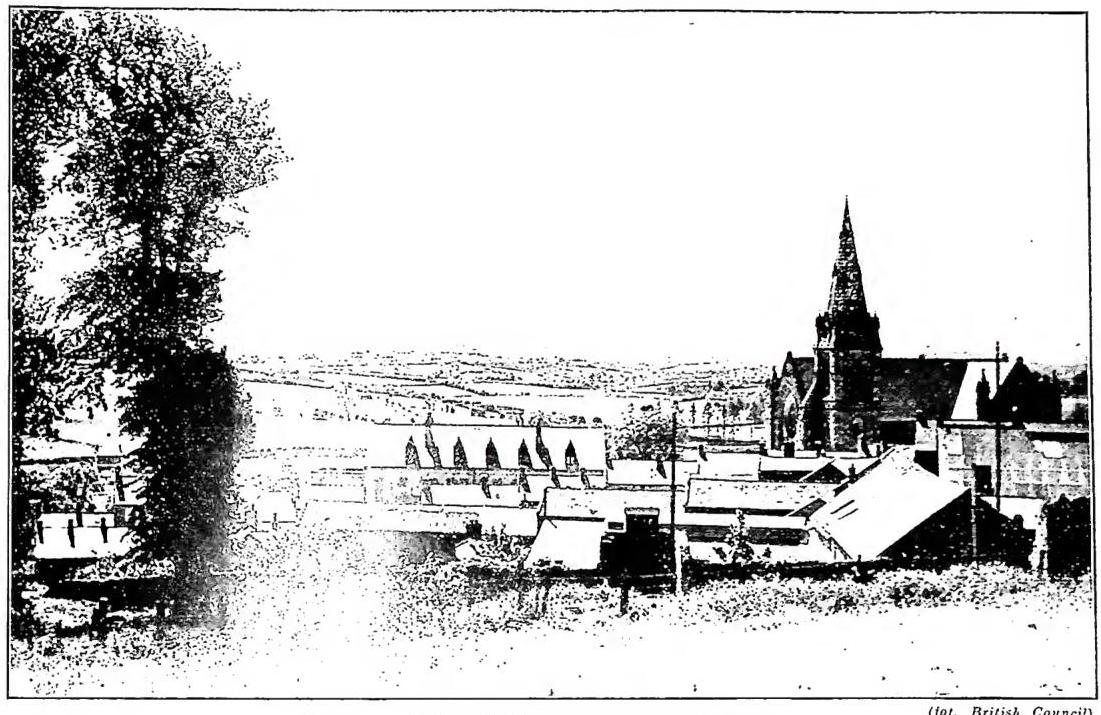
I. INTERMEDIATE PERIOD
It begins with the defeat of the Scandinavians by Brian Boru at the battle of Clontarf (1014). From the 12th century onward, especially after the Anglo-Norman conquest of part of the island, Ireland came into closer contact with the culture of Western Europe. This period is marked by the appearance of the schools of bards: schools of gifts under the protection of local chiefs; the bards correspond to the « fili » of the earlier era. Numerous collections of Irish literature from the intermediate period have been preserved in the form of large manuscript volumes, compiled both by monks and by scholars from families that cultivated a tradition of learning. The oldest of these books is the Lebor nah-Uidhre (« Book of the Dun Cow »), which was largely written by Mael-muire Mac Ceileachair (1100) in the monastery of Clonmacnoise. It contains a collection of romantic tales drawn from the great Ulster cycle of Irish saga. The Lebor Laigneach (« Book of Leinster ») was written in 1150 and contains another version of the Ulster cycle with new material from Leinster. A great quantity of romantic material is found in the Yellow Book of Lecan and the Book of Ballymote, written in the 14th and 15th centuries. The Leabhar Breac (15th century) contains much ecclesiastical matter. These five codices are preserved in Dublin and have been published in facsimile. In general, the language is Middle Irish, but there are many archaic forms derived from older manuscripts, now lost.There are two main cycles of Irish romantic tales: the Ulster cycle and the Fenian or Ossianic cycle.
a) The Ulster cycle is the oldest. The central tale is the Táin Bó Cuailnge (« Cattle Raid of Cooley »): a picturesque and barbaric story of struggle between the forces of Connacht and Ulster, with the victorious hero of Ulster, Cúchulainn, as the main figure. The Táin is
(photo: British Council)
A view of Dungannon, County Tyrone.
a narrative prose, interspersed with summarizing poems. The dialogue in the narration is very well conducted, and individual characters are vigorously delineated. The elements of a national epic and drama are numerous here; yet this abundant material never found its expression in literary form, likely due to the irregular course of Irish history. Many secondary tales are grouped around the central narrative of the Táin. One of these, The Tragic Death of the Sons of Usnech, captured the popular imagination more than the others and still survives in the memory of the people. There are other minor stories, such as The Destruction of Dá Derga’s Hostel, and a series of tales describing certain mortals’ visits to the Land of Prophecy: The Voyage of Bran, The Voyage of Maelduin, and others.
b) The Fenian cycle connects to the characteristics of a later era and is composed in ballad form. There is more humanity, good and evil, in its main character, Finn Mac Cumhaill, and his companions. There is also a greater awareness of the delight that the beauty of nature and the danger of the hunt provide. Many of the Fenian tales still live on in the provinces of modern Ireland where Gaelic is spoken. The oldest version of these Fenian legends is in The Colloquy of the Ancients, preserved in the Book of Lismore (15th century). Later ballads can be found in the Duanaire Finn (a compilation from the early 17th century). Prose romances on the Fenian theme appeared in the 16th and 17th centuries: The Pursuit of Diarmuid and Gráinne, and others.
The first prose narrative is Cogad Gaedel re Gallaib ("Wars of the Gaels and the Foreigners"), written shortly after the Battle of Clontarf (1014). Other prose works include Caithréim Cellacháin Caisil and the Leabhar Gabhála ("The Book of Invasions"), which compiles many legends of ancient Irish history. Annalistic literature is more abundant than historical narrative. The oldest annalistic compilation comes from the southern province of Munster: the Annals of Inisfallen (1090). Later compilations include the Annals of Tigernach (14th century); the Annals of Ulster (1490); the Annals of Loch Cé (1588); and the Annals of the Four Masters (1632-36). This last
compilation is the work of a group of Irish Franciscan scholars, who copied all the older material they could find into their annals, written at the Franciscan monastery in Donegal.
The most important collection of genealogies was compiled in Galway, with ancient material, by Duald Mac Firbis (1650-66). There is also a great deal of manuscript material from professional scholars of this period on topography, history, genealogy, grammar, metrics, and law. Only a small part of the Irish legal system, known as the Brehon laws, has been studied so far. There are also Irish translations from the Middle Ages of classical stories from Greece and Rome. Religious writings are well represented in this period. Numerous lives of Irish saints are contained in the Leabhar Breac and the Book of Lismore. A large number of texts deal with visits to Paradise and Hell. The most famous of these are The Vision of Adamnan (11th century), The Vision of Fursa, and The Vision of Tundal (12th century). It is said that Dante was influenced by The Vision of Fursa. The Vision of Mac Conglinne differs from these texts: it is a clever satire of the Irish monks of the 12th century. The love poetry of this period shows the influence of the amour courtois of the European tradition. The best of these love poems was collected by T. F. O' Rahilly in Dánta Grádha (Dublin 1916).
III. MODERN PERIOD
The 17th century saw the progressive increase of English power and culture in Ireland, and a corresponding decline of the old Gaelic tradition. Due to the scarcity of patrons, the bardic school declined, and poets abandoned the old classical metres in favour of the simpler verse of the popular language. David O' Bruadar, Pierce Ferriter, and Egan O' Rahilly are the most important poets of the 17th century. A school of religious prose emerged in the Irish colleges on the continent, particularly in the Irish Franciscan convent of St. Anthony in Louvain, where the first printed Irish books were produced.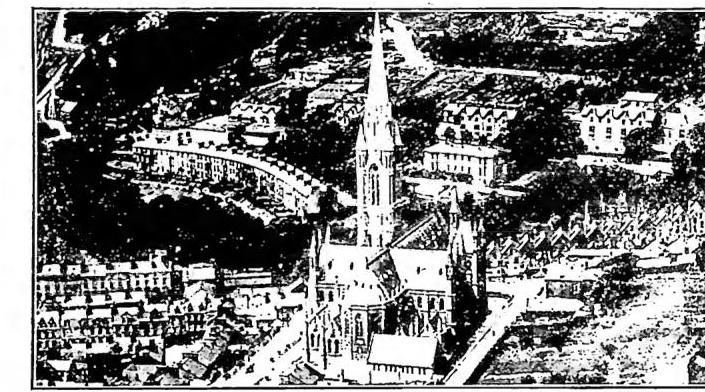
In the 18th century, Gaelic literature consisted mainly of popular songs and religious poetry, many of which are artistically first-rate. The two most notable poems are The Songs of Ossian by Michael Comyn and The Midnight Court, a satirical poem by Brian Marriman. However, the ancient literary tradition began to decline.
By the mid-19th century, interest in Gaelic literature revived. Scholars of comparative philology began to study the ancient Irish linguistic forms, and many of the oldest Irish manuscripts were printed for the first time. This was followed, towards the end of the century, by a movement to revive the spoken language, which was rapidly disappearing throughout the country. The Gaelic League was founded in 1893. Its first president was Douglas Hyde, later the first president of Ireland. His collaborator was Eoin Mac Neill, later professor of ancient Irish history at the National University of Ireland, one of the most learned Irishmen of his time. The literary output since 1893 has been vast, including modern editions of ancient Irish tales and translations of modern literary works from other European countries. The Irish Folklore Institute aims to preserve the oral tradition of the Gaelic-speaking centres. A school of Anglo-Irish writers also emerged, with the intent of translating the ancient Gaelic literary heritage for English readers.
It is too soon to say whether the attempt to revive Gaelic as a universally spoken language in Ireland will succeed. It is freely spoken by the Gaelic-speaking groups on the north-western, western, and south-eastern coasts. The teaching of Irish is followed in all schools in the country, and today (1950) it is far from being a dead language. Never since the 17th century has there been such a general interest in the Irish language and literature as is evident in Ireland today. Several great English writers (J. Swift, O. Goldsmith, E. Burke, S. Butler, O. Wilde, W. B. Yeats, J. M. Synge, J. Joyce, B. Shaw, etc.) were born or lived in Ireland; without delving into the particulars of their work, it is noted that certain traits of their character and art—perhaps first and foremost a particular form of irony and a taste for paradox—reveal the Irish soul.
V. ART.
For Celtic liturgy, V. CELTI, IV. Liturgia. For Celtic art up to the 12th century, V. CELTI, V. Arte. Celtic or Irish artistic production from the end of the 12th century to the 18th century is of little importance. During this long period, the numerous Gothic churches are almost all simple and unadorned. With the 18th century, however, the Irish genius once again found itself, particularly in the field of secular architecture, and in Dublin and throughout the country there emerged an extraordinarily large series of houses resembling, yet at the same time differing from, English ones. The houses also featured beautiful stucco decorations, and the minor arts flourished alongside architecture; noteworthy is the production of furniture and especially mirrors. During the 18th century, religious architecture also flourished in Ireland, but the churches were simpler than the houses, and the religious art of that period has only local importance. Subsequently, much was built, especially belo-
IRELAND - View of Cobh (Queenstown), County Cork.
under the protection of the Catholic Church, but little of it stands out for international significance, except perhaps some of the more recent stained-glass windows. - Vedi tavv. XIII-XIV. Davide Talbot Rice