
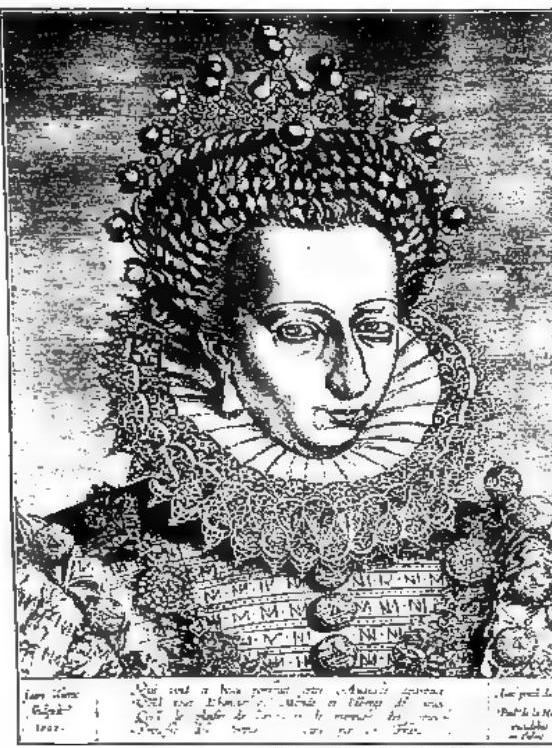
ELISABETTA, queen of ENGLAND. — Born at Greenwich on 7 September 1533, died at Richmond on 24 March 1603. Daughter of Henry VIII and Anne Boleyn, she succeeded her half-sister Mary at a grave moment in the nation’s history (1558).
As Boleyn’s daughter, Catholics could not regard her as the legitimate heir to the throne; they therefore looked to the Catholic Mary Stuart, queen of Scotland, the closest legitimate relative of Henry VIII. Catholics, however, regretted the pro-Spanish policy pursued by the late Queen Mary and were not displeased that E. emancipated herself from it in order to follow other directions. But education and “reason of state” led E. to adopt a pro-Protestant policy, such as that of her half-brother Edward VI. Indeed, with
But the persecutory laws grew harsher through new and more restrictive edicts, both to counterbalance the consequences of the bull of excommunication (2 April 1571) and to preserve the Queen from alleged papist conspiracies (23 November 1584), eventually ordering priests to leave the kingdom, prohibiting young men from entering seminaries on the Continent, and warning them never to return, on pain even of death (January 1585). When these measures proved insufficient, the edicts of 1590 and 1591 were issued against priests and the laymen who sheltered them or attended Mass celebrated by them; finally, on 2 November 1602, the edict of the absolute exile of the entire clergy was promulgated.
Nevertheless, neither did the priests disappear nor did the laity surrender to the false injunctions. During E.’s reign, 200 Catholics, priests and laymen, are counted among those killed for their faith, many of whom were beatified by the Church or proposed for beatification; the number of those who, without losing their lives, either lost their possessions, were forced into exile, or languished in the harsh prisons, considerably exceeds a thousand.
E., while keeping at bay the princes who longed for her hand, did not wish to marry any of them; and, while pursuing a cautious policy of supporting the Protestant cause on the Continent, she did not wish to compromise too openly the security of the country and the crown. She assisted the Protestant Netherlands, in revolt against Spain, and the French Huguenots against the Catholic League. She invested her own private capital in the enterprises of privateers and colonizers who, by attacking the maritime convoys transporting precious metals from America to Spain and by opening new territories to English commerce, undermined the foundations of Philip II’s power. But for decades, against the express advice of her counsellors, she refused to enter into open conflict with him, and only after much hesitation did she adopt that radical policy toward Mary Stuart which led to her condemnation and execution (1587).
The conflict with Spain, inevitable once the nation’s maritime and colonial expansion threatened the Catholic king’s supremacy in American waters, finally broke out in 1588 on the initiative of Philip II, who had prepared a powerful Armada. E.’s victory, while marking the beginning of English maritime predominance, definitively shattered Philip II’s hopes of establishing Spanish-Catholic supremacy in northern Europe. The final years of E.’s reign marked further progress in the nation’s economic development and internal cohesion. When the queen died in 1603, the material conditions of the country were among the best recorded in English history; but religious intolerance toward Catholics was also at its height.