
PROTESTANTISM. - The term "Protestantism" enters history on 19 April 1529, when the Diet of Speyer confirmed the decree of the Diet of Worms against Luther and strictly prohibited the suppression of the Mass and the use of violence under religious pretext (an implicit condemnation of the Pack affair). The states that had already embraced Lutheranism at that time presented a solemn "protest," later transformed, on the 25th, into an "instrument of appeal." The signatures of the "protesters" included five princes: Giovanni, Elector of Saxony; Filippo, Landgrave of Hesse; Giorgio of Brandenburg-Ansbach; the dukes Ernesto and Francesco of Lüneburg (jointly); Prince Wolfango of Anhalt; and fourteen cities: Nördlingen, Strasburgo, Norimberga, Ulma, Costanza, Lindau, Memmingen, Kempten, Heilbronn, Reutlingen, Isny, S. Gallo, Wissemburg, Windsheim. As early as 22 April, a secret league gathered a number of those who, from that moment on, were called "Protestants."
I. PRESENT MEANING OF THE TERM AND CHARACTERISTICS
Subsequently, the term took on a very different meaning. Indeed, Bossuet, in his Histoire des variations des Eglises protestantes (Paris, 1688), applied it to all the Churches formed following Luther’s rebellion, outside the Catholic Church, and distinguished four principal groups of Churches: Lutheran, Calvinist, Zwinglian, and Anglican. Today, Zwinglianism can be considered almost entirely absorbed into Calvinism, leaving a tripartite division. However, a good part of Anglicans rejects the denomination of "Protestants," while in the United States alone no fewer than 250 different Protestant denominations have proliferated. Practically speaking, all those who, while in some way connecting themselves to Christ, do not belong to the Catholic Church nor to the separated Churches of the East, are today considered Protestant, constituting one of the three great branches of Christianity in the world. The common points among all Protestant branches can be reduced to three principal ones: the "Reformation," especially in Calvinist circles, was: a) anti-papal; b) biblical; c) mystical-fideistic.1. The "Reformation" as anti-papal. - It violently attacked the primacy of the Pope, "the Antichrist in person," and of Rome, "the harlot of Babylon." On this point, there is no difference in tone or bitterness among Luther, Zwingli, and Calvin. It is true, however, that the decline of the papacy effectively contributed to the Protestant revolt, through the conflict between Boniface VIII and Philip the Fair, the "Babylonian Captivity" in Avignon, the Great Schism, the struggle between the Pope and the Council, and especially the "secularization" of the Renaissance pontiffs, from Sixtus IV to Leo X. Too much politics, too much luxury, excessive fiscalism, excessive worldliness, bad examples in the Roman Curia—precisely at the moment when, due to the concentration of power in monarchs, the weakening of feudalism, the development of commerce, the rise of bankers' capitalism, and the flourishing of arts and letters in the Renaissance movement, nationalism was on the rise and shattering the unity of Christians.
2. The "Reformation" as biblical. - It was indeed necessary to oppose to that of the Pope another unquestionable authority, and this could only be the Bible. They returned to the origins of Christianity to realize that "Reformation," of which Luther, Zwingli, and Calvin aspired to be the protagonists. They also had the skill to brandish an explosive term: reformation, and accused the Church of having not only corrupted discipline but also altered the
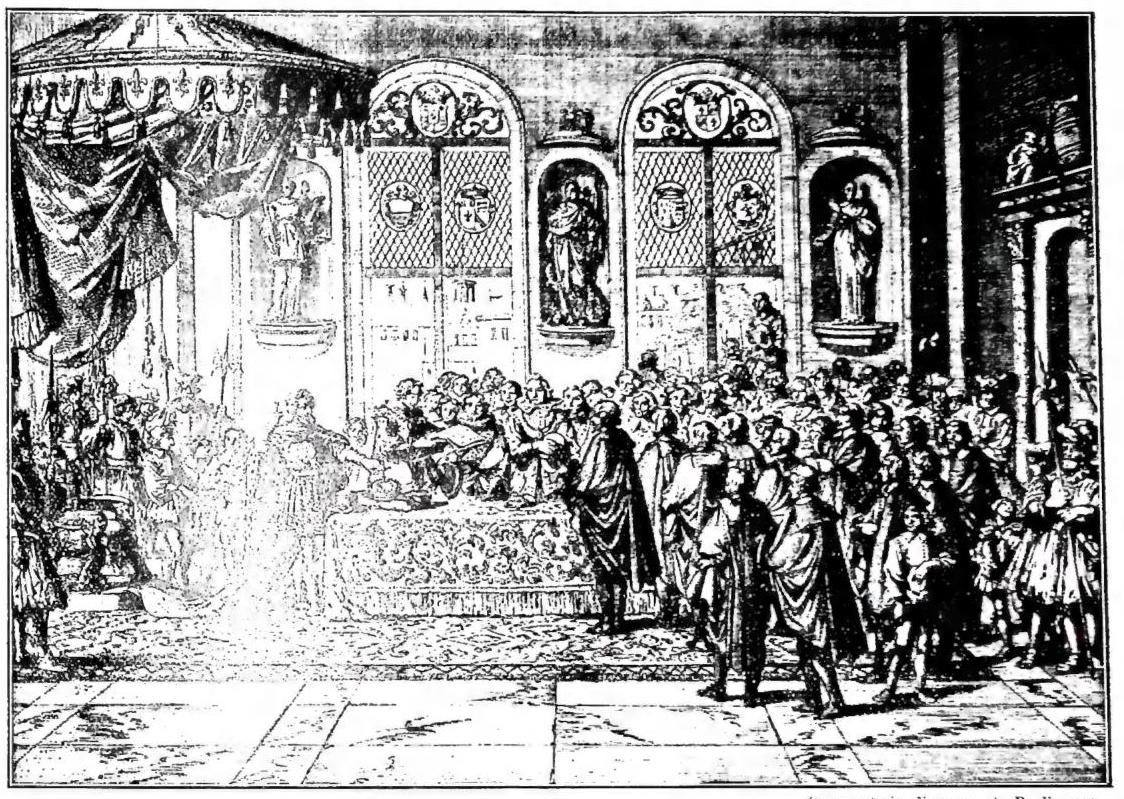
PROTESTANTESIMO - The Edict of Nantes (13 April 1598). Engraving exhibited at the exhibition held at the Bibliothèque d'histoire du protestantisme français (1932) - Paris.
The misunderstanding from which it has not yet been possible to escape originated here. As early as 1515, Luther, speaking of abuses, said in a speech prepared for the prior of the Premonstratensians of Leitzkau: « There are great scandals, it is true; they must be denounced, they must be remedied, but the vices of which you speak are visible to all. Unfortunately, there is an evil, a plague incomparably more harmful and cruel: the organised silence on the Word of truth or its adulteration... of this evil no one is aware, no one fears it, no one feels its terror » (Luthers Werke, ed. Weimar, I, 10-17, with the incorrect date of 1512). Here lies the crucial point of opposition between Protestantism and Catholicism. Protestantism rejects the authority of the Church to define and infallibly impose, in the name of God Himself, dogmas of faith, and systematically claims to prove, by means of the Bible, that the Catholic Church has fallen into error and that the Holy Spirit has given the original mission precisely to the men of the « Reformation ».
The « Reformation », in its countless divisions over the true meaning of the Bible, is unanimous in declaring that the Bible is the sole rule of faith and that, although the Bible was transmitted to the Church, it is not the Church that guarantees its truth. For the Protestant, the Bible says everything, contains everything, explains everything, is clear in everything necessary for salvation, and is, in a word, self-sufficient. Calvin formulated this thesis in resolute terms in his Institution chrétienne (I, I, ch. 7, § 3): « As for the objection that these Catholic scoundrels make to us—from whom, whence, and how we derive the persuasion that Scripture comes from God—it is as if someone were to inquire whence we learn to distinguish light from darkness, white from black, sweet from bitter. Scripture, indeed, has its own way of manifesting itself, in a manner so evident and infallible, as white and black things can manifest their colours and sweet and bitter things their taste ». And in the following paragraph, he further explained his thought: « This Word will not produce faith in the hearts of men unless it is sealed by the inner testimony of the Holy Spirit ». Ultimately, Protestantism grants to each individual what it denies to the Church. The consequences are as follows: 1) the visible and hierarchical Church of Jesus Christ can err; its teaching is not guaranteed by the promises of Jesus Christ, its Founder, and may even corrupt the deposit of faith entrusted to it; 2) it is up to any individual, even if assisted by the testimonium Spiritus Sancti, to rediscover the Word of God lost by the Church; 3) once the pure doctrine of Christ is rediscovered, it is possible to preserve it in its reconquered perfection, shielding it from the variations of individual interpretation. The continual « variations » of Protestants demonstrate that their very principle appears false, judging by the fruits it has produced.
3. The Mystical-Fideist « Reformation »
It claimed to derive from the Bible, under the pretext of restoring pure Christian doctrine, its central dogma of justification by faith alone: « From this article - said Luther - nothing can be subtracted, even if heaven and earth were to collapse » (Article of Smalcald, 1537). This doctrine is called mystical in the sense that Luther and his followers found in it a consolation that constituted an enchanting seduction for many. With Calvin, the consoling doctrine of justification by faith alone, the exclusive work of God without any human cooperation, took on the metaphysical form of predestination. The feeling and knowledge of being predestined produces an indescribable intoxication; everything becomes unnecessary after such certainty. Thus emerged a simple, mystical, and consoling doctrine that opposed the corruption derived from original sin—which each person could experience within themselves—with the infinite goodness of a God who saves those He wills and only those He wills, infusing in them the PROTESTANTISM - Blessing of the table in a Protestant family. Engraving by A. Bosse (17th century), exhibited at the exhibition held at the Bibliothèque d'histoire du protestantisme français (1952) - Paris.It is now sufficient to mention the derived characteristics of the "Reformation." In general, it was subjected to the State to prevent the proliferation of sects produced by the principle of "free biblical examination"; it was anti-monastic, because the principle of justification by faith alone abolished any notion of personal merit, the pursuit of holiness through religious vows, and the practice of the evangelical counsels. Princes, interested in preserving the unity of beliefs within their States, thus had a favorable opportunity to seize the assets of monasteries. The "Reformation" was also anti-scholastic, because it was biblical and rejected the interference of human reason in the field of religion. This, however, did not prevent the subsequent formation of a Protestant scholasticism in the 17th-18th centuries. Finally, the "Reformation" was anti-sacramental and anti-liturgical, by completely abolishing the Mass, the center of Christian liturgy, by reducing the Sacraments from seven to two (Baptism and the Lord's Supper), further emptying them of their efficacy and considering them merely as "excitatory" signs of justifying faith, by suppressing the cult of saints and images, and, among Calvinists, also the liturgical calendar.
II. HISTORICAL EVOLUTION
4. Means of expansion
The development of Protestantism was favored by a complex of converging factors. The use of printing and the growing practice of reading should be recalled.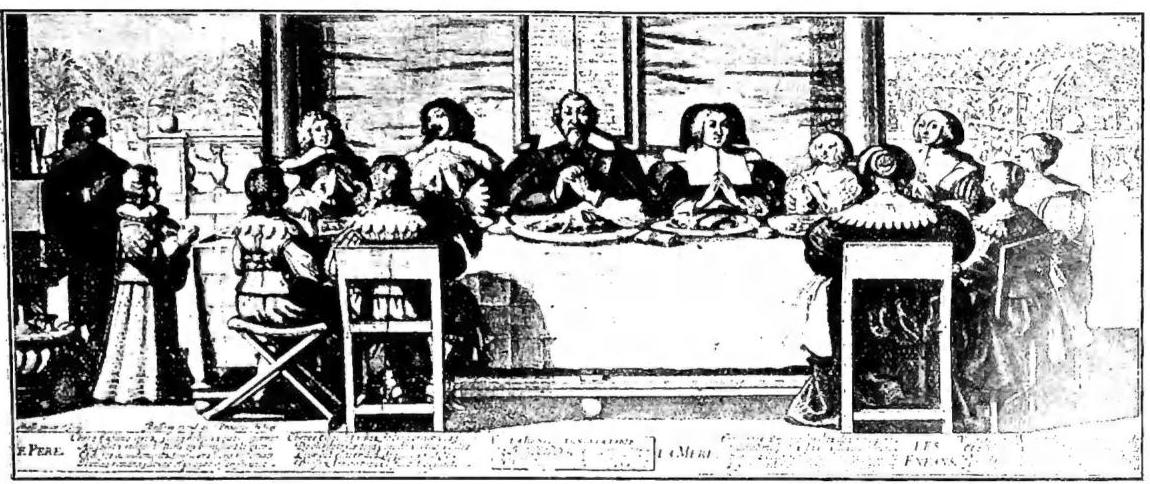
Lay princes, eager to dominate souls as well as bodies, and ecclesiastics, anxious to secularize in order to found a dynasty (a typical case being that of the Grand Master of the Teutonic Order in 1525), along with a considerable number of prince-bishops in Germany, influenced the Protestant revolt. Moreover, it was due to the notables of the cities that Lutheranism was able to spread and that Calvinism succeeded in establishing itself in Geneva and Zwinglianism in Zurich. Among the promoters of the “Reformation,” for reasons entirely other than religious, one must also recall Gustavus Vasa in Denmark, Henry VIII (primarily schismatic), Edward VI, and, decisively, Elizabeth in England. After the Protest of 1529, one can say that the principle that penetrated everywhere and imposed itself on all was cuius regio, huius et religio. However, national or established Churches, as they are called in England, are far from constituting all of Protestantism. Even in Protestant countries, and also in territories that remained Catholic, sects arose everywhere, which Luther called Schwarmgeister, that is, the exalted, the fanatics, while Calvin termed them bizarre deliriants, and in England they were called non-conformists or dissenters. One should recall the Anabaptists of Thomas Müntzer (v.), the followers of Carlstadt (v.), the Schwenkfeldians, the rebels of Münster, and many others. They turned to discontented peasants and incited them to rebellion against their lords (thus arose the Peasants' War [1524-1525]), or they disrupted an entire city, as in Münster (1534) under Jan van Leiden and his followers. In France, and especially in England, artisans, “mechanics” (as they were called in France), that is, wool carders and weavers, expressed their discontent in a religious revolt. Economic, social, moral, and political factors interfered everywhere and incessantly with intellectual, theological, and mystical factors.
5. Wars of Religion
This tendentious expression was coined in the 18th century, at a time when the “philosophers” felt the need to make people believe that revealed religions served only to set men against one another, to unleash civil or international wars, in order to conclude that for the peace of humanity one should adhere to natural religion alone or, better still, have no religion at all, ultimately practicing a tolerance equivalent to total religious indifferentism. In Germany, the Wars of Religion were called, in their time, the Schmalkaldic Wars: the first war (1546-47), which ended with the Emperor’s victory and the dissolution of the Schmalkaldic League; the second war (1551-52), which resulted in the defeat of the same Emperor Charles V. They culminated in the Peace of Augsburg (1555), which legalized the coexistence in Germany of Catholicism with Lutheranism. The Wars of Religion in France, from the Amboise Conspiracy in 1560 Nantes (v.) in 1598, were commonly called, in the documents of the time, wars or revolts. There were eight revolts in all. The Edict of Nantes put an end to them, granting Calvinism a statute of political-legal tolerance.However, it must be emphasized that the religious factor, though present in these wars, was overall of secondary importance. In Germany, the issue was primarily the independence of the princes from the authority of the emperor, as is proven especially by the fact that in the first war a Lutheran prince, Maurice of Saxony, was an ally of the Catholic Emperor Charles V, while in the second, betraying the Emperor, he was an ally of the Catholic King of France. As for the eight “revolts” in France between 1560 and 1598, it is no less evident that they were wars of sovereigns too young to impose their authority against the great families in conflict: the Guise on one side, the Châtillon and Bourbon on the other. Even more so, the long and disastrous Thirty Years' War (1618-48) was, in origin, a war of imperial hegemony against the Lutheran princes and, after Richelieu came to power, a war of rivalry between the Houses of France and Austria. In England, the civil wars under Charles I were undertaken against the absolutism of the King and for the legal supremacy of Parliament.
6. Theological Evolution
The entire theological evolution of Protestantism is dominated by the exercise of free examination. However, a fact not sufficiently noted is that free examination was consistently rejected by all the masters of the "Reformation." According to their conception, human reason, completely corrupted by original sin, could only remain in error. In any case, it could say nothing about the construction of Christian doctrine. Everything had to come from Holy Scripture and the Holy Spirit. But the facts contradicted the words. Luther said: the Bible affirms such a thing, I know the Bible only through the Holy Spirit, not through my reason. Karlstadt, then Münzer, Zwingli, Schwenkfeld, Farel, Calvin also expressed themselves, in their turn, like Luther; it followed that on certain essential points the Holy Spirit did not say to one what it had said to another. Each wanted to read the Bible in his own way, yet each explained it as he pleased. The appeal to the Holy Spirit was nothing but a pretext, a subjective conviction in fact; nothing remained but the free examination of each individual (for the principal doctrinal conflicts determined by free examination V. LUTERO, MARTIN, V). In all these conflicts, the lack of an authority capable of resolving problems in the name of Jesus Christ and restoring unity was keenly felt, and it led to the creation of separate confessions, breaking any union between Lutheranism and Calvinism, and even more so with Zwinglianism. But other sects, much further from the "Confessio Augustana" (1530), proliferated and found a common refuge in Poland, Transylvania, and later Holland: the Baptists (v.), the Socinians or Antitrinitarians. Within Calvinism, similar divisions occurred. The question of the "supralapsarians" (Gomarists) and the "infralapsarians" (Arminians [v.]) on predestination was particularly bitter. From the Puritans and Presbyterians in Scotland and England emerged the Independents and Congregationalists. Groups of ephemeral existence succeeded one another over a century or two, such as the Familists of Niclaes (1570), the Chiliasts, who reappeared later in America under the names of Irvingians (v.), Adventists (v.), Mormons (v.). After the Thirty Years' War, the Latitudinarians and Erastians were proof of the disorientation of minds. Against their deviations, official Lutheranism stiffened into a formalist and entirely scholastic orthodoxy. But a revival of Lutheran piety, a return to the Bible and religious song, occurred beginning in 1710 with Pietism ([v.] Spener, Frank). In England, Methodism (v.) developed under J. Wesley, analogous to German Pietism. But deviations did not cease: Quakers (v.), Shakers (v.), Hattemists, Swedenborgians (v.), Haugianists, Moravian Brethren.Beginning in 1770, philosophism (Aufklärung) introduced rationalism into Protestant sects. Lessing, Herder, Jacobi, Pestalozzi were idealists who more or less overshadowed dogma. Romanticism (v.) expressed itself in Novalis (v.). But especially during the 19th century, rationalism (v.) sowed the greatest ruin in Protestant, Lutheran, or Calvinist circles. It STRAUSS, D (v.), Christian Baur, Ritschl (v.), HARAN (v.), to whom must be added the numerous exegetes who sought to strip the Bible of every supernatural character. In France, such tendencies, grouped under the name of liberalism, were represented by A. Réville (v.), Steeg, Ménégot, SABATIER, PAUL (v.), Jundt, Massebiau, Frank Puaux. Above all emerged as leader Auguste Sabatier. The triumph of liberalism continued until 1910, when a complete reversal of the situation occurred, leading to present-day Protestant positions.
4. Influence of Protestantism: a) On political economy: historians agree in attributing to Calvinism, especially in its Puritan and Presbyterian forms, a remarkable capitalism (v.). The Church had condemned lending at interest; Luther remained faithful to this condemnation: for him, Fuggerei (the Fugger bank of Augsburg) was synonymous with Wucherei (usury). Calvin, on the other hand, in Geneva, was more lenient; he replaced monastic asceticism with that of the family head, tireless, frugal, severe with others as with himself. Thus, success in business came to be considered a blessing from heaven and almost a sign of predestination. In this way, as Hauser expresses it (op. cit., p. 83), "Protestant capitalism" was born. "One might think," he adds, "that Holland, Zeeland, Friesland would not have seen the rise within them of the capital of international commerce if they had not been Protestant" (p. 84). Similarly, in England first, and then in America, Calvinism in various forms favored the most immoral trades, such as alcohol and especially the slave trade. "Protestant asceticism," concludes the same author, "ended by making a very strange confusion between salvation in heaven and wealth on earth. Puritanism thus came to be identified with capitalism" (p. 85). b) In art: two very different attitudes should be noted: Lutherans permitted images and at least saved the masterpieces of medieval architecture and sculpture (the same can be said of Anglicans), while Calvinists, on the contrary, fought against sacred images and even against the Cross, bringing mutilations wherever they could reach to ancient cathedrals; numerous Catholic monuments in France still bear the marks of their iconoclastic fury. However, in Protestant lands, music and song progressed. It is sufficient to recall Johann Sebastian Bach (1685-1750), whose exceptional glory, however, did not eclipse that of his contemporary, George Frideric Handel (1685-1759). Both belonged to orthodox Pietist groups.
BIBL.:
H. Hauser, La prépondérance espagnole (1559-1660), Paris 1933; H. Strohl, Le protestantisme en Alsace, Strasbourg 1950; E. Doumergue, Jean Calvin, 7 voll., Lausanne 1899-1927; P. Imbart de la Tour, Les origines de la Réforme, 4 voll., Paris 1905-1935; A. Renaudet, Préréforme et humanisme à Paris, Paris 1916; H. Barge, Andreas Bodenstein von Karlstadt, 2 voll., Leipzig 1905; W. Köhler, Huldrych Zwingli, 3 voll., Leipzig 1920-1952; E. Stähelin, Huldrych Zwingli, 2 voll., Basel 1920-1929; A. Lang, Der Heidelberger Katechismus, München 1907; O. Ritschl, Dogmengeschichte des Protestantismus, 4 voll., Göttingen 1908-1927; K. Müller, Kirchengeschichte, 2 voll., Tübingen 1921-1936; A. Ritschl, Die christliche Lehre von der Rechtfertigung und Versöhnung, 3 voll., Bonn 1870-1874; A. von Harnack, Lehrbuch der Dogmengeschichte, 3 voll., Freiburg 1886-1890; E. Troeltsch, Die Soziallehren der christlichen Kirchen und Gruppen, Tübingen 1912; M. Weber, Die protestantische Ethik und der Geist des Kapitalismus, Tübingen 1904-1905; H. Taine, Histoire de la littérature anglaise, 5 voll., Paris 1863-1864; A. V. Müller, Luther und Karlstadt, Leipzig 1907; G. Ritter, Die Weltwirkung der Reformation, München 1941; H. Boehmer, Der junge Luther, Leipzig 1925; J. Lortz, Die Reformation in Deutschland, 2 voll., Freiburg 1939-1940; R. H. Bainton, Here I Stand: A Life of Martin Luther, New York 1950; P. Althaus, Die Theologie Martin Luthers, Gütersloh 1962; W. Elert, Morphologie des Luthertums, 2 voll., München 1931-1932.
A. M. Gentili
III. GEOGRAPHICAL EXPANSION AND STATISTICS
Protestantism has developed predominantly in Anglo-Saxon and Scandinavian regions. It has largely spared the "Latin" countries. The same holds true in the New World: Latin America has remained almost entirely Catholic, while Protestantism has spread throughout the United States. As for the figures, their accuracy is highly approximate, offering a comparative ratio rather than an exact statistic.1. Anglicanism. It counts approximately 35,000,000 adherents, distributed as follows: 20,000,000 in England, 10,000,000 in the Dominions (Canada, South Africa, Australia, New Zealand, etc.), 5,000,000 in the United States (New York and especially in Pennsylvania). The three traditional tendencies continue within it: High Church, Broad Church, Low Church. A recent event (1951) is that of approximately 2,000 Anglican ministers who accept the authority of the pope but wish to re-enter the Roman Church only collectively. — 2. Lutheranism: it is credited with the undoubtedly exaggerated figure of 84,000,000 adherents: approximately 40,000,000 in Germany, 6,000,000 in Sweden, 2,500,000 in Norway, 3,000,000 in Denmark, 3,000,000 in Finland, 250,000 in Alsace (France), and all the others in the United States or in mission territories. — 3. The Reformed Church (Calvinist). It counts between 40 and 45,000,000 members, of whom 3,000,000 are in Switzerland (including Zwinglians), and the rest in Scotland, England, the United States, mission countries, and approximately 750,000 in France. — 4. The Methodists or Wesleyans. They claim 35,000,000 coreligionists, residing partly in England, partly in the United States and in mission territories. — 5. The Presbyterians. They count 15,000,000 members between Scotland, the United States, and mission locations. — 6. The Baptists. They number 13,000,000, but, adding the children whom they exclude from their statistics, they reach the figure of 35,000,000. — 7. The Congregationalists. They range between 6 and 7,000,000, including children. To these must be added the considerable multitude of small sects, some of which, such as Christian Science or the Mormons, can scarcely be called Christian. Summing the figures presented, one would arrive at a total of 256,000,000: an undoubtedly exaggerated figure, since the number of Protestants does not in reality exceed 200,000,000, of whom 120,000,000 are in Europe, 60,000,000 in the United States, 7,000,000 in Asia, 6,000,000 in Australia and Oceania, 4,000,000 in Africa, and 1,500,000 in South America.
In comparison, the most recent Catholic statistic, that compiled by Canon Rupp in 1949, attributes 422,000,000 faithful to the Roman Church, even if a certain number of these are Catholics in name and by baptism only, without regular practice of the faith. The same applies to Protestants, many of whom do not practice at all. The Orthodox Church would have approximately 200 million members, also more or less practicing. After an in-depth study, the Jesuit Father Naidenoff reduced the number of effective Christians to 350 million (instead of the 800 million nominal), of whom 200 million are Catholics, 50-60 million are practicing Orthodox, and 60-70 million are faithful Protestants.
IV. CURRENT TRENDS
As has been observed, for the past forty years a profound transformation has been unfolding across the various branches of Protestantism. The era of liberalism appears to be waning. Just as the Roman Church, under the blessed Pius X, eradicated modernism (v. MODERNISMO), so too—and perhaps influenced by its example—rationalism has been contested within Protestant circles, with uneven but undeniable results. Today’s Protestantism exhibits a dual movement, internal and external. The first is regarded by Protestants themselves as a return to the sixteenth century, from a triple perspective: dogmatic, liturgical, and disciplinary. The second, commonly termed the ecumenical movement or movement toward unity, could be described, in contrast to the former, as a repudiation or retraction of the sixteenth century.1. Return to the Sixteenth Century. — This expression is attributed to the French pastor George Casalis (Positions protestantes, Paris 1947). He first denounces, in the Protestantism of the nineteenth century and up to the First World War, “all forms of individualism, rationalism, sentimentalism, and the incarnation of this spiritual anarchy in a number of theological schools and factions opposed to the Church.” Such was the past; but, he adds, “amid this disintegration and these mortal uncertainties, a very precise doctrinal and spiritual movement has now emerged since the last war (1914–18) and asserts itself today, day by day, as the fresh and dominant current of our Church” (ibid., p. 23). The initiator of this Protestant renewal in France and Switzerland was Professor Auguste Lecerf. The decisive factor, however, was the rise of neo-Calvinism, which occurred around 1930 through the work of Karl Barth, a resolute and combative theologian who oriented the Reformed Churches toward a restoration of pure Calvinist doctrine, including predestinarianism, abandoned by Calvinists for over a century (cf. H. Roux, in Protestantisme français, Paris 1945, pp. 189–97). Among the most eminent representatives of this restoration are the preacher Pierre Maury, the liturgist de Saussure (Cluny movement), pastors Casalis, Chapal, Bosc, Jouselin, Yann Roullet, Hébert Roux, M. Goguel, and, above all, Marc Boegner, president of the Federation of Protestant Churches of France. The movement’s organs include the journals Foi et Vie, Hic et Nunc, Le Semeur, and the Je sers editions. One of the most striking expressions of these new tendencies was the meeting held in Lyon in April 1938, a “constituent assembly” attended by delegates from four churches: Reformed, Evangelical Reformed, Free, and Methodist. These four Churches adopted the name “Reformed Church of France.” The assembly issued a declaration in which, according to Pastor Casalis, one could lament “a touch of pietistic pathos,” “a certain overuse of Christian-social formulas,” and a preamble reflecting an aversion to any “doctrinal conformism,” particularly theological laxism. Yet the declaration accepted nothing less than: a) the sovereign authority of Scripture as the rule of faith and life; b) the Apostles’ Creed, the ecumenical symbols, and the Confession of Faith of La Rochelle (1570). For Pastor Casalis, free examination must be nothing other than total submission to the Word of God contained in Scripture (Positions prot., pp. 35–38). In 1934, Karl Barth titled a widely resonant lecture: The Misery and Greatness of the Evangelical Church. In 1946, Pastor Casalis echoed him: “Our church, like every Church in France, gathers only a very limited number of men and women: the majority of the people eludes it” (op. cit., p. 49).
2. Ecumenism or Retraction of the Sixteenth Century. — The second defining characteristic of contemporary Protestantism is an undeniable retraction of the sixteenth century, though it is not openly acknowledged as such. Ecumenism, in reality, is precisely this (v. ECUMENISMO).
To gauge the breadth of this movement, one need only glance at the members who constituted the World Council of Churches, convened in France from January 30 to February 1, 1951. Participants included Dr. G. Bell, Anglican bishop of Chichester and president of the Executive Committee; Dr. G. Fry, president of the Lutheran Church of the United States; Dr. E. Berggray, former Lutheran bishop of Oslo; Dr. Marc Boegner, president of the Protestant Federation of France; Dr. B. Oxnam, bishop of the Methodist Church of the United States; Miss S. Chakko, of the Syrian Orthodox Church in India; the Rev. L.E. Cooke, general secretary of the Congregational Union of England; the Rev. N. Goodall, Congregationalist; M. K. G. Grubb, Anglican; M. M. Karabinis, archimandrite of the Greek Church in Paris; M. A. Koechlin, president of the Federation of Protestant Churches of Switzerland; M. M. Niemolier, president of the Lutheran Church of Hesse-Nassau; M. Panteleimon, metropolitan of Edessa (Patriarchate of Constantinople); the Rev. G. Sisco, general secretary of the United Church of Canada; Mrs. Leslie Swain, former president of the Baptist Convention of the United States; M. C. Taft, of the Protestant Episcopal Church of the United States; and Professor T. M. Taylor, of the Church of Scotland.
By February 1951, the ecumenical movement for unity encompassed 158 churches (spread across 43 countries on five continents) affiliated with the Anglican, Orthodox, Old Catholic, and Protestant confessions—that is, Reformed, Presbyterian, Methodist, Baptist, Congregationalist, and others.
Leone Cristiani
V. IN ITALY
7. Period of Origins
The political and religious conditions in Italy were not uniform with regard to Protestant propaganda, and it must be noted that while abuses in religious life and discipline were no less than elsewhere, the elements capable of countering them and sustaining the Catholic spirit were greater and more robust (v. CATHOLIC REFORM). Nevertheless, the public spirit was influenced by that intolerance provoked by the spirit of novelty characteristic of the time, as well as by the reaction against the evils commonly lamented throughout Christian Europe. If Luther initially had admirers, as Calvin did later, Italian reformism claimed to proceed along its own paths, though without entirely distancing itself from the common currents.a) The Currents. - It is difficult to classify the Italian Protestants of the first century; nevertheless, several currents can be identified. One formed around the Spaniard Juan de Valdés (v.); his teachings inspired the highly influential Trattato utilissimo del Beneficio di Jesu Cristo Crocifisso by Fra Benedetto da Mantova, written FLAMINI (v.). The Beneficio disseminated Valdés’s ideas through print, just as Ochino spread them through preaching. Lutheranism entered Italy via Venice, where Baldassare Altieri and Baldo Lupetino (uncle of Flacio Illirico) maintained relations with the leaders of the "Reformation"; the Lutheran friar Girolamo Galateo (1530) and Bartolomeo Fonzio (1538), translator of Luther, were condemned. The movement reached Padua through German students, Istria (converting Pier Paolo Vergerio, v.), and Bassano (provoking the apostasy of Francesco Negri, author of the Tragedia del libero arbitrio), which, along with Paleario’s Actio in Pontifices Romanos (v.) and Curione’s Pasquillus estaticus, introduced Luther’s polemical themes into Italy. For most Italian Protestants, however, Geneva soon became the spiritual capital, where they took refuge in times of danger. Calvinism inspired Giacomo Aconcio in works such as Il dialogo nel quale si scoprono le istanze che usano i lutherani and the Somma brevissima della dottrina cristiana. Under the influence of Michael Servetus, Anabaptism spread (particularly among artisans) in Italy, with followers in Piedmont, Lombardy, Tuscany, and the Veneto, who held meetings in Vicenza (1549) and Venice (1550).
b) Means of Propaganda. - In several Italian cities, a Protestant cell emerged. Though cases in Brescia, Bergamo, Vicenza, and the Valtellina reveal grassroots propaganda among the people, defections were numerous among the clergy and the educated. The very means of diffusion reveal its aristocratic character. The first was the printing press, which clandestinely disseminated the works of the heresiarchs from beyond the Alps in Italy; Venice became one of the principal hubs for Protestant books, as Girolamo Querini lamented and as Luther wrote to Zwingli. Books were even sent to those who did not want them: the Jesuits of Santa Maria in Strada, for instance, received two crates containing Protestant books hidden beneath Catholic ones. In the first half of the sixteenth century, decrees against heretical printing multiplied in Italy, culminating in a first Index in 1549; public book burnings also occurred, though such measures were not always effective, as books managed to circulate under different titles, authors, covers, and shipments, requiring at least partial reading to detect their errors. The second means was conversations and circles. These, whether clandestine or nearly so, were always led by a highly skilled hidden heretic. The participants were typically restless individuals, harsh critics, demolishers, systematic opponents—men of immature critical capacity, sentimental and extremist by temperament. The third means was preaching, through which the new spirit was injected into the masses. The most celebrated preachers included Girolamo Galateo, Pietro Martire Vermigli, Bartolomeo Della Pergola, Baldo Lupetino, Giulio Terenziano, Gian Battista Pallavicini, Giuliano da Colle, Agostino Mainardi, and above all Bernardino Ochino. The austerity of their lives, their distinguished intellects, and their skill in avoiding exposure allowed some to preach throughout Italy for extended periods.
c) The Principal Centers. - The most important center was Naples. In his home on the Riviera di Chiaia, Valdés formed a group of enthusiastic disciples and sympathizers: Scipione Capece, Galeazzo Caracciolo di Vico, Don Ferrante Brancaccio, Pietro Agosto di Caserta, Giovanni Berardino Bonifazio di Oria, Scipione and Giovanni Antonio Lentulo di Lecce, Valentino Gentile, Giulio Cesare Pascale, Matteo and Alessandro Cardoini, Bernardino Ochino, Pietro Carnesecchi, Pietro Martire Vermigli, Jacopo Bonfadio, Marcantonio Flaminio, and among noblewomen, Giulia Gonzaga, Duchess of Fondi; Vittoria Colonna, Marchioness of Pescara; Costanza d'Avalos, Duchess of Amalfi; Dorotea Gonzaga, Marchioness of Bitonto; Roberta Carafa, Princess of Maddaloni; Maria di Aragona, wife of Prince Ascanio Colonna; Isabella Colonna, Princess of Bisignano; Maria Cardona, Princess of Sulmona; Isabella Villamarí, Princess of Molfetta; Caterina Cibo, Duchess of Camerino; and the Spaniard Isabella Briseña Manrique.
Among those who recanted were Colonna and Flaminio. In Modena, a circle formed around Ludovico Castelvetro and Valentino Filippo Giovanni Grillenzoni, Gabriele Faloppi, and Francesco da Porto. The accusation by Annibal Caro in 1553 forced Castelvetro to flee. In Ferrara, Duchess Renata of France hosted Calvin, Louis Du Tillet, and the poet Marot at court in 1536; she sought to defend the Faenza reformer Faino Faini, financed Ochino, and kept the daughters of Olimpia Morata with her. After her husband Ercole II’s death, suspected by the Inquisition, she returned to France and openly declared herself a Huguenot in her castle of Montargis (Loiret). In Lucca, Pietro Martire Vermigli, a regular canon who in 1541 became prior of San Frediano, organized a school there, inviting hidden heretics: Paolo Lazise (for Latin), Celso Martinengo (for Greek), and Emanuele Tremello (for Hebrew). He won over eighteen religious, who on Sundays spread the ideas Vermigli preached from the cathedral pulpit in the countryside.
Chieri, with the reformed jurist Matteo Gribaldi Mofa, became a center of propaganda in Piedmont; there, Celio Curione was initiated into heresy by the Carmelite preacher Giambattista Pallavicino, a hidden Protestant, and religious discussions had long been held, earning Chieri the title of "little Geneva." At times, as many as forty citizens of Chieri took refuge with Calvin to escape the Inquisition. In Bergamo, artisans converted to the new doctrines spread them among peasants on Sundays. In Brescia, an inquiry was organized in 1528 to uncover members of the city’s Lutheran circle. The Brescians Celso Martinengo, Count of Barco; Vincenzo de’ Conti Maggi; Francesco Stella, nephew of the physician Bartolomeo; Girolamo Donzelino; Ippolito Chizzola; and the historian Jacopo Bonfadio converted to Protestantism. Even in the surrounding territory, heretics must have been numerous, as Baldassare Altieri, Hawel’s secretary, took refuge in Brescian territory to evade arrest, and Vergerio could ride from village to village in the diocese of Brescia, followed by a hundred "Humiliati" on horseback.
An active group was also that of Vicenza, where Curione influenced Moreto, who had been running a school there since 1536. Before 1536, much had been said about reform in the villa of Gian Giorgio Trissino. In Vicenza, between 1546 and the following years, Tizzano, Valentino Gentile, Gribaldi, Alciati, Ochino, Biandrata, Camillo Renato, Francesco Negri, Niccolò Paruta, Giulio Ghirlanda, Francesco di Rovigo, Lelio Socini, and a Vicentine Pigafetta met, giving rise to suspicions that the gatherings were held in the latter’s house. In 1550, numerous and secret Anabaptist meetings were still being held there. In 1551, one of the group, Manelfi, revealed in a Costituto of 12 November the Vicenza gatherings, and the most prominent figures took refuge in the Grisons canton. However, the Anabaptists did not disappear entirely, for in 1552 Gribaldi sent the "brothers of Vicenza" the announcement of Servetus’s execution. Traces of Italian Anabaptists appear later, in 1560 and 1573: then nothing more.
d) The exodus of Italian heretics. — Initially, the plan was to remain in the homeland, living outwardly as Catholics, to prepare for the hoped-for Italian apostasy and to attract souls to Protestantism "by oblique artifice" (Ochino’s phrase). However, it can be said that they almost all remained in Italy until 1542. In that year, two of the most notable figures, Bernardino Ochino and Pier Martire Vermigli, left Italy, along with two of Vermigli’s closest collaborators: Celso Martinengo and Tremello. In 1546, Valentino Gentile departed; in 1549, the bishop of Capodistria, Pier Paolo Vergerio; in 1551, the Marquis Caracciolo and La Manrique; in 1555, Gribaldi and the Marquis of Oria; in 1557, Castelvetro; in 1558, Renata of France; in 1574, Fausto Socini and others. In many foreign cities, they formed Italian communities, led by former friars and priests, whose pastoral abilities—fruit of their Catholic education—enabled them to carry out a "pastorate" that was sometimes notable for its duration and influence, such as that of Mainardi in Chiavenna.
e) The residence of Italian Protestants abroad. — Within the Italian Protestant communities, disputes frequently erupted, caused by religious radicalism, intolerance of discipline and ties, the inevitable discontents, and the unavoidable needs of all exiles of every age. The fugitive Italian heretics, strangers everywhere, without a homeland or their own church, ended almost all miserably: without disciples, intolerant of any imposition, they migrated from Switzerland to Poland and Hungary, forming groups of Italian Anabaptists; others, led by Vermigli and Ochino, went to England. Hidden at home and wandering abroad, they were poorly tolerated by the Reformed for their insubordination. Among the Italian episcopate, some were suspected of heresy and, like Cardinal Morone, even subjected to unjust trials. A Centanni or Zantani, bishop of Limisso in Cyprus, and Vittore Soranzo, bishop of Bergamo, were deposed from office, and most notably of all, Pier Paolo Vergerio, already mentioned. After his apostasy, the latter claimed to hold a position of dominance over Italians abroad. The attempt failed because the Italians did not want another pope and because Vergerio, proud and unstable, lacked the qualities of a leader. After the Council of Trent, one cannot speak of a Protestant movement in Italy. Many of the Italian heretics who remained in the homeland converted, such as Fra’ Sisto da Siena of the Minors, who sincerely returned to the faith and wrote many works in service of the Church. None of the Italian heretics abroad converted, except Biandrata in Hungary. In the final analysis, the Italian heretics achieved nothing, neither as dogmatists nor as reformers.
8. Protestantism in Italy in the 17th and 18th centuries
With the end of the second Protestant generation, the spread of Protestantism came to a halt. Due to the intensified reaction of the Catholic Reformation and internal exhaustion, Italy saw no more Protestant propaganda. Only a few episodes document the presence of innovators in Italy. The Waldensians, in their valleys of Savoy and Piedmont, strove to maintain and spread their faith. The events in Valtellina in the first two decades of the 17th century represented the attempt by Swiss Reformed to conquer the valley, which ultimately remained Catholic due to the strong reaction of its inhabitants. In the 18th century, the influence of Diodati’s Italian translation of the Bible was felt in Italy, though it did not achieve wide resonance. Only at the end of the 18th century, with the change in Protestant tactics, did a new proselytism emerge, and Protestant missions were established in Italy as well.9. Protestantism in Italy in the 19th and 20th centuries
The British and Foreign Bible Society began distributing Protestant Bibles from Malta in 1812. Christian Bunsen (1817–23), secretary to the Prussian ambassador Niebuhr in Rome, whom he succeeded from 1823 to 1838, was the first to organize Lutherans and foreign Evangelicals in Italy and made converts among Italians. In 1837, the American Robert Baird, visiting Protestants in Italy, found 25 ministers, which had decreased to 17 by 1840. To promote the spread of Protestantism in Italy, the Christian Alliance was founded in New York in 1839, condemned by Gregory XVI in 1844.In response to the vaunted and claimed superiority of Protestant countries over Catholic ones, Pius IX from Gaeta (8 December 1849), Balmes, Hauille, and Giacomo Margotti replied with Roma e Londra. Italian Protestants placed great hopes in the fall of the temporal power, as attested by De Sanctis in his book Il papa (1864). However, after the "Law of Guarantees," the sects remained in a condition of mere toleration.
Following the Lateran Pacts, non-Catholic cults were no longer merely tolerated but recognized. Despite this new favorable legal situation, Italian Protestantism has been of no significance in Italy’s religious evolution, due to its negligible number of followers, traditional doctrinal discord, obligatory anti-Catholic polemic that alienates Italians, and the strength of the Catholic Church (v. CHIESE PROTESTANTI ITALIANE).
VI. PROTESTANTISM AND MISSIONS
Initially, Protestantism, both in theory and in practice, showed little concern for spreading its doctrines among the infidels. Only later did it seek to undertake an activity, termed missionary, which, by its characteristics, is distinctly different from true Catholic missions.Martin Luther and his closest disciples offer few elements to speak of a missionology of their own. Only John Calvin presents a positive teaching on the matter, for according to his doctrine, the glory of God and His majesty demand that it be sought and proclaimed always and everywhere through the mission entrusted to the elect. The concept of national churches, moreover, prevented one from looking beyond one’s own borders, as did the theory of predestination. Further obstacles were the divisions among the so-called reformers and the lack of a central organization.
One of the first missionary attempts was made by some Huguenots who set out for Brazil (1555) under the leadership of N. D. de Villegagnon, whose return to the Catholic Church caused the expedition to fail, though Calvin himself had taken an interest in II. Within the same Reformed Church, the missions of the Dutch East India Company and those of the Dutch West India Company must be recalled. To coordinate the commercial, military, and religious activities of the various companies, a governor-general was appointed in 1613. For this reason, the names of the various governors-general appear in the missionary documents of the time. The first "Octroy" of 1602 makes no mention of religion or the Church. The second, however, dated 22 December 1622, recommends the preservation of the public faith in the spirit of the Dutch Confession. Indeed, pastors were always transported on the Company’s ships, and they began their activity in various locations of present-day Indonesia. At the same time, missionary collaboration was organized in Holland, among which the "Seminarium Indicum" of Antonius Walaeus is noteworthy, and in the mission field, the education of pastor-missionaries was not neglected.
The missions of the Dutch West India Company did not hold the same importance as those of the East India Company. They began in 1624 through the efforts of Bastian Jansz Krol and lasted until 1664. England began to take an interest in the fate of the peoples of the West Indies after the destruction of the Armada in 1588, and was aided by the emigration of Scots and English Puritans after 1620. In 1628, Charles I granted the Massachusetts Company a charter for the diffusion of religion among the natives. To this period dates the activity of the Pilgrim Fathers. Special mention is due to the mission of John Eliot among the Indians. Gradually, however, formalism and doctrinal disputes cooled what little enthusiasm had existed, and as a result, expeditions became sporadic and occasional, lacking lasting effectiveness. Knox (v.) had foreseen future missionary work in 1560, but his voice resounded in the desert, as did that of Erasmus (1556). Some missionary information can be found in the travels of Hakluyt and in the history of the Reformed and Episcopalian Churches in the United States of America. But the rare discoveries that are made demonstrate that the official churches, with the exception of that of Holland, generally exhibited a rather weak missionary spirit.
The methods employed by their pastors are worth noting: they took care of Europeans but paid far less attention to pagans or Blacks, as they called the indigenous peoples. They criticized the Portuguese for baptizing without sufficient preparation, yet they acted in the same manner. They showed little concern for the ethnological and psychological elements of the peoples to be evangelized, nor did they make much effort to learn their languages. At times, they even defended the profession of pagan and Muslim religions. Education was not highly prioritized, and religious literature was scarce. Since colonial missions had not proven a very favorable ground for missionary expansion, a reaction arose from elements outside the Reformed Churches. First among these was the Pietism of Jacob Philipp Spener (1635-1705) and August Hermann Francke (1663-1727). The latter, in 1701, published the project for a universal seminary and became the founder of the German Evangelical Mission. Halle was the center of the missionary movement and of men such as Ziegenbalg, B. Schulze, C. F. Schwarz, J. Ph. Fabricius, and C. F. Guericke—capable and zealous individuals, several of whom gave rise to the mission of Tranquebar. Pietism also gave rise to the missions of the Moravian Brethren, who, according to G. Warneck, in twenty years produced more missionaries than all the rest of Protestantism in 200 years. Meanwhile, the Church in England was undergoing a period of rationalism, but
thanks to the influence of Zinzendorf on the leaders of Methodism, John Wesley and George Whitefield, the missionary idea gained ground. In England, the first missionary societies emerged, often in opposition to official Protestantism, from which they abandoned not a few fundamental principles. The first was founded in 1691 under the name of the Christian Faith Society for the West Indies. Many others followed in Germany, Denmark, Holland, and other Protestant countries in Europe and America. They multiplied to such an extent that it is nearly impossible to provide a chronological list or indicate their confession of origin. The first effect they produced was to awaken, albeit slowly, the missionary interest of the official churches. Meanwhile, the societies continued their advance in Asia, Oceania, America, and Africa with the help of enormous capital from Anglo-Saxon and American countries, and in some territories of Oceania and Africa, they preceded the apostolate of Catholic missionaries.
Amid such a multiplicity of initiatives and activities, the lack of unity and coordination was soon felt, and attempts were made to remedy this through interdenominational meetings. General missionary conferences were held in Liverpool (1860), London (1878 and 1888), and New York (1900). That of Edinburgh (1910) was one of the most important, as were those of Jerusalem (1928), Tambaram (1938), and, more recently, Amsterdam. In other conferences promoted by the ecumenical current of Protestantism, missions were not forgotten. In this way, Protestant missions succeeded in forming an enormous block of cooperation, according to common norms and principles. They left in the shadows many doctrinal oppositions, so that their preaching became increasingly devoid of theological content. Consequently, healthcare activities were highly developed, also because Protestants dispose of ample financial means. Works of secondary and university education were also promoted, both to influence the masses and to form an elite in various social fields.
BIBL.:
G. Warneck, Abriß einer Geschichte der protestantischen Missionen, Berlin 1913; id., Die Mission in der Schule, Gütersloh 1908; J. Richter, Geschichte der evangelischen Missionen in Ostindien, Gütersloh 1913; H. K. Rowe, History of Religion in the United States, New York 1924; K. S. Latourette, A History of the Expansion of Christianity, 7 voll., New York 1937-1945; G. Rupp, Religion in England 1688-1791, Oxford 1957; H. Lehmann, Pietismus und weltliche Ordnung in Württemberg vom 17. bis zum 20. Jahrhundert, Stuttgart 1969; W. Holsten, Die Mission der Kirche, Gütersloh 1948; A. Mulert, Die protestantischen Missionen, Leipzig 1911; G. Rosenkranz, Die evangelischen Missionen, Stuttgart 1951; H. W. Schomerus, Die Mission in Indien, Gütersloh 1931; J. Schmidlin, Katholische Missionsgeschichte, Steyl 1925; id., Papstgeschichte der neuesten Zeit, München 1933-1939; C. Mirbt, Mission und Kolonialpolitik in den deutschen Schutzgebieten, Tübingen 1910; H. Frost, The Expansion of Protestantism, London 1953; A. T. Pierson, The Crisis of Missions, New York 1886; G. Uhlhorn, Die christliche Liebestätigkeit, Stuttgart 1882-1890; H. Dalton, Geschichte der reformierten Kirche in Deutschland, Leipzig 1867; J. N. Ogilvie, The Apostles of India, London 1926; J. Th. Beck, Die christliche Liebestätigkeit, Basel 1882; G. Warneck, Evangelische Missionslehre, 3 voll., Gotha 1892-1903; H. Venn, Missionary Papers, London 1867; R. Grundemann, Allgemeiner Missions-Atlas, Gotha 1867-1871; J. Schmidlin, Einführung in die Missionswissenschaft, Aachen 1925; A. K. Kuhn, Geschichte der protestantischen Mission in Japan, Gütersloh 1901; H. W. Schomerus, Die Mission in Afrika, Gütersloh 1929; J. Richter, Mission und Evangelisation im Orient, Gütersloh 1930; G. Warneck, Die Mission in der Schule, Gütersloh 1908.
Luigi Fossati
Even among the new peoples, national Churches have formed, independent of the ancient Churches of origin. Currently, there are approximately 200 of them, with full freedom of action and doctrine. From what has been said, it is clear that Protestant missionary methodology is not tied to any ecclesiastical organization and has almost exclusively individualistic aims. Today, it seeks new paths. After the two great world wars, the nationalism of peoples with ancient cultures and those in the process of progressive evangelization seeks to stifle the universalist message of the Gospel; religious elements, which previously lay dormant in the souls to be converted, too often awaken upon contact with this or that Christian truth, and furthermore, the monopolistic invasion of governments into the fields of education and healthcare has forced Protestantism to abandon individualistic methods in favor of broader approaches. This is a very arduous task, which missionary conferences will scarcely be able to resolve.
All this missionary activity is supported by a series of missiological studies, aiming to provide a missionary interpretation of the Bible. The various regional, national, and international conferences of Protestantism, especially those of Edinburgh (1910) and Jerusalem (1928), have been accompanied by a large number of publications, which have provided the materials to form a missiology according to Protestant principles. Among the writers on the subject, Adriano Saravia (1531-1613), Justus Heurnius (1587-1651), Antonio Walacus (1573-1639), Gisberto Voetius (1589-1676), Giovanni Hoornbeek (1617-66), Gustav Warneck (1834-1910)—who was the pioneer of mission theory in Protestantism—and others are remembered. Thanks to their efforts, the missiological science of Protestants can present a literature of high scientific value, which in the historical field can prove very useful. It cannot be denied that their works have exerted a broad influence on many Catholic authors.
VII. PROTESTANTISM AND THE METHOD OF APPROACH
The new situation that has arisen in relations between Protestants and Catholics makes the possibility of a return of the separated brethren increasingly relevant and consequently demands a revision of the methods by which Catholics approach Protestants.It cannot be denied that modern Protestantism has, on many points, severed its doctrinal and spiritual roots, losing itself in philosophical and religious ideologies foreign to the doctrine of the first Reformers. The re-examination of the entire Corpus Reformatorum has had the advantage of abandoning polemical tones in favor of a focus on constructive doctrinal aspects. All this activity of revision and new studies, conducted also by Catholics, has brought about a salutary clarification on certain questions of great importance.
Nevertheless, the three principal Reformed Churches, with their numerous confessions and groups, offer a terrain scarcely favorable to mass reunion, especially when one considers the various particular Churches that have given rise to modern currents strongly influenced by rationalism, positivism, and modernism. Protestants themselves are aware of the difficulties for any eventual reunion and propose a certain unity of good understanding, setting aside profound divergences on fundamental doctrinal points, which the Catholic Church cannot tolerate. In these attempts, many address the question from the most diverse viewpoints, thus compelling Catholics to a highly complex study. Indeed, for neo-Protestants, Holy Scripture is the starting point of their doctrine and constitutes its objective content. Only therein can the elements contributing to the edification of the Church be found. The principle established presents, for us Catholics, a formula too vague and subject to continuous variations, from which a series of profound divergences arise. In addition to these points of separation, there are many others concerning the value of merits in the work of Justification, the infallible magisterium of the Church, the Sacrifice of the Mass, the cult of the Most Blessed Virgin, and the dogmas of the Immaculate Conception and the Assumption. All these profound doctrinal differences must not lead one to consider the return of numerous denominations impossible. There are no lack of reasons for hope, arising from the desire for unity deeply felt by many Protestants, although this has encountered strong difficulties and experienced painful failures. A step toward unity is certainly represented by faith in Jesus Christ, recognized as God made man, proclaimed by the Ecumenical Council. Moreover, a certain tradition is also admitted by many. Especially within Anglicanism, various movements have arisen, among them the Oxford Movement, to promote the return to Rome. Not a few groups of chosen souls have gathered under the Benedictine and Franciscan Rule to satisfy the desire for a holier life. Unfortunately, however, these movements toward Rome are opposed by the heavy legacy of the past’s yoke and often by political and even racial prejudices, which shift the problem of reunion onto other grounds.
To clarify doctrinal points, many Protestants have placed excessive trust in direct contacts between Catholic and Protestant theologians. The conversations at Malines are a fine example of this, but all too often they highlight the points that divide us. Nevertheless, these must be conducted according to the prudent norms dictated by the instruction of the Holy Office of 20 December 1949 (AAS, 48 [1950], pp. 142-47), which completes those of the monitum of 5 June 1948 (ibid., 40 [1948], p. 257). The aforementioned instruction recalls the canonical prescriptions in this regard (cann. 1325 § 3, 1258, 731 § 2) and indicates the conditions for legitimate and useful contacts between Catholics and other Christians. It recommends that bishops vigilantly oversee the various movements toward reunion in light of the encyclical letters of Leo XIII: Satis cognitum (Acta Leonis XIII, XVI, Roma 1897, p. 157 sgg.), of Pius XI: Mortalium animos (AAS, 20 [1928], p. 193 sgg.), to which may be added the recent Humani generis (ibid., 42 [1950], p. 561 sgg.).
The integrity of Catholic doctrine must be fully safeguarded, and every danger of indifferentism avoided. The so-called irenic spirit must not lead to any compromise in the doctrinal field. It further requires that meetings and discussions between Catholics and non-Catholics be initiated only when they present all guarantees of true utility. Ordinaries shall choose competent and prudent priests for this purpose and shall not permit the admission of laypeople unless they are well-instructed and firm in the faith. Interconfessional unions for the purpose of safeguarding the principles of natural law and social action do not fall under this prohibition.
The 1949 instruction grants Ordinaries the faculty, for a three-year period, to permit the holding of conferences and local meetings, provided that all communication in sacris is avoided. Large public gatherings are little encouraged, and for interdiocesan, national, or international meetings, authorization from the Holy See is required. Both in discussions and in writings, great charity must be evident, fostering mutual understanding on both sides, while setting aside the enormous mass of literature from the 16th, 17th, 18th, and even 19th centuries, in which invectives of poor taste were not lacking. Moreover, as in any work of apostolate, in promoting the reunion of Protestants with the Church, Catholics must have recourse to prayer, sustained by a life lived in holiness, to offer Protestants the image of a Church perfect in discipline and morals. - Vedi tav. III.