
The cluster of C. prefigured Christ “ille botrus peregrinus, qui sicut uva de vite, ita ille in carne crucis pependit in ligno” (De Fide, I, 20; IV, 12: PL 16, 559-60, 648-49). The same teaching is found in St Augustine (Contra Faustum, XII, 42: PL 42, 276; Enarratio in Psalm., 55, 2 and 7: PL 36, 649, 653) and in a host of writers from the 5th to the 13th century, as C. Leonardi has recently emphasised (Ampelos, il simbolismo della vite nell’arte pagana e paleocristiana, Rome 1947, pp. 147-85).
The scene of the grape-carriers in early Christian art appears on a sarcophagus lid discovered at S. Vittore in Marseilles (Wilpert, Sarcofagi, I, p. 271, pl. 17, 2), on a gold-glass in the museum at Pesaro (R. Garrucci, Storia dell’arte cristiana, III, Prato 1872, pp. 129-30, pl. 172, 10), and on another from the cemetery of Pamphilus (C. Leonardi, ibid., pl. XIV). It is likewise portrayed on certain Christian terracotta lamps, for example one in the museum at Narbonne published by E. Le Blant (De quelques sujets représentés sur des lampes en terre cuite de l’époque chrétienne, in Mélanges d’archéol. et d’histoire, 6 [1886], pp. 237-38), and another in the museum of the Campo Santo Teutonico in Rome (O. Marucchi, Medaille und Lampe aus der Sammlung Zurla, in Römische Quartalschrift, 1 [1887], p. 327). The motif also occurs in later monuments, such as a French illustrated Bible in the National Library at Vienna and a Biblia pauperum at Heidelberg (Leonardi, ibid., pls. XIV-XVI, 30-31). – See Pl. XXXVI.
Enrico Josi
CANADA. – A region of North America.
SUMMARY:
I. Geography
II. Civil history
III. Religious history
IV. Religious statistics
V. Art
VI. Literature
VII. School system.I. GEOGRAPHY
Originally (16th century) the name referred only to the lands along the St Lawrence settled and held by the French until 1763 (Treaty of Paris); today it designates the whole of the territories of northern North America north of the 49th parallel and of the five Great Lakes, Alaska alone excepted.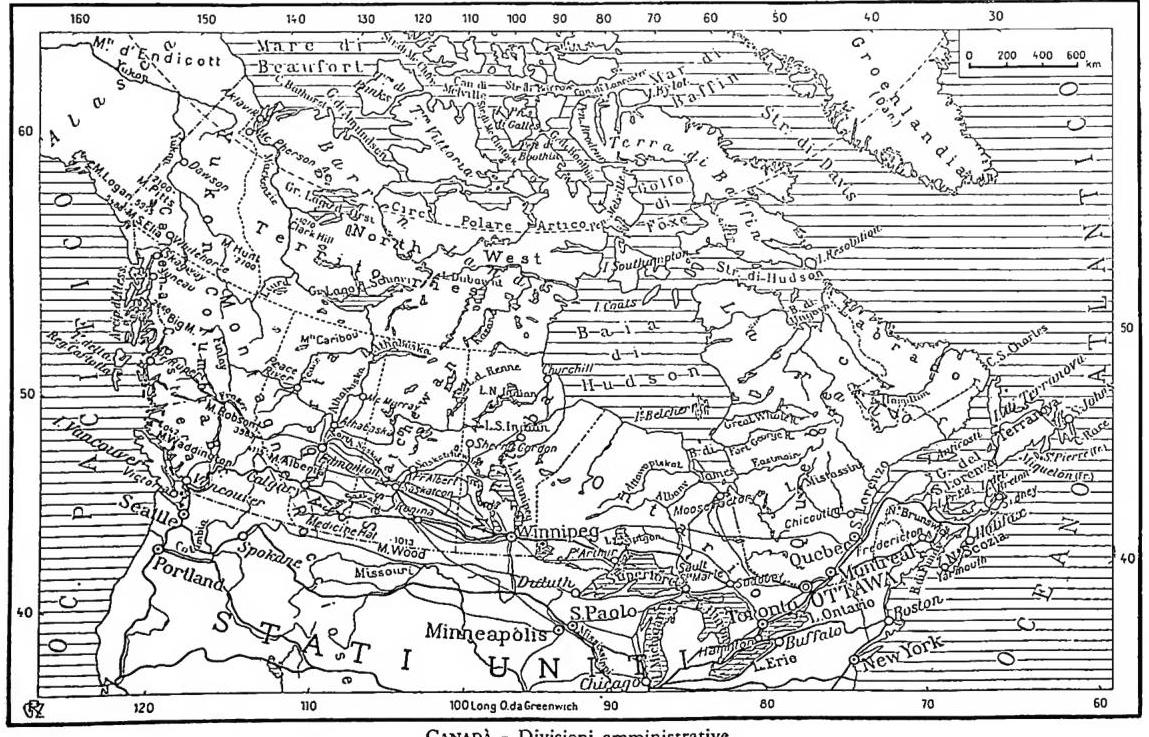
The vegetable landscape, which in this last zone is essentially reduced to tundra, gives way farther south to the forest stretching from the Pacific to the Atlantic over about one quarter of Canada (at least 330 million hectares, an area more than ten times that of Italy) and constituting one of the country’s greatest resources. Still farther south, in the inner zone poorer in rainfall, the forest is succeeded by the prairie, extremely fertile and now transformed into a magnificent cereal-growing and stock-raising region. Other notable resources are represented by fishing (even in inland waters; 160,000 persons are employed in it), by fur-bearing animals (for which indeed Canada enjoys world primacy; to hunting, now in decline, have been added artificial breeding), and above all by the treasures of the subsoil, not only varied and abundant but scattered in many places. For nickel, platinum and asbestos, Canada ranks first.
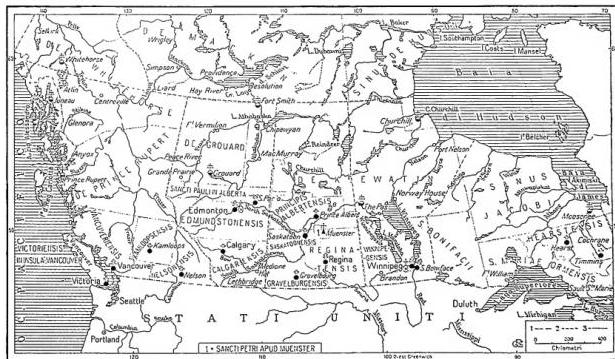
CANADA — Administrative Divisions.
Among world producers it also extracts gold, silver, cobalt, copper, radium, uranium, etc.; while its oil production is modest, it possesses abundant reserves of coal and iron, and vast water resources. It is therefore no surprise that Canada has experienced rapid industrial development in the last century, and although these industries are still young, they have already attained enviable prosperity (notably those in timber, foodstuffs, and chemicals, etc.). Alongside—and perhaps even more than—agricultural production, industrial output now makes Canada one of the richest regions in the world. Economic expansion has been facilitated not only by the abundance of space but also by Canada’s magnificent natural waterways, roads, canals, and railways (including transcontinental lines), which have been easily constructed, as well as by the ease of maritime communications afforded by its double ocean frontier with other countries.
The population, which—much as in earlier times—is concentrated especially in the south-eastern provinces (the St. Lawrence basin and the Atlantic region) and is spreading toward the central districts between Lake Winnipeg and the Rockies, where recent agricultural settlement is expanding, has more than doubled in the last fifty years (it was about 400,000 at the beginning of the 19th century and reached just over 5 million at the start of the present one). Nevertheless, with its 13,000,000 inhabitants (1947), it barely exceeds the population of the single urban agglomeration of New York. Of these, only 126,000—Indians and Eskimos—represent the original inhabitants of the continent; 3,500,000 are descendants of French settlers who settled along the St. Lawrence and the Great Lakes; 6,100,000 are of English origin, having increased especially in the 19th century; the remainder are immigrants of various nationalities, led by Europeans from Central and Eastern Europe (in 1941, citizens of Italian origin were estimated at 112,625). More than half of this population lives in urban centres: one city (Montreal) now exceeds a million inhabitants, one (Toronto) is approaching that figure, and six others have populations exceeding 100,000 (Winnipeg, Vancouver, Hamilton, Ottawa, Quebec, Windsor).
Canada was a federation of nine provinces and two territories, established in 1867 and recognized in 1926 as a Dominion within the British Commonwealth. By virtue of the agreement of 11 December 1948, the island of Newfoundland (which had constituted a separate Dominion, from which Labrador had depended since 1927) was constituted as a new province of the Canadian Dominion. Legislative power is exercised by a bicameral Parliament (a Senate of 102 life members appointed by the government and a House of Commons, or Chamber of Deputies, of 252 members elected for five-year terms by direct universal suffrage), while the Crown exercises executive power through the Governor General and the government. Each province, moreover, has its own parliamentary government for local affairs.
| Provinces and Territories | Area in sq. km | Population (1941 census) | Density per sq. km | Capital (population in thousands: 1941) |
|---|---|---|---|---|
| Prince Edward Island | 5,656 | 95,047 | 17 | Charlottetown (14) |
| Nova Scotia | 54,564 | 577,962 | 11 | Halifax (70) |
| New Brunswick | 72,478 | 457,401 | 6 | Fredericton (10) |
| Quebec | 1,539,778 | 3,331,882 | 2 | Quebec (151) |
| Ontario | 1,068,542 | 3,787,655 | 4 | Toronto (667) |
| Manitoba | 638,439 | 729,744 | 1 | Winnipeg (222) |
| British Columbia | 948,560 | 817,861 | 1 | Victoria (44) |
| Alberta | 661,160 | 796,169 | 1 | Edmonton (94) |
| Saskatchewan | 651,875 | 895,992 | 1 | Regina (58) |
| Newfoundland and Labrador | 417,477 | 305,600 | — | St. John’s (57) |
| Yukon Territory | 536,304 | 4,914 | — | Dawson (1) |
| Northwest Territories | 3,391,933 | 12,028 | — | (Ottawa) |
| TOTAL | 9,986,766 | 11,812,255 | 1 | Ottawa (155) |
Giuseppe Caraci
II. CIVIL HISTORY
1. Under the French regime (1534-1763)
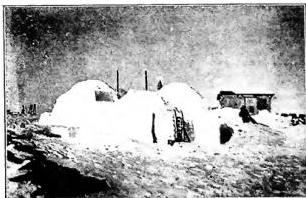
The discovery of the Canadian coast was probably made in 1497 by two Venetians in the service of Henry VII of England, Giovanni and Sebastiano Caboto, but they left no trace of their passage. In 1524 another Italian, the Florentine Giovanni Verrazzani, reached the Canadian coasts, but this time in the name of the King of France, Francis I, and gave the name of New France to the lands he discovered. However, the true discoverer of Canada was a French sailor, Captain Giacomo Cartier, who first took possession of it in the name of the King of France on 24 July 1534 (at Gaspé) and explored its interior (1535-36) as far as Québec (Stadacone) and Montréal (Hochelaga). From then on, that land took the name Canada, from the Huron word Kanata: Great Country. The first attempt at colonization (1541-43), carried out by Cartier under the direction of Francesco Roberval, could not, due to the wars in which France was then engaged, be continued until 60 years later by Samuel de Champlain, who in 1608 founded Québec and extended the discoveries and explorations of his illustrious predecessor. The struggle against the Iroquois and that against the English colonies on the coast, as well as the selfishness of the trading companies (Company of Rouen and the Merchants, 1614-20; Company of Caen or of Montmorency, 1621-27; Company of the Hundred Associates, 1627-63), to which the king had entrusted the dominion of the country, which they administered through a governor, appointed on their recommendation by the king and assisted by a kind of council, hindered the progress of the colony from its very beginnings. Nevertheless, in 1663 a new era of prosperity dawned with the replacement of company rule by royal government, the appointment of an intendant alongside the governor (the celebrated Talon was the first), and a sovereign council, to which was added the wise policy of the French minister Colbert. Québec, Trois-Rivières (1634), Montréal (1642), and Frontenac (1672; now Kingston) became the most important centres of the colony, while travellers and missionaries extended the dominion and power of France. European wars inevitably diverted the attention of the mother country; thus England and its Atlantic coast colonies took advantage of the Seven Years' War (1756-63) to seize Canada. Québec capitulated on 18 September 1759 and Montréal on 8 September 1760, while Acadia (Nova Scotia), another province of New France founded in 1605 at Port-Royal (now Annapolis, N.E.), had already been conquered in 1710. The Treaty of Paris of 19 February 1763 sealed the definitive cession to England of Canada and Acadia, along with Louisiana (the third and last province of New France).CANADÀ - Iglu (snow house) of the Eskimos.
(by courtesy of the Grey Nuns of Montreal)
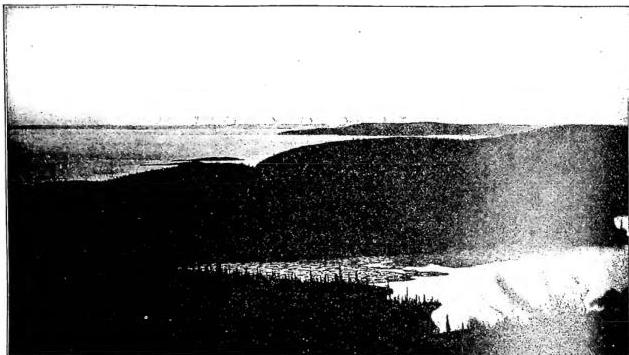
CANADÀ - The midnight sun in the Mackenzie. Position of the sun from 23.10 to 24.40 (at 10-minute intervals). Photograph taken north of Aklavik, Arctic Circle, by Sister Léonie Ferland, general secretary of the Grey Nuns of Montreal.
France, founded on the Mississippi in 1699, whose western part had already been ceded to Spain in 1762 by secret convention. By the same treaty, France lost two other Atlantic possessions: the islands of Newfoundland and Cape Breton; of all New France, it retained only the islands of St. Peter and Miquelon.
2. Under the British regime (1763)
From that time, the new English colony, estimated at 80,000 inhabitants, passed under an absolute regime. Moreover, a royal proclamation of 7 Oct. 1763 endangered the nationality of the conquered country by replacing French laws with English ones and practically excluding Catholics from public office by imposing the oath of the "Test". Fortunately, British authorities gradually mitigated their intolerance. The Quebec Act of 1774 restored French law and dispensed with the oath of the "Test". On the other hand, the American Revolution (1774), which led to the declaration of independence of the United States (1776) and to the emigration of monarchists from this new republic to Canada (about 15,000 settled in the province of Quebec and mainly in that of Ontario between 1782 and 1785), as well as the unpopularity of the legislative council and the discontent of Canadians with the Quebec Act, which had established it, led in 1791 to the creation of two constitutional governments: one for the province of Lower Canada and Quebec (French), the other for Upper Canada or Ontario (English), each consisting of a governor, an elective Chamber, and a life-appointed Council. Meanwhile, in order to suppress Franco-Canadian nationality, the British Parliament, under pressure from fanatics and interested parties both in Canada and in England, decided to unite the two provinces under a single governor. On 23 July 1840 it passed the Bill of Union, which established a single government composed of a governor, an executive council (chosen by the Crown), a legislative council first for life and then, from 1853, elective, and an elective Assembly. However, the Bill failed in its anti-national purpose because the politicians of Quebec joined the reformers (liberals) of Ontario in demanding a responsible government, which they in fact obtained in 1849. From then on, the other English colonies in North America, which were also struggling for political independence, aimed at union with Canada. Thus, two of the maritime provinces, New Brunswick and Nova Scotia, decided to form a federation with the Canadian provinces of Quebec and Ontario. London approved this federal pact, and on 1 July 1867 the four provinces were solemnly erected into a confederation under the official name of the Dominion of Canada, with Ottawa as its capital. Subsequently, the federal government purchased from the Hudson’s Bay Company the northwestern territories, where, in 1870, it created the autonomous province of Manitoba. In 1871, British Columbia, the Pacific coastal province, likewise entered the federation, soon followed in 1873 by Prince Edward Island. Following this, in 1880, Britain deemed the moment opportune to annex to Canada all North American possessions except Newfoundland. From these new annexations arose in 1905 the provinces of Alberta and Saskatchewan, then in 1912 the organized territories of Yukon and the three unorganized districts of the Northwest Territories: Mackenzie, Franklin, and Keewatin. In 1948, the island of Newfoundland voted to join Canada.###
III. RELIGIOUS HISTORY
3. The antecedents (1534-1650)
ANTONIO and GUGLIELMO IL BRETONE, who are believed to have been secular priests and chaplains to GIACOMO CARTIER in 1535-36, are the first two known ministers of worship in the history of Canadian Christianity. Their immediate successors appeared in another part of New France, in Acadia, only in 1605; at the time of the founding of Port-Royal, where the abbé NICOLA AUBRAY (d. 1605) was succeeded in 1610 by GIACOMO FLÉCHÉ (d. 1611), and then by the Jesuits ENNEMONDO MASSÉ and PIETRO BIARD, who, in 1613, abandoned that house to found the missionary station of St. Salvatore on the Isle of the Desert Mountains. Unfortunately, its destruction and that of Port-Royal, which occurred in the same year, deprived Acadia of priests, as it was already lacking churches.4. The mission (1615-18) and the apostolic vicariate (1658-74)
Fortunately, Québec, founded (1608) in the heart of CANADA, offered more security and stability. Thus, in 1615, at the request of the founder CHAMPLAIN, four Franciscans were sent there by the Pope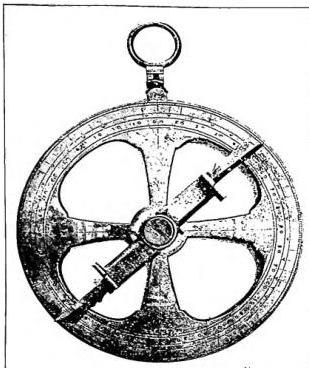
In 1632, the year of the restitution of C. to France, the Company of One Hundred Associates, which administered the colony, permitted only the Jesuits to return, but the Franciscans continued in Acadia, under the governorship of Lieutenant La Tour, the ministry begun in 1619, while Fr Joseph of Paris, the celebrated Grey Eminence, entrusted to his confreres
(courtesy of M. Pierre Brunet, Ottawa)
CANADA - Astrolabe of Samuel de Champlain, dated 1603.
Capuchins, at the request of his protégé Lieutenant De Rasilly, took charge of the mission at Port-Royal. Thus, with the continuous increase of colonists and missionaries, the mission of Canada gained new vigour. In 1635 the Jesuit college was founded at Québec, the first of its kind in North America; in 1639 the first religious women arrived, the Augustinian nuns of Dieppe for the care of hospitals and the Ursulines of Tours for the education of youth. At Montréal (Villemarie), founded in 1642 by Maisonneuve, the Institute of the Sisters of Our Lady was established in 1653 by the Venerable Marguerite Bourgeoys (q.v.); in 1657 a community of nursing sisters, the Hospitallers of the Hôtel-Dieu, was added, and in the same year the priests of St Sulpice took charge of the spiritual direction of the new city. Meanwhile, the missions among the Indians progressed, watered by the blood of the martyrs Jogues, Brébeuf and companions.
The year 1658 marks a new stage for the Church in Canada: on 11 April a decree of the Propaganda Fide erected the whole of New France into an apostolic vicariate, and on 3 June a brief of Alexander VII appointed as its first titular, with the episcopal title of Petra, the Venerable François de Montmorency-Laval (q.v.). The arrival of the Sulpicians at Montréal and the foundation of the seminary at Québec in 1663 were the first religious events of this period, which culminated in the return of the Franciscans in 1670.
5. The diocese (1674–1819)
In 1664 the king had requested the erection of the diocese of Québec, but it was only in 1670 that this was decided by a decree of the Propaganda Fide and carried out by a papal bull of 1 October 1674. The diocese, of which Mgr Laval, d. 1708, became the first bishop, comprised all New France, that is, all French possessions in North America. From then on, thanks to royal aid and tithes paid by the faithful, parishes multiplied and the life of the Canadian Church took on a more regular development. The cession of New France to England (1763) slowed this development. Indeed, while the peace treaty guaranteed full liberty to the Catholic Church, it left room for Protestant fanaticism through a clause subordinating such exercise to compatibility with English laws. Moreover, Canada had already lost its bishop, Mgr Henri du Breil de Pontbriand, three years earlier (June 1760). Nevertheless, although the English government did not then recognize the hierarchy organised by Rome, the Canadian clergy, relying on the religious freedom guaranteed by the treaty, insisted on securing a successor to Mgr Pontbriand. Finally, after long negotiations, the British government intimated to the candidate, Abbé J. O’Briand, who had gone to London to negotiate the matter, that they would turn a blind eye provided his consecration took place outside Canada and he did not assume the title of Bishop of Québec in the exercise of his episcopal ministry. Therefore, after his papal appointment, Mgr Briand was consecrated in France on 16 March 1766, and to ensure continuity in the Canadian episcopate, he obtained from Clement XIII, on 13 April 1766 and with the approval of the British authorities, the faculty to appoint an auxiliary with right of succession. He then entered the country, where the governor received him as superintendent of the Roman Church.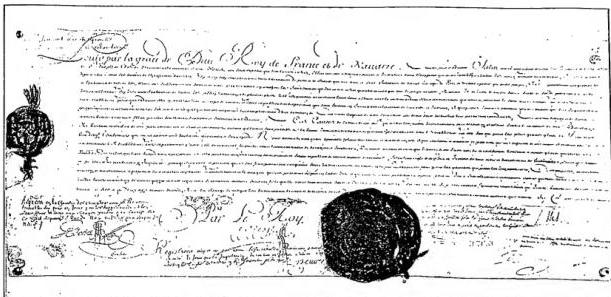
6. The archdiocese and ecclesiastical provinces from 1819 to the present day
On 30 May 1817 the apostolic vicariate of Nova Scotia (ancient Acadia) was erected; on 12 January 1819 Québec was elevated to an archdiocese andIda Sœur Mondoux, L'Hôtel-Dieu, premier hôpital de Montréal 1812-1812, Montréal 1812, p. 2315
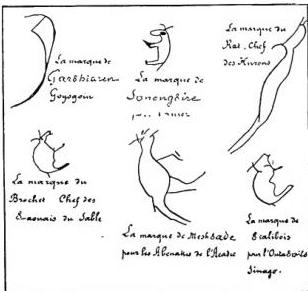
CANADA — Part of the autograph signatures of Indian chiefs affixed to the peace treaties with France, Quebec, 16 Oct. 1700.
CANADÀ - Letters patent of Louis XIV (8 Apr. 1669) for the Hospitaller Sisters of St Joseph of Montréal.
Archives of the Hôtel-Dieu of Montréal.
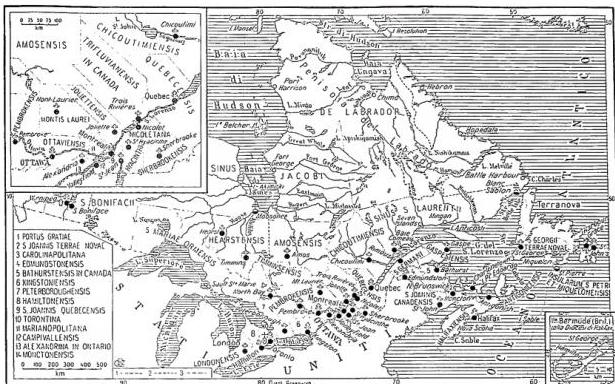
There were erected the vicariates of Upper CANADÀ (Kingston) and of Prince Edward Island, followed in 1820 by those of Montréal and of the North-West District, S. Bonifacio. However, prudently, only after the elevation of Québec to a proper ecclesiastical province (12 July 1844) did the archbishops of that city begin publicly to bear their title. From that time the six suffragan dioceses of Québec: Kingston (1826), Charlottetown (1829), Montréal (1836), Toronto (1841), S. Giovanni and Halifax (1842), were joined by those of S. Bonifacio and Arichat (1844), Ottawa (1847), etc., which soon formed new ecclesiastical provinces: Halifax (1852), Toronto and S. Bonifacio (1870), so that in 1909 the first Plenary Council of Québec could be held. Thus, thanks to the fecundity of French-Canadian families and to the immigration of Irish, Italian, German coreligionists, as well as to the arrival of the Oblates of Mary Immaculate in 1841 and the return of the Jesuits in 1842 and the Franciscans in 1890—whose communities had died out in CANADÀ following Anglican laws that forbade accepting new members—and thanks also to the rise of religious congregations, parochial schools, colleges and seminaries, and to the zeal of the Canadian clergy, the Catholic Church gained strength and spread into every province and territory of the confederation. In 1886 Québec had a cardinal and an apostolic delegation was established at Ottawa in 1899. Finally in 1908, CANADÀ, now fully organized, passed from the jurisdiction of Propaganda to that of the Consistorial Congregation. Eight apostolic vicariates still remain under Propaganda: Hudson Bay, James Bay, Gronard, Keewatin, Labrador, Mackenzie, Prince Rupert, Whitehorse.
IV. RELIGIOUS STATISTICS
1. Catholic Church — In 1947, out of a population of 12,582,000, there were 5,032,800 Catholics (about 70% French-Canadians, 12% Irish, 28.50% Germans, 2.40% Italians, 1.4% Indians and Eskimos). At the beginning of 1949 the ecclesiastical organization was as follows: 13 archdioceses, 12 metropolitan sees and one immediately subject to the Holy See; 33 dioceses and 8 apostolic vicariates, plus an abbazia nullius and apostolic exarchates for the Byzantine-rite Ruthenian faithful, divided as follows: Central Exarchate (Winnipeg), Eastern Exarchate (Toronto), Western Exarchate (Edmonton). The Eastern-rite faithful number over 300,000. The Apostolic Delegate resides in Ottawa. Five Catholic universities recognized by the State (of which Laval University in Québec is the oldest, founded in 1854) provide higher education, to which more than 50 classical colleges and minor seminaries prepare young men under the direction of secular and regular clergy. Each parish has its own primary school supported by the faithful. In 1931, 10,309 priests, of whom 3,689 were religious, exercised the sacred ministry in 4,335 parishes and mission stations, not counting the 500 Canadian missionaries in the Holy Land, Africa, the Indies, China, Japan and the Antilles. In 1937 there were 220 religious communities in Canada, 140 of them female, with a total membership of over 40,000.2. Protestant Sects — Under French rule Protestantism could not establish itself in Canada, since the king prohibited its activity in order to better protect the Catholic religion, which was the state religion. But with the advent of British rule and the great immigration of American Loyalists, Protestantism penetrated especially into Ontario and the Maritime Provinces, giving rise to the establishment of an Anglican see in Québec in 1793. Today Canadian Protestantism is divided into over 77 sects, the largest of which, in 1941, were the United Church (2,204,875), the Anglican (1,751,188), the Presbyterian (829,147), the Baptist (483,599), and the Lutheran (401,153). There are also 139,629 Greek Schismatics.
Corrado Morin
V. ART — Having only recently become a nation, CANADA does not possess an ancient artistic tradition; moreover, its political and geographical conditions have not allowed it to develop an independent profile within the international artistic panorama. Bordering on the United States of America and a British dominion, it has expressed in its artistic forms a close dependence on the two English and American civilizations.
As regards painting, prior to independence from French rule, there are some traces in the religious productions for churches and convents in the most populous centres, derived for the most part from those imported by French missionaries and repeated in popular styles of no great significance. There were a few other manifestations of an indigenous character, with references to Indian iconography, and the first notable painter of this trend was the Irish immigrant Paul Kane (1810–71), whose works remain in the Royal Ontario Museum in Toronto. Interest soon turned, however, to European works of art, of which excellent examples of Italian, French, Flemish and English art were to be found in the collection of Laval University, assembled by Joseph Legaré, who was also a good painter, during the French Revolution and on his travels in Europe. Towards the end of the 19th century, the first artistic societies were formed in CANADA, the most important of which, Mont-Art (1880), still exists today. Thus began the first exchanges of artists, and alongside the immigration of many Europeans—among them the Prussian Jacobi, the Englishman Fowler, the Frenchman Berthon, the Dutchman Krieghoff—there was a corresponding emigration of Canadian artists to Europe, especially to Paris and London. Among the interesting results of this was the formation around 1920 of the “Group of Seven,” comprising the young artists Harris, Jackson, Lismer, Johnston, Macdonald, Horsman Varley and Carmichael, who sought to reinterpret in contemporary language the grand wild landscapes of Ontario that had already inspired Tom Thomson, the singer of Canadian nature.
Canadian architecture may be said to have begun in earnest at the time of the Canadian Academy of Arts
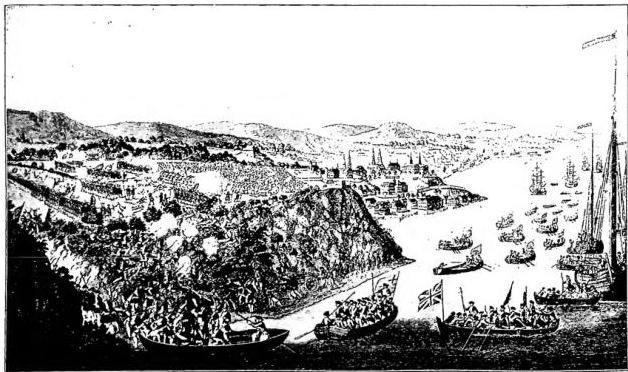
CANADA - Episode of the conquest of Quebec by the English (13 Sept. 1759). Print published by Laurie and Whittle of London (1797).
(1880) which included a group of nine architects. Previously, brief attempts more functional than anything else, produced buildings in which originality is rather to be sought in the adaptation due to the particular conditions of the climate. Generally utilitarian in character, private architecture had no significant episodes. More noteworthy may be considered some public buildings of the major cities, where a succession of easy fashions imported from time to time neoclassical, Georgian, neo-Gothic types of the Victorian era. At the beginning of the 20th century, American influence took over, from which only a few maritime and inland localities sporadically escaped, e.g. Halifax, which preserves traditional indigenous features in the Provincial Building, Montreal and Toronto.
Giovanni Carandente
VI. LITERATURE
While the United States now has a clearly defined literature, the same cannot be said of Canada, even though this vast country, partly at least bilingual, presents certain characteristics that ensure a distinctive position for its literary production, both in English and in French.The nature and the human environment of Canada are reflected in the lyric poetry of Isabella Valency Crawford (not without dialectal touches) and especially in that of Archibald Lampman (1861–1914). Among prose writers, particular mention should be made of Thomas Chandler Haliburton, creator of the typical character Sam Slick the Clockmaker, and William Kirby (1817–1906), author of a historical novel entitled Le Chien d'or or The Golden Dog.
In the field of French-Canadian literature, certain relations and historical works by Jesuits stand out, including the Histoire et description générale de la Nouvelle France by Fr. Charlevoix. A genuine poetic production in French Canada begins with O. Crémazie (1827–79); worthy of note are also L. Fréchette (1839–1908), who in Légende d'un peuple sang the epic tale of his land, and, among prose writers, J. Marmette, H. R. Casgrain, and especially J. P. Tardivel (1851–1905).
Echoes of 19th-century English poetry (Browning, Shelley) and distinctly local motifs are also found in more recent poetry. Among modern writers, W. W. Campbell, W. C. Bliss, and Ch. G. D. Roberts are notable. Adventure narrators include W. Wallace and Ch. V. GORGONE. English- and French-language writers, over time, reflect the evolution of their respective literatures. Among modern writers in French, A. Lozeau, E. Nelligan, A. Dreux, P. Morin, and A. Desilet have established themselves.
See also: INGHILTERRA (literature).
VII. SCHOOL SYSTEM
Since 1943 the Canadian school system has been taking on an increasingly national character, which is accentuated not only by pedagogical regionalism in the individual provinces—each of which enjoys broad freedom in its curriculum, including not only traditional subjects but also practical instruction in domestic economy, hygiene, sewing, and land cultivation—but chiefly by the inclusion of Canadian history in the programs as of 1943. Compulsory physical education at all school levels is another sign of this national spirit. The Canadian school system, however, lacks stability because of the aforementioned regionalism, and there are marked differences in the scholastic and cultural background of children and pupils. There is a perceived need to establish a Ministry of Education, which for the moment is in some ways being replaced by the Dominion Bureau of Statistics, which attempts at least a flexible unification of the school system and keeps the provinces informed through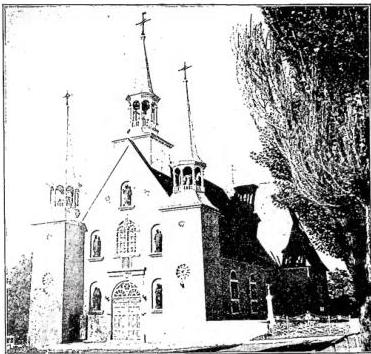
CANADA - Facade of the parish church of Sainte-Famille (I. O.), built in 1743. The central bell tower dates to 1843, the side towers to 1807.
Its Annual Survey of Education in Canada — In the individual provinces of Alberta, British Columbia, Manitoba, New Brunswick, Nova Scotia, Ontario, Prince Edward Island, and Saskatchewan, schools are inspected by special control boards or school trustees; in the province of Québec, oversight is exercised by a superintendent of public instruction assisted by a council of 35 members divided into two groups, one Catholic and one Protestant, corresponding to the two religions of the province. In all provinces, parents are free to establish minority schools, Minority schools, if they do not wish to send their children to the local majority-confessional schools. School attendance is compulsory from ages 8 to 14; religion, despite the confessional nature of the school, is taught freely, with the Catholic catechism used in Catholic schools and the Bible in Protestant ones.
The Canadian school system is divided into English-language and French-language schools, as the French-speaking population is guaranteed in the "Royal Proclamation" of 1763, among other rights, the establishment of schools in their mother tongue. Schools are divided into elementary (compulsory) schools lasting 7 or 8 years, followed by high schools. Secondary schools follow with a wide variety of programs. Higher education is provided by 20 universities, six of which are state-controlled. — V. Tav. XXXVII. Stumpf Miroslav