QUÉBEC, ARCHDIOCESE OF. - Archdiocese and city in the province of Q. (Canada, North America).
Q. covers an area of 19,000 sq. km with a
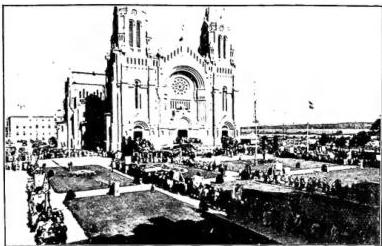
(mod. phot. E.N.B.G., Québec)
The history of the Archdiocese of Q. simultaneously marks the history of Catholicism in Canada and even in the whole of North America. The first European to reach this place was Jacques Cartier, and the city of Q. was founded by Samuel de Champlain in 1608. The first missionaries to arrive in Q. at Champlain's request were the Recollets, who had a chapel in Q. as early as 1615 and a convent in 1620-21. Shortly afterwards, in 1625, they were joined by the Jesuits. In 1617 the faithful numbered between 50-60, and in 1629 between 40-60. The missionaries depended directly on the Holy See. In 1629, following the English conquest, the missionaries were forced to leave the mission. In the year of its restitution to France (1632) only the Jesuits returned to Q.; at that time the Bishop of Rouen extended his jurisdiction over the colony. In 1633 the Jesuits opened the first college in North America, and the Ursulines arrived in 1639. On March 11, 1658, the Apostolic Vicariate of New France was erected. The Jesuits having refused, according to their Rule, to provide the first bishop, Msgr. MONTMORENCY-LAVAL, FRANÇOIS DE (v.) was appointed by Alexander VII as vicar apostolic with the title of Bishop of Petra. Msgr. Laval, consecrated on Dec. 8, 1658, arrived in Q. on June 21, 1659. A residence, called "the seminary," was built in 1662 and a minor seminary was founded in 1668. Students of the Seminary of the Child Jesus followed courses at the Jesuit college. The first parish of Q. was erected in 1664, and the parish church, begun in 1647 and consecrated in 1688, became the cathedral. In his first report to Rome (1660) the bishop counted 26 priests, 16 Jesuits, 8 churches and chapels in Q., 3 in Montréal, Trois-Rivières and Tadoussac, and 2,000 inhabitants.
In 1664 the King of France asked Rome to raise Q. to a diocese, which was granted in 1670 by a decree of the S. Congr. de Prop. Fide and by a papal bull dated Oct. 1, 1674. The diocese included the entire territory of New France in America, namely Canada, Newfoundland, Cape Breton, Acadia, St. John's Island, the entire Mississippi country and Louisiana. After the Treaty of Paris (1783) the Bishop of Q. retained all of Canada and Newfoundland. In 1683 there were 10,278 Catholics in Canada, 600 in Acadia, and 1,512 indigenous converts to the faith; in 1686, 44 priests, 12 theology seminarians, 43 Jesuits, 12
Recollets, 28 Ursulines, 26 Hospitaller Sisters of Mercy of Jesus, 16 Hospitaller Sisters of St. Joseph, and 13 Sisters of the Congregation of Notre-Dame. In 1684 Msgr. de Laval resigned; he later returned to Canada, where he died in 1708.
The diocese was elevated to an archdiocese by Pius VII on Jan. 12, 1819; there were 500,000 Catholics at that time. Q. was partitioned several times to create the other dioceses of Canada. The last partition took place on June 23, 1951, to form the Diocese of Sainte-Anne-de-La-Pocatière. In 1852, the Seminary of Q. founded the famous Université Laval (v. below).
The first Archbishop of Q. elevated to the sacred Roman purple was Msgr. Elzéar-Alexandre Taschereau (1871-98). Q. had three other cardinals: Louis-Nazaire Bégin (1898-1925), Raymond-Marie Rouleau O.P. (1926-1931), and J.-M. Rodrigue Villeneuve of the Oblates of Mary Immaculate (1931-47).
The sanctuary of Ste-Anne-de-Beaupré, which dates back to the 17th century, is famous; it has experienced tremendous development since 1675.
The curricula of Laval University were redone according to the requirements of the ap. const. Deus scientiarum Dominus and the University was approved again on September 8, 1936. At the time of its foundation, the University had only four faculties: theology, law, medicine, and arts. Today, 100 years later, it possesses 10 faculties with numerous annexed schools: the graduate school, the faculties of theology, philosophy, law, medicine (with the institutes of cancer, physiology, and the school for nurses), the faculty of arts (with the schools of music, pedagogy, domestic sciences), the faculty of letters (with the institute of history and geography), the faculty of sciences (with the school of pharmacy), the faculty of agriculture (with the school of fisheries), the faculty of social sciences (with the schools of social service, commerce, and the center of popular culture), and the faculty of surveying and forest engineering. There are also summer courses.
During the academic year 1950-51, students numbered 16,907, of whom 3,576 were in university courses, 651 in the graduate school, and 1,937 external students; professors number 750, of whom 150 are exclusively dedicated to teaching. The Library holds 374,290 volumes. The Canadiana collection is particularly rich.
The University is directed by a Royal Visitor and Apostolic Chancellor, a Rector Magnificus, a supreme council of vigilance composed of the bishops of the ecclesiastical province of Q., and a university council. Laval University has progressed greatly since 1920 and the number of students has necessitated an entire construction program. To this end, the authorities have decided upon the erection of a university city already in full development, and a public subscription started in 1948 yielded the sum of $10,600,
128. The celebration of the centenary in September 1952 was extremely solemn
See plates XII-XIII. Gastone Carrière