
SAINT JOSEPH. — Spouse of the Blessed Virgin Mary and putative father of Jesus (Heb. Jōsēph, apocopated form of Jēhōsēph, “May Jahweh add”; Gr. Ἰωσήφ, Lat. Ioseph, Iosephus), a preeminent figure in the history of Jesus’ infancy, upon which the Gospel narratives are centered. The few certain details about him are found in the first two chapters of Matthew and Luke, with a few fleeting references elsewhere in the Gospels. The apocryphal accounts, though of much lesser importance due to their markedly legendary character, have exerted a wide influence on tradition and art.
OUTLINE:
I. In Holy Scripture
II. In the Apocrypha
III. In theology
IV. In liturgy
V. In iconography
VI. In folklore.I. IN THE HOLY SCRIPTURES
The name of St. J. appears in the genealogy of Christ as a direct descendant of David (Mt 1:16), hence “son of David” (Mt 1:20; cf. Lk 2:4; 3:23 ff.), a messianic title legitimately transmitted by him to his legal Son, Jesus (v. GESÙ CRISTO, genealogia).Among the circumstances mentioned by Luke in the account of the Annunciation, the most important is that Mary, at the moment of the angelic message, was a virgin and at the same time bound to Joseph by a betrothal (Lk 1:27). The same is attested by Matthew (1:18), when he reports Joseph’s distress at the signs of his spouse’s maternity. Up to that moment was the Virgin “married” or only “betrothed” to Joseph? (the term desponsata, like the corresponding Italian “sposata,” lends itself easily to both meanings). The answer of tradition is not unanimous: the Greeks, for the most part, speak of betrothal; whereas the Latins, almost all, admit that the marriage had already been celebrated, with cohabitation in progress. But a careful exegesis of the evangelical text (Mt 1:18-23) allows us to exclude this second interpretation. Joseph, unaware of the mystery and troubled at the sight of his spouse become a mother, thinks of sending her away secretly (i.e., giving her a regular bill of divorce, but without publicity, cf. ibid. 1:19): at this point the angel appears, revealing the mystery of the virginal conception and enjoining him to “take Mary his wife” to himself; Joseph promptly obeys and “takes to himself (παρέλαβεν) his wife” (ibid. 1:20-24). With these words the concluding act of the marriage contract among the Hebrews is indicated, which comprised two distinct moments: the promise (betrothal) and the introduction of the spouse into the house of the spouse, which ordinarily took place after a year from the promise and was solemnly celebrated (cf. Jn 2:1). At the time of the Annunciation, and up to this moment, the two spouses did not cohabit (Mt 1:18 “antequam convenirent”): hence they were only betrothed. It must nevertheless be noted that betrothal, according to Hebrew custom, was a “promissio de praesenti,” and constituted essentially the marriage bond, making the spouses true conjugal partners even before cohabitation, which was the solemn and definitive seal of the marriage contract. In this way the honor of the Virgin and of her Son (for whom the Latin Fathers, ignorant of Hebrew customs, believed it indispensable to have the marriage celebration precede the Annunciation) was sufficiently safeguarded.
At the birth of Jesus (Lk 2:1 ff.), in obedience to the decree of the census of Augustus, J. moved from Nazareth, where he lived, to Bethlehem, the city of David his father. From this it does not necessarily follow that he was a native of Bethlehem: the reason for the journey indicated by the evangelist is his Davidic descent (ibid. 2:4). But the tradition of his Bethlehemite origin is authoritatively confirmed by St. Justin (Dial., 78, 10: PG 6, 637). In Bethlehem Jesus was born and laid in a manger, there being no place for them in the “inn” (Lk 2:7). Joseph was present with Mary at the adoration of the shepherds (ibid. 2:16), and after eight days, in the rite of circumcision (which was performed by the mōhēl, and not by St. J.; V. CIRCONCISIONE), he imposed on the Child the name Jesus, revealed by the angel (Mt. 1:21.25), thus inaugurating his paternal mission.
At the Presentation in the Temple it was J. who, in his capacity as head of the Holy Family, saw to the observance of the legal prescriptions: he went to Jerusalem with his spouse and assisted at the rite of Purification, also offering for the redemption of the Child a pair of turtledoves, the offering of the poor (Lk 2:22 ff.). He was present at the encounter with the pious old man Simeon, he was “blessed” together with Mary, and he listened to the fateful prophecy about the Son and the Mother (ibid. 2:34 ff.). After this event he probably returned to Nazareth, perhaps to settle his affairs (ibid. 2:39). After some months he is again in Bethlehem, at the time of the coming of the Magi: although the evangelical account (Mt. 2:1 ff.) does not mention J., there is no doubt that he was present at the adoration and received in his hands the gifts of those wise men. Immediately afterward, warned in a dream by the angel, he had to save the Child from the snares of Herod, taking refuge in Egypt (ibid. 2:13 ff.), where he stayed with the Holy Family until the death of the king, probably for a year. Warned again by the angel, he returned to the land of Israel (ibid. 2:19 ff.). This time he intended to settle in Bethlehem, but, admonished by the angel, he left Judea, which was governed by Archelaus, and returned to Nazareth, where he dwelt permanently with Jesus and Mary (ibid. 2:22 ff.), seeing the Son of God grow up before his eyes, in wisdom and grace (Lk 2:40, 52), who was subject to him (ibid. 2:51).
Of the long and silent period of Nazareth, which lasted until the beginning of the public life of Jesus (about thirty years), St. Luke narrates only one episode: the paschal pilgrimage to Jerusalem, when Jesus had reached the age of twelve (Lk 2:41 ff.). After the loss of the Child, Joseph and Mary anxiously searched for him and found him on the third day in the Temple. The paternal solicitude of J. is revealed very delicately in the words of the Mother: “Son, why have you treated us so? Behold, your father and I have been searching for you in sorrow” (ibid. 2:48). After this event the Holy Family returned to Nazareth: the rest, until the beginning of the public life, is described by the evangelist with the laconic phrase: “erat subditus illis,” Jesus was subject to J. and Mary (ibid. 2:51).
From the Gospels we know that J. practiced, together with Jesus, a manual trade: τέκτων, which the Vulgate renders faber (Mt 13:55; cf. Mk 6:3). What his specific trade was (faber lignarius, or ferrarius, or murarius?) has been debated since antiquity, since it cannot be determined exactly from the generic term used. Most commonly it is held to have been the trade of carpenter or joiner, an opinion that has solid support in tradition: apart from the testimony of the Apocrypha, already in the 2nd century St. Justin wrote that Jesus with J. made “ploughs and ox-yokes” (Dial., 88: PG 6, 888); the Syriac, Coptic, and Ethiopic versions also explain it in this sense. It is not excluded, however, that occasionally he also practiced one of the other related trades.
From these brief Gospel notices the moral figure of the Saint also emerges in some way: a most religious man, upright, industrious, obedient, gentle, tenderly devoted to Jesus and Mary. Moreover, in Mt 1:19 there is an explicit encomium, which is a panegyric: “cum esset iustus.” Even if we take the word in the restricted sense of a faithful observer of the law, the context reveals a justice that is accompanied by many other virtues: prudence, charity, gentleness, patience, faith, obedience.
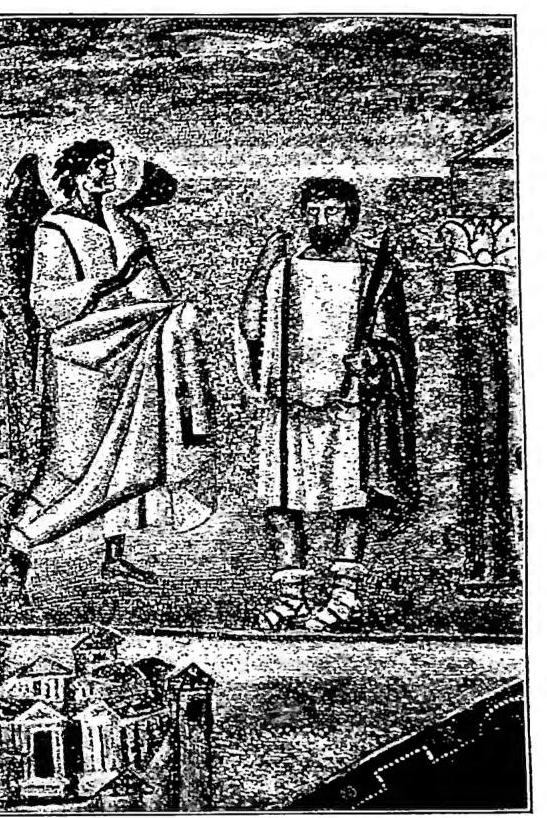
Nothing is known from the Gospels about the death of St Joseph. It probably occurred in the last years of Jesus’ hidden life. Certainly, he is completely absent during the public life, while mention is made several times of the Mother and even of the “brethren.” The very title “son of Mary,” sometimes given to Jesus by the people (cf. Mk 6:3), in a way confirms that the Blessed Virgin was then a widow. Moreover, the mission of St Joseph ended when Jesus and His Mother no longer needed a man to protect them in life and in honor. Naturally, Nazareth is thought of as the place of his death: the apocryphal History of Joseph (ch. 27) places his tomb in this city, as do the three Synaxaria—Alexandrian (with the date of death, 20 July, still preserved in the Greek liturgy), Arabic-Jacobite (same date), and Ethiopian (2 Aug.). In 1106, Abbot Daniel claimed to have seen the said tomb in the crypt of the Church of the Annunciation in Nazareth. In 1901, someone believed he had discovered St Joseph’s tomb in another part, outside the said church, about 60 meters west toward the hill. But both identifications lack any solid foundation (cf. U. Holzmeister [V. BIBLICA.], p. 109).
II. IN THE APOCRYPHA
Apocryphal literature has developed many legendary motifs around St. JOSEPH, not without interest for the influence they have exerted on tradition and art. The principal Apocrypha that deal with the Saint are: the Protoevangelium of James (2nd cent.); Pseudo-Thomas (probably 3rd cent.); Pseudo-Matthew (5th cent.); De nativitate Mariae; the Arabic Gospel of the Infancy; and particularly the History of JOSEPH the Carpenter (4th or 5th cent.; ed. C. Tischendorf, Evangelia apocrypha, Leipzig 1876, pp. 122-39: Latin version from the Arabic text; Coptic and Armenian versions also survive). The first five Apocrypha cover only the period of Jesus’ Infancy. The last purports to recount the story of JOSEPH in the very words of Jesus in a discourse with the Apostles; for the story of the Infancy it follows mostly the Protoevangelium of James and the canonical Gospels, but it includes its own accounts of the last days and death of JOSEPH, and is noteworthy for its ideas on the afterlife. According to these narratives, JOSEPH was first married at the age of forty to a woman named Melcha or Escha, with whom he lived forty-nine years and had four sons, who would later be called the “brethren of the Lord” (some Apocrypha add two daughters); the youngest was James, presumed author of the Protoevangelium that bears his name and a witness to the events of Jesus’ Infancy. Having become a widower at the age of eighty-nine, JOSEPH continued to ply his trade as a carpenter in Bethlehem, his native town, when he was sought out by the priests to be given in marriage to a fourteen-year-old maiden named Mary. As there were other suitors, the high priest entrusted the choice to divine will, which manifested itself through the miracle of the flowering rod, and, according to Pseudo-Thomas, through the appearance of a dove over JOSEPH’s head. The influence of this episode—especially the flowering rod, which is all the more suggestive for its symbolism—on the iconography of the Saint and Christian art is well known; one need only recall Raphael’s celebrated painting The Betrothal (Milan, Pinacoteca Brera). Two years later came the Annunciation; JOSEPH was absent. When he returned, signs of maternity were evident in his betrothed. Besides the Saint’s distress, the Apocrypha relate the episode of the ordeal of the bitter water (cf. Num. 5:11 ff.), which proved the innocence of JOSEPH and Mary. The narrative then proceeds through the other episodes of Jesus’ birth and infancy up to the age of twelve (the journey to Bethlehem, the flight into Egypt, the return to Nazareth, etc.), which correspond in substance to those of the canonical Gospels but are frequently annotated and amplified, with an exuberance of the marvellous that borders on the ridiculous. Some details are not only trivial but disrespectful toward JOSEPH: for example, the speech put into his mouth on arriving in Bethlehem (Protoev. of James, 17); at Nazareth he more than once finds himself embarrassed by the lively temperament of the boy and by His punitive miracles (Pseudo-Thomas, 3 ff.).According to the apocryphal History, JOSEPH would have died at the age of 111, after spending about twenty years with Jesus in Nazareth. In his last days the ailing man would have felt nausea toward food and drink and been seized by great distress; but Jesus consoled him, praying the Father to send the archangels Michael and Gabriel, who would receive his soul as it left his body, while his body, entrusted to the custody of two angels, remained incorrupt “until the feast of a thousand years” (C. Tischendorf, op. cit., pp. 126-37).
What is most jarring in the Apocrypha, beyond the frequent frivolous episodes, is the asserted decrepit age of JOSEPH at the time of his marriage to Mary. This is a legend that must be rejected, though it has taken hold in popular imagination even to this day. Perhaps at first it seemed a useful expedient to demonstrate to the simple in a clear way the perpetual virginity of the Mother of God. Yet it immediately reveals itself as paradoxical upon even a cursory theological consideration: the dignity and honour of Mary—whose virginal conception had to remain a secret—would not have been preserved if her spouse had been a decrepit old man of ninety; moreover, a man of such an age could not have been regarded as the father of Jesus. It was therefore necessary that between Mary and JOSEPH, at the time of their marriage, there should not be an insurmountable gap in years. These reasons, which after Suárez have been consistently adduced by theologians, also find solid support in the earliest representations (from the first five centuries), in which, as G. B. De Rossi first noted (Bullettino di archeologia cristiana, 3 [1865], pp. 25-32), and later R. Garrucci (Storia dell’arte cristiana, Prato 1873-81, tavv. 279, 280, 365, 417, 447, etc.) and G. Wilpert (Sarcofagi, tavv. 15, 20, 26, etc.), the Saint is never depicted as an old man but as a young or mature man in the full vigour of life, usually beardless. Only later, under the influence of the Apocrypha, did he begin to be represented with a beard and white hair and in senile guise (cf. Wilpert, Mosaiken, pp. 754, 763, 770). It is not possible, however, to determine exactly JOSEPH’s age at the time of his marriage to Mary; it probably ranged between thirty and forty. And if he died shortly before the beginning of Jesus’ public life, he must have been about sixty to seventy years old, considering that the hidden life at Nazareth lasted about thirty-two to thirty-four years.
Another disagreeable point in the Apocrypha is the first marriage and the consequent widowhood of St. JOSEPH; but on this see below.
III. IN THEOLOGY
In the patristic age, and even in the Middle Ages, Joseph was almost left in the shadows. One searches in vain throughout Greek or Latin patristic literature for even a single homily or discourse on the saint. The most prominent to speak of him are St. John Chrysostom and the author of the Opus imperfectum, but only incidentally, in their commentaries on Mt. 1:18 ff. Other Fathers do not fail to mention the saint when they deal with the genealogy of Christ. Frequent references or allusions occur in the writings of St. Augustine (especially in his discussions on genealogy, marriage, and virginity). St. Peter Chrysologus, St. Ephrem, and St. Bede speak of St. Joseph with great admiration, but only in passing phrases; the well-known saying of St. Ephrem is especially noteworthy: “No one can worthily praise St. Joseph” (Op. Syriaca, 3, 600; cf. Eph. Theol. Lovan., 5 [1928], pp. 221-24). St. Bernard, in his celebrated homily Super missus est, weaves a fine, albeit concise, panegyric on St. Joseph (PL 183, 60).Even among the great scholastics there is very little on St. Joseph. For the first homilies one must descend to the 15th century, which marks a great advance in doctrine and in the cult of St. Joseph: fifteen extended homilies are found, due to Cardinal Peter d’Ailly (d. 1420), to Gerson (d. 1429), and to St. Bernardino of Siena (d. 1444). In the 16th century the Summa de donis s. Ioseph of the Dominican Isidoro Isolani (q.v.) appeared at Pavia in 1522 and was reprinted many times until 1887 (the work of J. Seitz [q.V. BIBLICA.] gives an excellent account of the development of doctrine and cult up to the Council of Trent). After Trent, with the development of the treatise De Verbo Incarnato and of Mariology, and with the growth of devotion to St. Joseph, theology increasingly turned its attention to the saint, investigating and illustrating his prerogatives in the light of evangelical data and theological principles; even in exegetes, and above all in preachers and ascetical writers, interest in St. Joseph continued to grow (extensive bibliography in A. H. Lépicier, [q.V. BIBLICA.], pp. 363-73). Among theological treatments worthy of note are: P. Morales, In cap. I Matth., de Christo, S.ma Virgine... veroque eius Sponso, 2 vols., Paris 1869; a historical-scriptural dissertation De s. Ioseph published by the Servites in 1750 at Augsburg; V. Sedlmayr, Dissertationes de s. Ioseph (17 essays, in his Theol. Mariana, II, Munich 1758, pp. 420-57); A. Calmet, Dissert. de s. Ioseph (Opera, VII, Venice 1774); G. M. Schenck, De s. Ioseph, Augsburg 1850; P. V. MERCIER, DÉSIRÉ, St Ioseph d'après l'Ecriture et la tradition, Paris 1895; C. H. Jamar, Theologia s. Ioseph, Louvain 1897; G. Sinibaldi (q.V. BIBLICA.); A. H. Lépicier (q.V. BIBLICA.). Important for doctrine is also the work of G. C. Trombelli, Vita e culto di s. G., Bologna 1767. Also to be remembered are the two celebrated panegyrics of B. Bossuet (Œuvres, I, Liège 1862, p. 557 ff.), rich in doctrine, and the Élevations of St. Francis de Sales, Sur les vertus de st Joseph (Œuvres, III, Paris 1862). Among the great theologians, Suárez treats of St. Joseph in Disput. VII and VIII of his commentary on the third part of the Summa. The monographs on the cult of the saint likewise contain valuable theological considerations. Articles on the prerogatives of the saint, especially on his “fatherhood” and other special questions, are increasingly frequent in theological and biblical journals.
The points that most interest theology are the mission and the holiness of St. Joseph. His mission is essentially defined by his position as head of the Holy Family, particularly as spouse of the Blessed Virgin Mary and “father” of Jesus; from this follow special relations to the mystery of the Incarnation. An extension of his mission is his patronage over the universal Church.
1. Spouse of Mary
The title is explicitly contained in the Gospels: vir Mariae (Mt. 1:16, 19; cf. Lk. 2:4); it is the foundation of all Joseph’s greatness. The truth of this marriage is clearly attested in the Gospel, which calls Joseph “husband of Mary” (Mt. 1:19: ἀνήρ) and Mary “Joseph’s consort” (ibid. 1:20-24; cf. Lk. 1:27; 2:5). Joseph and Mary, already betrothed at the time of the Annunciation, then began to live together (Mt. 1:24) and continued to do so forever (betrothal and the taking of the bride into the bridegroom’s house: the two constitutive acts of marriage, with full effect, according to Jewish custom); they were therefore true spouses. No doubt would ever have been raised about this truth had it not been for the virginal character of this marriage itself. It was indeed ordained by God and accepted as such by the two spouses for the safeguarding and honor of Mary’s virginity and divine motherhood; hence the use of conjugal rights was excluded. For this reason some Fathers sometimes used expressions that might cause difficulty: thus, for example, St. Maximus of Turin: “Joseph was always the spouse of Mary, but not her husband” (PL 57, 639); similarly St. Jerome, St. Hilary, St. Ambrose, St. Gregory the Great, and St. Bernard.But their words can easily be understood in the proper sense, since they had primarily in view Mary’s perpetual virginity, and therefore, instead of the terms “husband,” “wife,” “marriage” (which ordinarily suggest the use of marriage), they preferred the more generic yet true terms “spouse,” “bride,” “espousal.”
Among the explicit deniers in antiquity was the Pelagian Julian of Eclanum, refuted by St. Augustine (PL 42, 810 ff.), and in the Middle Ages Gratian, whose erroneous opinion gave occasion to the scholastics to clarify the distinction between the consent of the spouses in the ius ad corpora, which constitutes the marriage contract, and the use of that right, which is not of the essence, since the spouses may renounce it, for one reason or another, for a time or in perpetuity (Peter Lombard, Lib. Sent., IV, dist. 30, 2 sqq.; St. Thomas, Sum. Theol., 3a, q. 29, a. 2; cf. J. Seitz [q.V. BIBLICA.], pp. 134-49).
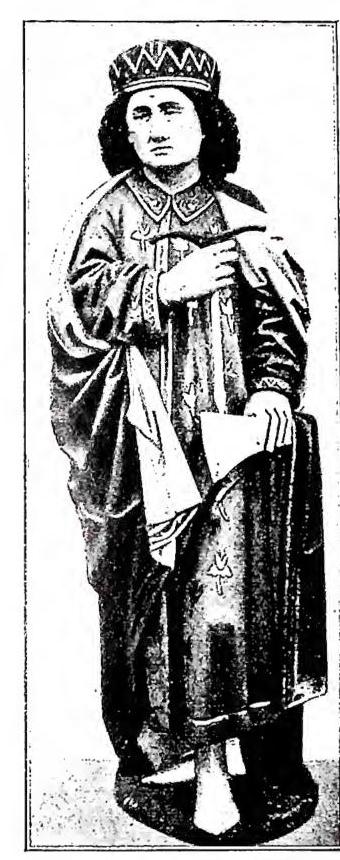
(from G. Braun, Tracht und Attribute der Heiligen in der Deutschen Kunst, Stuttgart [ed. fig. 16])
GIUSEPPE, santo — Polychrome wooden statue (late 15th century) — Dottighofen.
S. JOSEPH, Saint. — Spouse of the Blessed Virgin Mary and putative father of Jesus (Heb. Jōsēph,
Although virginal, and altogether singular and without precedent, the marriage of Joseph with Mary lacked none of its essential goods: the most perfect conjugal love, the most absolute fidelity, and even offspring: which, although conceived virginally by Mary without any share on the part of her spouse, may well be called the fruit of that virginal marriage, which was essentially ordered to that offspring.
2. Father of Jesus
Not only did the Blessed Virgin give S. Joseph the title of “father of Jesus” (Lk. 2:48), which might be explained by a delicate deference, but the same evangelist Luke (2:33) moreover calls the two holy spouses together “parents of Jesus” (2:27, 41-43). It is clear that, on account of the virginal conception of Christ, any true and natural paternity on the part of S. Joseph is absolutely excluded. The Evangelists plainly exclude any direct role of the spouse of Mary in the generation of Christ (cf. Mt. 1:18-25; Lk. 1:26-38). In particular, Luke takes care to note that Jesus was “reputed” the son of Joseph: “ut putabatur” (Lk. 3:23); hence he was not truly his son. But, while true and natural paternity is excluded, it must be acknowledged that S. Joseph exercised a paternity that is not fictitious, founded on a mere coloured title (as might at first sight be suggested by the cited text of Luke). It rests on a real foundation, namely his marriage with Mary, inasmuch as this was ordained by God for the sake of that offspring: a paternity improperly so called, but real. The Angel, in enjoining the Saint to give the Child a name (Mt. 1:21), confirmed the office and rights of this paternity, which was constantly exercised by Joseph and acknowledged by Jesus.Various titles have been proposed to designate this singular paternity: “putative” father, “nutritive” father, “adoptive” father, “legal” father, “virgin” father. None of them seems specifically appropriate, that is, capable of properly defining the character of this paternity in all its aspects. The most commonly used title, “putative” father, is based on the text of Lk. 3:23, but it is merely negative, excluding natural paternity, and says nothing more. The other title of “nutritive” father does not seem sufficient. Joseph was more than a mere guardian or foster-father, which is itself a title of glory for him. Undoubtedly he had from God for Jesus a father’s heart, as Bossuet expresses it, and his affection for the divine offspring was far greater than that of other fathers for their children; but affection and paternal care can exist even toward an outsider, whereas Jesus was certainly no outsider to S. Joseph. Less felicitous is the title of “adoptive” father: apart from the absurdity that a creature could adopt the Creator as a son, the fact remains that adoption is a positive, accessory act by which an outsider is received as a son into one’s family. Now Jesus was no outsider to the family of which Joseph was the head, nor was any juridical act required on Joseph’s part to establish his paternal relationship to Jesus: this was antecedent and innate, since Jesus from birth was the “son” of Joseph. The other title of “legal” father is quite true, but it has the drawback of having, for the most part, a strictly juridical sense. Nevertheless, if understood in its primary and fundamental sense, and with particular regard to the concrete case, it is fairly well suited. “Legal” paternity, in general, is that which derives its attributes from a prescription of law, and presents itself under various aspects and denominations. Even “adoptive” paternity, such as that of a guardian, is a legal paternity; likewise the paternity of a husband with respect to the children of his wife born of another marriage. But primary legal paternity is founded, by explicit recognition of the law, upon lawful wedlock, and is expressed in the well-known maxim enshrined in all legislations: “pater is est, quem iustae nuptiae demonstrant” (cf. CIC, can. 1115). The first consequence that follows from it, besides the rights of the father, is that the offspring is legitimate: that is, until the contrary is proved, it has the father who is justly recognized by the law, from whom it inherits name and goods. All this is important in the case of S. Joseph. He is the lawful spouse of Mary: in this marriage a son is born. Absolute honesty being safeguarded, yet with the veil of mystery remaining over the manner of his virginal conception, this offspring must have a father for the primary effects of the law. This father is Joseph: his paternity confers upon Jesus the honour of legitimacy. And something more: the first and fundamental messianic title, that of “son of David.” While other messianic titles might be called into question, no doubt could attach to this indispensable title. From whom did Jesus derive it? Not from his Mother, although in reality and truly through her he was descended from David according to the flesh (cf. Lk. 1:27, 69; Rom. 1:3): for juridically, and therefore for the purposes of messianic recognition, the mother’s status had no value for the child. Jesus derived the messianic title from the “father.” And when the Angel made known to Joseph his paternal mission toward the Messiah, he intentionally underscored this title: “Joseph, son of David” (Mt. 1:20). For this reason the paternity of Joseph rises far above the merely legal: it is not only a “legitimate” paternity, but in a certain sense “messianic.” He was the necessary vehicle for the transmission of the messianic title “Son of David” to Jesus. This paternity far transcends the commonly so-called legal paternity, which implies merely a juridical relationship. Its foundation, altogether singular, is the divine preordination of the marriage with Mary for the birth and protection of the Incarnate Word, with a real though indirect and moral cooperation on the part of S. Joseph. Yet he cannot be called the father of Jesus in the obvious and proper sense of the word, as has sometimes been
Saint Joseph, saint. — Spouse of the Blessed Virgin Mary and putative father of Jesus (Heb. Jōsēph, Gr. Ἰωσήφ, Lat. Ioseph), was chosen by God to be the virginal spouse of the Mother of God and the putative father of the Incarnate Word, in order that he might watch over and protect the mystery of the Incarnation.
The divine preordination of his marriage with Mary was entirely singular, being ordered to the birth and protection of the Word Incarnate, with a real, albeit indirect and moral, cooperation on the part of St Joseph. Yet he cannot be said to be the father of Jesus in the ordinary and proper sense of the word, as has sometimes been suggested, even by some Catholics, for which reason the virginal conception is an unassailable dogma. It may seem a matter of words; but in dogmatic matters it is well to avoid expressions and terms that lend themselves easily to misunderstanding. However sublime and excellent this paternity may be, and however superior in dignity to that of ordinary parents, it remains within the realm of paternities improperly so called: paternity in the full and proper sense of the word is unique, namely that founded upon generation (cf. R. Garrigou-Lagrange, in Angelicum, 22 [1945], pp. 109 ff.). Some unfortunate attempts, not well reconciled with dogma, have received due censure (cf. Monitore eccl., 2ª serie, 19 [1907], p. 361, regarding the opinion of G. Corbató, who advocated a real and proper paternity of St Joseph; Divus Thomas [Piacenza], 5 [1928], pp. 41 ff.; R. Petrone spoke of a positive instructional cooperation of St Joseph in the virginal conception; the article was reprobated by the Holy Office; cf. ibid., p. 361).
Recently the title “virgin father” has been proposed as more appropriate (J. Renard; G. Breynat, for whom this is the only specific title appropriate; J. Müller; U. Holzmeister; there is also a jaculatory prayer indulged by Pius X in 1906). This is acceptable insofar as St Joseph is a part, together with Mary, of that virginal marriage in which the divine offspring was miraculously born. Yet it does not seem the most appropriate title: its impropriety arises from comparison with the analogous title “Virgin Mother of Jesus.” In conclusion, as L. Billot remarks (De Verbo Incarn., Rome 1927, p. 400), there is no proper and specific title in our vocabulary for the singular paternity of St Joseph. Therefore one may use any of the many titles handed down by tradition or Christian piety. It is well to retain, without excluding the others, the most common title of “putative father,” however negative and inadequate it may be: its very indeterminacy makes it preferable, since while it denies the relation of natural paternity, it excludes none of the real attributes that belong to this singular paternity.