
GIACOMO. – It Giacobbe (v.). From the Greek Ἰάσοβος derive Iacobus, Jacopo, and G. In the New Testament, two Apostles bearing the name G. are listed: G. of Zebedee, or the Greater, and G. of Alphaeus. The latter is probably to be identified with G. the Less (the brother [cousin] of the Lord).
I. G. THE MAJOR. — Apostle, son of Zebedee and Salome (Mc. 15, 10, cf. Mt. 27, 56), brother of John the Evangelist. Called by Jesus while he and his brother were occupied in mending the nets beside the lake of Genezareth, he left his father, the boat, and the hired men (Mt. 5, 21 sqq.; Mc. 1, 19 sqq.; Lc. 5, 10 sqq.). In the list of the Apostles in Mc. 3, 16-19 he occupies second place; in those of Mt. 10, 2-4; Lc. 6, 13-16; Act. 1, 13, third place (after Peter and Andrew).
Together with Peter and John, he was among the privileged: he witnessed the raising of Jairus’s daughter (Mc. 5, 36), Jesus’ agony in Gethsemani (Mt. 26, 37), and asked for information about the end of the world (Mc. 13, 3 sqq.). Because of their impetuous character, the two brothers G. and John received from Jesus the nickname “sons of thunder” (v. BOANERGES): Mc. 3, 17; they called down fire from heaven upon the Samaritans (Lc. 9, 52-56) and aspired to the foremost places (Mc. 10, 35-40; cf. Mt. 20, 20-23).
G. the Major was beheaded Herod Agrippa I (v.) around 42 (Act. 12, 2); while he was being taken to the place of martyrdom, he is said to have converted his companion (Clement of Alexandria, Hypot., VII, apud Eusebius, Hist. eccl., II, 9: PG 20, 157).
According to a legend disseminated by Isidore of Seville (De vita et obitu Sanctorum, 71: PL 93, 151), G. the Major is said to have evangelized Spain and to have composed the Epistola di G. (v. below).
His body is venerated at Santiago de Compostella; it is said to have been discovered by Theodore of Iria in the ninth century. His tomb is a destination for pilgrimages, especially renowned from the tenth to the fifteenth centuries. He is the patron saint of Spain. His feast is commemorated on 25 July in the Martyrologium Romanum; formerly on 27 December, then on 30 April (among the Greeks), 12 April (among the Copts), and 28 December (among the Armenians).
Pietro De Ambrozzi
FOLKLORE. - The extraordinary importance that the sanctuary of S. G. at Compostella, a destination for pilgrimages from throughout Europe, enjoyed in the Middle Ages has left notable traces in popular tradition. The “Milky Way” is still called the road of S. Jacopo. The mira-
cles performed by the Saint inspired Latin hymns, a Provençal mystery play, a Tuscan sacred drama, and a “history” in ottava stanzas, preserved in Cod. 363 of the Vittorio Emanuele Library in Rome (published by Menghini and reprinted by Battelli: V. BIBLICA.). The memory of his miracles still survives in oral tradition, as demonstrated by a prose legend collected in Val Gardena and a Calabrian “history” in hendecasyllables.
The Saint, patron of pharmacists, druggists, hatters, and hosiers, is invoked against rheumatism and for fine weather. - Vedi tav. XXVIII.
In the lists of the Apostles, G. son of Zebedee (v.) is distinguished from G. son of Alphaeus (Mt. 10, 2-4; Mc. 3, 16-19; Lc. 6, 14-16; Act. 1, 13). S. Luca, in his lists preserved in the Gospel and in the Acts, also lists an apostle called Judas of G., which is commonly interpreted as “brother of G.” In the other lists, however, instead of this Judas of G., one finds Thaddeus (or Lebbaeus; V. GIUDA TADDEO).
Among the reasons that lead to identifying G. the Lesser with the Apostle of the same name, son of Alphaeus, are the following. The author of the Acts, who in the aforementioned list (1, 13) distinguishes two Apostles called G., after speaking of the martyrdom of the first (Act. 12, 2) continues to speak of another G. who enjoys great authority in the Church of Jerusalem (ibid. 12, 17), who at the Council proposes
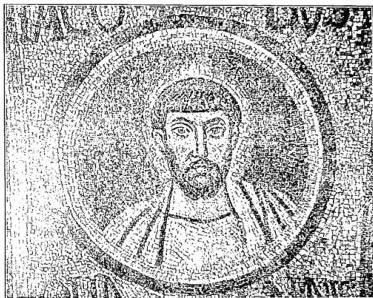
GIACOMO — Mosaic bust of the Apostle G. the Greater. Chapel of S. Andrea (6th century) — Ravenna, Archbishop’s Palace.
The inhabitants of Nazareth said of Jesus: “Where did he learn this? Is this not the son of Maria and the brother of G. and Giuseppe (Iosè), and of Giuda and Simone?” (Mc. 6:3 ff.). Among the pious women present on Calvary, s. Marco (15:40) mentions “Maria Maddalena and Maria [mother] of G. the Lesser and of Giuseppe (Iosè).” S. Giovanni (19:25) notes that, together with the mother of Jesus, there was his mother’s sister [called] Maria, wife of Cleofa (Klopás).
Many hypotheses have been advanced on the basis of these data. Some identify Alfeo with Cleofa (Klopás); others, following the indications of Egesippo cited by Eusebio (Hist. eccl., II, 23, 4–8), reconstruct the relationship as follows: Alfeo, of priestly origin, had by Maria two sons: G. (called of Alfeo, or the Lesser) and Giuseppe (Iosè). After Alfeo’s death, Maria married Cleofa (Klopás) in a second marriage; he was of priestly stock and the brother of s. Giuseppe, and she thus became the “sister,” in the sense of “sister-in-law,” of Jesus’ mother, who bore the same name. When Cleofa married Maria, he was already the father of Giuda and Simone. Thus G., Giuseppe, Simone, and Giuda became “brothers,” in the sense of “cousins,” of Jesus. Eusebio, referring to Egesippo, informs us that G., called “the Just,” lived an ascetic life and was the first bishop of Jerusalem.
According to Flavio Giuseppe (Antiq. Ind., XX, 9, 1), G. “the Just” was martyred by Anano (v. ANNAM, 2), the high priest who governed in the interim between the death of the procurator Festo and the arrival of his successor Albino, at Easter in 62.
The Latin liturgy celebrates the feast of s. G. (together with that of s. Filippo) on 1 May; the Greek liturgy commemorates G. of Alfeo on 5 Oct. and G., bishop of Jerusalem, on 25 Oct. The head of s. G. the Lesser is venerated in the cathedral of Ancona. The Saint is normally depicted with the fuller’s club, the instrument of his martyrdom.
III. EPISTOLA of G
The first of the seven Catholic epistles (v.) of the New Testament.There is no central theme developed according to a logical division. The principal ideas follow one another in this order: Chap. 1: “G., servant of Jesus Christ, to the twelve tribes [living] in the diaspora [wishes] joy” — Rejoice in suffering: ask God for this wisdom. — Temptation does not come from God, but from the passions; every good thing comes to us from God. — Hear and practice the word of God. Chap. 2: Do not show favoritism toward the rich. — Faith without works is dead. Chap. 3: Bridle the tongue. — True wisdom is charitable. Chap. 4: The cause of wars is the passions. Master them through charity and patience. — Avoid slander and rash plans. Chap. 5: Woe to you, rich, proud, unjust, and vicious men! — You who are oppressed, be patient, imitating the farmer, the prophets, and Giobbe. — Do not swear in vain. — Let whoever suffers pray. Let whoever is joyful sing psalms. — Let the sick person call the presbyters, who will administer Extreme Unction (v.). — Confess your sins. — Pray as righteous people. — Convert sinners.
The best interpreters see in G., author of the Epistola, the brother (cousin) of the Lord, probably to be identified with the Apostle called G. the Lesser, head of the church of Jerusalem. A Spanish
author (s. Isidoro di Siviglia: PL 83, 151; 85, 540; G. Sanchez, De profectione S. Iacobi in Hispaniam, 3), together with Dante (Par., XXV), attributes this Epistola to G. the Greater. But this opinion is untenable.
Some rationalists (L. Massebicau, F. Spitta, and especially A. Meyer, Das Rätsel des Jakobusbriefes, Giessen 1930) attribute this writing to an unconverted Jew of the 1st century A.D., who addresses the twelve tribes descended from him in G.’s name. — It is answered that the Christian character of the Epistola emerges not only from the words “Jesus Christ” (in 1:1 and 2:1, which, according to Meyer, would be glosses), but from the entire context, permeated by the spirit of the Sermon on the Mount.
The questions of its relationship to Paul, its date, its recipients, and its purpose, all much debated, are intimately connected with one another. G. writes: “Faith without works is sterile” (2:21). “A man is justified by works and not by faith alone” (2:24). Paul seems to contradict him when he writes: “We believed in order to be justified by faith and not by works of the Law” (Gal. 2:16; cf. Rom. 3:2 ff.). From the context it is clear that G. is not speaking of the works of the Mosaic Law; he assumes that his readers observe them and requires them also to perform the “good works,” those of charity, commended by the Sermon on the Mount. Without these, faith, regarded by G. as mere intellectual assent to truths, comparable to that possessed even by demons, does not justify and does not produce an increase of grace.
Paul, on the other hand, Judaizers (v.), who perhaps, misusing G.’s words, were proclaiming the necessity of observing the works of the Mosaic Law in order to obtain justification. He declares that, to obtain justification (initial grace), the works of the Law are not enough; what is required is living faith, activated by charity (Gal. 5:6), and therefore united with good works.
As can be seen, G. and Paul do not contradict one another, but use the same terms—works, faith, justification—with different meanings. From a comparison of the writings, it appears that G. wrote before Paul, to lax Jewish Christians who excused themselves from good works. The question of the legalists had not yet arisen. Thus the date of Giacomo may be placed before the Council of Jerusalem, between 45 and 49.
The Jewish-Christian recipients in the diaspora must have been those converted at a very early date and dispersed throughout Syria, Phoenicia, Cilicia, and Cyprus. They recognized the bishop of Jerusalem as their spiritual leader. It is possible that among the faithful of the diaspora G. also includes the converted Hellenistic Jews settled in Palestine. It does not seem, however, that he intended all Christians, as though “the twelve” tribes were equivalent to Paul’s “Israel of God” (Gal. 6:16).
The purpose of Giacomo is eminently moral, analogous to that of the Sermon on the Mount, and not anti-Pauline polemical, as Lutero supposed. Scholars who maintain Paul’s priority over G. date this Epistola as late as the end of the author’s life (after the Epistola ai Romani), or, in the case of non-Catholics, to a later period.
Giacomo is among the so-called deuterocanonical books of the New Testament. Eusebio lists it among the disputed books (antilegomena) recognized by many (Hist. eccl., III, 25).
(phot. Enc. Catt.)
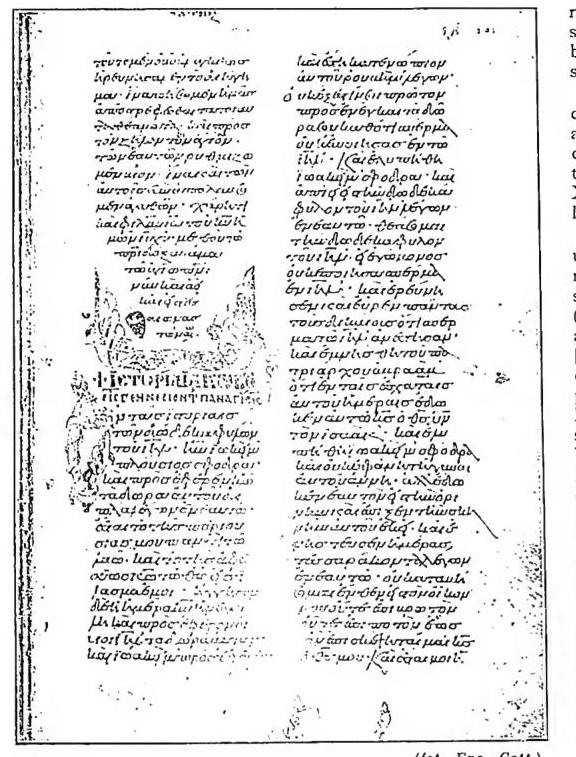
GIACOMO - Incipit of the Protovangelium of G., cod. Vat. gr. 455, fol. 201ʳ (10th century) - Vatican Library.
who is called the brother of the Lord,... wrote only one epistle, which forms part of the Catholic Epistles; it is asserted that... it was published by someone else under his name, although, gradually, in the course of time, it acquired authority» (De vir. ill., 2: PL 23, 609). After the 4th century, agreement regarding its canonicity was morally unanimous.
The Greek language is relatively elegant. Nevertheless, traces of Semitisms are not lacking. Perhaps G. himself made use of a secretary-editor who knew Greek well.
IV. PROTOVANGELIUM of G
An apocryphal work belonging to the series of the Infancy Gospels.18. Subject
It is developed in 3 parts. The 1st (chapters 1-16) recounts the birth of the Virgin GIOACHINO, SANTO (v.) ANNAM (v.), her presentation in the Temple, where she remained from the ages of 3 to 12, her betrothal to the carpenter Joseph, already the father of 4 children, the Annunciation, the visit to Elizabeth, and the husband’s perplexity, resolved before the tribunal by the trial of the bitter waters, which she passed brilliantly.The 2nd part (chapters 17-21) describes the marvelous circumstances accompanying the birth of the Savior: at that moment all life seemed suspended; an unbelieving midwife, Salome, who wished to ascertain the virginity in childbirth, was punished and then healed by the Newborn Child. The account of the coming and departure of the Magi conforms to Mt. 2.
The 3rd part (chapters 22-24, an appendix of a different nature) speaks of the massacre of the innocents: on that occasion the Virgin is said to have hidden the child in a manger, while Elizabeth is said to have found refuge with the little Giovanni in a cleft that miraculously opened
in the mountain. This is followed by the account of the murder of the high priest Zachariah, perpetrated by Herod, and a brief epilogue in which G. declares that he wrote this history.
19. Title
This title was given to the work by G. Postel, who brought a Greek codex from the East and published a Latin version of it at Basel in 1552. But neither that codex nor the others subsequently found elsewhere bears this title. Origen knew it as the Book of G. (In Mt., X, 17: PG 13, 867 ff.). Several manuscripts entitle it: History of the Nativity of Mary.20. Origin
In its present state, the work is the product of a compilation. The 1st part, from the birth to Mary’s marriage, certainly dates back to the 2nd century. Significant coincidences can be observed between Protox, 12, 2 and St. Justin (Dial. 5). The 2nd part, with its abrupt transition from the third to the first person (19, 2: «And I, Joseph, was walking [and was not walking]... »), presupposes another source: an apocryphal work by Joseph concerning the birth of Jesus. This part too belongs to the 2nd century. Clement of Alexandria knew the information concerning St. Joseph’s previous marriage and the ascertainment of virginity in partu (Strom., VII, 93: CB, III, p. 66). Origen learned from a book of G. that the brethren of the Lord were sons of Joseph by a previous marriage. The 3rd part, with the apocryphal legend of Zachariah, according to G. Bonaccorsi (v. BIBLICA., p. xxiii), cannot be later than the end of the 3rd century or the beginning of the 4th, because the Almunen papyrus (edited by E. Pistelli, Papiri della soc. ital., I, Florence 1912, pp. 9-16) dates from the 4th century and contains fragments of the final two chapters. E. Amann holds that the book, in its present form, is not earlier than the 5th century. Pope Innocent I (Ad Exuperium) excludes from the canon « cetera omnia quae sub nomine Matthiae, sive Iacobi Minoris » (Denz-U, 96). The so-called Gelasian Decree (492-95) excludes an Evangelium nomine Iacobi and a Liber de infantia Salvatoris et de Maria, vel obstetricis.The Protovangelium of G. intends especially to glorify Mary’s holiness and virginity in childbirth. Some have sought to discern Gnostic or Ebionite tendencies in II. But these are highly problematical indications. The best exegetes believe that the author, faithful to the Church, simply wished to satisfy the popular devotion of the faithful.
21. Latin Reworkings
There is no ancient Latin version of the entire Protovangelium of G., but several reworkings of it are extant. One is the so-called Pseudo-Matthew, which in Latin is entitled: Liber de ortu Mariae et infantia Salvatoris, a beato Matthaeo hebraice scriptus, et a beato Hieronymo in latinum translatus. In its first 17 chapters it depends faithfully on the Protovangelium of G.; it then adds information about the flight into Egypt and private life in Nazareth. It is a compilation from the 6th century. Another Latin reworking is the Gospel De nativitate Mariae, from the Carolingian period. It has toned down the inconsistencies of the Pseudo-Matthew. - Vedi tab. XXIX.Pietro De Ambroggi