
### ESTREMA UNZIONE (OLIO SANTO)
It is the Sacrament instituted by Jesus Christ for the spiritual and corporal relief of the faithful who are gravely ill.
### SEMINARIO
I. General Overview
II. Analysis of Particulars (matter, form, effects, minister, subject)
III. Liturgy
I. OVERVIEW
Around the year 60 A.D., St James the Less wrote to all converts from Judaism: “Is any one among you sick? Let him call for the presbyters of the Church, and let them pray over him, anointing him with oil in the name of the Lord; and the prayer of faith will save the sick man, and the Lord will raise him up; and if he be in sins, they shall be forgiven him” (Jas 5:14-15). This text attests the existence, from apostolic times, of a rite composed of an anointing (ἀλείψαντες αὐτὸν ἔλαιον) accompanied by prayer (προσευξάσθωσαν ἐπ’ αὐτόν), to which are joined supernatural effects both material and spiritual together (σώσει, ἐγερεῖ) and spiritual alone (κᾶν ἁμαρτίαι ὦσιν ἀφεθήσεται αὐτῷ). The rite was to be administered by the leaders of the Christian community (τοὺς πρεσβυτέρους τῆς Ἐκκλησίας) over a gravely ill believer (ἐν ὑμῖν ἀσθενεῖ κάμνοντα) according to the Lord’s command (ἐν τῷ ὀνόματι τοῦ Κυρίου).
This passage is so firmly structured in its core as to reveal the fundamental elements of a sacrament (divine institution, matter and form, spiritual effects, subject, minister), yet it is so vague in its details—it does not specify which oil to use, how many anointings to perform, or what words to pronounce—that one must conclude the Apostle intended not to introduce something hitherto unknown to the first Christians but simply to recall them to the observance of a practice whose particulars and inner meaning they had already learned in ordinary catechesis. This conclusion is confirmed by the fact that, had St James wished to introduce a new rite, the leaders of the Christian community entrusted with its administration would not have been able to derive sufficient instruction from so scanty a hint. We are therefore confronted with a written exhortation that presupposes an oral teaching whose origin must be traced back to Jesus Christ, all the more so because it concerns a rite productive of grace, which the Apostles could never have introduced except on the basis of precise prescriptions from the Lord. Thus the debated phrase “in nomine Domini,” though susceptible of other interpretations, seems to gain greater naturalness if understood as “according to the ordinance or command of Jesus Christ.”
From this it follows that the early Church possessed an anointing invested with all the marks of a sacrament. This historically demonstrable fact is the key to interpreting the patristic testimonies. Hence, whenever later documents contain allusions to the anointing of the sick, they may legitimately be regarded as links in a chain that begins with the passage of St James.
In the second century there are slight but precious hints in the Didache, 10, 7 (only in the Coptic fragment published in 1923) and in St Irenaeus, Adversus haereses, 1, 5 (PG 7, 663). In the third century the testimonies become more precise, appearing in St Hippolytus, Traditio Apostolica (text with commentary in A. Chavasse, L’Onction des infirmes dans l’Église latine du IIIe siècle à la réforme carolingienne, in Revue des sciences religieuses, 20 [1940], pp. 65-122), and in the Commentary on Daniel, 1, 33 (G. N. Bonwetsch and H. Achelis, Hippolytus Werke, 1, Leipzig 1897, pp. 44-45). Tertullian, De praescriptione haereticorum, 41: PL 1, 56, and especially Origen, Hom. 2 in Lev. n. 4: PG 12, 410. In the fourth century the documents become very clear: Afraates, Demonstratio, 23, 3 (Rouët de Journel, Euchologion Patristicum, 698); Scrapio, Euchologia (ibid., 1241); St John Chrysostom, De sacerdotio, 3, 6: PG 49, 644. In the fifth century there appears a papal document of exceptional importance: the letter of Innocent I (written in 416) to Decentius of Gubbio (text in Denz-U, 99), which clarifies many doctrinal and disciplinary points: a) the Pope provides the first authentic interpretation of the passage from St James: “non est dubium,” he says, that this text refers to the anointing of the sick, adding that the holy oil is prepared by the bishop: “ab episcopo confectum”; b) by the fifth century there existed a twofold use of holy oil, one sacramental, reserved to the ministry of the bishop and priests, the other private, so that all the faithful might use it for religious purposes “in sua aut suorum necessitate”; c) extreme unction can be administered only to believers who have duly performed penance—“paenitentia functis”—and is therefore considered a sacrament of the living, a complement to Penance, as Origen had already taught; d) the rite is called a sacrament “genus Sacramenti” in the proper sense, because it is placed on the same plane as the Eucharist; indeed the phrase “quibus reliqua Sacramenta negantur” certainly refers to the Eucharist, which is denied to penitents not yet absolved.
It was then that the Council of Trent, after thorough examination conducted during its sojourn in Bologna, promulgated in session c. 1551 the three chapters with their four canons (Denz-U, 907-10; 926-29), thereby definitively establishing the sacramental nature of this rite and enriching it with valuable clarifications. From that time Catholic theologians, in defence against the attacks of the early innovators and their successors (J. Daillé, G. A. Bengel, R. Pulleyn, modernists), upheld the dogmatic structure of the Tridentine Council, showing how it is rooted in the soil of Revelation.
II. ANALYSIS OF THE PARTICULAR ELEMENTS
After this comprehensive view, which establishes both historically and dogmatically the sacramental nature of Extreme Unction, its individual elements may now be analyzed.1. The remote matter of this Sacrament consists of:
a) olive oil, which, as Scripture attests: “Ungentes cum oleo” (Jas 5:14) and as the entire tradition—confirmed by the Councils of Florence and Trent—requires for the validity of the Sacrament. The Fathers (especially Victor of Antioch and Gregory of Nyssa) and the Roman Catechism explain its suitability based on the symbolism of oil (strength, healing, light, warmth);
b) blessed by the bishop, as is evident from liturgical tradition (Hippolytus’ Apostolic Tradition, Serapion’s Euchologion, Gregorian Sacramentary), patristic sources (Innocent I), conciliar decrees (Châlons 813, Quierzy 853), and confirmed by the Holy Office in 1611. The documents cited above prove that the blessing must be imparted by a bishop, but others demonstrate that this power may be granted to a simple priest: this refers to the Eastern discipline, which dates back to remote antiquity (7th century) and enjoys the approval of Clement VIII (1595) and Benedict XIV (1742), as well as the Western discipline established by Benedict XV during the war of 1914–18 and later incorporated into the Code of Canon Law (can. 945);
c) blessed “ad hoc,” that is, with a formula expressly intended to consecrate the oil of the sick, as all liturgical documents containing specific formulas seem to suggest (e.g., the Apostolic Tradition, Serapion’s Euchologion, the Gregorian Sacramentary). It is certain that this special blessing is necessary for liceity, but it is debated whether it is required for the validity of the Sacrament. Suárez favors the negative opinion and seems justified, since it is not established that Christ prescribed a specific blessing. Therefore, for validity, it suffices that the oil be blessed in some manner, so that, in case of necessity, other oils blessed by the bishop—such as holy chrism or the oil of catechumens—may be used.
2. The proximate matter is the application of the blessed oil, namely the anointing of the sick “ungentes cum” (Jas 5:14), which, according to the provisions of the Code of Canon Law for the Latin Church (can. 947 §1), must be applied to the eyes, ears, nostrils, mouth, hands, and feet—organs associated with sin (the anointing of the loins is always omitted). As St. Thomas observes (Summa Theol., suppl. q. 29, art. 2; q. 29, art. 6), the Church wishes to apply the remedy where the roots of evil lie. The Greeks, by contrast, anoint the forehead, chin, cheeks, and hands.
While these multiple anointings are required by ecclesiastical law, it is not established—as Benedict XIV already noted—that they are necessary by divine law; hence, in case of necessity, anointing a single sense, preferably the forehead, suffices, and it is permissible, for any reasonable cause, to omit the anointing of the feet. The anointing must be performed by the hand of the minister; instruments are not permitted except in cases of grave risk of infection or contagion (CIC, can. 947).
3. The form is a prayer “orantes... oratio fidei” (Jas 5:14–15), which varies in its wording across different rites. For the Latin Church, the Council of Trent sanctioned (Denz.-U., 908) the following formula, which appears only after the year 1000: “Through this holy anointing and His most merciful pity, may the Lord forgive you whatever you have committed through your eyes, ears, smell, taste, and tongue, through your hands and feet. Amen.” The Greek formula, however, is as follows: “O holy Father, physician of souls and bodies, who sent Your only-begotten Son, Our Lord Jesus Christ, to heal every disease and deliver us from death, heal also
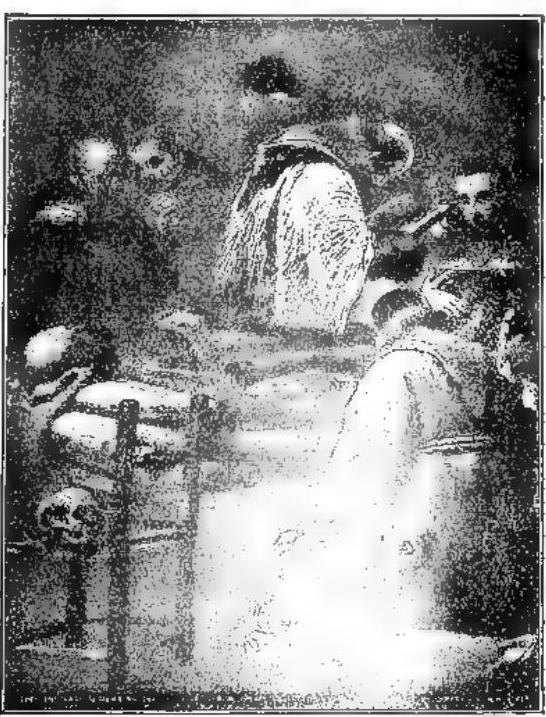
LAST RITES — Painting of the Last Rites by Giuseppe Maria Crespi known as “lo Spagnolo” (from the series The Seven Sacraments) — Dresden, Picture Gallery.
the servant N. N. from all the ailments afflicting him, and fill him with life through the grace of your Christ.”
4. Effects
The Council of Trent, summarizing the teaching of the Fathers, called the Last Rites “the consummation not only of penance, but also of the Christian life, which must be a perpetual penance” (Session XIV, opening, in Denz.-U., 907). The Last Rites are the consummation of Penance (consummativum paenitentiae) because:a) it completes incorporation into Christ, restored by the Sacrament of Penance. Indeed, by removing, on the one hand, the last remnants of sin, it removes the ultimate obstacles that hinder the perfect insertion of the member into the Mystical Body; on the other, by increasing habitual grace ex opere operato, it strengthens the bonds of union with Christ. Moreover, by disposing the sick person to suffer and die in Christ and for Christ, it associates and conforms individual members, as Bossuet observes, to the sufferings and death of the Head (the christological aspect of the grace of the Last Rites);
b) it strengthens the supernatural organism and renders it capable of overcoming the final weaknesses of the spirit, aggravated by the weakening of the body. Indeed, the wounds of original sin, healed in Baptism, and those of actual sins, healed in Penance, leave the spiritual organism of the faithful in many respects weakened, so that, when the collapse of the body devil (v.) occur, the person is exposed to the grave danger of succumbing in the final trial and thus jeopardizing the entire course of the Christian life. To avert such dangers, sacramental grace infuses new vigor into sanctifying grace, increases the virtue of hope, by which the sick person confidently entrusts himself to the hands of divine mercy, and multiplies the aids of actual grace, by which the dying person promptly repels the insinuations of the tempter. This is the “alleviatio” (of the Vulgate) or the “erectio, excitatio” (ἐγερσής of the Greek text) of which Jas 5:15 speaks. In the case where the sick person cannot confess, provided he has sorrow for his sins, this Sacrament also supplies Penance, remitting ex opere operato not only venial but also mortal sins, as the living magisterium of the Church has always understood, relying on the biblical text “et si fuerit in peccatis, remittentur ei” (Jas 5:15). Moreover, since the Last Rites are ordered to remove all obstacles that stand in the way of the immediate attainment of glory (cf. St. Thomas, Contra Gentiles 4, 73), it also remits temporal punishment for sin (assuming perfect disposition in the sick person) and sometimes even procures bodily healing (to which the verb σῴζει of Jas 5:15 alludes), when, according to God’s inscrutable judgment, this serves to facilitate the attainment of glory (anthropological aspect of the grace of the Last Rites).
c) It multiplies the Church’s solicitude for the suffering faithful. The dying person, now incapable of anything and in need of everything, abandons himself into the arms of the pious common Mother, who bends over him, enveloping his soul in an aura of prayers, recommendations, and supplications, summoning around him all the members of the Church militant, suffering, and triumphant: Angels and Saints, souls in Purgatory, and the just on earth are invisibly but prayerfully arrayed around the dying person, while the priest performs the sacred rite, the efficacy of which, as St. Thomas teaches, “plurimum valet devotio suscipientis et personae conferentis et meritum generale totius Ecclesiae” (Summa Theologiae, Suppl., q. 32, a. 3). In the light of this truth is conceived the wonderful poem by Cardinal Newman, The Dream of Gerontius, translated into Italian by B. Masperi, in C. Martindale, Lo spirito del card. Newman, Brescia 1934.
5. Ministers of the Last Rites are the “priests” (πρεσβύτεροι of Jas 5:14), not the elders of the people (as Protestants would have it), but bishops and priests duly ordained, as the Church has always understood and practiced (cf. Innocent I) and as defined by the Council of Trent (cf. also CIC, can. 938 § 1). From the fact that the biblical text uses the plural “the presbyters” (which is indeed a plural of category, so that the phrase “advocat presbyteros” is equivalent to “let him call one of the presbyters,” just as when one says “let him call the doctors,” it means “let him call one of the doctors”), there arose in the ancient Church, and still persists in the East, the custom of administering the Last Rites with the intervention of several priests, usually seven. According to current canon law in the Latin Church, the Last Rites must be administered by a single minister (ad reatum); and ordinarily this should be the parish priest, except in cases of necessity or with the permission of the parish priest himself or the local ordinary (can. 938–39).
The Sacred Congregation of Propaganda Fide has declared that even in cases of necessity, when no other priest is available, no missionary may administer this Sacrament to himself.
6. The subject. For valid reception, it is required that the subject be:
a) baptized, as is evident from Jas 5:14 “infirmatur quis in vobis?” i.e., among you, the faithful, and as is deduced from the entire sacramental economy, which is founded on Baptism. Even one who has recently been baptized may receive this Sacrament, because although Baptism cancels all sins, it does not remove that spiritual weakness which may compromise the soul in the final struggle;
b) in possession of the use of reason and with at least habitual intention of receiving this Sacrament. Infants and those perpetually insane, having never sinned personally, do not need this spiritual benefit;
c) gravely ill, as is evident from Jas 5:14–15 “ἀσθενεῖ τις,” and from Tridentine declarations. By “grave illness” is not meant an ailment that leaves no hope of recovery, but one that can lead to death. It is therefore a detestable error to regard Holy Oil as a precursor of death, whereas often, when administered while physical strength can still be restored without a miracle, this Sacrament is truly a messenger of life (cf. can. 944).
Although the Last Rites are not absolutely necessary (necessitate medii) for obtaining salvation, they must not be neglected (“nemini licet illud negligere,” can. 944).
The Last Rites cannot be administered to one who is in good health, even if near death, such as a soldier about to go into battle or a condemned person on the verge of execution, because a healthy person is in possession of his faculties and of other spiritual aids that he can easily apply, whereas the sick person lacks energy and needs the help of others.
III. LITURGY
5. Roman Rite
The rite for the administration of Extreme Unction is substantially that indicated by St James in his Epistle; the formulae and ceremonies, however, varied from region to region as time went on. “It was almost the final complement of Penance, and preceded Viaticum. In the early centuries it was not waited for, as today, until the sick person was at the point of death, but was administered as soon as the state of the sick began to cause anxiety. Very often, in the Middle Ages, as still today in the East, the sacrament of Extreme Unction was administered publicly in church, while the sick person sat or knelt before the priest. The present abuse of administering the sacrament at the last possible moment seems to have originated, besides from the ignorance and the languishing faith of modern times, also from the superstition that had become prevalent by the 13th century, namely that after the Holy Oil had been administered repeatedly it was no longer lawful to eat meat, to dance, or to live in the married state” (I. Schuster, Liber Sacramentorum, I, Turin 1932, p. 192).Little is known about the rites and prayers used in ancient times in the Latin Church: the first notice is given by the letter of Innocent I (of 416) to Decentius of Gubbio, but it only refers in general to the anointing and to the text of St James (5:14), and says nothing about the parts of the body to be anointed or the prayers accompanying the rite. More extensive are the prescriptions contained in canon 4 of the Synod of Nantes (c. 656), in the collection of the Capitularies of Benedict Levita (of 850), taken up again by Regino of Prüm (d. 915) and by Burchard of Worms (d. 1025), and the instructions to priests by Theodulf of Orléans (d. 821). From the 9th and 10th centuries onwards, however, there are numerous Sacramentaries and Ordines that report the formulae for the administration of Extreme Unction: Ordo ad visitandum et ungendum infirmum (M. Ferotin, Le liber ordinum, in Monumenta Eccl. liturgica, V, pp. 71-72); Ordo Romanus X (ed. J. Mabillon: PL 78, 1021-22); Sacramentarium Fuldense 10th c. (ed. G. Richter-A. Schönfelder, Fulda 1912, pp. 279-300). Since the formulae varied, the Roman Ritual of Paul V (1614) sought to introduce uniformity. Of the prayers contained therein, some had already been in use for a long time: e.g., the prayers “Respone fatiscentem...” and “Domine Deus, qui per apostolum...” from the 9th century; the others: “Introest” and “Domine sancte... aegris infundendo corporibus...” from the 10th century; the invocation “In nomine Patris... extinguatur in te omnis virtus diaboli...” is already found in Ordo X (9th century).
Amidst such variety, the rite has always contained, and still contains, the following central elements: 1) blessing of the sick person’s room. As he enters, the priest says: “Pax huic domui et omnibus habitantibus in ea” and sprinkles the room with holy water (sometimes also with incense: “cum odore incensi”; Sacram. Fuldense, n. 2504); this is followed by admonitions to the sick person. 2) Reconciliation and confession. The first, joined with the laying on of hands, recalls the present practice: “In nomine Patris... extinguatur in te... per impositionem...”; the second consists in the recitation of the Confiteor. 3) The anointing. The formulae vary: indicative: “Ungo te, ut...”; deprecative or optative: “Indulgent”; as today imperative: “Accipe”. The number of members to be anointed also varied, from 7 to 14: “ubi plus dolor imminent”, “ubi maximus dolor” (cf. Franz, op. cit. in bibl., p. 80). No one is anointed on the forehead, nor are priests anointed on the palms of the hands, since these have already been anointed respectively in Confirmation and in Ordination. Already Theodulf ordered the anointings to be made in the form of a cross; several priests took part: “perungant singuli sacerdotes infirmum”, “item ab alio sacerdote” (Sacram. Fuldense, n. 2410) and they were repeated for 7 days: “et sic septem continuos dies” (ibid., n. 2445). Then a Mass was said for the sick person, who received Communion: “Hinc cantetur Missa pro eo. Deinde communicat cum sacerdote corpore et sanguine Domini” (ibid., n. 2445). Today Communion precedes the anointing. 4) The solemn final blessing by all the priests present: “Dominus Iesus Christus apud te sit..., circa te sit” (ibid., 2451); then a cross was given to the sick person: “Deinde aquam benedictans, nisi aliam habeat et Crucem coram eo relinquat” (Roman Ritual).
These four elements, though simplified, are still found today. Already the Euchologion of Serapion of Thmuis (d. after 359) contains a formula: “oratio pro oleis et aquis” (“ut omnis febris et omne daemonium et omnis morbus per potum et unctionem removeatur”). In the Roman rite the formulae for the consecration of the Oil of the Sick, made by the bishop in the Mass of Holy Thursday, are found both in the Gelasian and in the Gregorian Sacramentary.
6. Eastern Rites
Among all the Eastern rites, with the exception of the Nestorians, the traditional rite of Extreme Unction is very long.In the Byzantine rite, after the opening prayers, the canon of Arsenius is recited or sung (probably bishop of Corfu in the 9th century), that is, a long hymn celebrating the virtues of the Holy Oil. It is a vestige of the time before the 13th century, when the vigil (Vespers and Matins) preceded the administration of this sacrament. Then seven priests recite together the prayer for the blessing of the Oil; the Oil is pure olive oil, sometimes mixed with a little wine. This is followed by the singing of several troparia in honour of saintly martyrs and wonderworkers, which were formerly sung while the sick person entered the church. Then the sevenfold office begins. After the prokimenon the deacon reads the first epistle and, after the alleluia, the first priest reads the first Gospel, the little ectenia and the first prayer; then he anoints the sick person. There are different usages in the choice of the members to be anointed, but the forehead is always anointed first. During the Extreme Unction the priest recites this prayer: “Holy Father, physician of souls and bodies, who sent your only-begotten Son Our Lord Jesus Christ to heal every sickness and to deliver from death, heal also your servant from every infirmity, both corporal and spiritual, by the grace of your Christ, and preserve the life of this man who, according to your good pleasure and for his good works, will render you the thanks that he owes you; through the prayers of our Lady the Mother of God...”.
The same sequence—prokimenon, epistle, alleluia, Gospel, litany, prayer, anointings with the deprecative formula—is repeated, with varying texts, by the second to the seventh priest; then they place the Gospel and their hand on the head of the sick person while the first priest recites a prayer; with a short litany of supplication they proceed to the apoisa, after which the sick person asks for forgiveness and prayers.
In the Armenian, Maronite, Coptic and Ethiopian rites, the ceremony comprises seven similar offices, but the anointings are performed once, after the end of these offices; the Syriac rite has five similar stations; only the Chaldean rite does not follow this system.
È evidente che quel rito lunghissimo non è per i moribondi, ma per infermi offerti da una malattia che mette la vita in pericolo, e può quindi eseguirsi anche in chiesa. Dai Bizantini è chiamato Ufficio dell'Olio Santo o Preghiera dell'Olio; negli altri riti, Ufficio della Candela. Ma è evidente che un tale rito è suscettibile di abbreviazioni, e si può eseguire con un minor numero di ministri, anche da uno solo; di più i cattolici di tutti i riti conoscono la maniera brevissima di dare il Sacramento con una sola unzione ed una sola formola. Inoltre, i cattolici dei riti armeno, siro-caldeo, malabarese, copto e etiopico hanno adottato, come rito ordinario, una versione dell'ordo latino, mentre i dissidenti di questi riti continuano ad adoperare - in pratica però ben raramente - la lunghissima officiatura. Presso i nestoriani non sembra esistere l'E. U., almeno che non la si voglia riscontrare nell'unica orazione che il sacerdote recita sull'Olio destinato ai malati; però di un rito di unzione con una formola propria non v'è traccia nei loro libri.
Bisogna osservare che in parecchie Chiese orientali, il rito dell'Olio Santo si quello della Candela si dà anche ai penitenti e allora, quasi sempre, viene cambiata od omessa la formola dell'unzione. Forse così si potrebbe spiegare che l'Olio Santo è amministrato non raramente anche ai sani di corpo.
Per i riti non bizantini, si trova la versione latina dei testi in H. Denzinger, Rites Orientalium, II, Würzburg 1863, pp. 483-525; per gli Armeni si completerà, per l'unzione stessa, con G. de Serpos, Compendio storico... della nazione armena..., III, Venezia 1786, pp. 307-309; P. Dib, Etude sur la liturgie maronite, Parisi 1919, pp. 129-309; T. M. Sembaray, De Sacramenti secundum ritum Archiepicum, Roma 1931, pp. 83-99; C. Kopp, Glaube und Sakramente der haptischen Kirche, ivi 1932, pp. 158-175; W. de Vries, Sakramententheologie bei den syrischen Monophysiten, ivi 1940, pp. 311-24; id., Sakramententheologie bei den Nestorianern, ivi 1947, pp. 281-83. Alfonso Raca