
LAW. - In general, it indicates the "constant form" that becoming must assume, whether in physical phenomena (physical law) or in human actions (moral and juridical law); in the first case, law constitutes the realm of regularity in nature, while in the second, it founds and realizes the moral and juridical order of human life. In the dynamic order of beings, law corresponds to the proper essence of things in their absolute structure and actualizes the inherent tendency of every nature to strive toward its own perfection: the content of laws and the manner of their realization therefore depend on their respective essences.
CONTENTS:
I. General concepts and classifications
II. Ecclesiastical law
III. Civil law.I. GENERAL CONCEPTS AND CLASSIFICATIONS.
In the strict sense, law is opposed to freedom and does not exist in the sphere of man's free actions, but only to stimulate and regulate the exercise of individual freedom within the concert of social life; in this sense, law is distinguished from "nature," which is an intrinsic principle that necessitates action in a constant and uniform manner, as St. Thomas teaches: «Actus irrationalium creaturarum, prout ad speciem pertinent, diriguntur a Deo quadam naturali inclinatione, quae naturam speciei consequitur» (C. Gent., III, 114). In its common essence, law is therefore defined as: «Regula et mensura actuum secundum quam inducitur aliqua ad agendum vel ab agendo retrahitur» (Sum. Theol., 1a-2ae, q. 90, a. 1). Law is not properly an act of the will, but of reason, and specifically of the practical intellect, of which it constitutes the fundamental act: «Secun-
(At W. Neuss, Die Kunst der alten Christen, Augusta 1870, pg. 170)
LAW – Moses receives the tablets of the law; reading from the altar to the people, tabernacle; Moses, Joshua, Aaron, Nadab, Abiu. Miniature from the Ashburnham Pentateuch (7th century) – Paris, Bibliothèque nationale, Nouv. Acquisit. lat. 2334.
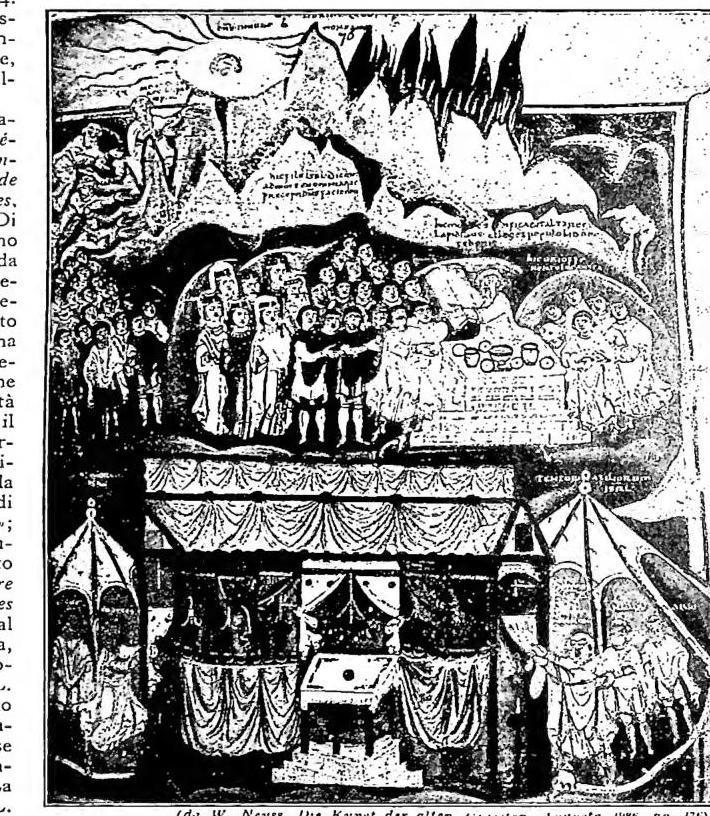
However, natural law assumes a special meaning in man, insofar as, being endowed with freedom, he can dispose of himself and of other things in relation to himself and others: in man, natural law does not have merely or properly an "executive function," as in other beings, but man's practical reason itself recognizes the value of acts (what is good and what is evil) by virtue of its spiritual light. This light is created by God and thus derived from the eternal law, whereby natural law "is nothing other than the participation of the eternal law in the rational creature" (ibid., 1a-2ae, q. 91, a. 2). In effect, this "participation" of man's practical reason in the eternal law consists—analogously to what occurs in theoretical reason with the immediate knowledge of the first speculative principles—in the immediate knowledge of the first moral principles that must generally regulate human actions; these first principles of morality in man are what St. Thomas calls sindereis or intellectus principiorum, which form: "the law of our intellect insofar as it is a habit containing the precepts of natural law, which are the first principles of human acts" (ibid., 1a-2ae, q. 94, a. 4 ad 2; cf. ibid., q. 91, a. 3 ad 1 and 1a, q. 79, a. 12). Synderesis (or sinteresis) constitutes the deepest core of man's moral conscience, from which he proceeds to determine, in concrete actions or particular objects, their goodness or malice, and thus it is almost identical with moral conscience itself (ibid., 1a, q. 79, a. 13). From natural law derives positive human law. Just as through the concrete application of the first speculative principles to things the various sciences of nature are formed, so practical reason—starting from the first moral principles of synderesis—proceeds to formulate the particular laws of human action (ibid., 1a-2ae, q. 91, a. 3; q. 100, a. 5 ad 4). In this positive human law, St. Thomas distinguishes a twofold category of precepts: the first embraces the "conclusions" that necessarily derive from the first moral principles, as when from the supreme principle "one must never do harm to anyone" it is concluded that "it is forbidden to kill anyone." The second class concerns rather the more concrete "determinations" of natural law, as when from the principle of natural law that "the guilty must be punished" one proceeds to determine concretely the nature and manner of punishment for various crimes; the first class belongs in a certain sense still to natural law, while the second properly constitutes human law and has value solely by positive disposition (ibid., 1a-2ae, q. 94, a. 12). But just as natural law derives its validity from its conformity with the eternal law, so positive human law draws its efficacy from its subjection to divine law and its conformity with natural law: therefore, unjust laws do not oblige; certainly, those that violate the rights of God do not oblige; laws that violate the rights of individuals do not oblige per se in foro conscientiae, unless scandal or disturbance of the public order results (ibid., 1a-2ae, q. 96, a. 4). In the economy of Divine Providence, positive divine law was directly bestowed upon man by God through Moses and the prophets in the Old Testament and through Jesus Christ, the incarnate Word, in the New Testament:
the first, in what was essential—that is, the precepts of the Decalogue—was preserved and perfected by Christ, but in what was strictly "figurative" of the Messiah to come, such as ceremonies and sacrificial rites, it was abolished at His coming (ibid., 1a-2ae, q. 98, a. 2). Finally, there exists positive ecclesiastical law, which pertains to the Church as a perfect society.
BIBL.:
A. Vermeersch, Theologiae moralis principia, Roma 1944; P. Delhaye, Synderesis et conscience aux XIIe et XIIIe siècles, in Mélanges de science religieuse, 1948; J. Mausbach, Katholische Moraltheologie, Münster 1940; F. Suarez, De legibus ac Deo legislatore, Coimbra 1612; G. Graneris, Contributi tomistici alla filosofia del diritto, Torino 1949; R. Garrigou-Lagrange, De beatitudine, Roma 1947; J. Maritain, Les droits de l'homme et la loi naturelle, New York 1942; E. Gilson, L'esprit de la philosophie médiévale, Paris 1932.
Il problema della l. morale si trova presente ai primi albori del pensiero umano: si può dire che l'antico pensiero greco è pervaso dall'antitesi di νόμος e φύσις, che in generale indicano ciò che dipende dall'uomo e ciò che dipende dalla necessità della natura. La necessità della physis aveva la sua espressione nella μοῖρα, il destino, a cui nei poemi omerici sono soggetti non solo gli eroi ma gli stessi dèi: esecutrici e custodi della μοῖρα sono le Erinni (Iliade, XXI, 410, 414; cf. XIX, 404, 418). L'Odissea mostra un tentativo di liberazione dalla μοῖρα con la θέμις che corrisponde al coraggio personale degli eroi. L'intento di Esiodo nella sua teogonia è di descrivere il divenire dell'ordine cosmico (φύσις), ma insieme anche di indicare l'esecuzione di un piano che culmina nel trionfo dell'ordine sopra il disordine o caos iniziale (θέμις o νόμος); a questo fine tendono anche le macchinose teogonie orfiche che saranno riprese dal tardo neoplatonismo. I sofisti sono tutti impegnati sul primato conteso fra φύσις e νόμος, e alcuni stanno per la natura (Ippia, Antifonte, Prodico), altri invece per la l. come Archelao, secondo il quale la giustizia e il turpe non sono effetto di natura ma di atto umano: τὸ δίκαιον εἶναι καὶ τὸ αἰσχρόν οὐ φύσει, ἀλλὰ νόμῳ (Diels-Kranz, Die Fragmente der Vorsokratiker, Berlino 1935, Fr. 60 A 1; t. II, p. 45). Ma se il tiranno, come Creonte, si prevale della l. sul singolo innocente e vuole imporre l'arbitrio della sua ὕβρις? Ecco allora Sofocle che all'innocente Antigone mette in bocca il richiamo alle « l. non scritte » (ἄγραπτα νόμιναι), la cui vita non è di oggi o di ieri ma di tutti i tempi (Antig. 452-457). L'essenza della tragedia greca è in questo conflitto di φύσις - μοῖρα e νόμος. È stato il merito di Socrate (e poi di Platone e Aristotele) l'aver fatto la sintesi dei due elementi in contrasto mostrando che il νόμος quando sia riconosciuto e accettato appartiene alla stessa φύσις dell'uomo completamente sviluppata: ciò soprattutto in polemica con il relativismo assoluto di Protagora che si risolveva nell'utilitarismo e nell'edonismo (cf. Senofonte, Mem., III, 8, 2-3; Platone, Protagora, 327 bc-328 ab, 334 a-c, 351 b 357 c. Anche Thenet. 151 e 152 dove si legge il celebre detto: πάντων χρημάτων μέτρον ἄνθρωπον εἶναι). Il rapporto fra φύσις e νόμος tende a rilasciarsi in Democrito e specialmente in Epicuro, secondo il quale gli dèi non si curano affatto di questo mondo; mentre per gli stoici il mondo è opera divina (κόσμος) e divinamente ordinata; risale agli stoici la distinzione delle cose che dipendono da noi (τὰ ἐφ' ἡμῖν) e quelle che sfuggono alla nostra iniziativa o al nostro controllo che dobbiamo sopportare (ἀνέχου καὶ ἀπέχου; cf. Epict., Fr. 10, da cui proviene la ἀπαραξία). Nella filosofia medievale giudaica, cristiana e islamica, il problema della l. viene sviluppato nei suoi tre campi religioso, etico e politico in conformità dell'orientamento proprio a ciascuna religione: la filosofia cristiana raggiunge il suo vertice dal punto di vista teoretico con s. Tommaso, di cui si sono indicati sopra i principi fondamentali. Ulteriori sviluppi si ebbero nel sec. XVI con F. de Vitoria e F. Suárez ai quali si devono notevoli trattazioni dello ius gentium. Nel pensiero moderno il problema della l. segue il destino del problema di tutto lo scibile in generale e si frammenta in tanti problemi quante sono le scienze nuove che vengono affermandosi: con Keplero e Galileo sorgono le nuove l. dell'astronomia, con Cartesio le nuove l. della fisica; più vicino a noi, con la scoperta del microscopio, si hanno le nuove l. della biologia; con l'osservazione dei fatti umani le nuove l. della psicologia, della storia, della sociologia, dell'economia, della politica ovvero nell'intero settore delle « scienze dello spirito » (Geisteswissenschaften). Il significato e il valore delle l. dipende dall'orientamento proprio di singoli sistemi (empirismo, fenomenismo,
idealismo, realismo, razionalismo ecc.); tutto ciò rimanda al problema generale del valore della «scienza» (v. DETERMINISMO). Come ritorno alla concezione greca del νόμος politico che assorbe e domina il destino dei singoli, si può indicare Hegel, per il quale l'espressione compiuta della «volontà libera» e quindi della natura umana come tale è il diritto, ovvero l'organizzazione esterna e politica dello Stato (cf. Vorlesungen über d. Philosophie des Rechts, §§ 29-30). Il problema della l. è quindi in funzione diretta del problema della ragione nel suo rapporto con il mondo e con gli altri uomini e del suo fondamento in Dio.
II. L. ECCLESIASTICA.
I. NOTION
Like the jurisdiction of which it is a part (v. GIURISDIZIONE), the legislative power also derives for the Church from its very nature as a perfect society. For the attainment of its supernatural end, it is indeed necessary that the Church possess the power to designate and impose the means suited to pursuing it; and it is precisely in this that legislative power consists.Ecclesiastical law (l. ecclesiastica) is subdivided: by spatial extension, into universal and particular; with regard to its recipients, into general and singular; regarding application, into common and special; by object, into affirmative or preceptive and negative or prohibitive, and, according to some, also permissive; by the obligation it induces, into simply moral (which obliges in conscience but without any sanction in the external forum), moral and penal together or mixed, also called merely penal (which obliges in conscience to do or omit something, and to undergo a penalty in case of transgression), and simply penal (which does not oblige in conscience to do or omit what the law commands or forbids, but obliges in conscience to undergo a penalty if this is inflicted for the transgression); by the manner of obliging, into personal (if it directly obliges persons, independently of territory), and territorial or local (when its efficacy is limited to the territory); by effect, into simply prohibitive (when it renders an act illicit), irritant (when it renders an act not only illicit but also invalid), and incapacitating (when it renders a person incapable of a determined act; in effect, incapacitating law is equal to irritant law).
II. AUTHOR
According to the very notion of law, its author or source is the one who has care of the community and can dictate norms for the common good.Legislative power is therefore part of the power of jurisdiction, understood in its broadest and most complete sense as public power in the external forum, and the legislator is the one who holds such power in its supreme expression, because the other functions that may be included under jurisdiction—namely, executive and judicial power—are at the service of law; they presuppose its existence and find their limit in II. The authority to make laws thus belongs to the supreme head of the Church, and, in a derived and dependent manner, to the superiors of inferior communities who are invested with such power for a determined portion of territory or subjects. Universal laws, that is, those binding for the entire Church, can therefore be issued only by the Supreme Pontiff (can. 218) and by the ecumenical council (can. 228 § 1), who have no limits to their authority except divine law, both natural and positive. Both the pope and the ecumenical council may delegate their universal legislative power, but they cannot renounce it and always retain the power to revoke or derogate from the laws of their delegates (v. FONTI DEL DIRITTO).
Such power is granted, within the limits established by the motu proprio: Cum iuris canonici of 15 September 1917, to the Pontifical Commission for the Interpretation of the CIC and, in exceptional cases, to the Roman Congregations. The Sacred Congregations of the Holy Office, for the Eastern Church, and of Rites, insofar as their competence concerns matters outside the CIC (cann. 6 n. 6, 1 and 2), exercise this power in an ordinary manner. Particular laws may be issued by the Roman Pontiff and the ecumenical council; by the Roman Congregations; by particular councils (plenary and provincial) for their respective territories, but with the approval of the Sacred Congregation of the Council (cann. 290-291); by residential bishops, both in synod and outside synod (cann. 362 and 335), for all non-exempt diocesans within the limits of common law; by prelates equated to bishops within the boundaries of their jurisdiction, namely: by the coadjutor of an incapacitated bishop (can. 351 § 2), by apostolic vicars and prefects (can. 294 § 1), by permanent apostolic administrators (can. 315), by abbots and prelates nullius (can. 323); furthermore, during the vacancy of the See, by the cathedral chapter for eight days after notice of the vacancy itself (can. 431 § 2) and, subsequently, by the capitular vicar (can. 432 § 1), while upholding the principle: sede vacante nihil innovetur (can. 436). In exempt clerical religious institutes, legislative power is generally reserved to the general chapter; however, it is not excluded that the constitutions extend it to others. Legates or representatives of the Roman Pontiff, whether a latere or with permanent mandate (nuncios, internuncios, apostolic delegates), do not have legislative power by common law. The same applies to patriarchs of the Latin Church, primates, metropolitans (can. 271 ff.), and vicars general.
III. OBJECT
By its very nature, law must be reasonable, hence honest and just in the matter it concerns.The object of ecclesiastical law is, in general, everything necessary for the end of the Church, and in particular, faith, morals, and discipline. Indeed, it is the Church’s duty to propose, even through its laws, the revealed truths that the faithful are bound to profess (cf., e.g., cann. 218, 731 sqq., 937 sqq., 948, 1012 sqq., 1322 sqq., etc.). Furthermore, since it is necessary that the faithful be directed toward their supernatural end also through norms that guide their actions, the Church has the power to enact laws by which it determines and commands what must be done or omitted by individuals for their salvation (cf., e.g., cann. 1037 sqq., 1316 sqq., 1399, etc.). Finally, since individual subjects are members of the social body of the Church, the latter may also enact disciplinary laws, by which it safeguards social order and promotes the common spiritual good.
Through its laws, the Church sometimes commands or prohibits what was already imposed or forbidden by divine law, whether natural or positive, occasionally adding a penal sanction or an irritant clause for transgressors. In other cases, ecclesiastical law is a determination or a conclusion of the same divine law, whether natural or positive, or the command of what the same law merely advises. In still other cases, the law imposes a wholly new precept, rendered necessary or useful by changed circumstances, but not at all contained in divine law.
In addition to being just and honest, the object of the law must be physically and morally possible.
For acts already completed, can. 10 of the CIC establishes the principle of non-retroactivity, such that a law does not have retroactive effect unless this is explicitly stated (v. DIRITTO QUESITO).
IV. PROMULGATION
For a law to be observed, it is required that it come to the knowledge of its recipients.Currently, the promulgation of laws by the Holy See occurs through publication in the AAS, unless, in particular cases, a different method is provided (cf. can. 9 CIC).
V. VACANCY
Before the CIC, there was no general norm determining the vacatio of ecclesiastical laws. Some, based on Nov. 66 of Justinian, required two months. However, most—and nearly all shortly before the CIC—held that ecclesiastical laws became binding as soon as they were promulgated, while admitting that for some time ignorance could be presumed, excusing from penalty; this period was extended outside Rome to as much as two months.The CIC establishes that laws of the Holy See take effect "only after three months have elapsed from the date affixed to the number of the Acta, unless, by the nature of the matter, they bind immediately, or unless a shorter or longer vacancy has been specially and expressly established in the law itself" (can. 9 § 2). The three months of vacancy are therefore not counted from the date of the law but from the date of the issue of the AAS in which it is published. It must be understood that a law, by its very nature, binds immediately when it is a declaration of divine law, natural or positive, a dogmatic law, or one intended to preserve the integrity of faith or morals (cf. also can. 17 § 2).
For legislators inferior to the Holy See, the following norms apply: the plenary or provincial council must designate the time when its decrees begin to bind (cann. 291 and 304 § 2); the laws of bishops bind immediately after promulgation, unless otherwise established (can. 335 § 2); the constitutions of the diocesan synod, if promulgated in the synod itself, bind immediately, unless a vacancy is established (can. 362).
VI. SUBJECT
Ecclesiastical law can only bind the members or subjects of the Church. Since one becomes a subject of the Church through Baptism, which imprints its character, ecclesiastical laws oblige only those who have received II. However, even infidels are subject to God, the supreme legislator, and thus they are also bound by divine law, both natural and positive, as proposed and declared by the Church, its infallible interpreter. They are not, however, held to those positive divine laws (e.g., those that impose the reception of other Sacraments) which presuppose Baptism, until they have received II.By the same positive divine law, they are obliged to receive Baptism after embracing the faith.
Apostates, heretics, schismatics, and excommunicates who, after Baptism, have renounced the faith and union with the Church remain, by virtue of the indelible character of Baptism, always subjects of the Church and bound by its laws (can. 87). Material heretics and schismatics, who were born and raised in heresy or schism (can. 1099 § 2), are not bound to observe the form in the celebration of Marriage (can. 1099 § 2); those who received Baptism outside the Catholic Church and have not converted to it are exempt (can. 1070 § 1) from the impediment of disparity of cult. Some authors, before and after the CIC, also hold that material non-Catholics are not bound by laws that directly or primarily tend toward personal sanctification (such as those concerning abstinence and fasting, the observance of the holy day of obligation, etc.), presuming that the Church does not intend to bind them, as this would offer an occasion for sin given the certainty of transgression. The majority of writers, however, hold the contrary opinion, since no indication of the Church’s will to grant such a general exemption is evident; indeed, it must be considered excluded by the particular and express exemptions that have been mentioned. The CIC does not make this exception to the principles established in cann. 12 and 87. Moreover, these are principles of extreme importance for ecclesiastical discipline. If material heretics or schismatics do not observe these laws because they are ignorant of them or unable to do so, this constitutes a case of ignorance or impotence, that is, a reason that excuses from their fulfillment and thus removes guilt.
While by positive divine law infidels are not subject to ecclesiastical laws, by natural divine law all those who lack sufficient use of reason (can. 12) are not subject to them, namely infants and the habitually insane, whether they were born so or later became so. The habitually insane are presumed to lack the use of reason even during lucid intervals. If, however, the contrary is proven, they are subject to the law, both in the internal and external forum. Those who are temporarily deprived of the use of reason (due to sleep, fever, etc.) remain radically subject to the law but may be excused from its observance.
By positive ecclesiastical law, the baptized who have not yet completed their seventh year are not bound by the laws of the Church, even if they possess the use of reason (can. 12). Before the CIC, there was no positive norm on this point, and the principle held that laws began to oblige from the moment one acquired the use of reason. This entailed a factual judgment not always easy to make. Until the 18th century, it was quite common to hold that the use of reason was not presumed before the age of seven but was presumed afterward; however, the law obliged when the use of reason was in fact attained, even if this occurred before the age of seven. St. Alphonsus considered the contrary opinion probable, and in the 19th century, it became the more general view, based primarily on the following argument: the law concerns ordinary cases, not extraordinary ones, and ordinarily, the use of reason is not attained before the age of seven. The CIC sanctioned this opinion. Even before the age of seven, children who possess the use of reason may be subject to the law if it expressly states so (can. 12). Such express mention is made for Baptism (can. 745 § 2, 2°), for adequate disposition and instruction for Confirmation if received before the age of seven (cann. 786 and 788; decree Spiritus Sancti of 14 Sept. 1946: AAS, 38 [1946], p. 353, n. 5), for annual Confession (can. 906), for Paschal Communion (can. 859 § 1), and for Communion and Extreme Unction in danger of death (cann. 854 § 2, 940). Upon completing their seventh year, children are bound by all ecclesiastical laws unless expressly exempted. They are not bound to fasting (can. 1254 § 2) and are excused from latae sententiae penalties (can. 2230).
The legislator is subject to the laws enacted by a legislative college of which he is a member (e.g., the bishop in relation to the provincial council), because the authority of the college is superior to his own (cf. cann. 291 § 2, 501-502). The Roman Pontiff is excepted in relation to the ecumenical council, because he is not only a member but also its head. A singular legislator is not subject to the coercive force of the laws he enacts by his own authority and is thus exempt from both ferendae and latae sententiae penalties. Nevertheless, since laws are directed toward the common good, to which the legislator must also contribute, he is subject, by natural law, to the directive force of the law.
In particular: universal law binds all those who are its intended recipients, that is, those for whom it has been promulgated (can. 13 § 1). A law promulgated for a particular territory obliges when these three conditions are simultaneously met: a) that one is subject to it (not, therefore, in the case of exemption); b) that one has domicile or quasi-domicile in that territory; c) that one is physically present therein (can. 13 § 2): upon leaving the territory, the subject is no longer bound by its obligation. Those who are absent, that is, those who are outside their own territory, are not bound by its laws for the duration of their absence (can. 14 § 1, n. 1), regardless of the reason for their departure, including the intention to evade the law. The reason is that the legislator has deemed it sufficient for the law’s purpose that it be observed within the particular territory. However, the absent are bound by the laws of their territory when these are personal or when their transgression would cause harm within that territory (e.g., the law of residence [can. 465], of attending the provincial council or synod, etc.).
In doubt, the law is presumed territorial (can. 8 § 2). Outsiders are not bound by the laws of the territory in which they find themselves, unless they concern laws that provide for public order or determine the form of acts (can. 14 § 1 n. 2). In determining which laws provide for public order, authors do not agree. However, it can be held that these include all laws whose observance is necessary for the existence of society and the proper ordering of social relations, so that social life is not disturbed. Such are the laws that determine the exercise of public power or public offices, that directly protect external order (e.g., cann. 1262-1263, 1295), that concern the property of local things, and those whose violation would give rise to scandal. Outsiders also incur the penalties attached to laws concerning public order (can. 2226 § 1); as for penalties not attached to such laws, authors do not agree. Reserved sins and censures, given that the reservation is directed toward the protection of public order, must also be considered as such for outsiders. For the defense of public order, Ordinaries may also make special laws for outsiders. The latter are finally bound by universal laws, even if (by indult, privilege, concordat, custom, etc.) they do not have force in their own territory; they are not, however, obliged if the law has ceased in the place where they find themselves (can. 14 § 1, n. 3). Vagabonds, that is, those who have neither domicile nor quasi-domicile in any place, are bound by the universal and particular laws in force in the place where they find themselves (can. 14 § 2); they are not, however, bound by universal laws that do not oblige in that place.
V. IGNORANZA; INTERPRETAZIONE.
VII. CESSATION
The law properly ceases when it definitively and completely loses, that is, for the entire community, its obligatory force. This can occur due to an intrinsic cause within the law itself, when its end ceases to exist; or also due to an extrinsic cause, namely the will of the legislator who abrogates it, or through desuetude or contrary custom. Depending on its object, the law may cease entirely or partially, according to whether it loses its obligatory force over its entire subject matter or only over a part of II.The end of the law ceases to exist when, due to changed circumstances, the law becomes morally impossible, harmful, unjust, or even simply useless. If the end of the law ceases completely and for the entire community or for the majority of it, the law ceases. If the end does not cease completely, neither does the law; however, when in particular cases the law becomes morally impossible, unjust, or harmful, it ceases to oblige in those particular cases; it continues, instead, to oblige even in those particular cases in which it becomes simply useless, because it is ordered to the common good. A law that has ceased does not revive, even if the circumstances that determined it return; for it to be restored, it must be promulgated anew.
In accordance with the principle set forth, the CIC establishes that laws enacted to defend against a general danger oblige even in the particular case in which this danger does not exist (can. 21). Such laws are indeed directed not to remove or avoid existing harm, but the possibility of harm, and to avoid this possibility not for the individual but for the community (this occurs, for example, in the case of prohibited books). However, they too would cease if, in a particular case, they became morally impossible, unreasonable, or harmful.
The revocation of the law by the legislator is always valid; for it to be licit, a cause grounded in the good of the community is required. If the revocation is made by an inferior, by concession of the legislator, a just cause is necessary for its very validity.
The revocation may be direct or indirect, depending on whether the legislator’s will is directed toward the revocation itself or toward a fact that necessarily determines II. The CIC establishes that a later law abrogates the previous one if it expressly revokes it, or if it is directly contrary to it in such a way as to be incompatible with it, or if it entirely reorders its subject matter (can. 22).
However, a general law does not derogate from particular laws or statutes unless it expressly states so. Nevertheless, by virtue of can. 6 n. 1, it remains firm that laws, even particular ones, contrary to the CIC are abrogated, unless otherwise established in the CIC itself (can. 22). As has been said for general laws, a particular law also abrogates a particular law of the same legislator if it is expressly stated, or if it is incompatible with it, or if it reorders its subject matter. A particular law cannot derogate from a particular law of a superior legislator (e.g., the law of a bishop cannot derogate from that of a plenary or provincial council, can. 291 § 2). A particular law may, however, derogate from a law that is even universal, if it is enacted by someone who has the power to derogate even from a universal law. Likewise, the particular law of a superior legislator (e.g., the Roman Pontiff) derogates, even without mention, from the particular law of an inferior (e.g., the bishop).
In case of doubt, the revocation of the law is not presumed, but later laws must be reconciled, as far as possible, with earlier ones (can. 23). Nevertheless, the correction of the law must be admitted, beyond cases in which it is proven, also in cases in which otherwise an absurdity would result. Furthermore, if the correction is proven with regard to the principal, it must also be admitted in the accessory. The revocation or correction is to be understood in an extensive sense when, by means of it, a return is made to the common law in force.
VIII. DISPENSATION
The notion of dispensation is intimately connected with that of positive law, since dispensation is a derogation from the law in a particular case, made for a justified reason by the legislator or by a delegate. No man can derogate from natural or divine law, as it lies beyond his competence. It is therefore clear that, if the matter does not concern human positive law, one cannot be dispensed from II. Laws commonly take into account possible circumstances that might impede their execution, but they cannot contemplate all cases and provide for those particular instances in which, if the law were observed, harm would result to individuals. Preventing such private harm for reasonable motives is the legislator’s purpose when admitting the possibility of dispensing from the legislative norm—that is, of ensuring that in a particular case the law does not apply. However, if the derogation from the law, granted in favor of a private individual, were to harm others or the community itself, it would lack juridical foundation, for in cases of conflict, private good must yield to the common good. In a broad sense, dispensations may also refer to exceptions admitted by laws under certain conditions, which therefore do not require the intervention of the legislator, such as, for example, the dispensation from Eucharistic fasting for the sick after a month of bed rest.The authority that established ecclesiastical laws, or a superior authority, may dispense from them (can. 80): thus, the Pope or the Holy See for general laws of the Church, however issued by it or by inferior legislators; the local Ordinary for diocesan laws (can. 82); the Ordinaries of the circumscription for laws of provincial or regional councils (can. 82); and religious Ordinaries for those determined by constitutions. It is a constant tradition that the Pope may dispense from certain bonds contracted by an act of human will, even if obligatory by divine right, such as vows, oaths, and a ratified but unconsummated marriage. In granting dispensation, each authority may delegate its subordinates to do so, either permanently or in individual cases.
Furthermore, every Ordinary may grant dispensations that would ordinarily fall under the competence of the Holy See, either by law or by special faculty. The CIC indicates cases of faculty ex iure, for example, for interstices and certain irregularities in Holy Orders, for publications and some matrimonial impediments, for the law of fasting and abstinence, for vows and oaths, and for certain penalties. But in a general way, the law attributes such concession to Ordinaries for general ecclesiastical laws from which the Holy See usually dispenses: a) when recourse to the Holy See is difficult and, at the same time, there is danger of grave harm due to delay (can. 81); b) in case of doubt of fact (can. 15). The granting of special faculties is usually given to those Ordinaries for whom recourse in individual cases would be burdensome or difficult, either due to distance from Rome or to the multiplicity or urgency of the cases arising (v. QUINQUENNALI FACOLTÀ). Apostolic nuncios and delegates also enjoy special faculties to dispense (cf. can. 267 § 1 n. 3 and § 2). Parish priests cannot dispense from any law, except (cf. can. 83) in cases of express concession made either by law (e.g., for obligations related to holy days of obligation, abstinence, and fasting: can. 1245 § 1) or by the competent authority.
From general ecclesiastical laws that are preceptive and non-disqualifying—that is, those that oblige all the faithful without distinction after the age of seven—physical or moral impossibility excuses one without the need for any dispensation. However, to be exempted from other laws, the intervention of the competent authority and the existence of a just cause are necessary.
Certainly, the legislator could, in particular cases, derogate from the laws he has issued even without any motive, but this would harm his dignity and prestige and could even frustrate the purpose of the law itself. It is therefore necessary that the dispensation be justified by a cause that induces the legislator to grant the requested derogation.
The causes must be proportionate to the importance of the law from which dispensation is sought; otherwise, the dispensation granted by an authority inferior to the author of the law is null. The causes that induce the authority to grant the dispensation and are indicated in the document of concession are called motive or final; others, less grave, that are added, are called impulsive. The causes must be true at least at the moment the dispensation becomes executory; but if the causes indicated in the rescript differ, it is sufficient and necessary for the validity of the concession that at least one of the motive causes be true. For minor-degree matrimonial impediments, however, the dispensation is always valid even if the cause is false (can. 1054). Sometimes, even if the individual causes are not sufficient alone, considered together they may acquire the value of a motive cause. In case of doubt regarding sufficiency, the dispensation may be validly and licitly granted (can. 84 § 2).
The request for dispensation must be made to the competent authority by the interested party, clearly indicating the object and the causes. It is not excluded that a dispensation may be requested without the knowledge of the interested party.
The statement must correspond to objective truth; otherwise, the concession may be rendered null.
When the request is made to the Holy See, it must reach its destination through the proper Ordinary. If the latter is favorable to the concession, he accompanies it with his commendation (unless he deems it opportune or is obliged to make the request himself in favor of the interested party); otherwise, he expresses his negative opinion, motivating II. All requests made to the Holy See must be addressed to the Holy Father but transmitted to the competent ecclesiastical dicastery, which, after considering everything, will make the decision.
The concession of a dispensation may be made definitively—that is, as it is called, in forma gratiosa, taking effect from the moment the grantor intended to give the dispensation. But ordinarily, it is made in forma commissoria, meaning the granting authority entrusts the execution of the concession either to the requesting Ordinary or to another designated person. For this entire subject, V. RESCRITTO.
It may happen that, when an Ordinary requests a dispensation that the Holy See usually grants, and the response is delayed, there arises or supervenes a grave and urgent reason that advises immediate concession. In such a case, the Ordinary may grant the requested dispensation himself, with the obligation to inform the authority to which he had applied.
The granting of a dispensation and its execution must be done in writing (though not under pain of nullity), so that they may be proven in the external forum.
Every dispensation takes effect as soon as it becomes executory. However, depending on the laws from which it is obtained, it may or may not have a duration in time. Thus: a dispensation of age for Holy Orders, once obtained and used, ceases to produce further effect; whereas a dispensation from Eucharistic fasting lasts for the entire period established in the concession. Therefore, the cessation of a dispensation can occur only when it has, as it is said, a tractus successivus—that is, when it can be used with repetition of acts.
One may also renounce a dispensation after obtaining it and not use it at all or only for a certain time, if it has a tractus successivus. But just as the dispensation is null if the necessary cause is lacking, so too, if the motive cause ceases entirely, the dispensation’s validity also ceases (can. 86).
Moreover, a dispensation may cease by express revocation made by the grantor and communicated to the interested party.
BIBL.:
A. Van Hove, De legibus ecclesiasticis, Mechliniae 1930; H. I. Cicognani-D. Staffa, Commentarius ad librum primum CIC, I, Romae 1939; G. Michiels, Normae generales, I, 2ª ed., Mechliniae 1949; F. M. Cappello, De sacramentis, I, Romae 1945; A. Vermeersch-I. Creusen, Epitome iuris canonici, I, Romae 1949; P. Gasparri, De matrimonio, I, Romae 1932; F. X. Wernz-P. Vidal, Ius canonicum, I, Romae 1938; E. F. Regatillo, Institutiones iuris canonici, I, Santander 1951; J. Creusen, Religieux et religieuses d'après le Code de droit canonique, Bruges 1949; A. Blat, Commentarium textus Codicis iuris canonici, I, Romae 1921; J. B. Ferreres, Institutiones canonicae, I, Barcinone 1921; T. Ortolan, Dictionnaire de théologie catholique, IV, Paris 1911, s. V. Dispense; F. M. Cappello, Summa iuris canonici, I, Romae 1945; J. A. Abbo-J. D. Hannan, The Sacred Canons, I, St. Louis 1952.
Dino Staffa
Among dispensations from ecclesiastical laws, those from matrimonial impediments occupy a special place, both due to their frequency and their social importance. The aforementioned norms also apply to these, but they possess certain particularities (v. IMPEDIMENTI).
In the granting of dispensations of any kind, a fee is imposed, serving as a deterrent, a preventive penalty, and simultaneously as homage to the Holy See for the favor received. While this fee varies according to the type or importance of the dispensation, it remains uniform for all. However, for matrimonial dispensations, a traditional taxation system is followed. Thus, a distinction is made between the rich and the poor, that is, between those whose possessions and earnings fall below a certain threshold and those who exceed II. For the poor, a minimal fee is established, varying with the impediment (the destitute pay only the expenses), whereas for the rich, the componenda applies. This is a sum determined case by case by the Holy See, based on the personal wealth and income of the spouses. The percentage also varies here according to the nature and gravity of the impediments. In the past, if a certain amount was exceeded, the dispensation was granted in the form of a brief, but subsequently, the rescript was used for all. In addition to the aforementioned entries, see also PENA and VOTO, respectively for dispensation from penalty and from vow.
The term dispensation also refers to the dissolution of a ratified but unconsummated marriage, granted by the Supreme Pontiff: V. MATRIMONIO.
### III. CIVIL LAW.
### III. CIVIL LAW
I. GENERAL NOTIONS. — Organized civil society, the State, has the right and the duty to establish juridical norms aimed at regulating the life of its members.
This derives from the fact that God Himself, by dividing "the government of the human race between two powers, the ecclesiastical and the civil, the one charged with divine matters, the other with human affairs" (Leo XIII, encyclical Immortale Dei, 1 November 1885, § 6), has thereby conferred upon the State the power to issue juridical commands within its own sphere of competence. From this follows the obligation for members of society to obey the norms issued by the human legislator, provided these do not conflict with the norms of divine law—natural and positive—and with the teaching of the Church, and provided the State does not exceed the limits set for its action: "all things... that fall within the civil and political sphere are rightfully subject to civil authority, since Jesus Christ expressly commanded to render unto Caesar what is Caesar’s, and unto God what is God’s" (Immortale Dei, § 6). Regarding the moral obligation to obey civil laws, V. below, n. II.
Civil law (which falls under the category of human laws) is the deliberate and conscious juridical thought, expressed by designated organs representing the prevailing will in an associated multitude, which in the law manifests its politically unitary organization. It may be defined as a rule of conduct applicable to a generality of persons and to an indefinite number of cases, the observance of which is made obligatory through coercion. The foundation of law is public assent, whether it manifests directly in the approval of the law itself or indirectly in the support of the authority from which it emanates. In this sense and with this clarification, the Roman definition of communis rei publicae sponsio may be applied to any law, even that issued by an authoritarian ruler.
Regarding the Italian legal system, which is the subject here, the term law may assume multiple meanings. Beyond the distinction between law in the formal sense and law in the substantive sense (denied, however, by an authoritative part of doctrine), the Italian legislator often speaks of law in the generic sense of a source of law, of acts having the value of law, etc. (v. FONTI DEL DIRITTO). Here, only law understood as the result of the legislative function "exercised collectively by the two Chambers" (Art. 70 of the Constitution) is treated.
In the process of law formation (meaning the entire iter necessary for a law to come into being and be observed), several stages may be distinguished: the initiative of the law, examination and approval by the two Chambers (v. PARLAMENTO; POTERI PUBBLICI), promulgation, publication, and entry into force.
The initiative of the law, that is, the faculty of setting in motion the mechanism that submits a draft to the Chambers, which through their determining decision will transform it into law, belongs to the government, to each member of the Chambers, to certain organs and entities (currently the National Council of Economy and Labour and the Regional Councils), and finally to the people, who exercise it through the proposal of at least fifty thousand electors of a draft drawn up in articles (Art. 71 of the Constitution).
Examination and approval are carried out by the Chambers through three different systems: one normal, one abbreviated for bills declared urgent, and one that, in practice, removes the draft from discussion by the assemblies, entrusting its examination and approval to special commissions reflecting the composition of parliamentary groups (Art. 72 of the Constitution).
The law approved by the Chambers is transmitted to the President of the Republic for promulgation. This serves to attest that the law exists, and the President is obliged to proceed with it, except in cases of urgency declared by the Chambers, within one month of approval. The President of the Republic (who is excluded from the actual formative process of the law, as the current Italian system lacks an act equivalent to the sanction once given by the king) may, however, before promulgation and if deemed necessary, return the law to the Chambers with a motivated message to request a new deliberation; if the Chambers approve the law again, it must be promulgated. Promulgation must be followed immediately by publication, under the care of the Minister of Justice, who must ensure the insertion of the original text of the law in the Official Collection of Laws and Decrees of the Republic, announce in the Official Gazette of the Italian Republic the insertion that has taken place, and publish the text of the law in the Gazette itself. From the moment of publication begins the so-called vacatio legis, which, unless otherwise provided, lasts fifteen days (Arts. 73 and 74 of the Constitution). It should also be noted that the current Italian system distinguishes between ordinary laws and constitutional laws (including those for constitutional revision); the latter must be approved by the Chambers with special formalities (Art. 138 of the Constitution).
II. MORAL OBLIGATION
A topical and much-debated question is whether laws enacted by civil authority oblige in conscience. Setting aside certain particular problems that merit specific treatment—such as those concerning laws on taxes and duties, military service, purely penal laws, and those enacted by tyrants or usurpers regarding the Church and the clergy—it is appropriate to address the issue in general terms.Firstly, the civil legislator can enact laws that oblige in conscience, since all authority comes from God and is exercised in God’s name. Classic in this regard is the passage from St. Paul (Rom. 13:1-7), preceded by Prov. 8:15 ff.; Wis. 6:2-5, and confirmed by 1 Pt. 2:13 ff., the doctrine of the Church (cf. Leo XIII, Immortale Dei, 1 November 1885; Libertas, 20 June 1888; Inter gravissimas, 16 February 1892), the practice of the Church, and theologians, beginning with St. Thomas (the principal texts in I. Lo Grasso, Ecclesia et Status, fontes selecti, Rome 1939, nn. 2, 28, 35, 98, 102, 413, 649 ff., 661 ff., 690, 696).
It is also universally accepted that just civil laws become obligatory in conscience once the judge has ruled on their application in a specific case. Otherwise, social chaos would ensue.
However, theologians do not agree on the obligatoriness in conscience of existing civil laws prior to a judicial sentence, nor on the extent of such obligation. Some assert that nearly all civil laws oblige in conscience, supporting their thesis with the aforementioned texts, the reason of the common good (which would require this obligation), the fact that the legislator is generally constituted by a body in which the exercise of authority is independent of individual ideas, while each member intends to use the power they possess to its fullest extent, and the fact that, if non-obligation in conscience were admitted, there would be too many evasions of the law, whose burden would fall on a few, and individual arbitrariness would find every pretext to evade social duties. A contemporary example is the proliferation of so-called conscientious objectors.
The more common opinion, at least until recently, holds instead that the majority of state laws do not oblige in conscience unless after a judicial sentence. The reasons are: 1) the multitude of laws; they are so numerous and issued continuously that subjects are physically unable to know them all. 2) Currently, most legislators are not at all concerned with moral obligation, content that the law be observed, even if only by force; the basis of the social order is a human, not religious, foundation. 3) Many upright individuals think and act accordingly. 4) Authority must be exercised with prudence and thus should impose burdens as little as possible. Since the end of society can be achieved without obligation in conscience, reason dictates that the legislator not exercise power to this extent. 5) Finally, many citizens are unconcerned with moral obligation; imposing it on others, perhaps on a minority, is not equitable; civil obligation suffices. Nor can it be objected that legislators do not declare their will in this regard, it being sufficient that this may be deduced from positive indications.
These reasons undoubtedly carry some weight but are not apodictic. Indeed, a tendency has recently emerged that favors emphasizing moral obligation.
Today, state laws are considered obligatory in conscience when: 1) they sanction natural or divine law (homicide, theft, restitution, family duties) or determine indeterminate natural law (succession, property rights). In such cases, the obligation precedes the state law and does not arise entirely from II. Public order itself requires that conflicts between the internal and external forum in matters of rights be resolved.
In particular, laws regulating the creation, duration, use, and extinction of property rights, etc., belong to this category. Today, many syndical laws regulating labor relations between employers and workers regarding wages, family allowances, and social security must likewise be considered obligatory in conscience. Laws that render persons incapable of certain acts or invalidate acts performed without formalities are considered obligatory in conscience if they concern the essential conditions of the act (mental incapacity, error, or violence, etc.). Those that pertain only to external formalities or solemnities (notarial act, registration, writing, etc.) are not deemed obligatory in conscience before a judicial sentence.
2) All just laws after a judicial sentence has intervened, as required by the common good and public tranquility. However, if the sentence is based on non-existent facts or applies an unjust law against the rights of God or the Church, it does not oblige. 3) Those laws that are commonly held to oblige in conscience by prudent persons or the sound majority of the population.
The judgment is generally based either on the nature of the commanded act or on the superior reason of the common good (e.g., in times of emergency). For reasons of scandal or piety, certain laws may oblige specific individuals: a priest, for example, or a son may be bound in conscience to observe a particular law, the former to avoid scandal, the latter to prevent reprisals against his family. Conversely, state laws accompanied by excessive pecuniary penalties are considered without moral obligation.
In concrete terms, the criteria are highly variable. Nevertheless: a) one must not create certain obligation where there are no certain reasons; b) certain criteria are the matter pertaining to natural, divine, or ecclesiastical law, the evident common good, and the just sentence of the judge.
For a human legal provision to have moral and juridical efficacy, it must rest upon two presuppositions: 1) God, transcendent, creator and orderer of nature, and thus the first true legislator with natural law, of which positive law must only specify generic norms, supplement deficiencies, and prevent and punish violations. 2) A historical-divine fact: the existence of the Catholic Church, a perfect society, to which God entrusted religious social powers. Therefore, unjust and non-existent is the law that tramples natural law or diminishes the native and essential rights of the Church (cf. can. 2205 § 3). To this intrinsic injustice is added extrinsic injustice, in the case of a usurper.
Faced with intrinsically unjust law, the problem arises of how the subject should conduct himself.
1. Historical Notes
That there is, at least sometimes, an obligation for the faithful or subjects in general to resist an unjust law is documented by many historical and scriptural examples. The Egyptian midwives (Ex. 1:15 ff.), the prophet Elijah (III Kings, 17 ff.), Tobit (2:9), the Maccabees (I Mach. 1:65-67; 2:19-26; II Mach. 6:23-26) found themselves confronted with unjust laws and refused to observe them. Jesus, while asserting that one should give to Caesar what is his (Mt. 22:21), and while acknowledging in Pilate the power to judge (Jn. 19:11), also speaks of dutiful resistance (Mt. 10:17 ff.) and of the abuse of power. The Apostles, while recommending submission to public authorities, even if unfaithful (Rom. 13:1 ff.; Tit. 3:1; I Pet. 2:13), declare resistance a duty in the case of a higher right (Acts 4:19; 5:29; Phil. 1:13; I Pet. 4:16) and seal this principle with their blood, followed by the martyrs.With the total Christianization of the Empire and the conversion of the Germanic peoples, the juridical situation took on a different form. In the face of injustice, the principle "Vim vi repellere" (18, X, V, 12) was also applied in public law; the struggle for Investitures and for the liberties of the Italian Communes, supported and backed by the Popes, demonstrates a resistance more than passive to the abuses of civil power. But here, perhaps, the public law of the time could have had an influence (cf. Pius IX, Allocution, 20 July 1871, in I. B. Lo Grasso, Ecclesia et Status, Roma 1939, n. 648).
While at the dawn of the modern era Machiavelli and Lorenzino de' Medici legitimized rebellion and regicide, the Church followed passive and legal resistance (the schism of Paolo Sarpi; Gallican questions, etc.). The Protestants, having attained power through violence, upheld full submission, paving the way for later reactions. The Gallicans joined them.
The social errors of the 19th and 20th centuries (liberalism, state absolutism, etc.) and the practices they followed posed the problem in a often tragic manner, with large-scale violations of natural law and of the Church. The natural principles in this regard are summarized, validated by ecclesiastical magisterium.
2. Theoretical Solutions
The possible solutions to the problem of unjust law are: either pure and simple acceptance or cooperation, total or partial, or only material cooperation in execution, or passive and legal resistance, or organized armed active resistance.a) Every intrinsically unjust law does not exist as true law; accepting it is always illicit; at least passive resistance (not obeying) and legal resistance (using the means recognized by public law to move the power to recede: press, diplomatic action, public opinion, etc.) must be opposed to II. When well used and organized, the means available to citizens often achieve the goal in the long run: thus with Napoleon, with Bismarck, in France before and after 1905, in Italy after 1871 and in the painful events of 1931. This is the constant teaching in the various encyclicals of Leo XIII (Quod apostolici numeri, 28 Dec. 1878; Diuturnum, 29 June 1881; Immortale Dei, 1 Nov. 1885; Libertas, 20 June 1888; Sapientiae Christianae, 10 Jan. 1890); of Pius X (Vehementer, 11 Feb. 1906; Gravissima, 10 Aug. 1906); of Pius XI (Ubi arcano, 23 Dec. 1922; Firmissimum constantiam, 28 March 1937); of Pius XII (various messages and allocutions). Leo XIII says: "There is a reason for men not to obey when what is openly contrary to divine and natural right is demanded of them" (Diuturnum); "then to resist is a duty, not to obey a debt" (Libertas); and he laments the fatal connivance of Catholics, so that evil increases without an effective remedy (Sapientiae). Pius XII, denouncing the persecution in Hungary, appeals to indomitable fortitude and the union of Catholic energies, nourished by Grace, since for the rights of the Church one must endure hardships and even the deprivation of life, if necessary (AAS, 41 [1949], p. 29 ff.).
b) Sedition or outright rebellion and related conspiracies aimed at changing the legitimate government, which does not gravely abuse its authority, are intrinsically illicit (Mt. 22:21; Rom. 13:1 ff.; etc.; Gregory XVI, Mirari, 15 Aug. 1832; Pius IX, Syllabus, nn. 63-64; Leo XIII, loc. cit.; Pius XI, Ubi arcano, etc.).
c) Under certain conditions, active armed resistance is licit, and, according to some theologians, even obligatory, excluding regicide (except for personal defense in actu aggressionis). Circumstances play a decisive role. St. Thomas says (Sum. Theol. 2a-2ae, q. 42, a. 2): "The tyrannical regime is not just, because it is not ordered to the common good, but to the private... Overthrowing this regime is not rebellion, unless the uprising (perturbatio) is done with insufficient tactics, causing greater evils... the true seditious one is the ruler..." In De regimine principum (I, ch. 6) he proves this assertion with historical facts or those considered as such, e.g., the expulsion of Tarquin the Proud from Rome.
Bellarmino goes further and speaks of a duty of resistance (De Romano Pontifice, Venice 1596, bk. V, ch. 7). Christians, he says, cannot tolerate the government of an infidel prince who attempts to detach them from the true faith, since the integrity of the faith is a matter of natural law. The Church's failure to exercise this right in the early centuries was due to the lack of sufficient means for success; and ancient and recent history (England) proves this necessity. It is reproved by nature to abandon legitimate defense; and, since faith and life can be preserved, one is obliged to preserve both. If it was licit for the Maccabees to take up arms, under the same conditions it is licit in the New Testament.
Few authors, either because of Gallican leanings or because they based themselves on pontifical documents interpreted out of context, declared armed resistance illicit. The question was much debated recently, during the long persecution in Mexico, where passive and legal resistance achieved nothing. Pius XI, with the encyclical Firmissimum constantiam, then posed the problem and resolved it thus: the practical solution necessarily depends on concrete circumstances, while keeping in mind certain principles. Namely: a) claims have the character of means or relative ends, not of ultimate and absolute ends; b) therefore, they must consist of licit actions and not intrinsic-
c) they must be suitable and proportionate to the end and effectively conducive to it in whole or in part, provided they do not cause greater evils to the community and to justice than those they intend to remedy; d) the use of these means and the full exercise of political rights, touching on problems of a merely technical and material nature or of violent defense, do not fall directly within the tasks of Catholic Action or the clergy, belonging instead to them the task of forming conscience. In case of difficulty, the hierarchy may issue a practical judgment of conduct. These principles are nothing other than the conditions set by theologians and philosophers for the lawfulness of resistance to unjust law. They too require: a) that it be a question of grave, enduring, and evident injustice; b) that there be no other more effective means; c) that success be probable; d) that greater evils not be foreseen; e) the judgment of opportunity pertains to enlightened persons, and in the religious sphere, the injustice must be judged by ecclesiastical authority; f) that honest means be used. In theory, then, the solution is affirmative regarding the lawfulness of resistance; in practice, it depends on historical and environmental circumstances to judge the opportunity to resort to II.
In certain circumstances, material cooperation with regimes issuing unjust laws and their execution is lawful. This was practically suggested during the French Revolution (Pius VI), in the Third Republic (Leo XIII); in Italy before the Concordat and in 1931 (cf. AAS, 23 [1931], p. 307), and in general terms recently by Pius XII in his address to jurists (AAS, 41 [1949], p. 597 ff.).
IV. PENAL LAWS
The primary and essential effect of law is to create an obligation, so that the subject is no longer free to choose. However, there are degrees of obligation, both in the matter imposed and in the will of the legislator; thus, there is grave and light obligation, purely moral, purely penal, and mixed. Moral law creates an obligation in conscience before God; its violation constitutes theological guilt (sin), punishable by God with temporal or eternal penalties. Purely penal law obliges only to undergo the punishment eventually inflicted in case of violation. Mixed law is moral law, equipped with a human sanction, to be endured before or after the judge's sentence. It should be noted, however, that in penal laws, the obligation to undergo the inflicted penalty is by its nature moral (in conscience).3. Nature of penal law and related theories
The nature of penal law is variously explained. Some say it involves a disjunctive obligation: the legislator, that is, leaves the subject free to choose either observance of the law or the penalty. This theory was in vogue at the end of the last century, but it has the flaw, at least in its external form, of suggesting that the legislator is indifferent to the subject's decisions, whereas in fact he desires obedience to the law. Others explain merely penal law through the theory of purely juridical or civil obligation (seemingly already enunciated by Billuart, and today attracting greater sympathy): the legislator deems it sufficient that the subject be obliged to the law only in the external forum; transgression thus directly constitutes juridical guilt, for which one must answer only to society; indirectly, it obliges in conscience to undergo the inflicted penalty. This better corresponds to the concept of law and the legislator's intention.The first example of the introduction of penal laws dates back to the constitutions of the Dominicans, in the form redacted by the General Chapter of 1236: the Constitutions were then imposed only sub poena. The reason given by commentators was that religious souls, amid the variety of prescriptions, might not find frequent occasion for sin. Henry of Ghent restricted the doctrine of merely penal laws to laws concerning indifferent matters, but he also transferred it to the field of civil laws. Giovanni da Imola went so far as to assert that all civil laws were penal, even raising doubts about the competence of civil authority to oblige in conscience. A foundation was found (from St. Raymond onward) in the axiom of the glossators, later modified and included in the 23rd regula iuris in Sexto: « Aliquis punitur quotidie iuste et licite sine culpa, sed non sine causa ». Guillaume de Rennes applied the doctrine to taxes, fines, and corporal punishments. The Summa Angelica of Angelo da Chivasso, though somewhat imprecisely adopting Henry of Ghent's theory, disseminated it widely, despite opposition from the Summa Sylvestrina (by Silvestro Prieras). But the great theorist of the doctrine of penal laws was, with his work De potestate legis poenalis libri duo (Salamanca 1550), the Franciscan Alfonso de Castro (1495-1558). The theory was contested by St. Robert Bellarmine; however, with Suárez (De legibus, Coimbra 1612, I, V, cap. 3 sgg.), the theory was definitively affirmed without opposition, except for two or three authors at the beginning of our century.
The reasons for this position are manifold: a) he who can do the greater can certainly do the lesser; since the legislator can impose an obligation in conscience, there is no difficulty in his imposing a lesser obligation when this depends on his will; b) all agree that the legislator can impose a matter grave in itself under a light obligation; it is not repugnant that he be content with an imperfect mode of obligation. It is true that every law must have its sanction; but in matters merely useful to the common good, the authority that can choose one law over another can also prefer one sanction over another, when thus equally able to achieve the law's end; c) here, indeed, the external obligation is not denied, which is certainly sufficient in a society where the individual must answer for his actions only in the external forum; d) the end of the law is perhaps achieved more effectively, since for many the fear of punishment is more compelling than the obligation of conscience.
In short, it can be said that this theory finds its reasons in the contingent matter that penal laws address; in the strictly temporal end that civil law intends to achieve, for which a single civil obligation suffices; in the demand for better distributive justice, which requires equal burdens for all; in the duty of superiors to avoid, as far as possible, exposing subjects to the dangers of sin; and in the modern mentality that conceives civil society as sufficiently protected by a purely civil obligation of the law, which no longer rests on ethical and religious elements.
2. Existence of penal laws. — Divine law (natural and positive) contains only moral laws. The Church, founded for the specific purpose of the ultimate spiritual good of the faithful and as the dispenser of supernatural means of sanctification, often lacking external coercive means or disinclined to use them, has every reason to oblige with its laws in conscience, and ordinarily does so, unless it concerns secondary matters or norms of a purely directive nature. Official confirmation is found in the decree of the Sacred Congregation of Religious, which approved the statute for the cloistered Sisters (16 July 1931: AAS, 23 [1931], p. 380), where in n. 125 it is stated: « Quae in his statutis continentur e Codice iuris canonici aliusve Ecclesiae legibus deprompta, conscientiam sororum ita ligant ut sine culpa violari non possint ».
In religious institutes, there are usually many penal laws by express declaration of the law. Generally, prescriptions that are not of common law and do not touch upon vows or the fundamental principles of the respective institute (cloister, choral office, etc.), excluding contempt or scandal, have only the value of penal laws (though in concrete cases, violation may constitute sin due to circumstances). The Franciscan Rule is an exception (3, V, 12, in VI; 1, V, 11, in Clemen); for the Discalced Carmelites, the Rule obliges under pain of venial sin (Constitutiones, n. 4).
Civil laws that sanction divine law, that determine generic natural law, particularly regarding commutative justice or morality, oblige in conscience, as required by the common good. Similarly, other laws that, in the common judgment of upright and learned persons, induce moral obligation; for example, in times of public emergency, laws concerning national security, the price—assuming it is just—of indispensable goods, the delivery of products within a certain measure; in cases of oaths, certain syndical laws. Within certain limits, direct taxes are considered binding in conscience; and under certain conditions, military service. In the same matter, there may be different obligations; thus, the prohibition against hunting without a permit is considered penal, while the prohibition against minors carrying weapons under the legal age is considered moral.
Criteria assigned by moralists for recognizing penal laws are: 1) the interpretation of upright and competent persons, as well as their practice; 2) the express declaration of the law (as in religious institutes, in the United States); 3) the penal sanction disproportionately severe in relation to the fault; 4) the matter, if the law concerns morally indifferent things (cleanliness, road maintenance, etc.). In any case, contempt for authority or scandal may constitute grave guilt; as may the attempted corruption of public officials.
In case of doubt, quod minimum tenendum est. Nevertheless, in principle, due reverence must be paid to authority by observing its laws.
BIBL.:
A. de Castro, De potestate legis poenalis libri duo, Salamanca 1550; F. Suárez, De legibus, Coimbra 1612; H. de Gand, Quodlibeta; G. da Imola, Commentaria in Clementinas; A. da Chivasso, Summa Angelica; S. Prieras, Summa Sylvestrina; R. Bellarmino, De laicis; Billuart, Summa S. Thomae; oltre ai trattati di teologia morale e di diritto canonico.
G. Vismara
V. L. CIVILI IRRITANTI. — Una particolare considerazione meritano in rapporto alla loro obbligatorietà in coscienza le l. civili irritanti (da tenersi ben distinte dalle leggi meramente proibenti o dalle l. civili che neghino azione civile circa alcuni atti: ad es., art. 1933, Cod. civile italiano). In senso ampio possono chiamarsi irritanti quelle l. nelle quali può manifestarsi un impedimento all'efficacia del negozio. Questi difetti, che impediscono il conseguimento degli scopi, ai quali il negozio è preordinato, sono raggruppati o possono raggrupparsi in diverse categorie. Tenendo presente soprattutto il diritto civile italiano la l. può, irritando più o meno gravemente, dichiarare la nullità del negozio, o l'annullabilità, o la rescissione o la risoluzione. Lasciando da parte quest'ultima che si manifesta per un difetto nella vita del rapporto, senza riferimento diretto alla sua costituzione, si hanno qui tre graduazioni.
La forma più grave di invalidità del negozio è la nullità: il negozio che la l. dichiara nullo è praticamente come se non fosse mai esistito per la mancanza di requisiti essenziali (cf. artt. 1418 sgg. Cod. civile italiano). La seconda forma è l'annullabilità, per la quale l'atto esiste e può anche produrre i suoi effetti, ma è data facoltà ad un soggetto di chiederne l'annullamento, eliminandone retroattivamente ogni diretta conseguenza (cf. Cod. civile italiano, art. 1425 sgg.). Con la terza forma, la rescissione, il negozio è lasciato dalla legge valido, ma rescindibile con risultato molto simile a quello dell'annullamento. Il fondamento della rescissione consiste nella violazione di un criterio di sostanziale giustizia ed equità (cf. artt. 1447 sgg. Cod. civile italiano). In caso di semplice rescissione comunemente si ritiene dai teologi che l'atto così colpito dalla l. in coscienza è da ritenersi come valido prima della sentenza del giudice che però si può chiedere, stando naturalmente poi alle sue decisioni anche in coscienza. Circa poi il valore in coscienza delle l. che dichiarano l'atto nullo o annullabile, le opinioni dei teologi si possono raggruppare in tre classi: a) alcuni ritengono tali l., che sono determinative di diritti, come valide in coscienza e perciò irritative dell'atto anche nel campo etico, prima della sentenza del giudice (cf. I. Bouquillon, Theol. mor. fund., 3ª ed., Bruges 1903, p. 474). b) Altri ritengono tali l. come puramente penali e perciò vincolanti in coscienza solo dopo la sentenza del giudice (cf. Seraphinus a Loiano, Inst. theol. mor., II, Torino 1937, p. 18). c) Altri infine ritengono che le l. irritanti lascino nel loro pieno valore in coscienza gli atti naturalmente validi fino alla sentenza del giudice, a meno che non consti in maniera certa della contraria intenzione del legislatore, basata su una vera esigenza del bene comune (cf. E. Génicot-I. Salamans, Inst. theol. mor., 13ª ed., I, Bruxelles 1936, p. 511 sgg.).
In pratica, dati questi diversi punti di vista, prima della sentenza del giudice, chi ha interesse alla validità
dell'atto può in coscienza ritenerlo tale e agire in conseguenza; chi invece ha interesse alla sua irritazione può chiedere a tal fine il ministero del giudice. Promulgata poi la sentenza ciascuno deve osservarla anche in coscienza.