
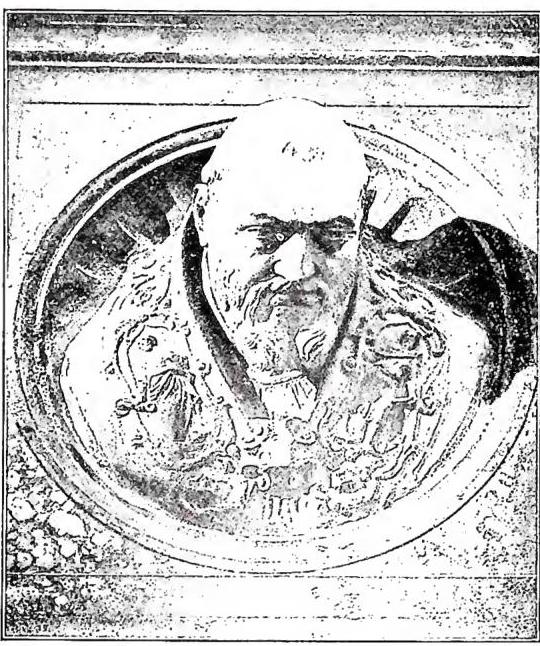
CLEMENTE VIII, POPE. — Ippolito, son of Silvestro Aldobrandini, an illustrious jurisconsult, and of Lisa Deti, b. at Fano on 24 February 1536, was elevated to the pontificate on 30 January 1592; d. on 5 March 1605. He studied law at Padua, Perugia, and Bologna, where he earned his degree. His honest and exemplary life from his youth onward won him the favor of Pius V, protector of his family, opening to him access to the Roman prelature; he honorably held the offices of consistorial advocate and auditor of the Rota; Sixtus V promoted him to datary on 15 May 1585 and, in that same year, on 18 December, also made him cardinal of S. Pancrazio. He was major penitentiary in 1596 and subsequently extraordinary legate in Poland
In the religious war in France, in which Spain was also involved, C. VIII avoided taking sides, unwilling to come into conflict with either of the two powers; but when Enrico di Borbone abjured Calvinism and was consequently recognized as king (v. IV), he gave his sanction to this solution and was subsequently able to reconcile the two crowns (Peace of Vervins, 1598) and provide for the reform of the Church in France. Indeed, only then could the Tridentine canons effectively be introduced in France, with a prompt revival of religious life. Precisely with a view to concord among Catholics and peace in the kingdom, C. tolerated the Edict of Nantes of 1598, by which that king granted the Huguenots, who were still very powerful in the kingdom itself, freedom of worship and conscience and special political guarantees. With the support of Enrico IV, the transfer of Ferrara to the Holy See met with success. As a cardinal, in response to the persistent efforts of Alfonso II d’Este, Duke of Ferrara, to secure the succession of that dominion for the House of Este, despite his having no legitimate male descendants, Aldobrandini had maintained that such solicitations ought not to be accepted, in obedience to a well-known bull of Pius V prohibiting any further alienation of Church fiefs; at the beginning of his pontificate he had also confirmed the bull. Upon the duke’s death, Cesare d’Este, his nephew and designated heir, sought to succeed him also in the dominion of Ferrara, trusting in the opposition of the Italian powers to an enlargement of the Papal States. In reality, however, lacking the hoped-for support of Spain, Venice, and the Empire, while C. VIII could count on the assistance of Enrico IV, not only diplomatic but, if necessary, military as well, the Este ruler was induced to submit to the Pope’s will; thus Ferrara was peacefully transferred to the Holy See. C. VIII wished to enjoy this political triumph by going pompously to Ferrara and ordering there, among other things, the construction of a fortress.
The Pope had fewer successes in other areas of his political-ecclesiastical government: Spanish power, which was still strong in Italy and bore heavily upon the papal court itself, became more obdurate, under the pretext of an alleged preference on C.’s part for France; the Pope’s effort to organize a Christian league against the Ottomans produced no serious result, nor did the dispatch of army corps to Hungary at his expense meet with success. Although C.’s efforts for the Catholic restoration in Germany and the Spanish Netherlands were considerable, the results in reality were not commensurate. The hopes placed in Giacomo I, King of England, for the restoration of Catholicism in England, and the attempts made in this regard, produced nothing but disappointment. He received little consolation concerning the fortunes of Catholicism in Poland and Russia; he found comfort, though not lasting, in the ju-
bilee proclaimed for the Holy Year 1600, which brought large numbers of pilgrims to Rome from various parts of Christian Europe. His body was transferred in 1646 from S. Pietro to S. Maria Maggiore, to the tomb built by Paolo V. - Vedi Tav. CXVI.