PERUGIA, ARCIDIOCESI DI

PERUGIA, ARCHDIOCESE OF. — City and archdiocese, capital of the homonymous province in Umbria.

It has an area of 1,600 sq km, but for the most part hilly, traversed in part by the Tiber and bordered by the waters of Lake Trasimeno. It borders the dioceses of Assisi, Foligno, Todi, Orvieto, Città della Pieve, Cortona, Arezzo, Città di Castello, and Gubbio; it comprises the municipalities of Perugia, Castiglion del Lago, Tuoro sul Trasimeno, Passignano, Lisciano Niccone, Magione, Torgiano, Marsciano, Deruta. It has a population of 166,200 inhabitants, all Catholic, except for a small Jewish minority. It has 194 parishes distributed across 16 rural vicariates, with 228 secular priests and 65 regular clergy, a minor seminary, 19 male religious houses and 49 female ones. It is the seat of the regional ecclesiastical tribunal. The cathedral is dedicated to the martyr St Lawrence.

In Umbria, due to its proximity to Rome, Christian communities must have formed at an early date, and one of the places that soon became a regularly established diocese is Perugia (Perusium). It too had its martyrs, among whom is known Costanzo, recorded in the Hieronymian Martyrology (29 January). Around his body, buried where the church dedicated to him now stands, the particular veneration of the Perugians gathered, who later proclaimed him patron of the city. It is a reliable tradition that St Costanzo was bishop of Perugia (Lanzoni, I, pp. 548 ff.).

Article illustration

Once the ecclesiastical authority of the bishop was firmly established within its boundaries, he also exercised those public powers that Roman legislation had recognised and transmitted to him. During the Gothic War, while Perugia was besieged by the army of Totila, Bishop Herculanus led the city’s resistance. After a long and exhausting siege, when the city was taken, he was beheaded by the Gothic king on the very walls from which he had encouraged the defence. His remains, later exhumed and solemnly buried, became a palladium of the city’s freedom and greatness; and Bishop Herculanus, venerated as a martyr, was adopted as another protector of the city, and the Perugians continued to show him particular devotion throughout the Middle Ages.

In the 5th century Christian worship was flourishing in its outward expressions as well: this is attested by the church of St Michael the Archangel, still in its characteristic circular-plan architectural structure, which arose outside the inhabited area, to the north of the city, beyond the Etruscan-Roman walls within which Perugia was still contained; while to the south, likewise outside the walls, on Monte Capraro, in the place where the monastery of St Peter was later built, stood the original cathedral, which in the 10th century was transferred by Bishop Ruggero to the hill of Porta Sole, in the centre of the city, into the very ancient church of St Lawrence; hence this saint also became one of the city’s protectors. There, in the 15th century, work began on the construction of the present cathedral, which is dedicated to him.

In Perugia, as the first administrative district of the Exarchate, after a brief Lombard interlude becoming a Byzantine duchy, and with the fall of the Exarchate passing to the Church, while the bishop continued to intervene in civil affairs even without governing the city until the establishment of the Commune, the city must also have been a centre of study and teaching. It has been inferred that law was taught in the episcopal school from the fact that, from time immemorial, the Chapter Archive contained, alongside sacred texts, the Summa Codicis, known as the Summa Perusina, a juridical compilation for forensic and educational purposes, dating from before the year 1000. But the frequent visits of the popes must also have contributed to increasing the prestige of the Perugian Church, beginning with the first historically attested one, Pope Zachary, who in the year 749, by the authority of his word, succeeded in having the siege laid to the city by King Ratchis of the Lombards lifted.

Perugia is Guelph, not far from Rome and in a secure position: the popes liked to stay there; indeed, the Commune, ever jealous of its own freedom even in the face of the Church, pressed and made offerings so that they would take up permanent residence there. The Conclaves from which Honorius III (1216), Clement IV (1265), Honorius IV (1285), Celestine V (1294), and lastly Clement V (1305) were elected were held in Perugia. In the episcopal school it has also been thought possible to discern the first impulse of that civic cultural movement which in the 13th century led to the foundation of the University of Perugia, declared a Studium Generale by Clement V in 1308, and to which John XXII added the right to confer doctorates in civil and canon law in 1318, in medicine and the arts in 1321; while the Faculty of Theology was established there by Gregory XI in 1371, and the university retained its name even after the decline of the Faculty of Law, which had already counted among its great jurists Bartolus and Baldus.

A critical study of the bishops of Perugia still remains to be done. Notable figures have occupied the Perugian see, distinguished for their piety, their care for studies, and their interest in the city’s monuments. Closer to our own times are Fulvio della Corgna, bishop in 1550, later raised to the cardinalate, who founded a seminary even before this was prescribed by the Council of Trent; Napoleone Comitoli, elected in 1591; Lucalberto Patrizzi, a distinguished jurist, elected in 1669; Anton Felice Marsigli, learned in law, literature, and the sciences, elected in 1701; Gioacchino Pecci, later Pope Leo XIII, from 1846 to 1878, after having been there from 1841 to 1843 as apostolic delegate of the province of the Papal State. The seminary, which already boasted an illustrious humanistic tradition, having at its beginnings counted, as a teacher after having been a pupil, Marco Antonio Bonciario, one of the leading exponents of Perugian culture, owed to Pecci, surrounded by a most cultivated clergy, a revival of religious, philosophical, and literary studies. Pecci also made Perugia, with the Academy of St Thomas, a centre in the revival of Thomist philosophy. At present, the seminary offers secondary-level studies; the students of philosophy and theology attend the regional seminary for Umbria in Assisi.
Article illustration
The diocese was elevated to an archiepiscopal see by Pope Leo XIII on 27 March 1882, without suffragan dioceses.

At the hands of Brother Raniero Fasani, the movement of the Disciplinati began in Perugia around 1260, from which numerous urban confraternities originated, to which are owed many works of charity and many works of art; just as in their dramatic Laudi one can trace the origins of Italian theater. In Perugia, as testified by its school of painting, entirely of sacred inspiration, religious sentiment regained fervor through the preaching of St. Bernardino of Siena, who renewed laws, reformed public and private customs; and in his honor the city erected some of its most beautiful artistic monuments. Despite the most acute political contrasts with the Papal States, into which the city, with its territory, was definitively absorbed in the 16th century and remained until 1860, religious faith remained ever active there: in 1631, by decree of the city magistrate, the city was consecrated to the Virgin of the Rosary.

Martyrs of the Roman era, hermits of the early Middle Ages, such as St. Bevignate, to whom a church is also dedicated, cenobites like St. Peter Vincioli, founder in the 10th century of the monastery of St. Peter, and other citizens of Perugia have attained sanctity. In particular historical prominence remains the figure of the Blessed Colomba, who, though originally from Rieti, is entirely Perugian in her life. With her zeal and austerity, with her pacifying action among the city factions of the Oddi and the Baglioni, she follows the examples of her great Sienese counterpart. Before Alexander VI she maintained a strict respect, neither rebellious nor accommodating; yet she had to suffer from the malice of Lucrezia Borgia. She founded the monastery of St. Catherine, of the Dominican Tertiaries, known as the Colombe. She died at the age of 34 on May 20, 1501.

The Benedictine, Franciscan, Dominican Orders, among others, have built in Perugia notable monasteries, centers of study, and in their monumental aspect. The Benedictine abbey of St. Peter has been adorned for centuries in its church and cloisters with artistic treasures; and in its vast lands of the Tiber Valley it rendered meritorious service to the agricultural reclamation of the region. The Dominicans, who came to Perugia in 1220, erected the grand convent of St. Dominic, now home to the civic museums, with its temple still imposing even in its 17th-century remodeling. The Franciscans had two convents; that of the Conventuals of St. Francis at Prato, whose church, now destroyed, was begun in the same year as the Upper Basilica of Assisi and had become the Pantheon of illustrious Perugians; the other, of the Observants at Monte Ripido, built on the hill where the Blessed Giles of Assisi had his hermitage and died. The Olivetans also built in the 18th century a majestic monastery, destined by the Napoleonic government and later confirmed by Pius VII in 1815 as the seat of the University of Studies.

Within the diocese, among the shrines of the countryside, toward which the devotion of the faithful converges more for the miraculous events that are placed at their origin, are to be remembered that of Castel Rignone and that of Ponte della Pietra. For several centuries the very cathedral of St. Lawrence was a pilgrimage destination, for the custody of the Holy Ring, which tradition held to be the wedding ring of the Virgin. With the cult of her, under the title of the Graces, in the beautiful image, a work by a pupil of Perugino, existing in the Duomo, the religious sentiment of the city finds its most vivid expression.

BIBL.: C. Baglioni, Annali della Chiesa perugina, 17th c. ms. (in the Biblioteca comunale Augusta); L. Jacobilli, Vita de' santi e beati dell'Umbria, Foligno 1647; F. Riccardi-O. Lancellotti, Memorie storiche delle Chiese perugine, 6 vols., 17th c. ms. (in the Archiepiscopal Chancery); G. Belforti-A. Mariotti, Serie dei vescovi perugini, 18th c. ms. (in the Biblioteca comunale Augusta); A. Mariotti, Saggio di memorie storiche ecc.,

«Stragi» of Perugia

The campaign against Austria and the consequent uprisings in the Legations and central Italy led, on June 14, 1859, to the establishment of a provisional government even in Perugia.

Its inspiration had come from the Sardinian dictator in Florence, Carlo Boncompagni, at the instigation of Marquis Filippo Gualterio, with the connivance of about a hundred local innovators and the aid of some 800 well-armed Tuscan volunteers. The great majority of the urban and rural population remained, as usual, entirely uninvolved, but due to the scarcity of police forces, the energetic apostolic delegate Monsignor Luigi Giordani was forced to withdraw to Foligno. Instead, Cardinal Archbishop Gioacchino Pecci, later Pope Leo XIII, who had repeatedly warned the Secretariat of State in advance of what was being prepared, remained at his post.

Article illustration

From Foligno, through timely instructions from Cardinal Antonelli, Giordani directed the operation to subdue the city, employing 1,700 Swiss commanded by Colonel Antonio Schmidt, half a battery of artillery, and about 60 gendarmes and 30 customs guards. State Councilor Luigi Lattanzi, another valuable witness, a man well known in Perugia for his integrity and even appreciated by the innovators, was sent in vain to prevent, on June 20 and 21, a futile resistance. Thus, shortly after 3 p.m. on the 21st, the city was stormed and the Swiss succeeded in overcoming the outer defenses of the Frontone and the monastery of St. Peter.

At that very moment, the commander of the insurgents, Carlo Bruschi, fleeing with the colleagues of the provisional junta toward the Tuscan border, entered the inhabited area shouting loudly to those who had been posted on the roofs and windows of the houses to continue resistance to the last drop of blood, firing and throwing whatever came to hand at the troops.

This resulted in a bloody mêlée in the streets and houses, and among the victims were even some innocents. The papal forces, in three hours of fighting, had about 90 men put out of action, largely by treacherous shots; the innovators suffered about 70 dead, a hundred wounded, and 120 prisoners. The fatal misunderstanding of continuing fire even after the sign of surrender—an equivocation attributable solely to the revolutionary leaders—and the material damage suffered, through their imprudence, by the American Perkins family lodged in the Storti inn, from whose roof shots were fired at the soldiers, was widely and tendentiously exploited by Italian and foreign liberal diplomacy and press, and the alleged “stragi” of Perugia became for many years one of the “showpieces” of anticlerical polemics.

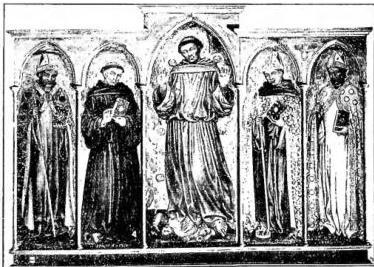
Perugia, Archdiocese of — St. Francis in Glory with Sts. Ercolano, Anthony of Padua, Louis of Toulouse, and Costanzo, by Taddeo di Bartolo (c. 1395) — Perugia, Pinacoteca.

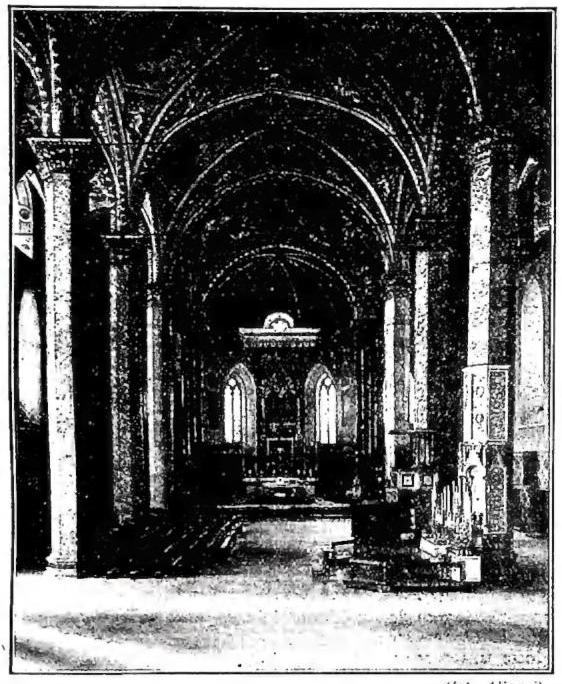
Perugia, Archdiocese of — Interior of the Cathedral (1354–1490) — Perugia.

**

BIBL.:** Giornale di Roma, 21, 24, 27, 28 June; 5, 11 July 1859; H. Ganter, Histoire du service militaire des régiments suisses à la solde de l'Angleterre, de Naples et de Rome, Geneva 1893, p. 480; H. Nelson Gay, Uno scrivio diplomatico fra il governo pontificio e il governo americano e la condotta degli Svizzieri a P. il 27 giugno 1859, in Arch. stor. del Risorgimento Umbro, (1907), pp. 113-201; G. Leti, Roma e lo Stato Pontificio dal 1849 al 1870, Note di storia politica, I, Ascoli Piceno 1911, pp. 385-80; L. F. Stock, United States ministers to the Papal States, Instructions and despatches (1848-68), Washington 1933, pp. xxviii and 143-82, 157, 158, 171; P. Mencacci, La rivoluzione. Mem. documentate, II, Roma s. a., parte 2, pp. 242-43; III, parte 1, pp. 269-88; P. Pirri, Pio IX e Vittorio Emanuele II dal loro carteggio privato, II, Roma 1951, parte 1, pp. 104-106; parte 2, pp. 281-94. Paolo Dalla Torre

**Archaeology.** — The Archaeological Museum in P. preserves several Christian inscriptions from Roman cemeteries: one bears the date 364; but the most notable is that of a child Eutychianus, which ends with “Dei Servus” (Ἱσχὸς χριστός ΙΧΘΥΣ; cf. Fr. J. Dölger, *Das Fischsymbol in frühchristlicher Zeit*, Rome 1910, pp. 192-97, no. 4). A 4th-century Christian sarcophagus was reused for the burial of Bl. Egidius of Assisi and found in S. Francesco in the 14th century. Known since the 18th century, it was published by G. B. De Rossi (*Spicilegio d'archeol. crist. nell'Umbria*, in *Bull. di arch. christ.*, 2nd ser., 2 [1871], p. 127 and pl. 8; G. Elisei, *Di un sarcofago cristiano del sec. IV trovato a P. nel sec. XIV e servito di sepolcro al b. Egidio di Assisi*, in *N. Bull. di arch. crist.*, 4 [1898], pp. 9-23); it was re-examined by G. Wilpert (*Beiträge zur christlichen Archäologie*, in *Römische Quartalschrift*, 20 [1906], pp. 1 ff. and in *Sarcofagi*, I, pp. 35, 126 and pl. 28, 3). It is divided by columns into seven compartments; in the centre is G. Christ teaching, flanked by saints, on the lid two scenes of Glory, and on the titulus the 15th-century inscription: “bati Egidi sepulchrum.”

In the eastern part of P. in 1717, among the ruins of a building, a hoard was found containing 61 gold coins of Emperor Justinus and 77 aurei of Justinian together with fibulae, rings, and a silver disc bearing the inscription “De donis Dei et Domini Petri utere felix cum gaudio” (CIL, XI, 2089). G. B. De Rossi conjectured that it was a gift offered by Pope Vigilius to Belisarius (*Bull. arch. crist. cit.*, p. 147). In S. Prospero at P. there is a ciborium supported by four columns dated to the end of the 8th century, its four faces decorated with interlace and rosettes, and on the main face a cross and two peacocks. Inside was an altar with a mensa containing a cavity for relics (Ph. Rohault de Fleury, *La Messe*, II, Paris 1883,

V. index)

See pl. LXXXI. Enrico Jasi

**Perugino, Pietro Vannucci**, called il. — Painter, b. Città di Castello 1445. Despite the flourishing of studies around this artist, the problem of his training has not yet been clarified, and every solution remains in the realm of hypothesis; all the more so since there are no securely attributed early works.

According to Vasari he completed his education with Piero della Francesca at Borgo S. Sepolcro, then moved to Florence where, in 1472, he is enrolled in the painters’ matriculation and is in the workshop of Verrocchio. But even of this period there are, apart from the two

Article illustration

**Perugino, Pietro Vannucci** called il. — St Ansanus — Assisi. Oratory of the Pilgrims.

**Saints in the Oratory of the Pilgrims at Assisi (1468), works that are either certain or securely dated.** Recently an attempt has been made to deny him authorship of the *Storiette di s. Bernardino* (1473) in the Pinacoteca of Perugia. For the *Adoration of the Magi*, in the same Pinacoteca, the dating ranges between 1470 and 1475, and the *St Christopher* in the Borghese Gallery is disputed with Pinturicchio (q.v.). It is therefore from the *St Sebastian* of Cerqueto (1472) that one can begin his exact chronology and the development of his art based on certain and dated works. With this painting we are still in the Florentine, or rather Pollaiuolesque, phase of P., when the plastic force, which in no way detracts from the elegance of the modelling, reveals an artist already formed and confident in his abilities. Moreover, the list of his lost earlier works from Perugia and Florence—frescoes in the Convent of Porta a Pinti in Florence, the decoration of the Palazzo dei Priori in Perugia, and others—bear witness to the fame he had already achieved. To these paintings must be added the apse decoration of the old basilica of St Peter in the Vatican (1479), destroyed in the rebuilding of the church. Already during this first sojourn in Rome P. had come into contact with Melozzo da Forlì, whose influence is evident in some works of the following period; a period of ascent for the artist that would reach its climax in the last decade of the century. Of 1481 are the works in the Sistine Chapel, where he executed alone the *Delivery of the Keys* and in collaboration with Pinturicchio the *Circumcision of the Sons of Noah* and the *Baptism of Christ*; of 1488-89 the *Annunciation* of Fano and the *Apparition of the Virgin to St Bernard* in the Munich Museum, followed by the Albani triptych with the *Nativity*, the two paintings of the *Virgin and Child* at Vienna and the Uffizi, the *Resurrection of Christ* in the Vatican Pinacoteca (1495), an *Agony in the Garden* and a *Pietà* in the Uffizi. In all these works there is a crescendo of those essential elements of his art that culminate in the great Florentine fresco in S. Maria Maddalena de’ Pazzi: the solitary, sculptural figure of the crucified Christ, the figures of the Virgin and the saints, so detached and gathered in devout contemplation and expressing a sense of mystical piety, find their counterpart in the landscape that opens deep and luminous, suffused with serene and peaceful atmosp

**PERUGINO PIETRO – PERUZZI BALDASSARRE**

In 1516 he adorned the Cappella Ponzetti in S. Maria della Pace with paintings; then in 1520 he was appointed architect of the Fabbrica of St Peter, a position confirmed in 1530 after the Sack of Rome in 1527, during which he was captured and maltreated, when he took refuge in Siena, welcomed with great honour by that Republic. And in Rome, after five years in Siena, where he worked especially as military architect and painter (panel in the church of Fontegusta with Augustus and the Sibyl, and frescoes in the Castello di Belcaro), he returned to direct the works of the Fabbrica of St Peter and to build, between late 1532 and 1536, what is his masterpiece: the Palazzo Massimo alle Colonne.

Initially linked to the pointillistic and Peruginesque styles, but soon inclined in Rome toward Raphael’s forms and, consequently, toward Lombard accents—such as he could have encountered through Sodoma, who arrived in Rome in 1515—P. achieved his greatest fame through his work as an architect. At first guided by the example of Francesco di Giorgio Martini, during his Roman sojourn he was drawn into the cultural orbit of Raphael and, like Uribante, knew how to interpret and adapt the forms of ancient art with spontaneous freedom and grace. This is evident in the Palazzo della Farnesina, which Vasari describes as “built with such grace that one sees it not as constructed but as if born,” in the completion of Raphael’s dome for S. Eligio degli Orfei, and in other works widely attributed to him. Yet in the Palazzo dei Massimo, the still-timid grace of those earlier buildings gives way to a new and exuberant sense of Renaissance form. Here, within a small space—in the curved façade, the deep ground-floor portico, the entrance hall, and the courtyards—the linear refinement of P.’s early constructions yields to a fresh chiaroscuro sensibility. This manifests itself in bold contrasts of light and shadow, in free perspectival and scenographic play, and in the ostentatious heaviness of certain antique elements juxtaposed with others still imbued with the delicate elegance of the Quattrocento.

Article illustration

There is in the colors, composition, figures, and landscape an equilibrium that P. would never again achieve, although in works executed up to 1500 (the *Virgin and Child* in the Pinacoteca of Bologna; the triptych for the Certosa of Pavia, now in London; the *Assumption* in the Uffizi; and, still dismembered, the altarpiece for S. Pietro in Perugia) he still showed himself fully in command of his means. Yet already in what should have been the masterpiece of his maturity—the decoration of the Collegio del Cambio in Perugia—there begins, with the repetition of old formulas, a repetition that grows ever more weary and superficial, the painter’s decline: he continued to work until the end of his life in the now outmoded modes of Quattrocento painting. Witness to this are even his best late works: an *Adoration of the Magi* in Città della Pieve, a *St. Sebastian* in Panicale, a *Crucifixion* in Siena, an *Adoration of the Shepherds* in Montefalco, and finally the frescoes at Fontignano, the *Virgin and Child* and the unfinished *Adoration of the Magi*, cut short by his death in 1523.

Numerous other works are variously attributed to him. His pleasing, elegant, and serene manner won him a wide following, whose members, with the exception of Raphael, generally remained inferior to the master. To him, a great artist especially in the period of his early maturity, belongs the credit for having helped renew Umbrian art by infusing its distinctive character with the latest discoveries of Florentine Renaissance. — See pl. LXXXII.

BIBL.: Venturi, VII, II, Milano 1913, pp. 453 ff.; W. Bombe s.V. in Thieme-Becker, XVI, 1932, pp. 450 ff. (with bibliography); A. Bertini Calosso, s.V. ENOCH. Ital., XXVI, pp. 911–913; F. J. Mather, *Two peruginesque drawings*, in *Museum of hist. art Princeton*, 1914, p. 6; C. G. mba, *Pittura un'ebola del Rinascimento*, Nuova 1949, pp. XXVIII–XXXVIII (with bibliography).

Maria Donati