
BALDO degli UBALDI. — One of the greatest Italian jurists of the Middle Ages, born in Perugia into a noble family (it is uncertain whether in 1319 or 1327), he received his doctorate in his native city while still very young (according to tradition, at the age of only 17), being presented by the most illustrious of his teachers, Bartolo da Sassoferrato, though he had also attended the courses of Giovanni dei Pagliaresi, Francesco Tigrini, and the canonist Federico Petricci.
In 1344 he was apparently already teaching at Bologna, where his long and eventful academic career began, as he was sought after and repeatedly summoned by the leading universities of the period: he taught law at Perugia perhaps in 1348 and certainly in 1358; he then moved to Florence, where he remained for approximately seven years, arousing such widespread admiration that he was granted honorary citizenship of the city; from the final months of 1364 until 1376 he was once again teaching civil law as an ordinary lecturer at the University of Perugia; from 1376 to 1379 he taught at Padua; in January 1380 we find him again at Perugia, where he remained at least until February 1390; at Pavia, his final place of residence, he died on 28 April 1400.
If Bartolo is rightly regarded as the greatest jurist of the fourteenth century, his disciple B. surpassed him in breadth of learning, juridical acumen, and modernity of outlook. His more extensive knowledge of legal literature, which enabled him to write even a treatise De commemoratione famosissimorum doctorum, his sound training in canon law, and a respectable philosophical culture provided B. with a greater wealth of arguments in support of his theses, while his speculative intellect led him to make more pronounced use than Bartolo had done of dialectics and scholastic subtleties, to the point, moreover, of causing him to fall into some of the defects that were later rightly reproached to the Bartolists; yet it is also true that he succeeded in overcoming not a few of the difficulties before which Bartolo had halted, and in bringing about a further significant adaptation of the law to the new reality of the times. In this intention to transcend Bartolo’s doctrine, and in his own polemical temperament, one must see the inspiration for the criticisms, sometimes even harsh, that B. frequently directed at his great teacher, rather than an envious bitterness that he supposedly harbored against him, as some believed. In fact, he is less Bartolo’s antagonist than the integrator of his scholarly work.
B.’s adherence to the reality of the century is always vivid and active, for he was convinced that the laws «in scholis deglutiuntur sed in palatio digeruntur». The public law of his time became known to him in its innermost essence through his own experience as an ambassador, negotiator, and statesman, even more than through scientific elaborations; private law, before being presented to him through the study of the texts, was revealed by legal practice and by his functions as advocate for the two great guilds of the mercantile and wool trades in Perugia, as a mixture of diverse Roman, canonical, statutory, and feudal elements, and likewise in the new branches of criminal, commercial, and international law.
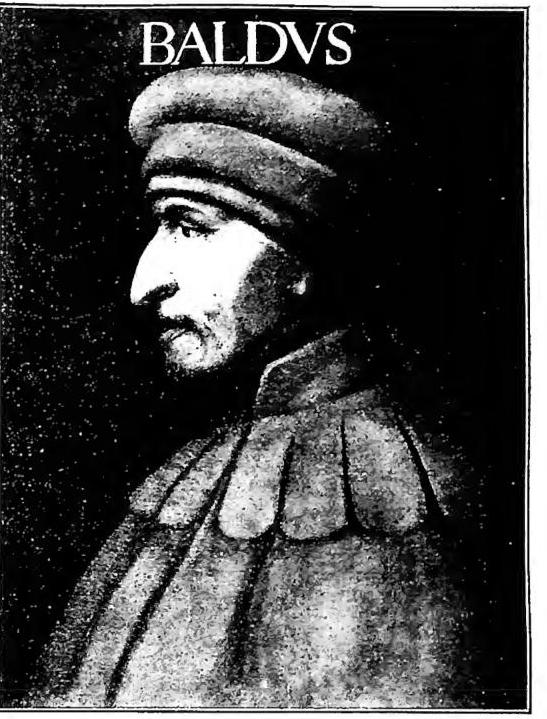
(Alinari photograph)
BALDO DEGLI UBALDI — Sixteenth-century copy of a contemporary portrait — Florence, Uffizi Gallery.
the literary genre of treatises, numerous and concerning the most varied subjects: agreements, witnesses, notaries, the audit, the constitutum, the inventory, the auction, legal questions, prisons, exceptions, and the right of protimesis.