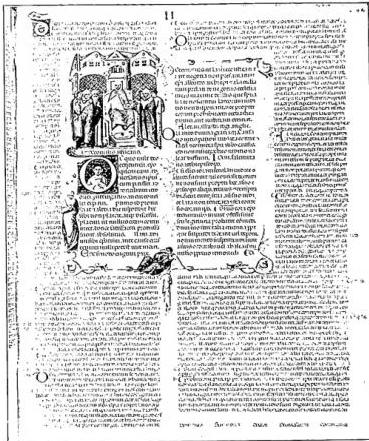
DECRETALI

DECRETALS. — The term is used antonomastically for the letters of the Pope containing a normative statement either in a general way or, more often, for the resolution of a particular question brought before his judgment.

A precise distinction from the point of view of law was represented by the classification of decretals as interpretative of existing law, constitutive of new law, and hortatory.

The characteristic of the *decretales praeceptivae* was noted, beginning with Pope Siricius (384–99), in the formula *«volumus et mandamus»*, by which this type of decretal was issued. But the same Pope Siricius recalls the *«Generalia decreta»* of his predecessor Liberius (352–66). The earliest texts of papal constitutions have not come down to us, and of the oldest registers only those of Gregory the Great, John VIII, and Gregory VII have survived.

The practice of compiling collections of decretals of one or more popes must have arisen early, due to the need to have at hand the established and currently valid norms. The known collections are numerous (see also CANONICAL COLLECTIONS). The principal collections, which enjoyed particular authority in the period when a true scientific doctrine of canon law was taking shape, are contained above all in the *Quinque compilationes antiquae* (see COMPILATIONS [QUINQUE] ANTIQUAE), and in the official collections of Gregory IX’s *Liber extra*, Boniface VIII’s *Liber sextus*, John XXII’s *Extravagantes*, and the *Extravagantes communes* (see CORPUS IURIS CANONICI).

Beginning in the 5th century, with the *Collectio Dionysiana*, the practice was adopted of uniting decretal letters with the canons of the councils, thus forming a distinct and predominant source of Church law. It should be noted that alongside the regular collections of decretal letters, there also exist collections in which the texts of such letters are partly spurious or artfully altered. — See plate LXXXV.

BIBL.: H. Grisar, *Über Sammlungen älterer Papstbriefe und deren theologische Verwertung*, in *Zeitschrift für katholische Theologie*, 12 (1888), pp. 487–532; C. Silva-Tarouca, *Le antiche lettere dei papi e le loro edizioni (sec. V e VI)*, in *Civ. Catt.*, 1921, I, pp. 13–22 and 323–26; H. Getzeny, *Stil und Form der ältesten Papstbriefe bis auf Leo den Grossen*, Günzburg 1922; on the collections of false decretals cf. recently P. Fournier – G. Le Bras, *Histoire des collections canoniques en Occident depuis les fausses Décrétales jusqu’au Décret de Gratien*, Paris 1931–32; A. Van Hove, *Prolegomena*, 2nd ed., Malines-Rome 1945, pp. 136–42. Antonio Roca

DECRETALISTS. — It is customary to designate by this term the canonists who dealt with the abundant legislative material issued by the popes of the 12th and 13th centuries, to whose decretals general normative value had been attributed both in practice and in theory. *Decretalists* were therefore both the compilers of all the collections that were gradually made from these sources of canon law and the interpreters of those same collections. What had been done for the *Decretum* (see DECRETISTS) was also done for all the collections of decretals, which were glossed and abundantly commented upon.

Among those who made one or another collection of decretals the object of teaching and study, mention should be made of Bernardo Balbi of Pavia and Riccardo Anglico, who glossed the first of the *Quinque compilationes antiquae* (see COMPILATIONS [QUINQUE] ANTIQUAE); Alberto of Benevento, who glossed the second; Vincenzo Hispanus, who glossed the third; Giacomo d’Albenga, who glossed the fifth; and also the Englishman Alan, Magister Damasus, Gratia Aretino, and Tancred, author of an apparatus to the early compilations, considered, until the publication of Gregory IX’s decretals, as the *glossa ordinaria* of the decretals.

But the true historical period characterized by the activity of the decretalists begins in 1234, the year in which the promulgation of Gregory IX’s decretals (see CORPUS IURIS CANONICI) gave rise to a flourishing school of decretalists, which proceeded to adorn them with glosses and commentaries conducted with a more rational and refined method. Among the decretalists of this second period, the names of Sinibaldo Fieschi (later Pope Innocent IV), to whom we owe the celebrated *Apparatus* on the five books of the decretals, Enrico of Susa, better known as Cardinal Ostiensis, the Frenchman Peter of Sampson, Cardinal Geoffrey of Trani, Bernard of Compostella, credited with the *Margarita Compostellana*, a compendium of Sinibaldo Fieschi’s *Apparatus*, and Bernard Bottoni of Parma, author of a *Summa Decretalium*, considered the *glossa ordinaria* of the decretals, remain famous. Nor are there lacking in this period authors of particular treatises on special topics (on marriage, on elections, etc.), such as, for example, Raymond of Peñafort, William Duarte, Egidio Fusciaro, who was the first lay professor of canon law, and others of lesser note.

BIBL.: W. Holtzmann, *Beiträge zu den Dekretalensammlungen des XII. Jahrhunderts*, in *Zeitschrift der Savigny-Stiftung für Rechtsgeschichte. Kanonistische Abteilung*, 47 (1927), pp. 37–115; A. Van Hove, *Prolegomena*, 2nd ed., Malines-Rome of the R. pp. 442–53 (with extensive bibliography).