
CORPUS IURIS CANONICI. — The term corpus indicates a collection of documents; “corpus iuris” is a collection of legal documents, especially when arranged in systematic order. At times the term is intended to designate the authentic and complete collection of all the laws by which a society is governed; thus, when Benedict XIV sends the first volume of his Bullarium to the doctors and students of Bologna, in the constitution prefaced to it (Iam fere sextus) he explains that this volume certainly remains outside the C. i. c., if this term is given its more usual meaning, which we shall immediately discuss, but that it falls within it if “appellatione corporis iuris canonici intelligendum est quidquid ab Apostolica auctoritate promanat.”
SUMMARY:
I. General notions
II. The Decretum of Graziano
III. Decretales of Gregorio IX. —IV. The Liber sextus
V. The Clementines
VI. The Extravagantes
VII. Editions.I. GENERAL NOTIONS
For several centuries, however, the term C. i. c. has indicated a collection of well-defined sources; and the term itself, as well as its success, clearly reflects the influence of the analogous designation that entered universal usage beginning in the twelfth century for the Justinian codification. Sources designated in remote periods by this or analogous terms (Corpus decretorum) may be disregarded, since they never possessed a general character. It is enough to recall that, at least since the sixteenth century (although the Council of Basel had already, in session XXIII, c. 6, referred to «reservationibus in corpore iuris clausis», intending to allude to provisions of the Liber sextus), it has comprised three unofficial collections and three official collections: namely, respectively, Graziano’s Decretum, the Extravagantes Joannis XXII, and the Extravagantes communes; the Decretales of Gregorio IX, the Liber sextus decretalium of Bonifacio VIII, and the Clementinae (the motu proprio Arduum sane munus of 19 March 1904 (Acta Sanctae Sedis, 36 [1904], pp. 549–51), which ordered the codification of canon law, in fact states that the present «corpus quod dicitur iuris canonici praesertim coalescit» of the Decretales of Gregorio IX, the Sextus, and the Clementinae cum Gratiani decreto).The work was never promulgated as a single whole: the C. i. c. is a unity by virtue of tradition and doctrine; it cannot, however, in any respect be regarded as a code deriving its unity from legislative will, such that all its parts might have the same
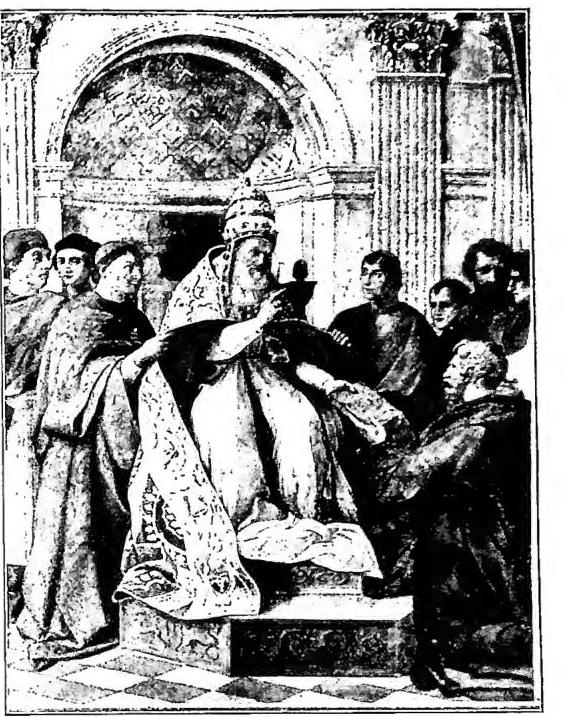
CORPUS IURIS CANONICI — Gregory IX, in the guise of Julius II, hands the Decretals over to a conciliar advocate. Fresco by Raphael and collaborators (ca. 1509) — Vatican, Stanza della Segnatura.
same value. Gregory XIII, with the constitution Cum pro munere of 1 July 1580, approved the work carried out by a commission of cardinals and scholars (correctores romani) appointed by Pius V in 1566 with the task of reviewing, correcting, and purging of spurious additions the Decree of Gratian (the revision was especially necessary for this reason), the Decretals of Gregory IX, the Sext, the Clementines, and the Extravagants; he thus approved the edition printed in officina populi Romani, to be adopted as the standard, granting that printing house a ten-year privilege to reprint the work. With the other constitution, Emendationem decretorum, of 2 June 1582, the Pontiff limited himself to approving the emendation of Gratian’s Decree, carried out on the basis of the oldest manuscripts and of the authors whom Gratian had used. The following expressions in the constitution Cum pro munere are noteworthy: «... ut... hoc Iuris canonici corpus fideliter et incorrupte iuxta exemplar hic Romae impressum... imprimi possit... providere volentes ut hoc ius canonicum sic expurgatum ad omnes ubique Christifideles sartum tectum perveniat... nulli omnino hominum... liceat huiusmodi libris dicti iuris canonici... quicquam addere»; that is, the constitution uses the three expressions C. i. c., Ius canonicum, and Libri iuris canonici interchangeably. As for the significance of Cum pro munere, it was clearly an approval of an edition, which may properly be called an official edition, and not the promulgation of a body of laws. Indeed, it was never doubted that the norms contained in the various parts of the C. i. c. could not be regarded as homogeneous in their efficacy, but that the older ones might have been abrogated by the more recent, and those of general scope derogated by special ones, in accordance with the customary general criteria for the interpretation and mutual accommodation of different laws.
II. THE «DECRETUM» OF GRATIAN
The oldest part of the C. i. c. is constituted by the so-called Decretum Gratiani, the work of the Camaldolese monk Giovanni Graziano, born, apparently, at Carraria near Ficulle (according to others, at Chiusi), who taught at a convent school in the monastery of SS. Felice and Nabore in Bologna. Almost nothing is known about him, unless legendary accounts are accepted. The work must have been completed in 1140. The title Decretum, probably derived from that of the Chartres (v.), appears in the oldest manuscripts; but other ancient manuscripts instead bear the title Concordia discordantium canonum, which more accurately conveys the content of the compilation and the aims pursued by its author.Through numerous collections of canons from the 11th and 12th centuries (and to a much lesser degree through direct research into the sources), Graziano assembled a vast body of material, consisting of pseudo-apostolic canons; canons of Eastern, African, Spanish, French, German, and Italian councils held between the 4th and 12th centuries; letters of popes (many of them spurious) from Anacletus to Innocent II; passages from the Fathers of the Church and ecclesiastical writers (Ambrose, Jerome, and especially Augustine are extensively used); fragments of the Corpus iuris civilis, the Codex Theodosianum, the Lex romana Visigotorum, and the Frankish capitularies.
With this material Graziano composed his work, which consists of three parts. The first, divided into 101 distinctiones, themselves subdivided into canons (although this arrangement is later than Graziano), deals with law in general, with the law of the Church in particular and its sources, with clerics and their obligations, and with the conferral of the various degrees of the ecclesiastical hierarchy and the requirements demanded for them. The second, divided into 38 causa, subdivided into quaestiones, which are further divided into canons, concerns judicial and penal law, various questions of property law, relations between the secular and regular clergy, and matrimonial law. The third (divided into five distinctions, subdivided into canons; here too the arrangement is later than Graziano) deals with the consecration of churches, the Eucharist, Baptism, various questions of liturgy, and certain points of theology. Following the model of Algero of Liège’s De misericordis et institio and Pietro Abelardo’s Sic et non, Graziano endeavours to connect the texts with one another and to set forth the conclusions emerging from them. The author often explains that the contradictions among the texts are merely apparent, or how they are to be overcome: ratione significationis (by appealing to the spirit of the norm), ratione temporis (the more recent norm prevails), ratione loci (the local character of a norm), ratione dispensationis (one canon establishes the general rule and the other a dispensation from observance of that rule). More precisely: in the first part, at the beginning of each distinctio, Graziano summarizes the general principles that will be developed in it and sometimes takes care to connect the distinctio with the preceding one; in the second part, each causa begins with the exposition of an imaginary practical case, followed by Graziano’s formulation of the various questions that must be resolved in order to arrive at a solution to the case; in both parts (the third is a simple exposition of texts), individual texts are often followed by a brief commentary, frequently intended precisely to resolve their apparent contradictions with other texts; all these passages constitute the so-called Dicta Gratiani. Each canon also has a brief title summarizing its content. Certain passages, called Paleae, were incorporated into the Decretum; they are later than the original edition and are attributed to the earliest commentator, Paucapalea. The work enjoyed enormous circulation and was truly fundamental to the development of canon law (in the heaven of the sun, Thomas Aquinas shows Dante the light of Graziano [Par., X, 103-105]); nevertheless, as has been noted, it never received legislative sanction.
The customary method of citing the Decretum is as follows: for the first part, by the numbers of the canon and the distinctio (e.g., c. 1, D. X); for the second, by those of the canon, the causa, and the quaestio (e.g., c. 1, C. XII, q. 1); for the third (which, because of the first subject treated in it, is designated under the title de consecratione), the citation is made as for the first part, with the abbreviation de cons. following the number of the distinctio (e.g., c. 1, D. I de cons.).
III. «DECRETALES» OF GREGORY IX. — In 1230 Gregory IX entrusted his chaplain and penitentiary, the Dominican Raimondo da Peñafort, later raised to the honours of the altars, with the task of compiling a new collection of decretals. The promulgation bull, Rex pacificus of 5 September 1234, by which the new collection was sent to the Universities of Bologna and Paris, indicates the practical aims of the work in the following terms: « diversas constitutiones et decretales epistolas praedecessorum nostrorum, in diversa dispersas volumina, quarum aliquae propter nimiam similitudinem, et quaedam propter contrarietatem, nonnullae etiam propter sui prolixitatem, confusionem inducere videbantur, aliquae vero vagabantur extra volumina supradicta, quae tanquam incertae frequenter in iudiciis vacillabant, ad communem, et maxime studentum, utilitatem... illas in unum volumen resectis superfluis providimus redigendas, adicientes constitutiones nostras et decretales epistolas, per quas nonnulla, quae in prioribus erant, dubia, declarantur ».
The name immediately adopted for the collection was Decretales Gregorii IX, although the other designation, Liber extravagantium (that is, of the decretals wandering outside Gratian’s Decretum) or Liber extra, was also widely used. Its contents consist of papal decretals (for the most part from the period 1145–1234), a small number of conciliar canons, passages from the Bible, the Fathers and ecclesiastical writers, and secular laws. The compiler, however, consulted the original sources only for the more recent decretals; for the others he used five compilations subsequent to Gratian’s Decretum, the so-called Quinque compilaciones antiquae. The material is arranged, according to the division of Bernardo da Pavia, in 5 books (the approximate content of which is indicated by the mnemonic verse index iudicium clerus connubia crimen), subdivided into titles indicating the subject matter (e.g., De in integrum restitutione) and into chapters (each having an inscriptio, that is, an indication of the source of the chapter, which is nevertheless often incorrect, and a nummarium, a concise formulation of the rule of law enunciated by the passage constituting the chapter). In accordance with its practical purpose, the compiler abridged the decretals, suppressing parts that seemed superfluous or that contained particular cases rather than statements of general principles (the omission is usually indicated by an et infra); at times he interpolated them, and he often distributed among various titles, in accordance with the subject treated in the different passages, fragments of the same decretal.
The Rex pacificus established that only the new collection was to be used in the tribunals and schools; it is disputed whether this amounted to the abrogation of the legal force of provisions not incorporated into the collection.
The customary method of citing passages from this collection is: the chapter, the work (indicated by an X, from Extra), the subject of the title, and the numbers of the book and title: e.g., c. 2, X, de consuet., I, 4.
IV. II “LIBER SEXTUS”
Bonifacio VIII, observing the uncertainty that prevailed concerning the papal legislative work subsequent to 1234, commissioned Guglielmo Mandagot, archbishop of Embrun, Berengario Fredoli, bishop of Béziers, and Riccardo Petroni da Siena, vice-chancellor of the Holy Roman Church, to prepare a new collection. It was promulgated by the bull Sacrosanctae Romanae Ecclesiae of 3 March 1298, which was sent to the University of Bologna and thereafter to others. The bull established that the collection, to be added to the five books of the Decretales of Gregorio IX, would be called Liber sextus; and it warned that the decretals subsequent to the work of Gregorio IX that had not been included in the new compilation or expressly preserved by provisions of the latter were to be regarded as abrogated.The Liber sextus contains canons of the First and Second Councils of Lyon of 1245 and 1274, and papal decretals from the period 1239–1298; its final chapter consists of 88 Regulae Iuris by Dino da Mugello.
Here too the texts were revised in accordance with the practical purposes of the collection. Like the Decretales of Gregorio IX, it is divided into 5 books, subdivided into titles and chapters. The method of citation is likewise the same as that indicated for the Decretales of Gregorio IX, with in VIᵒ replacing X in the indication of the collection (e.g., c. 1., in VIᵒ, de elect., I, 6).
V. LE CLEMENTINE
Giovanni XXII, by the constitution Quoniam nulla iuris of 25 October 1317, published, by sending it to the universities, the collection of the decretals issued by his predecessor Clement V, which represent the reforming work of the Council of Vienne of 1311 (Clementinae; but the collection was initially designated as Liber septimus; the Quoniam nulla gives no name for the collection).According to the constitution, this was simply the promulgation of the collection already prepared, a promulgation that Clement V’s death prevented him from carrying out; it appears, however, that Giovanni XXII revised the decretals that his predecessor had already published in the Consistory of Monteaux near Carpentras on 21 March 1314.
The division follows the customary system into 5 books, subdivided into titles and chapters; the method of citation is likewise the customary one: c. 1., in Clem., de rescriptis, I, 2.
VI. THE “EXTRAVAGANTES.” — In the manuscripts and the earliest printed editions, additions to the collections mentioned here are found in the form of various decretals later than the Sextus, sometimes published as an appendix to it; more often, they were attached to the Clementine. The decretals included and their arrangement vary according to the editions.
In the edition prepared in 1500 by the Parisian booksellers Ulrich Gering and Bertold Rembolt, Giovanni Chappuis, a licentiate in law entrusted with preparing the edition, added two further collections to the three official collections. One of them consists of 20 decretals of Giovanni XXII (which, as early as 1325, Zenzelinus de Cassanis [Jenselin de Cassagnes] had collected and glossed as a separate whole), and bears the title Extravagantes Joannis XXII; the decretals are distributed among 14 titles subdivided into chapters. The other collection comprises the decretals customarily printed with the official collections, as well as 40 new ones; it is entitled Extravagantes communes; the decretals are arranged in the 5 books of the traditional system, except that quartus liber vacat; the 4 books are subdivided into titles and chapters; the decretals belong to the period 1281–1478.
These two collections of Extravagantes were included in all subsequent editions and thus entered into the traditional formation of the C. i. c., although they never received official sanction. Method of citation for the two collections: c. 2, Extrav. Joann. XXII, de concets. praeb., IV; c. un., Extrav. comm., de celebr. missarum, III, 11.
VII. EDITIONS
The work of the correctores romani, noteworthy above all in relation to Gratian’s Decretum, was not perfect, owing to the rather limited knowledge that existed in their time of the sources on which Gratian had drawn. The Spaniard Antonio Augustino (Augustin), with his De emendatione Gratiani libri duo, published in 1587, instead made a valuable contribution to the reconstruction of the Decretum.During the second half of the 16th century, the two brothers Pietro and Francesco Pithou prepared a critical edition based on various manuscripts of the entire C. i. c.; it was not published, however, until 1685–87. An edition, likewise of the entire C. i. c., considerably more accurate, was the one edited by Giusto Henning Böhmer, which appeared in 1747. These were followed—to mention only those marking a stage in the scholarly elaboration of these texts—by Emilio Ludovico Richter’s edition of 1835 and, finally, by that of Emilio Friedberg, published by Tauchnitz of Leipzig in 1879–81. In the Decretum, Friedberg restored Gratian’s genuine text (accepting only the division that had been introduced and the Paleae), noting the alterations accepted or introduced by the correctores romani. In Gregory IX’s Decretales, he adopted the text of the 1580 edition (indicating in the notes the passages in which it differed from the original), but printed in full the decretals that Raimondo da Peñafort, in view of his practical purpose, had abridged, setting in italics the portion that had been suppressed. For the other collections, he adopted the text of 1580, indicating in the notes the passages in which it departed from the original text. — Vedi tav. XXX.