
CORPUS IURIS CIVILIS. – Since the time of the Glossators, this expression has been used to designate the various parts of Justinian’s legislation, thereby distinguishing it from the Corpus iuris canonici.
Justinian’s legislation is collected in the following four compilations: Digesta or Pandectae, Institutiones, Codex repetitiae praelectionis, Novellae (constitutiones). The task of collecting leges and iura, that is, the constitutions of the emperors and the texts of Roman jurisprudence, was I (v.), emperor of the East from 527 to 565. A century earlier, II (v.) had been unequal to the same task.
The circumstances were extraordinarily favorable, but Justinian knew how to take brilliant advantage of them. The schools of law were flourishing, chiefly those of Berytus and Constantinople in the fifth century and at the beginning of the sixth; beside the Emperor, as quaestor sacri palatii, stood a man of the highest ability, Tribonian. Yet neither the revival of the schools, nor the possibility of making use of the exceptional abilities of a highly learned scholar, nor even the increasingly urgent need for legislative work better suited to altered social conditions would have been sufficient, had Justinian not wished to reconstruct the unity of the Empire through arms, ecclesiastical policy, and legislation.
The plan for the legislative work had probably not yet been fully elaborated when, by the constitution Haec quae necessario of 13 February 528, the Emperor appointed a commission, presided over by John, then quaestor sacri palatii, and including Tribonian and Theophilus, with the task of drawing up a new code from the three pre-existing codes (Gregorian, Hermogenian, and Theodosian) and from the subsequent constitutions. It was published on 7 April 529 by the constitution Summa reipublicae, remained in force for only four years, and has not come down to us. A fragment of this Codex, preserved in a recently discovered papyrus (pap. Ox. no. 1814), contains, among other constitutions from titles 11–16 of the first book, the very constitution called the law of citations; this has rightly led de Francisci and Bonfante to think that Justinian, immediately after ascending the throne, had not yet departed from the program that inspired the Theodosian constitution. The great project matured later and brought about the constitution Deo auctore of 15 December 530, which ordered the compilation of the Digest.
SUMMARY: I. Digesta or Pandectae. – II. Institutiones. – III. Codex repetitiae praelectionis. – IV. Novellae. –
V. Manuscripts and editions
VI. General observations of synthesis.I. «DIGESTA» or «PANDECTAE». – These are the compilation of jurisprudence carried out by a commission whose members, under the presidency of Tribonian, were four professors (Theophilus and Gratian of Constantinople, Dorotheus and Anatolius of Berytus), together with Constantine, comes sacrarum largitionum, and eleven advocates of the Constantinopolitan bar. They consist of fragments extracted from the works of the principal Roman jurists, arranged in 50 books of unequal length, each of which—with the exception of three, XXX, XXXI, and XXXII, which expound the subject of legacies and trusts—is further divided into titles, each headed by a rubric. Within the titles, the fragments of the jurists follow one another apparently without a systematic order: each fragment has its inscriptio, containing the name of the jurist and an indication of the original work and its corresponding book. For ease of reference, the schools subsequently divided the longer fragments into principium and paragraphs. An arduous work of broad conception, it was completed with extraordinary speed: published by the constitution Tanta on 16 December 533, it entered into force on the following 30 December.
The arrangement of the subject matter coincides, at least in its broad outlines, with that of the edictum perpetuum of Salvius Julianus. More than a century ago, a German scholar, Bluhme, when he was only twenty-three years old, established that in all the titles of the Digest the fragments follow a predetermined order that can be traced to the existence of four different series of works. Not all the series are represented in each title, nor is the order in which the fragments are arranged within them constant, but each title displays separately the series that contributed to its formation. Bluhme called these series “masses” and gave each the name corresponding to the type of legal work that predominates in it: he called “Sabinian mass” the one consisting almost entirely of works relating to the ius civile, after the great jurist who first developed the ius civile into a genuine system; “edictal mass” the one whose fundamental component is commentaries on the edict; “Papinian mass” the one in which works of casuistry predominate, among which those of Papinian occupy the foremost place; finally, he called “appendix” a last mass, consisting for the most part of less accessible or more antiquated works, because these works would have reached the hands of the compilers only later, after the work had already begun.
There is much debate as to whether the compilers of the Digest themselves extracted the various fragments, directly and consistently, from the original works of jurisprudence, or whether they made use of pre-existing compilations.
The works that Justinian, in the constitution Omnem, recalls as partes of the leges studied in the post-classical schools, under the names of prima pars legum (τὰ πρῶτα), pars de iudiciis, pars de rebus, and quatuor libri singulares, without indication of an author, were probably private compilations. To what extent, however, the work of Justinian’s commission was facilitated by post-classical compilations cannot even today be determined. The constitution of 426, which limited to five the number of jurists whose works the judge was to consult in applying the law, not only directed the attention of practitioners toward those works but must also have led to the use of parts of them as the basis of school instruction. It may therefore be that, in such circumstances, after the works of the five had become legislative texts, a private compilation was made from all or from the most important of them.
Certainly, the following observations cannot fail to be striking: 1) the very large proportion (approximately 11/15) that the five jurists of the Theodosian constitution occupy in the Justinian Digesta; 2) the manner in which the remainder (approximately 4/15) is distributed: this is almost entirely occupied by extracts from the works of seven other jurists (Cervidius Scaevola, Pomponius, Julianus, Marcianus, Javolenus, Africanus, and Marcellus) which, together with those drawn from the works of the five jurists of the Theodosian constitution, amount to approximately 11/12 of the Digest; 3) the character of the works most extensively excerpted from the other jurists not included among the five: namely, systematic works (libri ad Sabinum, libri ad edictum, digesta); elementary works (libri of institutiones and regulae); works of casuistry (responsa, quaestiones); and also specialized works on particularly important subjects (libri ad legem Iuliam et Papiam, fideicommissorum, de iudiciis publicis, de appellationibus, etc.). All these works were certainly more readily available to interpreters of the post-classical age, and in the works of the five they had a substantial as well as formal point of attachment, since they dealt with the same subject matter and bore the same title; 4) the insignificant excerpting of many works, both those belonging to the five jurists of the Theodosian constitution and those of others—an insignificant excerpting that seems to exclude the reading
direct examination of these works by the legislative commission; 5) the manner in which this commission was composed: of sixteen persons (excluding Triboniano), eleven were chosen from among the advocates of the prefecture of the East; two were magistrates (in Cratino this status was predominant over his other status as a professor); the four professors were therefore reduced to only three. A commission utterly unsuitable, for the great majority of its members, to the examination of an immense body of material which, devalued by the Theodosian constitution, should no longer have been in the hands of practitioners; 6) the extreme brevity of the time in which the compilation of the Digest was completed—three years. While the work on this compilation was still in full progress, Triboniano, together with two of the three professors (Teofilo and Doroteo), began and completed the Institutiones; 7) the violation of the Emperor’s order to employ only imperial jurists, endowed with the ius respondendi (there exist 535 fragments of Gaio, who never possessed the ius respondendi), considered in relation to the circumstance that Gaio was one of the five jurists of the Theodosian constitution; 8) the division of the material contained in the Digest into three distinct masses, reflecting the parallel division of the material that formed the subject of pre-Justinian scholastic instruction.
II. «INSTITUTIONES». — While work on the compilation of the Digest was still under way, the Emperor charged Triboniano, Teofilo, and Doroteo with preparing an elementary school treatise to replace the Institutions of Gaio. In its system and division into four books, the compilers followed the Gaian model, but, in obedience to the imperial instructions, they also drew upon other classical Institutiones (those of Fiorentino, Marciano, and Ulpiano), the Gaian paraphrase known by the name res cottidianae or aurea, and the Digesta themselves, which were then almost complete. They added to these, deriving it from the Code published in 520 or from the constitutions issued in the last years, information on the innovations introduced by Giustiniano, and often prefaced it with indications concerning the internal condition of the law and its development.
The four books are divided into titles, each bearing a rubric indicating the subject treated in that title; but, unlike what had occurred with the Codex and was being done for the Digesta, the individual passages in the title are cited without indication of the sources from which they derive, and constitute a continuous exposition in which it is the Emperor himself who speaks. Published on 21 November 533 by the constitution Imperatoriam maiestatem, they entered into force on 30 December of the same year together with the Digesta.
III. «CODEX REPETITAE PRAELECTIONIS». — This is the new edition of the compilation of imperial constitutions, made necessary after the official collection of the iura. The preparation of the Digesta had been preceded by a group of constitutions intended to resolve an equal number of disputed questions: whether they were issued to indicate a definite solution to the compilers of the iura, or to provide a rule for practitioners who drew upon the iura in accordance with the Theodosian codification, as seems more probable, is debated. It appears that, under the name quinquaginta decisiones, they were collected in a volume at the same time as the compilation of the Digesta was commissioned.
Moreover, many other constitutions were issued in the years 531 and 532 to resolve new questions that arose in the course of the compilation, and these are the ones called, using Giustiniano’s own words, the constitutions ad commodum propositi operis pertinentes.
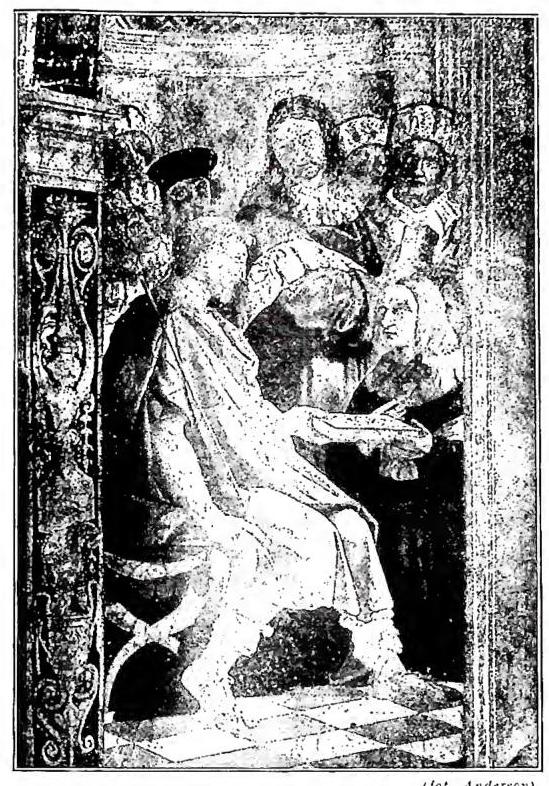
1st. Anderson
CORPUS IURIS CIVILIS - Justinian in the act of handing the Code over to Tribonian. Fresco based on a design by Raphael (ca. 1509). Vatican, Stanza della Segnatura.
Dorotheus and three lawyers. It too was completed in less than a year. Published on 16 Nov. 534 with the constitution Cordi, it entered into force on the following 29 Dec.
The Code is divided into 12 books: Book I contains the regulation of relations between State and Church, the treatment of the sources of law, and the officia of the various magistracies; Books II–VII concern private law, set out according to the edictal order; Book IX, criminal law; Books X–XII, administrative and financial law. The books are divided into titles, each with its rubric; within the individual titles, the constitutions are arranged chronologically, each with an inscriptio, containing the name of the emperor and an indication of the addressee, and with a subscriptio bearing the date; the longer ones, like the fragments of the Digesta, were divided in the schools into principium and paragraphs.
IV. «NOVELLAE» (constitutiones). - These are the new constitutions issued after the compilation of the iura and the leges had been completed, from 535 to 565. Published partly in Latin and partly in Greek, they are particularly numerous in the years 535 to 546, in which Tribonian died, and are sometimes very extensive, largely innovative constitutions, especially those concerning marriage and intestate succession.
The plan, repeatedly expressed by Justinian, to make the Novels an official collection was never carried out: only private collections of them exist. The oldest of these (around 555) appears to be the Epitome Iuliani, so called from the name of its compiler, a Julian, perhaps a professor in Constantinople; it contains a Latin summary of 122 Novels. A more extensive collection, containing 134 Novels (the constitutions up to 556), is the one known by the name of Authenticum: a curious name applied to this collection because, wrongly, in the 11th century the Bolognese school had believed it to be false; the prevailing opinion today is that it was prepared in Italy precisely in the 11th century. The Novels are not epitomized in it as in the preceding collection: the Latin ones are reproduced in the original text, while the Greek ones appear in a Latin translation that is not always faithful. The best of all is a collection containing all the Novels, Latin and Greek, in the original language, dating from no earlier than 575: it comprises 168 Novels, 158 of them by Justinian; the others by his successors, especially Justin II and Tiberius II. Whereas the various parts of the Justinian compilation, Institutiones, Digesta, Codex, although they entered into force at different times (the first two on 30 Dec. 533; the third on 29 Dec. 534), are considered in their organic entirety as a single code promulgated on the same day, the Novels derogate from the provisions established in the compilation and, among Novel and Novel, the more recent derogates from the older.
V. MANOSCRITTI ED EDIZIONI
The oldest and most authoritative manuscript of the Digesta is the one now preserved in the Biblioteca Mediceo-Laurenziana of Florence, of which a phototypic reproduction has been made. It is known as the Florentina or littera Florentina, because in 1406 it was taken by the Florentines as booty in the war against Pisa, where it had been since the 12th century. It belongs to the 6th or, at the latest, the 7th century: thus, it is only slightly later than the Justinianic compilation. Other manuscripts, of much more recent origin (from the 11th century onward), are known as the littera Bononiensis or Vulgata: they are the result of the revival of the study of Roman law at the University of Bologna and derive from a copy that must have been transcribed from the Florentina, but with corrections drawn from another manuscript, itself ancient; consequently, the reading of the manuscript of the Florentina may properly be corrected when the manuscripts of the Vulgata agree on a different reading.Of the Institutiones, there are manuscripts dating no earlier than the 9th century: one of the most important is preserved in the library of Turin.
Of the Codex repetitae praelectionis, a very ancient manuscript contemporary with the littera Florentina of the Digesta was almost entirely lost: only a small portion (Codex rescriptus of Verona) has survived. Other manuscripts are in Pistoia, Cassino, Paris, etc.
Each of the various collections of Novellae has a rich manuscript tradition: the most celebrated manuscript is held by the library of S. Marco in Venice.
The older editions were produced in 5 volumes, following the division made by the glossators. The first contained the Digestum vetus (ll. I-XXIV, 2); the second, the Digestum infortiatum (ll. XXIV, 3; XXXVIII); the third, the Digestum novum (ll. XXXIX-L); the fourth, the first nine books of the Codex; and the fifth, finally, the last three books of the Codex, the Institutiones, the vulgate version (Authenticum) of the Novellae, divided into nine collections; in addition, two books of feudal law which, together with certain laws of the Empire, formed the tenth collection. Among these, the glossed editions occupy a distinguished place.
In the 13th century, the great Accursius collected the glosses scattered through the various manuscripts, extracted the best from them, and added material of his own; thus the “ordinary gloss” came into being. The glossed editions of the C. i. contain precisely the “ordinary gloss.”
The first critical edition of the individual sources, prepared after the collection of several manuscripts and with rigorous acumen, was that of the Dutchman Gregorio Aloandro (1329-31); the first edition bearing the title C. i. c. was produced by Dionisio Gotofredo in 1583; a notable advance was represented by that of Gabauer and Spangenberg (1776-97), in which the results of two centuries of work by the Dutch school were collected. To the end of the last century belong Mommsen’s masterly edition of the Digesta in two volumes (1868-70), based on the Florentine manuscript after it had been reexamined, and the equally valuable edition of the Codex prepared by P. Krüger (1877), as well as the school edition of the entire C. i. c., for which Mommsen first, and P. Krüger thereafter, edited the Digesta (15th ed., 1928), P. Krüger the Institutiones and the Codex (10th ed., 1929), and Schöll and Kroll the Novellae (5th ed., 1928). A fine critical edition of the Digesta, in a convenient format, is the Italian one, publication of which was completed in Milan in 1931.
VI. GENERAL SYNTHETIC OBSERVATIONS
The Justinian compilation does not contain the whole of pure Roman law. Quite a few texts had already begun to undergo alteration in the post-Diocletian age; very many were altered by the Justinian compilers, who, moreover, very often must have had the opportunity to make use of glosses from the post-Diocletian age, existing in great number around the classical texts and not yet absorbed into the texts themselves. That the passages of Roman jurisprudence and the texts of the imperial constitutions incorporated into the Justinian compilation were freely altered by the compilers in order to adapt them to new circumstances is demonstrated by explicit statements of Justinian himself. Above all, in the constitution Tanta (§ 10), the Emperor recalls that he had granted the commissioners the broadest authority in this regard: «... si quid in legibus eorum vel supervacuum vel imperfectum vel minus idoneum visum est, vel adiectionem vel deminutionem necessariam accipiat et rectissimis tradatur regulis... multa et maxima sunt, quae propter utilitatem rerum transformata sunt».Thus, in the Digesta, the Institutiones, and the Codex interpolations (v.), or, as was formerly customary to say, many emblemata Triboniani.
In the post-Diocletian age Roman law increasingly felt the ever broader and more powerful influence of numerous new factors, which introduced new rules and new institutions into the system and eliminated Roman rules and Roman institutions.
New principles and concepts, superimposed upon Roman principles and concepts, already burst forth immediately in the legislation of Constantine: that is, in the legislation of the Emperor «novator turbatorque priscarum legum et moris antiqui recepti», as Ammianus likes to describe him.
The Justinian compilation, which appeared after approximately two and a half centuries, had to reflect the evolution of Roman law, no longer proceeding in a straight line, beginning with the age of Constantine, as a continuous internal development might have done, but in a disorganized, disjointed, and complex manner, since from the beginning of the fourth century to nearly the middle of the sixth it had proceeded under the pressure of new external factors, which were new formidable forces entering into play. In order to reflect it, substantial and extensive interpolations were required.
These factors may be reduced to the following:
1) Christianity. The influence of Christianity upon Justinian Roman law, although denied, or at least admitted far too sparingly, by some solitary writer, is immense. 2) The new political, social, and economic constitution of the Empire, which after Diocletian had its center of gravity in the East. If the principate is, in a certain sense, the continuation of the ancient Republic, the Constantinian Empire is the beginning of a new era. The new constitution represents, in Roman guise, a profound upheaval, in which Roman character was drowned in the Hellenistic and Oriental spirit: absolute monarchy was integrated with an order in open contrast to the Roman orders. 3) Provincial laws. When the constitution of Antoninus Caracalla extended Roman citizenship to all, or nearly all, the inhabitants of the Empire and consequently imposed Roman law upon them, Hellenic civilization, and with it Greek law, had already spread widely throughout the Roman East, as far as the Tigris and the Euphrates and the cataracts of the Nile: substantially the same law prevailed in Athens and Damascus, in Antioch and Hermopolis or Egyptian Thebes. Just as, once the ancient dialectal varieties had disappeared, the common language of the Hellenes served commerce and culture throughout the East, so, once the secondary local differences had been composed or forgotten, the general law of the Hellenes regulated the relations of private life across that vast expanse of lands and seas. Imperial legislation from Caracalla to Diocletian struggled tenaciously for the application of Roman law in the provinces; but the legislation of Constantine opened new paths and new eras, and a tumult of new rules burst into the Roman legal system. 4) The empiricism of decline. In the Roman-Hellenic age, as in every age of juridical decline, purely empirical considerations brought about serious changes in the field of law. These empirical considerations, at times conspiring with the new Christian ethical currents, led to the rescission of transactions for consideration when, although concluded in observance of all the rules prescribed by the legal order, their practical performance revealed too grave an imbalance between performance and counter-performance. 5) The spirit and doctrinal training of the jurists of the Greek East. Toward the end of the fourth century, numerous centers of study developed in the eastern provinces of the Empire: in Alexandria, Antioch, Caesarea, Constantinople, and Berytus. This city, already celebrated in 230 as the school of law (συνδεικτῆριον τῶν νόμων), was later regarded as the mother of law (μῆτηρ τῶν νόμων), and its teachers were exalted as heroes (ἔρασες) and teachers of the world (διδάσκειν τῆς οὐκουμένης): some of them, such as Cyril, Patricius, Donninus, Demosthenes, Eudoxius, and Leontius, were remembered for centuries in the Byzantine doctrinal tradition. But these teachers, who had been entrusted with the task of interpreting Roman law, brought into the interpretation of that law—necessarily connected with the elucidation of its practical application—a new spirit and a new method.
The new rules became established in Roman law: a) through imperial legislation, from Constantine onward; b) through the practice of the forum (unus iudiciorum), and through notarial and private practice, that is, through the longa consuetudo to which Justinian himself refers in the constitution Deo auctore (§ 10): unus iudiciorum and longa consuetudo, through which Roman rules and institutions, by falling into disuse, declined, while Greek rules and institutions, through the constant frequency of their application, succeeded in prevailing; c) through school instruction.
Roman architecture in the Justinian compilation is dominant: the fundamental element remains, as ever, national Roman law; but this law is also profoundly transformed.
In any event, it was the East that saved the fortunes of Roman law. After the sudden silence of classical jurisprudence in the second half of the third century, the poverty of learning was a general phenomenon in both the West and the East: Claudius Mamertinus, Ammianus Marcellinus, Theodosius II, and Valentinian III provide direct and certain testimony to this. But in the East the schools soon flourished again and prepared the way for Justinian’s great legislative work.
Men of theory more than of practice, rich in learning and patience, the Byzantine teachers, while concentrating their principal study upon the works of the five jurists recalled in the Theodosian constitution, also ventured somewhat beyond them, encouraged by their own philosophical education and dialectical ardor; they attempted to combine the old and new elements—that is, Roman, Hellenistic, and Christian elements—into a necessarily heterogeneous system, yet one that made it apparent that doctrinal elaboration existed within it and asserted itself in new conceptions, new general ideas, and new classifications.
The Justinian work was also based upon the fervent labor of these teachers of the fifth and sixth centuries; but, despite its many updates, it was necessarily to prove a work of compilation more than of legislation: fortunate if viewed from other aspects; poor if viewed from the legislative aspect, since it arose, to a considerable extent, already overtaken by the times; to a considerable extent, more history than doctrine.
To seek the law in force in the age of Justinian, one must not infrequently look outside the Digesta: one must discover it in the legislator’s personal constitutions within the Codex and, above all, in the Novellae.
But Romanitas, so powerfully and mystically felt by Justinian, who came from that Illyria which in the third century had produced the only men capable of confronting the great crisis (Aurelian, Probus, Diocletian), contributed to the
salvation of the juridical tradition which the schools of the East, while adapting and deforming it, had preserved, and which would otherwise have been disastrously lost.
Through his work, in which historical material seems not infrequently to overwhelm legislative material, Justinian preserved a precious part of the most resplendent treasure of Latin wisdom, from which the juridical education of human thought draws in every age and place, and cast his great legislation as a gigantic bridge between ancient civilization and modern civilization. Had the Emperor allowed the Greek-Oriental practice that later inspired the Isaurian Ecloga to prevail, his work in the West would have lost all influence with the fall of Byzantine rule; instead, he constructed a work that, through the Bolognese renaissance, was able to rise to become, during the Middle Ages, the common law of a large part of Europe. - Vedi tav. XXXI.