
COSA. —
I. GENERAL NOTIONS
In legal language, c. is every portion of the external world capable of being used for the satisfaction of human needs; a concept which, as can be seen, tends to coincide with that of an economic good.Excluded from the notion of c., however, in addition to the human body and its parts, are all those immaterial entities that are not susceptible to that exclusive dominion protected by the action for recovery (immaterial goods).
In law, c. are distinguished as fungible and non-fungible, according as they can be replaced by one another, so as to be designated only by sums or quantities of a given category, or are considered in their individuality; as divisible and indivisible, according as they are or are not susceptible of division, with the qualification that not only those c. whose division would entail material destruction are considered indivisible, but also those in which
the parts resulting from division do not retain, proportionately, the value of the whole c. (thus a diamond is indivisible when its value consists in a particular size); as consumable, whose use consists in destroying them (foodstuffs) or disposing of them (money), and non-consumable, which can offer more than once to the person to whom they belong the utility of which they are capable; as simple, which by nature constitute a single whole, and composite, which consist of several parts, made of the same or different materials, brought together by human beings to serve a particular purpose; as productive of fruits and non-productive of fruits, according as, while remaining intact and retaining their purpose, they yield or do not yield, more or less periodically, a certain product capable of becoming an autonomous c.; as movable and immovable, according as they can or cannot be transported from one place to another without prejudice to their material integrity (with regard to this latter classification, it should be recalled that c. which, although movable, are traditionally called, in relation to their use, immovable by destination, are now called appurtenances by the Italian Civil Code, art. 817).
II. CANON LAW
In canon law, the term c. is also used in a more general sense, to indicate everything that is not a person; in this sense, Book III of the CIC, under the title de rebus, includes the means for attaining the end of the Church, distinguishing them as spiritual things, temporal things, and mixed things (can. 726). According to this terminology, sacraments (v.), sacramentals (v.), and ecclesiastical offices (v.); temporal things are those that have economic value; mixed things are those that have economic value but at the same time contain an element of spirituality, which may derive above all from the conferral of a sacramental (e.g., sacred things, which will be discussed shortly).But, apart from this already broad notion of c., and confining ourselves here solely to things having economic value, canon law, in addition to the general distinctions already seen above (cf. can. 1497 § 1 and others, for the distinction between divisible and indivisible things; can. 1543, for the distinction between fungible and non-fungible things, etc.), has other distinctions of its own. Thus ecclesiastical goods are distinguished, that is, those things or patrimonial rights person (v.), from non-ecclesiastical goods (can. 1497 § 1; V. BENI ECCLESIASTICI); precious things from non-precious things (can. 1497 § 2); sacred things from non-sacred things (can. 1497 § 2).
Precious things are subject to certain special rules concerning prescription (can. 1511 § 1), administration (can. 1522 n. 2), alienation, and other acts exceeding ordinary administration (cann. 1532 § 1 n. 1 and 1533). Pio Ciprotti
Sacred things are those which, through blessing or consecration, have been designated to serve immediately and exclusively for worship. They, in turn, are subdivided into consecrated things, which are designated for divine worship by means of the solemn form of consecration (e.g., cathedral churches, the immovable altar stone: cf. cann. 1137, 1148, 1150, 1497 § 2, 1539 § 1, 1199, 1200, 1169 §§ 2 and 5, 1167, 1155, 1156, 239 § 1 n. 20, 323 § 2, 294 § 2), and blessed things, which are designated for divine worship by means of the less solemn rite of blessing (e.g., bells, cemeteries: cf. cann. 1156-59, 1169 § 5, 239 § 1 n. 20, 1165 §§ 1, 2 and 4, 1196, 1304, 1279 § 4).
In canon law, sacred things are not considered, as in Roman law, to be absolutely extra commercium, since it is not the thing in itself that is regarded as absolutely incapable of being traded, but rather the sacred character inherent in it, that is, its designation for spiritual use. In
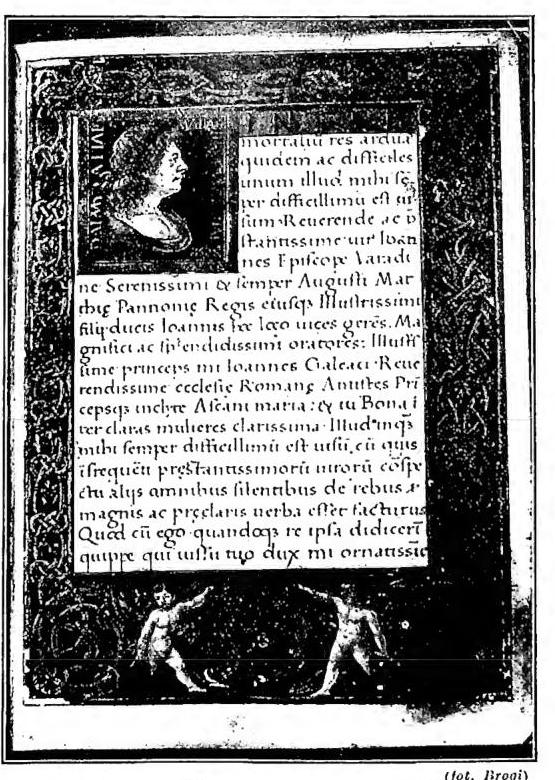
CORVINO, MATTIA — Portrait of M. C. Page from the epistolamio for the wedding of B. M. Sforza to Giov. Corvino, miniature of the Lombard school, perhaps by Ambrogio de Predis (1463). Volterra, National Museum.
in other words, sacred things can form the object of private rights, since they may be owned both by ecclesiastical bodies and by private individuals (cf. can. 1510); thus, in certain specified cases and subject to the prescribed formalities, they may be exchanged, donated, or alienated. However, in a transaction for consideration involving a sacred thing, it is not permissible to include its consecrated or blessed character in its value, and therefore in the determination of the price, under pain of committing the sin of simony (can. 1539 § 1); likewise, prescription (v.) does not cause the thing to lose its sacred character. It goes without saying, however, that this exceptional juridical situation, due to that character, no longer has any reason to exist, and the norms of common law apply whenever the efficacy of the consecration or blessing ceases, as in the case of the so-called exsecratio ecclesiae, which follows the destruction of most of the church, or in the case of the so-called decretum de profanando (or exsecratio) issued by the ecclesiastical authority (can. 1187).
See also CHIESA; CIMITERO.
III. ITALIAN LAW
For ecclesiastical property in general V. BENI ECCLESIASTICI.With regard to the legal status of sacred things in Italian state law, numerous questions have been raised and various positions maintained.
The principal controversial issue concerns whether churches are objects of commerce or not.
Before the Concordat, alongside the two radical positions according to which churches, and sacred things in general, were either non-commercial in the ancient sense of Roman law or commercial without any consideration for the purpose of worship and the public use to which they are devoted, there were other opinions: one held that, in the present matter, canon law should be regarded as in force for the State as well; another maintained that churches constituted a public domain belonging to ecclesiastical institutions, analogous to that of provinces and municipalities; yet another held that churches were excluded from commerce because a servitude of public use existed in favor of the faithful over buildings intended for worship; finally, another maintained that in our law no account is taken of the sacred character acquired after the consecration or blessing of buildings or objects of worship, but regard is paid solely to the actual and current dedication of a building or object to public worship. Accordingly, the principles applicable to immovable property and to things intended for public service would apply to them, and they would fall within those categories.
In the silence of the Lateran Concordat, the aforementioned question remains open. Nevertheless, Articles 9 and 10 of the Concordat show that sacred buildings are in a condition different from that of other buildings and that, consequently, the same rules applicable to buildings for private use do not apply to them.
On the basis of these provisions, Del Giudice adopted the position that regards churches as public-domain property of ecclesiastical institutions; Jemolo shared, though not without limitations and reservations, the opinion that, because of their dedication to public worship, sacred buildings and objects fall within the category of things directly intended for public service and should therefore be considered exempt from seizure, attachment, and alienation. For, when the interest of worship—or rather, the interest of the population in having worship—conflicts with the interest of the creditor of the institution, or of the person to whom the things belong, in proceeding against them by enforcement in order to satisfy their claims, the latter interest must yield to the former. Falco held that churches
must be recognized as non-commercial in the terms established by canon law, that is, in the limited sense that things devoted to worship may indeed be the object of private-law legal relations, but may not be the object of acts that would remove them from the use of worship for which they are intended. Thus, they may not be subjected to enforcement proceedings; moreover, alienation or prescription does not cause them to lose their dedication to spiritual use.
After the Concordat, Article 22 of the property section of the Civil Code (now Article 831 of the Civil Code), having established in general terms that the property of ecclesiastical institutions is subject to the provisions of the Civil Code insofar as the special laws governing it do not provide otherwise, stipulates, with regard only to buildings intended for the public exercise of Catholic worship, that such buildings, even when belonging to private individuals, may not be removed from their intended use, not even as a result of alienation, until that dedication has ceased in accordance with the laws governing them (that is, canon law).
For other provisions of lesser importance concerning buildings of worship, cf. Article 879 of the Civil Code; Article 15 of the Lieutenant Decree of 26 July 1917, no. 1513; Articles 98, 171, and 192 of the Consolidated Act of 18 June 1931, no. 773; Article 12 of Royal Decree of 22 November 1937, no. 2105; Article 4 of Law of 8 May 1940, no. 408; Article 171 of Royal Decree of 6 May 1940, no. 635; Article 27 of Law of 26 October 1940, no. 1543, subsequently amended and supplemented several times (most recently by Legislative Decree of 29 May 1947, no. 649); and furthermore V. CIMITERO.
Other provisions of Italian law concern sacred things in general, for which, for example, absolute exemption from attachment is established (Article 514, no. 1, of the Code of Civil Procedure), together with various forms of protection (cf. Article 404 of the Penal Code; Articles 61 and 295 of the wartime law, Royal Decree of 8 July 1938, no. 1415, Annex A; Article 8 of Law of 1 June 1939, no. 1089; Articles 179 and 187 of the Military Penal Code for Wartime).