Machine translation of the 1948–1954 Italian original. The original text is authoritative.
CHARTRES, DIOCESE of. - Diocese and city in the department of Eure-et-Loir (France), with an area of 5,869 sq. km and a population of 252,690 inhabitants, of whom 250,000 are Catholic; it comprises four archpriestships: (Chartres, Châteaudun, Dreux, and Nogent-le-Rotrou) and 25 deaneries forming 377 parishes with 331 diocesan priests and 36 regular clergy; the major seminary.
A catalogue of the bishops of Chartres is contained in a manuscript of the Trinity of Vendôme from the 11th century, which stops at Bishop Agniero (1048–60). Nothing is known of the first two bishops, Adventus and Optatus, while the third, Valentinus, is recorded at Chartres in the year 395. Among its bishops are remembered St Leobinus, who attended the Council of Paris in the year 552, Fulbert (1007–99), Ivo (1090–1116). Throughout the Middle Ages, Chartres had very renowned schools (A. Clerval, Les écoles de C. au moyen âge du Vᵉ au XVIᵉ siècle, Chartres 1895). The diocese originally encompassed the entire civitas Carnutensis and became one of the largest in all of France, including the present diocese of Blois, which was detached from it by Innocent XII in 1697, and a large part of the diocese of Versailles, on which it depended in 1802; it regained its autonomy in 1821. Chartres belonged to the province of Sens until 1622, the year the province of Paris was created.
With a brief dated 29 January 1908, Pius X raised the illustrious cathedral of Chartres, dedicated to the Blessed Virgin Assumed, to the rank of minor basilica, and Benedict XV, on 19 November 1917, granted the see of Chartres the privilege of the sacred pallium.
BIBL.: L. Duchesne, Fastes épiscopaux de l'ancienne Gaule, II, 2nd ed., Paris 1910, pp. 422–30; Guide de la France chrétienne et missionnaire, 1948–49, Paris 1948, pp. 540–52, 1020; H. Leclercq, s.V. in DACL, III, 1, cols. 1019–45. Elia Griffe
ART. — The principal artistic monument of the city is the cathedral of Notre-Dame, one of the most famous in France and the most distinguished and complete monument of 12th-century sculpture in northern France.
Of the great Carolingian construction, destroyed by fire in 1020, the crypt still remains, forming part of the present one. The church was rebuilt under Bishop Fulbert (d. 1028) as a three-aisled basilica with an enormous crypt and was consecrated in 1037. Subsequently (c. 1135–60), after the old façade was destroyed by fire in 1134, the three western portals, the narthex, and, in front of the façade, the two northern and southern towers were constructed. This building too was damaged by fire in 1194; the crypt of Fulbert and the western façade with its two towers were saved. However, this second fire did not halt the work, and by 1198 the new choir, in rich mature Gothic style with seven radiating chapels, was consecrated; around 1210 the transept was completed (its portals around 1230); about 1220 the vaulting of the central nave; and in 1260, in the presence of St. Louis, the entire structure was consecrated. The church now presents itself as a three-aisled structure in the form of a cross, with seven bays.
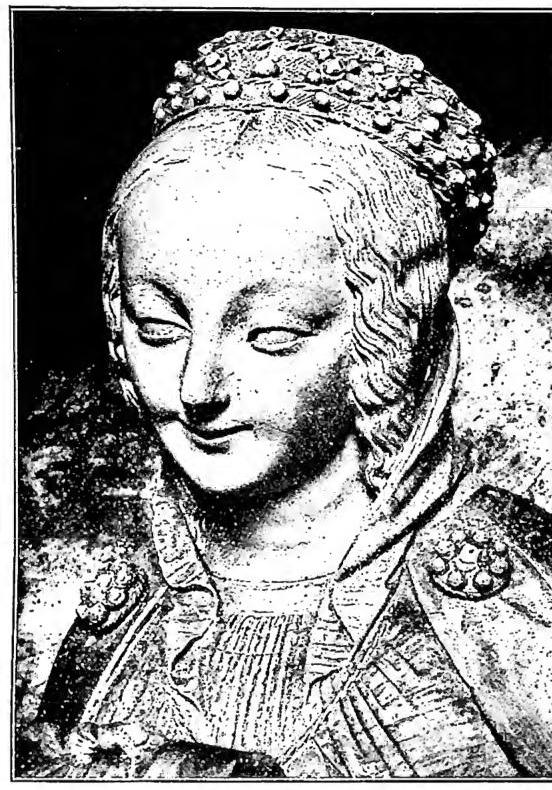
The sculpture follows chronologically the progress of the architecture. The most “archaic” sculptural cycle of the CHARTRES – Face of the Virgin in the Adoration of the Magi (16th century). – Cathedral.The sculptural decoration of the cathedral is most “archaic” in the western portal, the so-called Portail Royal, from the mid-12th century. It was executed by several masters, some of whom came from St-Denis and also worked at Étampes. This is followed by the very rich sculptural decoration with figures and reliefs on the northern façade of the transept (first and second quarters of the 13th century) and that on the southern façade of the transept (c. 1220–40), both important for the development of Gothic sculpture in general and for the great influence exerted in particular on French sculpture. The style that had been foreshadowed in the Royal Portal of St-Denis (c. 1145) is developed here for the first time in full, and is further enriched in the transept sculptures, especially in the new type of triple portal, adorned with antitheses of scenes from the Old and New Testaments (apostles–prophets, the elders of the Apocalypse and the predecessors of Christ); lunettes with the blessing Christ, the Ascension of Christ, the glorification of Mary, symbols of the Evangelists, etc.
Equally important for its richness and preservation is the series of stained-glass windows. The oldest date to the 12th century, a substantial group can be dated from c. 1210 to 1260; others are from the 15th century. They add to the monumental grandeur of the architecture and the beauty of the cathedral’s sculptures the mysticism of deep, transparent, pure colours.
In comparison with the cathedral, other churches of Chartres are of lesser importance, among which should be listed: St-Brice, with Romanesque capitals from the 11th century; St-Père-en-Vallée, rebuilt after a fire in 1134, c. 1150, modified in the nave (c. 1215–30) and in the choir (13th–14th centuries); St Andrew’s, in Romanesque-Gothic style; St-Aignan, in Gothic-Renaissance style. – V. Tnv. LXXXV.
BIBL.: M. Guérard, Capitulaire de l'abbaye de St-Père de C., 2 vols., Paris 1840; J. B. A. Lassus, Monographie de la cathédrale de C., ibid. 1867; L. Merlet, Catalogue des reliques et joyaux de N.-D. de C., Chartres 1885; R. Merlet and J. A. Clerval, Un manuscrit chartrain du XIe siècle, ibid. 1893; W. Vège, Anfänge des monumentalen Stils im Mittelalter, Strasbourg 1894; Abbé Bulteau, Monographie de la cathédrale de C., 3 vols., Chartres 1887–93; M. S. Marriage, La façade de la cathédrale de C., ibid. 1900; J. A. Clerval, Guide Chartrain, 3rd ed., ibid. 1905; M. S. Marriage, The Sculptures of C. Cathedral, Cambridge 1909; J. Baum, Romanische Baukunst in Frankreich, Stuttgart 1909 and 1928; P. Frankl, Die Baukunst des Mittelalters, Berlin-Neubabelsberg 1918, passim; A. Priest, The Masters of the West Façade of C., in Art Studies, 1 (1923), pp. 28–44; E. Gall, Gotische Baukunst in Frankreich und Deutschland, I, Leipzig 1925, passim; R. de Lasteyrie, L'architecture religieuse en France à l'époque gothique, Paris 1926; id., … à l'époque romane, ibid. 1929; P. Vitry, La sculpture Française sous le règne de s. Louis, Florence-Paris 1929; A. Michel, Histoire de l'Art, I, Paris 1926, pp. 612, 885–88; II, ibid. 1906, pp. 18, 22, 134 ff., 160–71, 373–78, 395; V, ibid. 1912, p. 724; [Y. Delaporte], Chartres, bibl. municipale, Les mes, enluminés, Chartres 1929; Y. Delaporte and E. Houvet, Les vitraux de la cathédrale de C., 4 vols., ibid. 1926; M. Aubert, La sculpture française au début de l'époque gothique, Florence-Paris 1929; id., L'Art français à l'époque romane, Paris 1929; E. Houvet, Monographie de la cathédrale de C., Chartres 1927; J.-J. Gruber, s.V. in Enc. Ital., IX (1931), pp. 943–44; R. Schwob, Le Portail Royal, Paris 1931; P. Clemen, Gotische Kathedrales in Frankreich, Zurich-Berlin 1937; H. Pocillon, L'art des sculpteurs romans, Paris 1939; Y. Delaporte, La cathédrale de C. et ses vitraux, ibid. 1943; P. Claudel-M. Aubert, Vitraux des cathédrales de France, ibid. 1947, passim; L. Grodecki, A Stained glass atelier of the thirteenth century, in Journal of the Warburg & Courtauld Inst., 11 (London 1948), pp. 87–111; E. Mâle, Notre-Dame de C., Paris 1948; J. Evans, Art in Mediaeval France, London-New York 1948; E. Houvet, La cathédrale de C., 7 vols., Paris n.d. Bernardo Degenhart
Cite this article
“CHARTRES, DIOCESI DI.” Enciclopedia Cattolica, vol. III (1949), p. 811. Azione Romana digital edition, https://azioneromana.com/article/chartres-diocesi-di.