
CAROLINGIA, ARTE. — This encompasses the art of Western Europe under the rule of the Carolingians (751–911), especially the art of the court of Carlomagno (768–814) and of his successors. Spiritually, it arose in the cultural centers of the imperial court, at Aquisgrana, Ingelheim, and Nimega, but it developed in the great monasteries maintaining direct relations with the royal family, such as St-Denis, Reims, Metz, Tours, St-Riquier, Lione, Echternach, Magonza, Fulda, Lorsch, and Reichenau, and soon spread to Switzerland (S. Gallo) and northern Italy (Milano). Rome and central Italy were little affected by the influence of this art. In many respects, this artistic flowering assumed a Renaissance character, owing to the evident influence of classical and early Christian monuments. The new orientation had already been announced under Pipino, when Anglo-Saxon missionaries in Germany, such as s. Bonifacio, established increasingly close contact with Rome.
But perhaps more than these spiritual ties, the political vision of Carlomagno, and above all that of the «renovatio Romani Imperii», together with his coronation in Rome (a. 800), also heralded changes in the field of art. Carlomagno’s ideal was Costantino il Grande. Alongside the emperor, his close advisers, such as Alcuino, Rabano Mauro, Eginardo, and Angilberto, supported the new ideas, in politics as well as in humanistic studies and art.
The classical form predominates, but the survival of Merovingian art is still clearly perceptible, together with influences from various cultures, especially Irish and Byzantine, and occasionally Muslim.
The emperor did not restrict his interest to the new architecture, painting, or minor arts; he also directed the spirit of this artistic movement.
(phot. F. Behn)
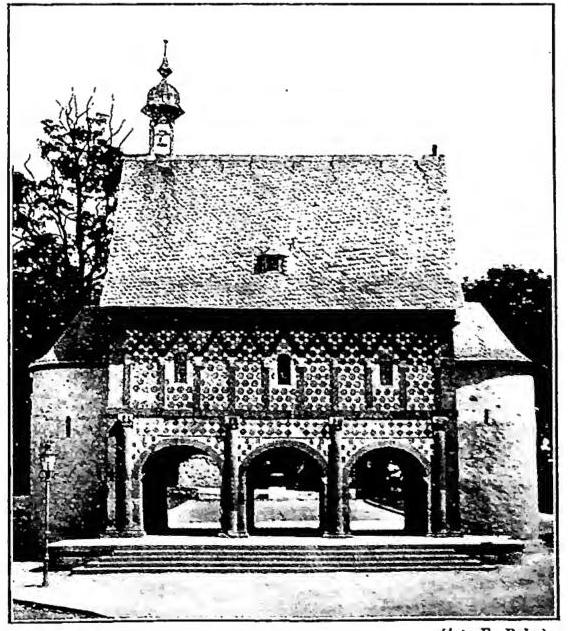
CAROLINGIA, ARTE - Entrance of the monastery of Nostra Signora e S. Nazario of Lorsch (diocese of Magonza), the sole surviving part of the building inaugurated in 774 in the presence of Carlomagno.
in the recently subjugated countries. New churches then arose at Lorsch (ca. 767), Paderborn (in 777), Bremen (in 789), Aquisgrana (ca. 790-805), Centula (ca. 790-836), Germigny-des-Près (ca. 800), and many other places. There is also much information concerning the imperial palaces, which the excavations at Nimega and Ingelheim have shown to be accurate. Generally, they developed from the ancient royal hall, with other buildings added on the model of prototypes existing in Italy and Africa.
Here one senses contact with the Muslim world. The sources tell us of the magnificent complexes of the new monasteries; an old plan of that of S. Gallo (820) has survived, and the arrangement of the churches and buildings at Lorsch can be clearly understood from the recent excavations. Very little, however, is known about secular architecture (e.g., the « house of Rabano Mauro » at Winkel).
The new churches were built in various forms. Thus, while the old basilican type without a transept, characteristic of the Merovingian period, continued in some cases, the basilica with a transept was preferred in others, its model being found in the Roman churches of the 4th century, as at St-Denis (ca. 754-75), Fulda (ca. 790-819), Seligenstadt (ca. 831-40), or Hersfeld (ca. 831-50). Sometimes these churches had detached bell towers, as did S. Salvatore of Monte Cassino.
The ever-increasing separation of the clergy from the laity in the great abbeys led to new architectural requirements; construction developed toward the entrance, with a building extending westward (Westwerk), which perhaps also served as a baptistery. This was the case in the basilica at Lorsch (ca. 774), now destroyed; but the grandest example was at St-Riquier in Centula (ca. 790-799), rebuilt by Angilberto, son-in-law of Carlomagno. Churches with polygonal plans, on the other hand, derived from Byzantine prototypes; the finest example is provided by the octagonal chapel of Aquisgrana (ca. 790-805), which recalls S. Vitale of Ravenna.
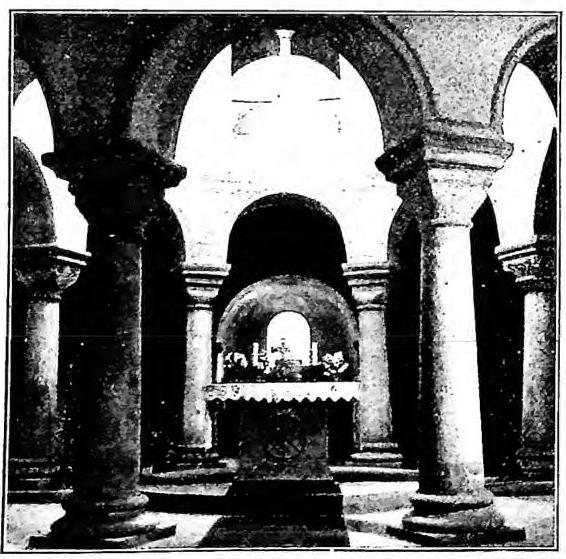
It is known from a letter by Eginardo that capitals were copied from ivory models. The bronze screens and doors in the cathedral of Aquisgrana also imitate classical forms.
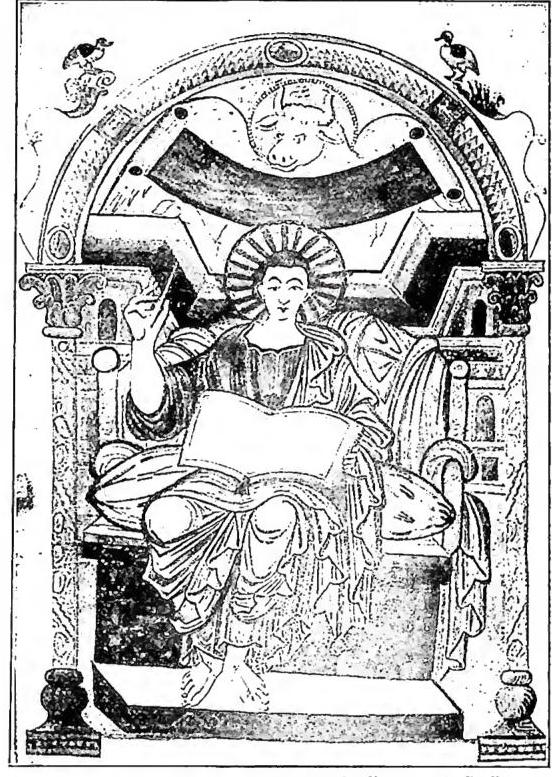
(courtesy of Mons. A. P. Frutaz) CAROLINGIAN, ART - Gospel Book, known as the Codex Aureus or Codex Adae. Miniature depicting St Luke (late 8th century). Trier, Stadtbibliothek.
Many records also exist of monumental painting, but very little has survived. Of the mosaics, only one example has come down to us, at Germigny-des-Près (806), recalling Eastern prototypes.
The mosaics of Aachen are known through several drawings. Some fragments of fresco discovered at Lorsch (now in the museum at Darmstadt) suggest the beauty of the wall paintings of the Carolingian age, whose development is subsequently documented by the frescoes of Mals (before the year 881) and Münster (now in the National Museum in Zurich).
Illuminated manuscripts make it possible to study the orientations of the various schools. Near the imperial court, perhaps in Aachen itself, the Schola palatina flourished; a group of manuscripts with classicizing miniatures remains from II. One of its finest products is the Emperor’s Gospel Book, now in the treasury of Vienna. Another group of illuminated manuscripts derives from a school that found its prototypes in classical painting, but also displayed Eastern influences. Its most significant product is the manuscript that Ada, perhaps the emperor’s sister, gave to St Maximinus at Trier (Trier, library). The school of Metz, flourishing especially under Louis the Pious (d. in 870), and that of Reims derived from the “Schola palatina.” Another monastery closely connected with the court and especially supported by Charles the Bald was St-Denis. The splendid Bible of St Paul (Rome), probably written for Charles the Fat (c. 880–88) by Ingolbert, is very close to its products; it displays a combination of influences from the various schools of Metz, Reims, and Tours. The school of Fulda came into contact with England through St Boniface, but under Rabanus Maurus it was strongly influenced by Tours.
In the eastern part of the kingdom, the school of St Gall developed. In Italy, the miniatures of the schools of Bobbio and Ivrea, and at times also those of Montecassino, demonstrate in their more advanced phase the influence of Frankish abbeys.
The development of the minor arts, especially in the field of ivory, followed a similar course. The earliest works of Charlemagne’s time in fact display evident classical elements, as do the ivories of the school of Ada. The school of Metz too initially displayed many elements of classical taste; such, for example, is the binding of the Sacramentary of Drogo (826–55) in Paris.
Enormous losses must likewise be lamented in the field of goldsmithing. Nevertheless, some pieces have survived and reveal a stylistic evolution analogous to that of the miniatures and ivory sculptures.
The altar by Volvinus in St Ambrose’s in Milan, dedicated around 835 by Bishop Angilbert (824–66), is very close to the school of St-Denis, but was certainly made in Milan.
The sources also record many works in glyptic art executed with precious or engraved stones, but few have come down to us. In this field too, as in that of the imperial seals, the classical or Early Christian style and technique were revived.
Almost nothing remains of the many textiles that adorned the walls of palaces and churches or served in worship. What has survived shows that silk fabrics were for the most part imported from the East, although they sometimes also came from Italy.
Just as in politics, so too in the field of art during the Carolingian period, after the division of the empire, a separation between the eastern and western territories became increasingly evident. Indeed, whereas in Charlemagne’s time the artistic manifestations of the territory of his empire were characterized by a revival of classical forms, subsequently, as the influence of the various currents of Eastern art intensified, the orientations of taste proper to the Franks and Germans emerged with greater definition. - Vedi Tav. LII.