
TREVIRI (TRIER), Diocese of. – A city and diocese in western Germany. It covers an area of 12,870 sq km with a population of 2,101,324, of whom 1,595,031 are Catholic, distributed across 915 parishes served by 1,263 diocesan priests and 454 religious; it has two seminaries, 54 male religious communities and 388 female (Ann. Pont. 1953, p. 430).
Situated on the Roman road between Lyon and Cologne, Augusta Trevirorum became an imperial residence due to its strategic importance and proximity to the frontier.
In 285, Maximian Herculius established Trier as the seat of his capital, which expanded under Constantius Chlorus and Constantine; a gold coin from this period depicts the Moselle, the bridge, a monumental gate surmounted by the statue of the Emperor, and in the background the enceinte of the walls. Besides Constantius Chlorus and Constantine, Trier was also the residence of Constantius II, Valentinian I from 364 until his death, Gratian, and Magnus Maximus.
Trier had its amphitheatre and its baths; it reached its zenith as the capital of the praetorian prefecture of the Gauls. It was the second capital of the province of Prima Belgica and became an ecclesiastical metropolis. St Ambrose was born there; St Athanasius was exiled there from 335 to 337 (Apologia contra Arianos, 9, 87); it was visited by St Jerome, St Augustine, and St Martin of Tours; Ausonius was there as tutor to Gratian. However, with the transfer of the praetorian prefecture to Arles at the beginning of the 5th century, its decline began. The Franks occupied it around 464 and it became a county under the comes Arbogast. By the Treaty of Verdun in 843, Trier was incorporated into the kingdom of Lothar. The comital power then passed to the archbishops until 1212, when it received letters patent from Emperor Otto IV, confirmed by Conrad IV. Yet in 1308 it reverted to archiepiscopal jurisdiction, with administration by scabini, which the archbishop completed in 1443 with the election of two burgomasters. It was occupied in 1634 by the Spanish and in 1645 by the French. By the Treaty of Lunéville in 1801 it became the capital of the Saar department; the Germans recaptured it between 4–5 January 1814. By the Congress of Vienna it passed to the Kingdom of Prussia.
The archdiocese had as suffragans the dioceses of Metz, Toul, and Verdun. With the bull De salute animarum of 1821, Pope Pius VII made Trier a suffragan of Cologne.
There are no ancient documents to confirm local traditions regarding martyrs of Trier. The subdeacon Ursinianus “meruit sanctorum sociari sepulchris” (CIL, XIII, 3787), but by sepulchra one should perhaps understand the altar in which relics of martyrs brought from elsewhere were preserved (H. Delehaye, Les origines du culte des martyrs, 2nd ed., Brussels 1937, p. 359). For the early period, bishops of Trier were St Eucharius around 250, Valerius, Maternus, Agricius in 314; Maximinus (332–49 ca.), who received St Athanasius, bishop of Alexandria, in 336–37; Bishop Paulinus (347–58) transmitted to St Athanasius the letters of recantation of Ursacius and Valens; at the Council of Arles in 353 he was deposed and exiled to Phrygia, where he died in 358. Felix (386–400 ca.); Severus around 430; in 479 Iamlychus. At Chalon-sur-Saône in the church of St-Germain-du-Plain a marble slab was found which some propose to identify as the epitaph of “Iamlychus ep(iscopus)” deposited “in spe resurrectionis” in 479 (CIL, XIII, 2478; E. Diehl, Inscr. christ. lat. veteres, Berlin 1925–31, no. 1077).
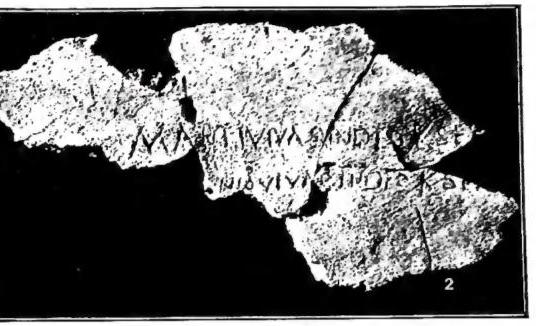
(from Th. Kemp), Die vorläufigen Ergebnisse der Ausgrabungen auf dem Gelände des Trierer Domes, in Germania, 2 (1931), no. 15, pl. 1, no. 2)
TREVIRI, Diocese of. – Graffito of Marti, from the time of Gratian, found in the presbytery of the cathedral (1949) – Trier.
pla vetusta Dei revocasti in culmine prisco et floret senior te reparante domus” (III, 11). In 857 a lightning strike burned its bell tower; in 882 it was sacked by the Normans. Archbishop Egbert (977–93) erected the chapel of St Andrew. Archbishop Poppo (1016–47) transformed the cathedral into a Romanesque building; Hillin added the towers (1160); in the 12th century crypts were created in the two apses; in 1719 the building was again modified in Baroque style and renovated between 1891–1910.
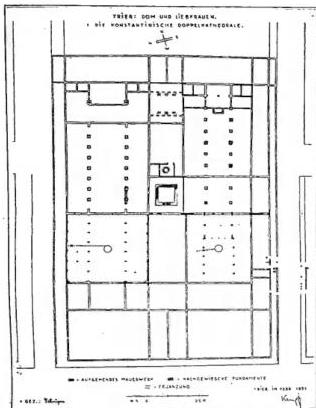
Excavations carried out since 1943 in Trier have made it possible to identify in the cathedral and the Liebfrauenkirche a double basilica enclosing the baptistery. Remains of the great Constantinian basilica (324–26 and 348) have been uncovered, including an atrium preceded by a kind of marlhes and the three-aisled basilica itself, partly replaced by a large quadrilateral hall; between 370–78, in the time of Emperor Gratian, these structures were superimposed on a large hall in which about 50,000 fragments of painted stuccoes were collected, which, carefully reassembled and studied, have yielded portraits of St Helena, mother of Constantine, and of Fausta, wife of the same emperor, as well as erotes, etc. The Christian character of the complex is attested by the arrangement of the spaces and by graffiti such as, for example, “Marti vivas in Deo XP semper. Germanio vivas in Deo XP semper; ΕΛΠΙΑΙΟC Marcellianus.”
In the treasury, the ivory plaque with two bishops seated who hold on their knees a reliquary chapel in the atrium before the church. It may refer to the translation of relics carried out by St Helena and Bishop Agricius; others preferred to see here the translation of relics of St Stephen in 428. The treasury also preserves the famous Egbert codex from the 10th century (F. X. Kraus, Die Miniaturen des Codex Egberti in der Stadtbibliothek zu Trier in unveränderlichen Lichtdruck, Freiburg in Br. 1884). The church dedicated to the Blessed Virgin (Liebfrauenkirche) was built between 1242–53, with a central Gothic plan; the chapel dedicated to the Holy Cross (Heiligkreuzkapelle) and the church of St Simon (second half of the 12th century) in the monumental Porta Nigra are Romanesque. The church of St Lawrence was dedicated by Emperor Valentinian (G. B. De Rossi, Inscr. christ. Urbis Romae, II, Rome 1888, p. 6, no. 6); near the Roman palace the “ecclesia ad Palatium” is mentioned in the Gesta Trevirorum. Many Christian inscriptions have been found in St Matthias, in St Maximin, and in the cemetery called that of the Evangelists; in the oratory of St Eucharius, in St Matthias a Greek inscription commemorated an ‘ΑΩ-ΟC Agrippa Syrus, born near Apamea (F. X. Kraus, Die altchristliche Inschriften der Rheinlande, I, Freiburg in Br. 1888, p. 44, no. 80); another Greek one from 409 was found in St Paulinus (ibid., p. 82, no. 163).
The Benedictine abbey of St Mary “ad Martyres” on the Moselle was founded by Archbishop Lutwin in the 7th century in memory of the pseudo-martyrs of Thebes; it was restored in 975 by Archbishop Theodoric, suppressed in 1802 by Napoleon I (Weisenahl, Der Grundbesitz des Klosters S. Maria ad Martyres zu Trier in Butzweiler, in Trierische Heimat, 4 [1927–28], pp. 97–99; Cottineau, II, cols. 3210–11).
La chiesa di S. Massimino, in origine S. Giovanni Ev., poi S. Ilario, fu più volte rifatta. L'abbazia benedettina fu arricchita dai Merovingi e dai Carolingi; rimangono avanzi della cripta e di pitture carolingie; devastata nell'882 dai Normanni, fu rifatta nel 934; nel sec. IX fiori il suo scriptorium (codice di Ada del sec. IX nella Biblioteca comunale); dette sviluppo ad altre abbazie della Germania (Echternach, Tegernsee, Maria Laach e Branweiler); fu soppressa nel 1802 (Cottineau, II, coll. 3212-13). A S. Massimino si è scoperto un oratorio adorno di affreschi rappresentanti la Crocifissione, gli Evangelisti, i quattro profeti maggiori, santi martiri e confessori; dalla storia del monastero sono databili all'età carolingia (H. Eichler, Peintures murales carolingiennes à St. Maximin de Trèves, in Cahiers archéologiques, 6 [1952], pp. 83-90).
S. Paolino è costruzione del IV sec., rifatta nel sec. XII; fu distrutta dai Francesi nel 1674, trasformata in stile rococò nel 1732-54, contiene nella cripta il sarcofago di S. Paolino. La chiesa dei Gesuiti o « Dreifaltigkeitskirche » sorse nel sec. XIII; S. Gervasio fu costruito dai Francescani nel 1765-68; contiene il sepolcro dell'arcivescovo Popone; S. Sinforiano in antico S. Uodnaldo ca. l'882; S. Irmina fondata ca. il 680; S. Simeone del tempo dell'arcivescovo Popone presso la Porta Nigra.
La basilica romanica di S. Mattia è la chiesa sepolcrale di S. Eucario situata in un'area cimiteriale cristiana; fu rinnovata nel 1921; vi si conservano le reliquie dell'apo-
stolo S. Mattia portatevi nel 1127. L'abbazia benedettina di S. Martino « ad litus super Mosellam » fu fondata dal vescovo Magnerio ca. il 587; distrutta dai Normanni nell'882, restaurata nell'888, ne fu abate tra l'899-915 Reginone di Prüm (Cottineau, II, col. 3211). Esplorazioni misero in luce sarcofagi e alcuni oggetti d'oro (K. Böhner, Die Anfänge der ehemaligen Abteikirche St. Martin zu Trier, in Trierer Zeitschrift, 18 [1949], pp. 107-31). S. Gangolfo, eretta nel sec. XV fu rifatta nel 1732; mentre resta l'alta torre campanaria del 1498. In stile gotico è la chiesa della S.ma Trinità (1228) poi detta chiesa dei Gesuiti; anche gotica è la chiesa di S. Antonio (1462). In T. la Gesellschaft für Rheinische Geschichtshunde dal 1884 iniziò le sue pubblicazioni; dal 1898 le iniziò il Trierer Archiv; dal 1925 la Trierer Zeitschrift für Geschichte und Kunst.
L'antica abbazia di S. Salvatore di Prüm fu fondata nel 721 con monaci di S. Faron di Meaux, da Bertrada moglie di Pipino il Giovane che l'arricchì di privilegi seguito in ciò dai suoi successori; ebbe immunità e batté moneta. La chiesa fu ultimata nel 779, e secondo una leggenda, consacrata da Leone III nel 799; vi fu monaco Lotario I nell'855; il suo sepolcro fu identificato nel 1866 e l'imperatore Guglielmo I ne fece deporre le spoglie in un sarcofago marmoreo. I Normanni la saccheggiarono nell'882 e nell'892 ma rifiorì ben presto, tanto che raggiunse il numero di 300 monaci. Dette vita è numerose filiazioni, anche il suo scriptorium fu rinomato; ad esso appartengono l'evangeliario di Lotario I oggi nella Biblioteca nazionale di Berlino; il « Liber aureus » oggi nella Biblioteca di T.; il « Registrum Prumiense » dell'893 con le glosse dell'abate Cassarius oggi conservato parte a Coblenza e parte a T. (S. I. Beissel, Miniaturen aus Prüm, in Zeitschrift für christliche Kunst, 19 [1906], pp. 11-22; 43-54). Tra coloro che illustrarono l'abbazia si ricordano Adone di Vienna, Vandalberto, Reginone, Berno di Reichenau, ecc. Cominciò a decadere nel sec. XIII; col tempo i vescovi di T. divaniero amministratori dell'abbazia, ma vi furono spesso lotte; tra il 1721-29 la chiesa venne trasformata in stile barocco; per la pace di Lunéville passò sotto la Francia che secolarizzò l'abbazia; la chiesa è oggi parrocchia.
CULTURAL INSTITUTIONS. — Valentinian I (364–75) favoured men of letters, rhetoricians and poets, drawing them to Trier: among them was Ausonius (q.v.), tutor to his son Gratian. It seems that under his influence the law of 23 May 376 on the fees due to professors of grammar and rhetoric was promulgated, with preferential treatment for those of Trier (Cod. Theod., XIII, 3, 11). To its flourishing schools (cf. Ausonius, Mosella, ll. 383 and 403 ff.), where Eumenius and Claudius Mamertinus also taught, students flocked from every quarter: St Jerome began his theological studies there, maturing his resolve to embrace the ascetic life (Epist., 3, 5; St Augustine, Conf., VIII, 6). After the region passed into Frankish hands (5th century), the life of the city, which had flourished under the Carolingians, continued under the protection of the bishops and through the work of the Benedictines (abbey of St Matthias) and, later, the Dominicans, Franciscans and Carmelites.
613. The University
Archbishop James of Sierck, in the Jubilee of 1450, petitioned the Pope for the erection of a Studium generale. The cardinal of Trier, Nicholas of Cusa, papal legate in Germany, supported the request. Pope Nicholas V granted the Studium in 1454 by two bulls: Inter ceteras felicitates (2 Feb) and Romanum decet Pontificem (12 Feb). Political and social circumstances following the fall of Constantinople (1453) delayed its opening until 1473. Its statutes were drawn up on the model of those of Cologne: the chancellor was the archbishop; the principal faculty was that of theology. Under the electoral principality, from 1561 to 1773, the Jesuits directed II. After their suppression (21 July 1773), the archbishop and prince-elector Clement Wenceslaus founded at Krahn, in the former Jesuit novitiate, the major seminary (16 Oct 1773), which in 1779 was transferred to a building erected near the University. Thus the chairs of the faculty of theology were entrusted to the professors of the seminary. When the territory was occupied by the French, the University, transferred to the Benedictines, was abolished in 1798.614. The new Faculty of Theology
In 1798 the “Clementine” seminary was also closed, but Archbishop Charles Mannay succeeded in re-establishing it in 1805, though without the faculty of theology. Repeatedly requested by Archbishop Rudolph Bornewasser (1948 and 1950) and advocated by Monsignor Ludwig Kaas, this faculty was granted by Pope Pius XII in 1950 and canonically erected in the major seminary by decree of the Sacred Congregation of Seminaries and Universities of Studies (5 June 1950). This was followed by governmental recognition (22 Aug 1950), and on 21 May 1951 the Holy See approved its statutes.The patron, as for the ancient Studium, is St Jerome, whose effigy appears in the university seal. The faculty possesses a library of over 100,000 volumes and includes scientific seminars for philosophy, theology, Sacred Scripture and ecclesiastical history. It is attended also by students from various religious orders. It publishes the review Trierer Theologische Zeitschrift (which succeeded in 1947 Pastor Bonus, founded in 1889) and the scholarly series Trierer Theologische Studien (1941).