
TOUL (Tullium, Tullum Leucorum). — On the left bank of the Moselle, where the Rhine Canal forms a harbor, it belonged to the ancient province of Belgica I, whose metropolis was Trier.
At the end of the tenth century, Adsone knew the Gesta praecedentium Leucorum urbis antistitum. In the first half of the twelfth century, a cleric of T. compiled a catalog of its bishops. The first was Mansueto, whose life was written by Adsone, followed by Amone; both were buried in the church of St. Peter (St-Mansuy). The fifth was Auspicio (d. ca. 470), mentioned by Sidonius Apollinaris (Ep., IV, 17; VII, 10). S. Aper (Epyre), who is said to have founded the suburban church of St. Maurice, is listed under 15 September in the Bern manuscript of the Hieronymian Martyrology. Alodio was present at the Council of Orléans in 549; Eudila attended that of Paris in 614; Leudino, called Bodo, brother of S. Salaberga, founded the monastery of Bonmoutier; Giacomo signed the privilege of Gorze at Compiègne in 757; Frotario, consecrated ca. 813, attended the Council of Mainz in 829: much of his correspondence has been preserved (PL 106, 863 ff.). Arnolfo was present at Savonnières in 859, at Tusey in 860, at Aachen in 862, and at Attigny in 870; Arnaldo attended the Councils of Ponthion in 876 and Troyes in 878. S. Gauzelino (922–62) founded the monastery of Notre-Dame de Bouxières; Bruno of Dagsburg (1026–49) later became Pope Leo IX (v.). Also G. Fillâtre (1449–60); Cardinal Giovanni of Lorraine (1517–43); Carlo of Lorraine, Cardinal of Vaudémont (1580–87); Cardinal Nicola Francesco of Lorraine (1625–34); A. de Saussay (1649–75), who wrote the Martyrologium Gallicanum. The see of T. suffered during the Investiture Controversy. In the sixteenth century, together with Metz and Verdun, it formed the territory of the «Trois-
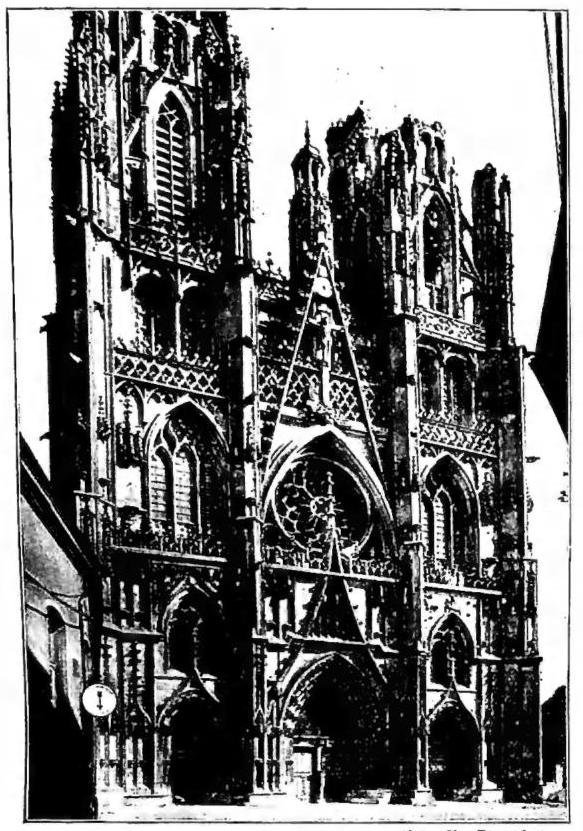
The ancient cathedral of St. Stephen preserves the apse and choir built between 1221 and 1260; the transept is somewhat later, while the naves and chapels date from the 14th century. The bishops’ chapel was built in Renaissance style by Mgr E. d’Ailly (d. 1533). The façade, with two tall towers, one of which was damaged in 1940, was erected between 1460 and 1496 by Jacquemin de Lenoncourt, following a design by Tristano de Hattonchâtel. Adjacent to the south is the 14th-century cloister, with three galleries and the chapter house. The ancient 18th-century episcopal palace, damaged in 1940, is used partly for the Hôtel de ville and partly as a museum and library. The episcopal palace garden is now a public park.
The Gothic church of St-Gengoult is noteworthy, with an apse from the second half of the 13th century, a transept and nave from the 14th century, a façade from the 15th century, and a cloister from the 16th century. St. Eucharius and St. Lupus, bishop of Troyes (d. 478), were born at T.