
GORZE (GORZIA). - A city in Lorraine, 20 km. southwest of Metz, with the remains of a 4th-century Roman aqueduct. It was a fortified center of the eponymous territory of Metz and the seat of one of the most influential Benedictine abbeys.
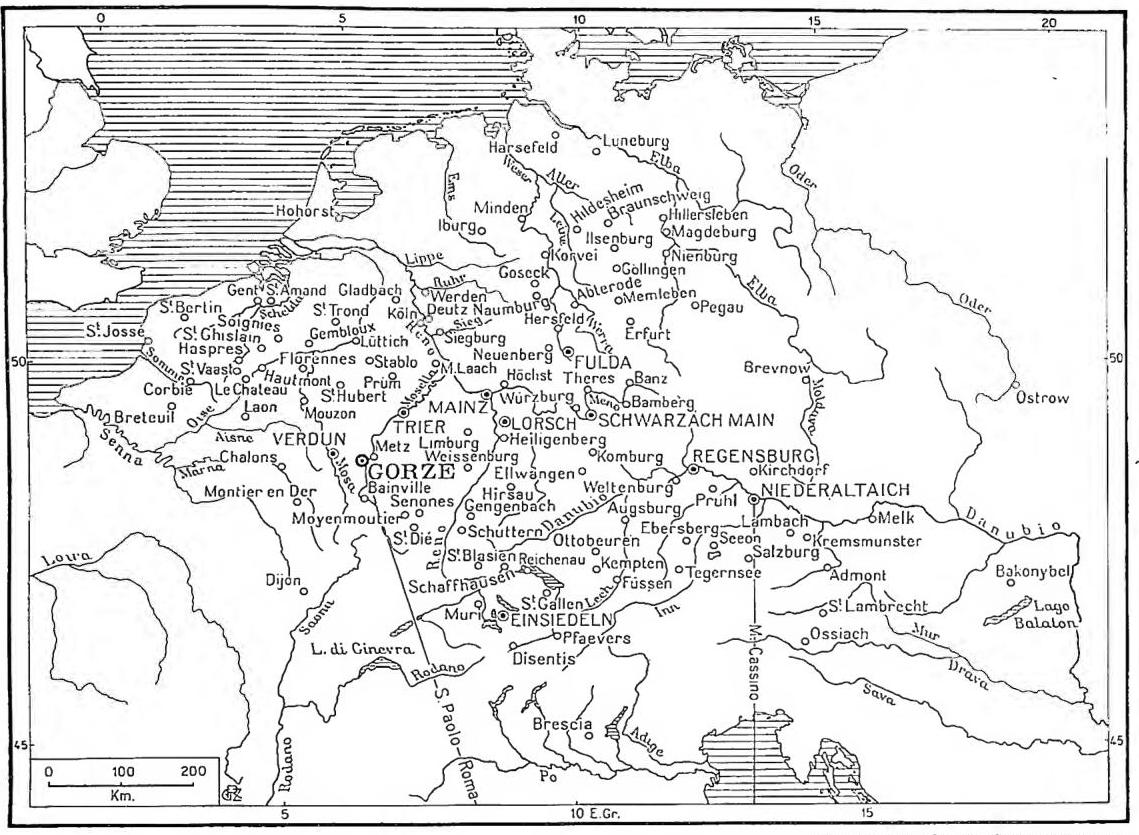
A new period of commendams lasted from 1445 to 1580. The occupation of Lorraine by Francis I brought about the ruin, between 1542 and 1556, of the abbey church of St. Peter, blessed on June 26, 1068. Gregory XIII suppressed the abbey and, with the bull In supereminenti of Dec. 5, 1572, assigned part of its property to the new Jesuit College in Pont-à-Mousson. The reform movement initiated by Bishop Adalbero in 1433 was favored by the feudal lords and the Ottonians, and spread to 170 communities divided into the following ten groups of affiliations: 1) the Lorraine group, the most genuine, originating from G., with over 31 communities (e.g., St. Epiphanius in Toul, Stavelot, Moyenmoutier); 2) the Trier group, centered at St. Maximin with over 18 monasteries; 3) the Regensburg group, centered at St. Emmeram with over 18 communities (Schwarzach am Main, Lorsch, Bleidenstadt, Fulda, etc.); 4) the Niederaltaich group with ca. 15 monasteries, among which are St. Leno near Brescia and for a time Monte Cassino; 5) the Lorsch group, with ca. 12 monasteries; 6) the Fulda group, with ca. 10 communities; 7) the Mainz group, with ca. 3 monasteries; 8) the Alamannic group, centered at Einsiedeln with ca. 12 monasteries; 9) the mixed-observance group of Lorraine (St. Victor, Verdun), with over 33 monasteries; 10) the New-G. group, centered at Schwarzach am Main and Ilsenburg in Saxony with ca. 20 communities. Unlike the Cluniac movement, these communities had no centralizing tendencies, but maintained the free election of the abbot with the right to dispose of property, maintained faith in the feudal organization, and retained the Anianian dress style until the 13th century.
The abbeys of Reichenau, St. Emmeram of Regensburg, Niederaltaich, etc., flourished until 1122; among the saints and blessed are counted John of G., Guibert of Gembloux, Sandrad of St. Maximin, Ramwold of Regensburg, Godehard of Niederaltaich, Druthmar of New Corvey, Egbert of Münsterschwarzach, etc.