
REICHENAU. – This “Augia dives,” an island in Lake Constance, connected with the mainland by a causeway, today belongs to Baden. It was the site of a historic Benedictine abbey.
In the year 724, Charles Martel gave Bishop Pirmin the island of Sindlezzeisan, situated on the Rhine near Lake Constance. Pirmin founded there a Benedictine monastery later called “Augia dives” (R.). The authentic text of Charlemagne’s diploma was restored by K. Brandi from a forgery of the twelfth century (Die Gründung der Abtei R., I, Munich 1925, pp. 10 ff.). Pirmin was also involved in the foundation of Hornbuch, where he died in 754; the epitaph is preserved by Rabanus Maurus (MGH, Poëtae latini aevi Carolini, II, p. 224). On his figure V. I. Perez, S. Pimenio, in Boletín de la R. Academia de la historia, 77 (1920), pp. 132 ff.; G. Jecker, St. Pirminis Herkunft und Mission in der Kultur der Abtei R., I, Munich 1925, pp. 19, 36; id., Die Heimat des hl. Pirmins, des Apostel der Alamannen, in Beiträge zur Geschichte des alten Mönchtums und des Benediktinerordens, XIII, Münster 1927.
Pirmin’s successor at R. in 727 was Heddo, who introduced the Benedictine Rule; in 734 he was elected bishop of Strasbourg. He was followed by the abbots Kebe (734–36), Arnefrido (736–46), Sidonius (746–60), Giovanni (760–82), Pietro (782–86), Waldo (786–806), who was also bishop of Pavia and Basel; Haito (806–23), likewise bishop of Basel. Charlemagne made two rich donations to R. when he visited it in 780 and 813.
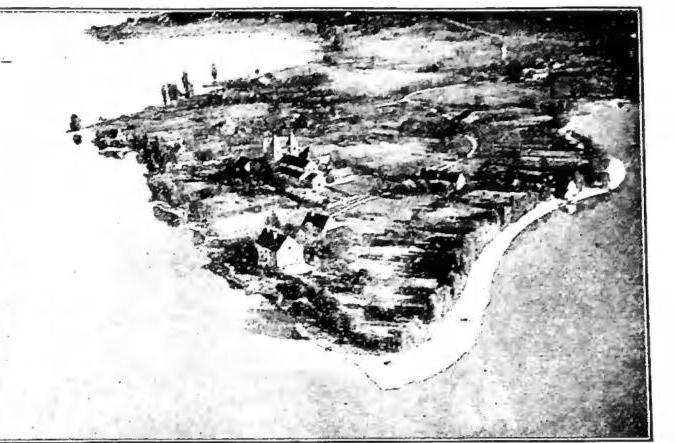
(from Die Kultur der Abtei R., Munich 1925, p. 263)
REICHENAU - Lake Constance with the peninsula of R.
and Carlo il Calvo, who was buried in the monastery church of Mittelzell. It obtained immunity from secular authority, the iurisdictio fori, and exemption from episcopal jurisdiction. Other abbots were Erlebaldo (823–38), who is said to have received the relics of St. Mark from Bishop Ratold; Walafrido Strabone (846–49), one of the most prominent intellectuals of the Carolingian age; Hatto III (891–913), who founded Oberzell and became archbishop of Mainz; and Heribrecht, who obtained the relics known as those « of the Blood ». Ruodman (972–85), Wittigovo (985–97), Immo (1006–1008), Berno of Cluny (1008–48), and Ermanno Contratto renewed the scriptorium. Pope Gregory V (996–99) conferred privileges on the abbey, as did the Ottonian emperors. Particularly noteworthy is the bull of Innocent II of 22 March 1207 concerning the abbey’s possessions and rights. Great prosperity led to a relaxation of the Rule and to decline; in 1521 the abbey was incorporated into the diocese of Constance, whose bishops became commendatory abbots of R.; the personnel was reduced to twelve monks, including the prior. In 1757 the novitiate was abolished. The monastery was secularized in 1802. The abbey’s literary production was highly active and fruitful, and spread throughout Germany and also into Italy. Suffice it to recall the Gospel Book of St. Ausfriede in the Archiepiscopal Museum of Utrecht; that of the Emperor Otto in Aachen Cathedral; the manuscript of the Gospels offered by Canon Illinus to Cologne Cathedral; the Sacramentary of the Abbey of St. Maximin at Trier, now in Paris (Bibl. nation., Cod. lat. 18005); and most of the manuscripts donated by Emperor Henry II to Bamberg Cathedral. The apogee of R. came under the Ottonian dynasty.
The school of R. counted among its most distinguished teachers and pupils Waldo, Haito, Erlebaldo, Wetti, Hatto, Reginberto, and Walafrido Strabone; after the latter’s death in 849, the school’s flourishing period began to decline. The development of the liturgy at R. and its relations with the Roman liturgy, its relics, etc., were presented by A. Manser and C. Beyerle, Aus dem liturgischen Leben der R., in the Beiträge cit. (pp. 316–437). The poets were Walafrido Strabone and Ennenrich d’Eltwangen, Burcardo, Ruotperto, Abbot Bernone, and Ermanno Contratto (A. Bergmann, Die Dichtung der R. im Mittelalter, in the Beiträge cit., pp. 711–55). The following emerged from the scriptorium of R.: Walafrido Strabone (839–849), Hatto III (891–913), archbishop of Mainz, Abbot Immo, St. Meinrado, Count of Zollern (861), founder of S. Maria di Einsiedeln, and Ermanno Contratto (1054). The Library of R. and its school of illumination were famous; from the latter came the Egbert codex (H. Sierp, Walafrid Strabos Gedicht über dem Gartenbau, poëma de cultura arborum, in the Beiträge cit., pp. 756–72). The principal historical works are the annals of the early period and the works of Ermanno Contratto and his pupil Bertoldo (J. R. Dieterich, Die Geschichtsschreibung der R., in the Beiträge cit., pp. 773–801). The activity of Reginberto and his pupils in transcri-
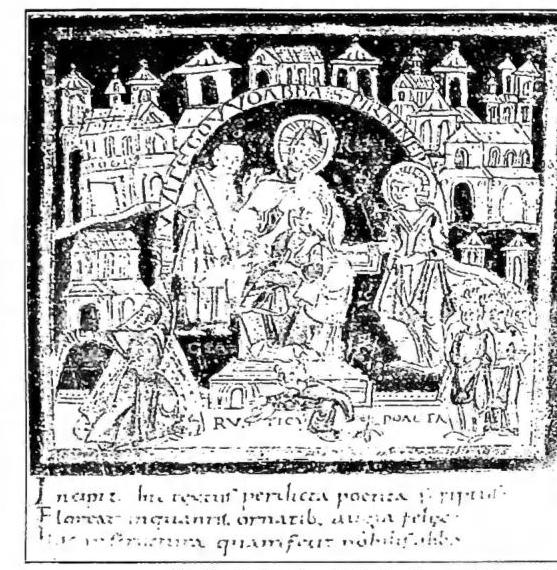
Among the manuscripts are noteworthy the fragmenta that supplied the formulae Augienses (MGH, Leges, V, Berlin 1886, XXI-XXIII, p. 347); ancient hymns (F. J. Mone, Lateinische Hymnen des Mittelalters, I, pp. 97, 111, 183, 218; II, p. 450, III, p. 430). A sacramentary followed by a palimpsest fragment of the Gallican Psalter; the sacramentary of the sixth century was reconstructed in 54 pages by C. Mohlberg (Fragments palimpsestes d'un Sacramentaire gélasien de R., in Revue d'histoire ecclésiast., 11 [1910], pp. 471-82; V. also A. Dold, Das Palimpsestsacramentar in Codex Augiensis, CXI, Ein Messbuch ältester Struktur aus dem Alpengebiet, Beuron 1925). The codex of the Apocalypse in the Bamberg Library (A II, 42), the Gospel Book of Heron, archbishop of Cologne, now in the Darmstadt Library (no. 1948); the Psalter of Egbert, archbishop of Trier, at Cividale; the Gospel Book of the abbey of Poussay, now in Paris (Bibliothèque nation., lat. 1051-4); the Gospel Book of Egbert, now in the Municipal Library of Trier, contains 51 illustrations of the life of Christ (on the activity of the Scriptorium of R. cf. G. Baesecke, Das Schrifttum von R., in Beiträge zur Geschichte der deutschen Sprache u. Literatur, 51 [1927], pp. 206-22. H. Wölfflin, Die Bamberger Apokalypse, eine Reichenauer Bilderhandschrift vom Jahre 1000, 2nd ed., Munich 1921; F. Kraus, Die Miniaturen des Codex Egberti in der Stadtbibliothek zu Trier, Freiburg in Br. 1884; S. Beissel, Die Bilder der Handschrift des Kaisers Otto im Münster zu Aachen, Aachen 1886; J. K. Hecht, Der romanische Kirchenbau des Bodenseegebietes, Basel 1928; A. Schmidt, Die Miniaturen des Gerohodex. Ein Reichenauer Evangelistat des X. Jahrhunderts, Leipzig 1924; id., Die Reichenauer Hs. CXC der Stadtbibliothek zu Leipzig, ibid. 1927; J. Sauer, Die geschichtlichen Beziehungen der R. zu Italien und zum Osten. Studien zum Kunst des Ostens, Vienna 1923; A. Goldschmidt, Die deutsche Buchmalerei, II, Die Ottonische Buchmalerei, Florence-Munich 1928. On the manuscript collection of R.: A. Holder, Die Reichenauer Handschriften beschrieben und erläutert, I. Die Pergamenthandschriften, Leipzig 1906; II. Die Papierhandschriften. Fragmenta, Nachträge, ibid. 1911; III. Grundstock der Bibliothek: Die alten Kataloge. Zeugnisse zur Bibliotheksgeschichte gesammelt und bearbeitet von Karl Preisendanz, 1918).
The three villages of Oberzell, Mittelzell, and Unterzell or Niderzell (from “cella”) contain notable churches. At the center of the island stands the Cathedral, first dedicated to the Blessed Virgin and later to St. Mark. It was erected by Abbot Eddo and dedicated in 816; it was frescoed in 985; in the middle of the eleventh century it was enlarged. The Treasury contains the Reliquary of St. Mark (1.20 × 0.42 m, from the first half of the fourteenth century), a rectangular chest with a roof, entirely covered with gilded silver leaves bearing scenes from the life of Christ and two episodes relating to the history of the relics of St. Mark and their translation to R.
To the northeast of the island, Egino, bishop of Verona, founded in 799 the church of SS. Peter and Paul, which, however, in its present Romanesque form dates from the beginning of the twelfth century. It is divided by columns into three naves; beneath the high altar is the tomb of Egino. In 1880, in the church of St. George at Oberzell, on the island of R., it was discovered that the church had been entirely frescoed in the time of Abbot Wittigowo (985-97); the following may be seen there: medallions with Prophets; The Twelve Apostles; the Raising of Lazarus, the Healing of the Woman with the Issue of Blood; the Raising of the Son of the Widow of Nain and of Jairus’s Daughter; the Healing of the Leper; the Exorcism at Gerasa; the Healing of the Dropsical Man; the Storm on the Sea of Galilee; the Healing of the Man Born Blind. For the paintings, V. J. Sauer, Die Monumentalmalerei der R. (pp. 902-55). For the sacred buildings of R., V. O. Grüber, Die Kirchenbauten der R., in the cited Beiträge, pp. 821-71); K. Grüber studied die Reich. Plastik bis zum Anfang des Mittelalters in the cited Beiträge (pp. 872-901). The Treasury preserves a gilded silver reliquary that is said to have contained particles of the Redeemer’s blood, brought from the East as a gift to Charlemagne; a manuscript preserved in Karlsruhe (Codex Augiensis, 84), from the end of the tenth or the eleventh century, recounts its history; but the Reliquary is not earlier than the twelfth century: on the reverse an inscription in Greek reads: “Lord, help Ilarion Igirithon, your servant and hegumen of your monastery” (A. Heisenberg, Das Kreuzreliquiar der R., in Sitzungsberichte der bayer. Abad. der Wissenschaft; Philos. und philolog. und hist. Klasse, 1926; K. Künstle, Die Kunst des Klosters R. im IX. und X. Jahrhunderte und der neuentedeckte karolingische Gemäldezyklus zu Goldbach bei Überlingen, Freiburg in Br. 1906; id., R. Seine berühmtesten Abte, Lehrer und Theologen, ibid. 1924; Cottineau, II, 2427-30).