
RELIQUIARIO. - The common name for an object chosen to contain relics; but since antiquity it has had a great variety of names depending on its shape.
The most common names encountered in texts are: reliquarium, vas, vasculum, busis, theca, lipsanotheca, hie-
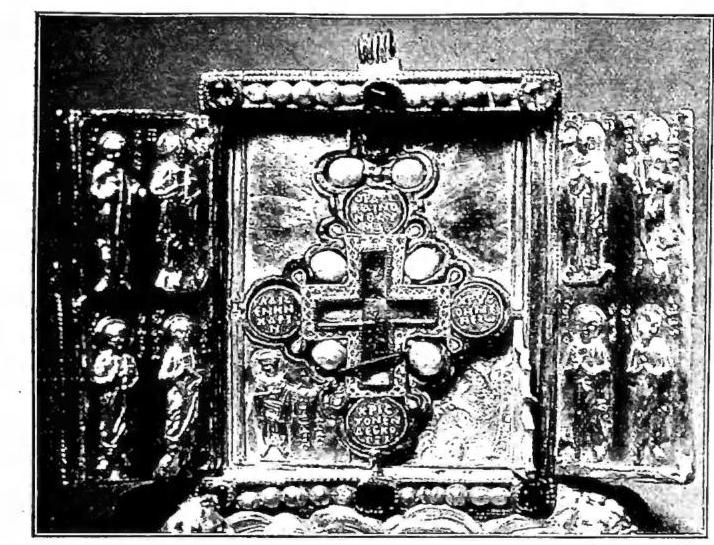
RELIQUIARIO - Gold casket, used as an encolpion, with a relic of the holy Cross; to the right of the cross appears the small figure of Constantine (8th-9th century). Rome, Basilica of St. Peter, Treasury.
rotheca, staurotheca, philacterium, chrismarium, conditorium, conservatorium, custodia, gestatorium, sanctimonium, repositorium, jocale, phiala, ampulla, acerra, arca, cista, coffrus, coffinus, ladula, scrinium, locus, loculus, sarcophagus, sepulcrum, tumba, griba, feretrum, capsa, capsella, capsula, scatula, trucha, domus, castrum.
The materials used in preparing reliquaries are extremely varied. St. Jerome already speaks of relics contained in a «modico vasculo pretioso linteamine circumdatum» (Contra Vigilantium, 4: PL 23, 357); from ancient times there are reliquaries in gold (Lib. Pont., I, pp. 179, 261, 374; Martin of Tours, De gloria martyrum, 11: PL 71, 716, etc.); in silver (De miraculis s. Stephani, I, 8: PL 41, 839; G. B. De Rossi, La capsella reliquiaria argentea africana, Rome 1888); then in bronze, copper, lead, crystal, stone, clay, glass, bone, ivory, wood; in silk, brocade, linen.
These reliquaries were used to enclose particles of the Holy Cross or earth from the Holy Places or to contain relics ex ossibus or from contact with holy martyrs; they were placed under altars, as shown by those found in the ancient churches of Roman Africa (not a few reproduced in P. Monceaux, Enquête sur l'épigraphie chrétienne d'Afrique, Paris 1907, nos. 262, 275-78, 280-84, 321). Others were exposed to veneration: among these, the most conspicuous ancient group is represented by the treasure of relics that the popes collected in the chapel of the martyr deacon St. Lawrence in the Lateran Patriarchate, today in the Museo Sacro of the Vatican Library. These relics were enclosed in a cypress chest that still bears the inscription: «Leo indignus tertius episcopus, Dei famulus, fecit» (795-817); at the time of Innocent III the words Sancta Sanctorum were added to II. It contained relics of the Holy Cross, such as the enameled gold cross discovered already at the time of Pope Sergius I (687-701) and its historiated case, a gemmed cross, a wooden cross, silver cases with custodias of Paschal I (817-24); silver chests containing respectively the head of St. Agnes and that of St. Praxedes with their relative custodias; copper, brass, and cedarwood boxes, ivory capsules, silk pouches, crystal vases, glass ampullae, colored wooden pyxes. All of this was illustrated by H. Grisar (Il Sancta Sanctorum ed il suo tesoro sacro, Rome 1907).
In the Romanesque period, reliquaries assumed the shape of the relic they housed: in the form of a head with precious stones in the eyes, firm and suggestive modeling (head reliquary of Pope St. Alexander, by the goldsmith Godefroid de Huy, in Brussels, Musées royaux d'art et d'histoire), or of an arm (Messina, Cathedral, relic of St. Marcian), of a rib (Namur, Monastery of Notre-Dame, relic of the rib of St. Peter made by Hugo d'Oignies, 1228). From that time there were also reliquary caskets in the form of a chest with rich decoration of champlevé enamels on figurative motifs, such as that of St. Servais in Maastricht (11th-12th century) from the Meuse workshop, or other Limousin ones (Agrigento, Cathedral; Aosta, parish church of Villanova Baltea [reproduced under V. LIMOGES]; Florence, Bargello). Reliquaries of various shapes can be seen in the Treasury of the Basilica of St. Francis in Assisi, among which is the famous reliquary of the unusual garment and that of the sandals of St. Francis and the veil of Mary in the Duomo of Padua, one of which is of grandiose proportions with Gothic spires, as were very popular in Spain and Sicily following the example set by Juan de Arfe. The use of reliquary busts in silver and gilt silver continued during the same Gothic period, often with a base richly ornamented with enamels (Florence, Duomo, reliquary of St. Zenobius; Gorizia, Duomo, reliquary of St. Hermagoras), often patinating the cheeks with enamel for realistic effects, as did the famous goldsmith Giovanni di Bartolo for the reliquary bust of St. Agatha, the only one remaining in the Cathedral of Agrigento, the other two for the Lateran Basilica having been lost. But during the Gothic period a constant type of reliquary was determined, also used for the exposition of the Eucharist, composed of three elements: a base with a mixed-line outline, often decorated with enamels, a shaft interrupted by a hexagonal knop, and the reliquary proper, in which the relic was kept inside a small box. The artists' imagination added motifs of adoring little angels, mitigating with the horizontal cut of the expanded wings the verticalism of the ascending line (Pistoia, Duomo, gilt-silver reliquary; Monreale, S. Martino delle Scale, reliquary of St. Gregory, etc.) or, inside niches, statuettes of saints, giving the arches pointed or heart-shaped forms, according to Catalan fashions; which occurred in Italy in the workshops of Sardinia (Cagliari, church of S. Giacomo) and Sicily (Castelbuono, Cathedral), slowly later welcoming Renaissance forms (Florence, S. Maria
(courtesy of Dr. B. Degenhart)
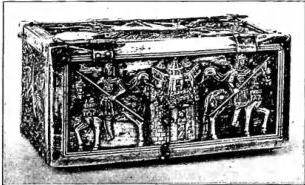
RELIQUIARIO - Ivory casket from the 10th century - Troyes, Cathedral Treasury.
del Fiore, reliquary by the goldsmith Salvi; Spoleto, reliquary of s. Eutizio).
Some examples in gilt silver or chased gold, decorated with enamels, can be seen in the Cathedral of Cosenza, at the Bargello, at the Academy of Venice (the famous reliquary of the True Cross, at S. Martino delle Scale, Monreale); at other times they took the form of a double cross with filigree and trefoiled arms, following the French example, which were also found in Italy.
During the Baroque period, relics multiplied and all churches had an extraordinary number of reliquaries executed in carved and gilded wood, as well as bust reliquaries that followed the fortunes of sculpture with soft and lively modeling of garments and hair. Entire chapels were adorned with reliquaries of all shapes—small boxes with spires, busts, and palms—placed in various orders so as to entirely cover the walls (Veroli, Duomo). In the following century, that is, the nineteenth, such fervor for reliquaries began to subside, and when new ones were commissioned, it was preferred to imitate the shape of monstrances, incorporating new neoclassical and romantic repertoires into the decorative motifs. - Vedi tavv. XXXVI-XXXVIII.