
TROYES, DIOCESE of. — Diocese and capital city of the department of Aube, formerly the capital of Champagne, where the Haute-Seine Canal now passes.
It extends over 6010 sq. km., with the same boundaries as the department; it has a population of 255,237 inhabitants, of whom 210,000 are Catholics. The diocese is divided into 5 archpriestships and 32 deaneries; it comprises 457 parishes, served by 200 diocesan priests and 39 religious; it has a major and a minor seminary, 9 male and 18 female religious communities (Ann. Pont. 1953, p. 433). The patrons of the diocese are the apostles Peter and Paul.
It was the capital of the tribe of the Tricasses, whence the name Tricae or Trecace and consequently the present T.; it also bore the name of Augustobona. The counts of Champagne also favored the Jewish community, and among the rabbis there emerged Rashi or Jarchi (1040–1105), founder of T.’s Talmudic school. The city was burned by the Normans, but was soon resupplied. The power of the bishops gradually waned with the rise of the power of the counts of T., later counts of Champagne; T. became famous for its fairs and obtained its franchises between 1230 and 1242. A Council was held there in 1128 which approved the establishment of the Order of the Templars. Champagne was united to the French crown through the marriage of Philip the Fair in 1248. It suffered greatly from the fire of 1524 and during the Wars of Religion. Gradually T. became a notable artistic center, especially under Louis IX, Charles VIII, and Louis XII; from approximately 1480 to 1635 a school of architecture, sculpture, painting, and stained-glass art flourished there, particularly through the work of J. Soudan, J. Macadré, and L. Goutier.
A manuscript from Auxerre (no. 132) contains the catalogue of the bishops of T.; up to Manasse de Pougy (1181–1190), continued through Nicola de Brie (1232–69). The list begins with Amator, around the year 300; he was succeeded by Ottazianus around 346, then by Leo, Heradius, Melanius, Aurelian, Ursus, and Lupus, to whom Sidonius Apollinaris wrote several times (Epist., VI, 1, 4, 9; IX, 11); he was bishop from approximately 426 to 478 or 479; he went to Brittany with s. Germanus of Auxerre and acted energetically against the invasion of Attila. He is commemorated on 29 July in the Martyrologium Hieronymianum. Gregory of Tours recounts a miracle that occurred in his Basilica (In Gloria Confessorum, 66); his life was written shortly after his death (Acta SS. Julii, VII, p. 80). His successors were Camillian, who was present at the Council of Orléans in 511 and is commemorated on 28 July in the Hieronymianum; Vincent, around 540, who erected a church to s. Aventinus; Ambrose, who attended the Council of Orléans in 549; Galomagnus, who attended the Councils of Paris in 573 and Lyon in 581 and is mentioned by Gregory of Tours (Vitae Patrum, VIII, 8); then Agrecius, Lupus II, Evodius, Modegisilus, Ragnegisilus, around 667, who erected a church in honor of s. Sabina; s. Leuconius (venerated on 1 April); Bertololus, around 660; Vanmiro; Abbo, around 667, who buried s. Frodebert, founder of the monastery of Montier-la-Celle; Fulcherius; Ottulf, who was at the Council of Attigny in 870 and welcomed Pope John VIII to T., where he held a synod (Jaffé-Wattenbach, 3179); Bodo, around 890; Rievo, on whose behalf Pope Formosus intervened (Flodard, De Christi triumphis, 12,5: PL
135, 829). Later there were Garnerius of Trainel (1193–1206), who brought a relic of the Crown of Thorns from the Fourth Crusade and placed it in the church of S. Stephen; G. Leguise (1426–50), who welcomed Joan of Arc to T. in 1429; G. Parvi (1519–27); A. Caracciolo di Molfetta, a heretic (1551–62); G. B. Bossuet (1716–49); L. A. de La Tour du Pin-Montauban (1803–1807); S. A. Boulogne (1808–25); J. M. M. Debelay (1844–48), later archbishop of Avignon.
The Cathedral is dedicated to ss. Peter and Paul. Its construction began in 1208 but continued until 1638. The apse and choir were completed in 1314; when the church was dedicated in 1430, it also included the transept and three bays of the nave. The façade is the work of the same artist, M. Chambiges, who worked on Beauvais Cathedral; it is flanked by two square towers; the one on the left is 74 m. high and is the only one to have been completed (1559–1640). At its base, an inscription recalls that Joan of Arc was solemnly received in the Cathedral on 10 July 1429, when she accompanied Charles VII to Reims for the coronation. The three portals were damaged during the Revolution; at that time the statues that decorated them were demolished. The interior measures 114 × 51 m., with vaults 29 m. high. The presbytery terminates in an ambulatory with five chapels; the stained-glass windows date from the 13th century and were partly restored; noteworthy is the scene of the Pressoir mystique, by Linard Goutier (1625). In the chapel of Our Lady of Loreto, a beautiful statue of the Madonna is greatly venerated. Particularly artistic in the narthex is the gallery, called the Chapel of Calvary, which is reached by a monumental staircase. South of the Cathedral stands the former bishop’s residence, partly a Renaissance work, with an 18th-century chapel. The Treasury is particularly rich; noteworthy are the enameled reliquary from the end of the 12th century, from Nesle-la-Reposte (Marnc), containing relics of s. Bernard and s. Malachy; the modern Reliquary of s. Lupus, set with Limoges enamels from the 16th century; a Byzantine ivory casket from the 10th century; another casket in chased metal donated by Blanche of Castile; Evangelistaries from the 11th and 12th centuries; croziers from the 12th–13th centuries; a chalice from the 13th century; tapestries from the 16th century, etc.
Synods were held at T. in 420, 867, 878, 1104, 1107, and 1128 (Hefele-Leclercq, II, p. 487 ff.; IV, pp. 415–20, 665–78, 1353; V, pp. 482, 499–503, 670–71, 1761).
The oldest church in the city is S. Madeleine, built in the middle of the 12th century in the form of a Greek cross and reconstructed between 1498 and 1565 by J. Gailde; the façade has a tall tower on the right (1531–60). The five-aisled interior is divided by a magnificent jube in the Flamboyant style, a masterpiece by the same J. Gailde. In the transept are a noteworthy 16th-century statue of s. Martha and a wooden statue of s. Robert, prior of Montier-la-Celle. The windows have 16th-century stained glass. Near the baptismal font is a statuette of s. Sebastian from the beginning of the 16th century. The original Basilica erected by Queen Clotilde in honor of s. Germanus, when his body was brought back from Ravenna in 448, was enlarged in the 9th century by Count Conrad; but the present deconsecrated building dates from the end of the 13th century, part of it having been destroyed in 1820. Inside, the ambulatory leads to the apse chapel erected above two underground chapels. In the southern crossing, besides the 12th-century tombstone of Bishop Hugh of Montaigu, there is the portal whose tympanum is carved with scenes from the life of s. Germanus; the adjoining cloister preserves only a Gothic section and vaulted rooms. The church of S. Peter, also called St-Père-en-Vallée, was erected between 1536 and 1672; its large square bell tower, 45 m. high, resembles that of the Cathedral; its stained-glass windows were damaged by bombardment. The church of S. Urban is one of the most artistic not only in the region but of the entire 13th century. It was begun in 1262 by Pope Urban IV, the son of a shoemaker from T., on the site of his father’s workshop. Completed in 1389, it was restored from 1879 to 1905. The modern portico leads to the main portal, whose tympanum is carved with the Last Judgment. The interior has three aisles and a transept, with 13th-century stained-glass windows; it has two terminal chapels; the one on the right has on the altar the
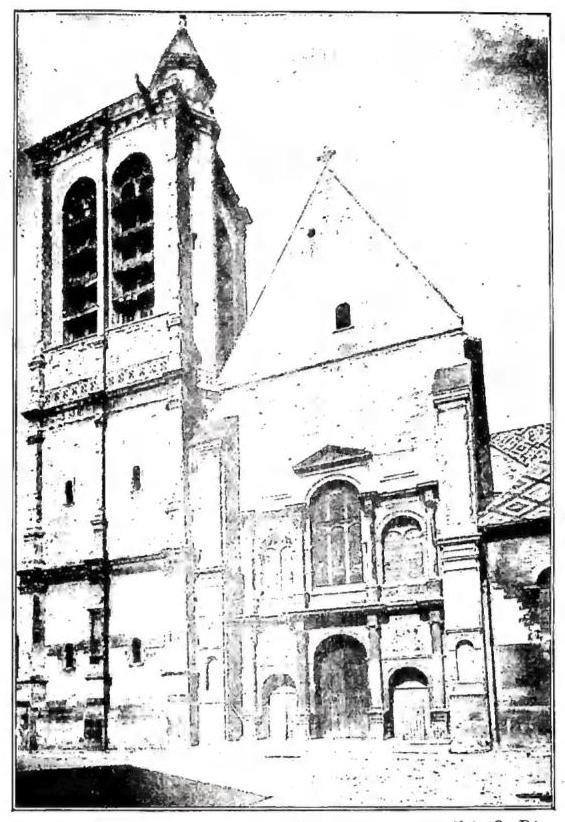
(photograph O. P.)
recently. In the portico it preserves a 15th-century portal; the bell tower of 1386 has been almost entirely rebuilt and is flanked by four small turrets. The interior has three aisles, with an ambulatory opening onto two chapels; the stained-glass windows are modern. The church of S. Nazarius is Gothic in style (1528-73) and has a portal from 1531; the façade of 1574 was mutilated; to the left stands a large square bell tower. The interior has three aisles with transept and ambulatory, where 16th-century stained-glass windows are particularly well preserved. Beyond the bridge over the Yonne stands the church of S. Peregrine, rebuilt in the 16th century and used for Protestant worship since 1866; excavations carried out there from 1927 to 1928 by R. Louis brought to light the structures of the ancient church, which was the primitive cathedral until Bishop Amator transferred II. The church of St-Jean-au-Marché dates from the middle of the 6th century; in its present form, however, it is later than the fire of 23 July 1888; it burned again in 1524 and was already rebuilt by 1534. It has three aisles with pillars surrounded by a cluster of four columns; the choir was enlarged at the end of the 14th century and rebuilt in the 16th, and the nave (1561-91) in the 15th; the bell tower, which collapsed in 1911, dated from the 14th century; the western portico is from 1593, and that of the clock from 1603-1607. During the Revolution it was used as a granary, and the small bell tower was demolished; it was restored several times in the 19th century (P. Piétresson de St-Aubin, Topographie Troyenne. Autour de St-Jean, in Mémoires de la Société académique de l'Aube, 92 [1929]; id., L'église de St-Jean-au-Marché à T., in Bulletin monumental, 89 [1930], p. 47).
The abbey of S. Lupus was founded ca. 841; burned by the Normans ca. 892, it was rebuilt by the Canons Regular; s. Vinebald was its abbot (J. Roserot, Les abbayes au département de l'Aube, in Bulletin historique du Comité, 1904, pp. 568-71, 594-97; id., Les abbayes de l'ancien diocèse de T., ibid., 1909, p. 441). The abbey of Notre-Dame aux Nonnais, for canonesses, was established ca. 657 by Bishop s. Leucconus, who was buried there; it was rebuilt by Count Henry; it received gifts from Urban IV; in 1518 it passed to the Benedictines (Cottineau, II, col. 3225). The abbey of St-Martin-ès-Avies (in Aréis) was founded at the beginning of the 12th century; it has a cloister erected under Louis XIII and is now used as an orphanage (Cottineau, II, col. 3227).
The Museum occupies what remains of the former buildings of the abbey of S. Lupus, with the addition, in 1892, of the “Pavillon Brissonnet.” It comprises archaeological, sculpture, painting, and natural-history collections. Attached to it is the Library, one of the most notable in France; it contains more than 200,000 volumes, 3131 manuscripts, and 547 incunabula. It was founded in 1651, but the holdings of more than 37 monastic libraries were later added, including those of the abbey of Clairvaux. In the great hall are 52 stained-glass windows by L. Goutier depicting episodes from the lives of Henry IV, Louis XIII, and Anne of Austria. The oldest manuscript is the pastoral book of s. Gregory the Great from the end of the 7th century. There is also a Gospel Book from 909; La città di Dio by s. Augustine (11th century), s. Bernard’s Bible from the 12th century, a 14th-century Bible with 117 miniatures, a locally illuminated Missal from the 14th century, etc.; and a 13th-century Gospel Book binding with enamels, etc. The discovery in T. of Chifflet’s famous Synaxarion enabled Fr. F. Halkin to produce a revised and corrected edition of the chronology of s. Tryphyllius, bishop of Cyprus in the 4th century (Anal. Boll., 66 [1948], pp. 11-19). The Museum of Decorative Arts is housed in the Hôtel de Vauluisant, which served as a temporary residence for the dignitaries of the abbey of Vauluisant (in the archdiocese of Sens). It contains tapestries, bronzes, marbles, ceramics, stained glass, sculptures, and paintings. The prefecture stands on the site of the former abbey of Notre Dame aux Nonnains, dating from the end of the 18th century but partly rebuilt in the 19th.
In the vicinity of T. are St-Martin-ès-Vignes, with its church erected in 1592 and completed in 1691. The sanctuary has a large classical portal with columns and a pediment. The interior has three aisles with splendid stained-glass windows (depicting scenes from the Old and New Testaments, the stoning of s. Stephen, s. Sebastian, s. Francis of Assisi, s. Catherine, etc.) and numerous statues. In addition,
St-André-les-Vergers, with the church of S. Andrew from the 16th century, which has a portal from 1646 decorated with statues and, inside, an altarpiece carved and painted in 1541.
Shrines: Notre-Dame-du-Chêne near Bar-sur-Seine; Notre Dame de la Ste-Espérance at Mesnil St-Loup; Notre-Dame de Valsuzenay.