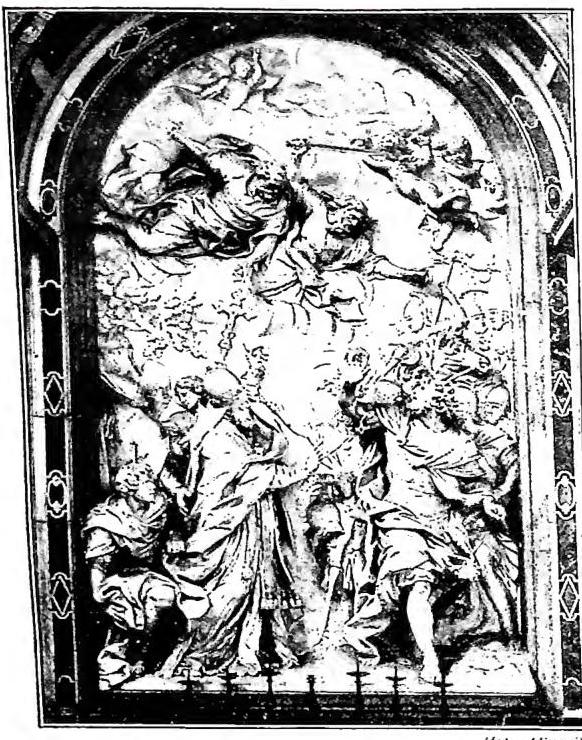
ATTILA. - He was the leader of the Huns around the middle of the 5th century, at first together with his brother Bleda, then, after the latter had been killed, alone. He first invaded the Balkan peninsula during the war against the Vandals and obtained concessions from Teodosio II. He then turned his ambitions toward the West and, since his demands had not been accepted by Valentiniano III, assembled a powerful army with which, at the beginning of 451, he crossed the Rhine. The battle between the Huns and the Romans (assisted by the Visigoths) took place in June on the Catalaunian Fields; A. was defeated, although he succeeded in withdrawing with his men. The following year he invaded Italy, destroying Aquileia and Padova and plundering Milano and Pavia; seeing that it was impossible to check his advance, the emperor began negotiations, and Pope Leone himself went to the Mincio to parley with A.; the Pope’s influence induced the barbarian to come to terms. He died suddenly in Pannonia in 453, and with his disappearance the hordes of the Huns scattered, ceasing to represent a danger to Roman civilization. Documentation concerning A. is extremely scanty; from the 8th century onward he has been known by the title of “Scourge of God.”