
MISSALE. – From the ecclesiastical Latin Missa, whence Missale or Liber Missalis, it is the liturgical book containing the euchological formulas (readings, chants, prayers) and ritual prescriptions for the celebration of the Holy Mass.
I. ORIGIN
The celebration of the Holy Mass in antiquity and the Middle Ages was an essentially choral act, in which ministers and cantors took an active part, for whom special books were reserved (Sacramentary, Evangeliary, Epistolary, Gradual or Antiphonary: V. LIBRI LITURGICI). While cathedral or abbatial churches could boast of possessing the complete series of such books, the same could not be said for smaller or rural churches, often poorly endowed and with scarce clergy, and for missionaries who had to carry with them what was necessary for the celebration, in reduced form, of the divine Mysteries. Thus, for economic and practical reasons, the Missal came into being, in which all the eucological formulas required for the celebration of Mass were gathered in sequence.Precursors of the Missal were the libelli Missarum, containing partial (prayers and Prefaces) or complete (prayers, readings, Prefaces, Canon) formularies of a few Masses, preferably votive or of the Commune. Such are, in addition to the collection contained in the Leonine Sacramentary, the so-called Gallican Masses of Mone, 7th century (PL 138, 863-883); the Irish Missal of Stowe, 7th-9th century (ed. G. F. Warner, London 1906, 1915); the Liber Sacramentorum of Alcuino (PL 101, 445-66; cf. his letters 51 and 142 [*« misi chartulam missalem »]: ibid. 100, 215-16, 385) and the Masses of the Munich palimpsest (cod. Lat. 6333, late 8th century, ed. A. Dold, Beuron 1930). Booklets of this kind continued to be in use throughout the Middle Ages (cf. the so-called Missals of Worms and St-Aubin with a few Masses, 10th century: Leroquais [V. BIBLICA.], I, pp. 62-63, 74) until the 15th-16th centuries, when they were replaced by portable printed Missals called Missale itinerantium, Missale vade mecum or veni mecum, containing a selection of Masses and the Canon (cf. W. Weale-H. Bohatta [V. BIBLICA.], pp. 82-85; M. Besson [V. BIBLICA.], I, pp. 319-32). Sometimes these booklets were combined with other texts of practical utility for priests in pastoral care, as in the typical case of cod. 10.127-44 of the Royal Library of Brussels, 8th century (cf. P. de Puniet, Un abrégé ancien du Missel rom., in La vie et les arts lit.*, 7 [1920-21], pp. 534-42).
The first rudimentary and imperfect attempts at a Missal proper date back to the 7th-10th centuries with the palimpsest fragments of Montecassino, cod. 271, late 7th century (ed. A. Dold, Beuron 1943); the Missal of Bobbio, 8th century (ed. E. A. Lowe, London 1917, 1920), probably used by a missionary; the characteristic Missal copied at S. Cristina di Olona, ca. 850, later migrated to the monastery of Wessobrunn, with chants and readings inserted into the text of the Masses (cf. A. Dold, Geschichte eines karolingischen Plenarmissales, in Archivalische Zeitschrift, 46 [1950], pp. 1-40; these are fragmentary folios); the Sacramentario Bergomense, 10th century (ed. P. Cagin, Solesmes 1900), the first attempt, despite the title, at an Ambrosian Missal; the Liber Ordinum, 10th-11th century (ed. M. Férotin, Paris 1904), a Mozarabic ritual, pontifical, and Missal.
For the period of origins, from the 7th-8th centuries until almost the entire 11th century, the fusion of the individual books into the Missal was far from homogeneous, as compilers proceeded with great freedom and entirely personal criteria, almost always intent on making use of existing Sacramentaries, which they transformed in the most varied ways: the Sacramentary was, for example, bound
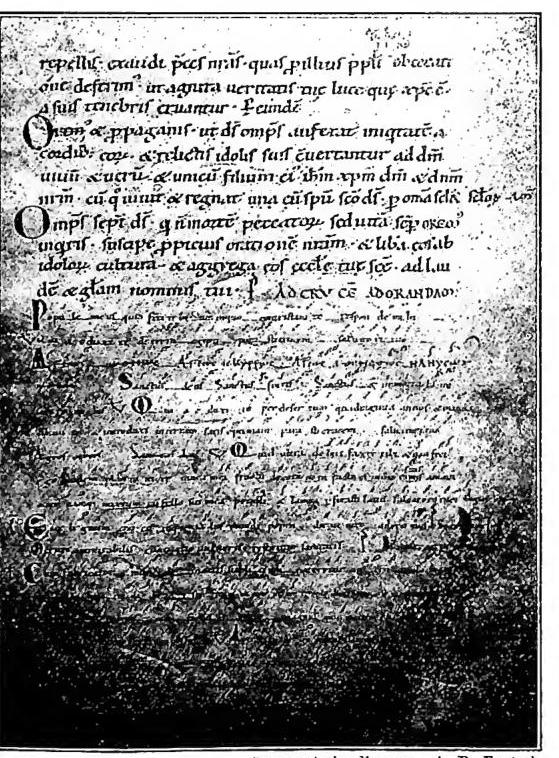
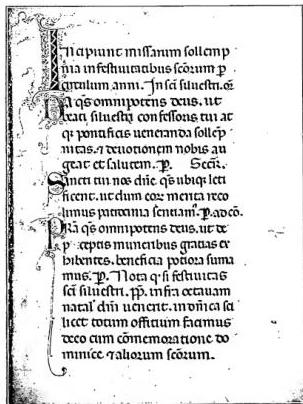
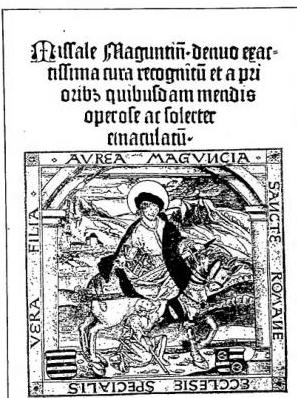
(from Hanns Bohatta, Liturgische Drucke..., und liturgische Drucke, Hatisbona [1898], tsn. II) MESSAGE - Title page of the Missal of Mainz, printed there by Peter Schöffer in 1507.
II. THE MISSAL OF THE CURIA
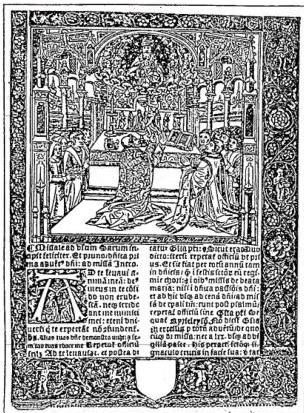
Among the many plenary Missals in use during the 12th-13th centuries, that of the Curia or of the Papal Chapel was destined to become universal. The continuous peregrinations of the pontifical court, not only within Italy but also abroad, compelled the clerici capellae to abbreviate and modify the solemn papal rites celebrated in the Roman basilicas, principally in the Lateran. From these abbreviations and modifications arose, for the Divine Office, the Breviarium Curiae (v. BREVIARIO), and for the Mass, the Missale Curiae, which shares many affinities with the aforementioned Vetus Missale Romanum edited by Azevedo. The form of this Missal was definitively established during the pontificate and through the efforts of Innocent III (1198-1216). It is certain that before 1223 it was complete, since in that year Francis of Assisi ordered his sons to conform to it (cf. Regola, ch. 3). The Missal of the Curia from the 13th century is known from cod. 100 of the Avignon Library (copied between 1276 and 1288) and cod. Ottoboniano 356.(from Hanns Bohatta, Liturgische Drucke... und liturgische Drucke, Ratschana [1895], pl. 5)
MESSAGE – Incipit of the M. of Sarum, printed in Paris by Wolfgang Hopyl in 1510-11.
of the Vatican Library (copied between 1288 and 1292), as excellently demonstrated by M. Andrieu (Le Missel de la Chapelle papale à la fin du XIIIe siècle, in Miscell. F. Ehrle [Studi e testi, 38], Rome 1924, pp. 348-76); another witness to this type of M. is found in the so-called "Breviary" of S. Chiara, which contains from fol. 192ᵛ to 204ᵛ Masses of the Commune and votive Masses (cf. A. Cholat, Le Bréviaire de Ste Claire, Paris 1904, p. 45). The two cited codices contain only the parts reserved for the celebrant (orations, Prefaces, and Canon) with numerous rubrics that reproduce the Ordinarium of the Papal Chapel in accordance with the liturgical innovations of Innocent III (cf. M. Andrieu, Le Pontifical romain au moyen âge, II [Studi e testi, 87], Vatican City 1940, pp. 4-5, 205, 301-308, 319-20), which was later modified when the Curia resided in Avignon (cf. Ordo XIV of Cardinal Giacomo Gaetani Stefaneschi).
The Franciscans, adopting this M., adapted it to the needs of their apostolate and their liturgical life and gave it the following title: Ordo Missalis Fratrum Minorum secundum consuetudinem et usum Romanae Curiae, or Romanae Ecclesiae. Gregory IX considered extending the M. thus reformed to the entire Church, but did nothing in this regard; Nicholas III, in 1277, instead ordered its acceptance in all the churches of Rome (cf. A. Le Carou, Le Bréviaire romain et les Frères Mineurs au XIIIe siècle, Paris 1928, p. 213). Only three centuries later, after the necessary emendations and updates, St. Pius V succeeded in having it accepted by almost all the Churches of the Latin rite.
The M. of the Curia, thus reformed and sponsored by the flourishing Franciscan Order and other religious, such as the Augustinians and the Servites, soon had a very wide diffusion throughout Europe, but by now its content, like that of other types of plenary M., being fixed—except for some local elements—no longer holds great interest for the liturgist: scholars of art turn their attention to the manuscript M. of the 14th-16th centuries, for
their external presentation (script, decoration, binding) reaches in all countries the height of perfection.
The M. of the Curia was among the first M. to be printed, excepting the Missale speciale of Constance and the Missale abbreviatum (v. ill. at col. 795) printed by Gutenberg ca. 1457 (cf. E. Misset, Un missel spécial de Constance, oeuvre de Gutenberg avant 1450, étude liturgique et critique, Paris 1899, extract from Bibliographe moderne, 1899, no. 4; A. Ruppel, J. Gutenberg, sein Leben u. sein Werk, 2nd ed., Berlin 1947, pp. 156-62). Indeed, the editio princeps was published in Milan on 6 December 1474 by Antonio Zarotte of Parma, with the title: Incipit Ordo Missalis secundum consuetudinem Romane Curie (reproduced from the only existing copy at the Ambrosiana in vol. XVII of the H. Bradshaw Society, edited by R. Lippe, Missale Romanum Mediolani, 1474, I, London 1899). The content is arranged as follows: calendar; Ordo ad faciendum aquam benedictum; Proprium de tempore; after Holy Saturday follows the Ordinarium Missae with Prefaces and Canon; Proprium sanctorum; Commune Sanctorum, votive Masses and various orations; Masses for the dead, various blessings. The rubrics are inserted into the text.
Editions of the M. of the Curia followed rapidly, as can be seen from Weale-Bohatta ([V. BIBLICA.], pp. 148-99), but due to the lack of a central authority to oversee their genuine reproduction, publishers introduced numerous variants, some of them substantial, and various updates, as can be seen from the comparison made on 15 editions by R. Lippe (op. cit., II, London 1907).
III. THE ROMAN MISSAL OF ST. PIUS V. – At the dawn of the Protestant Reformation, anarchy in the field of Latin Eucharistic liturgy had reached its peak, and printing, rather than fostering the triumph of a specific type of Missal, worsened the situation. The catalogue of Missals published in various dioceses before the Council of Trent, compiled by Weale and Bohatta, is highly instructive in this regard. Moreover, traces of popular festivities—such as those of wells and donkeys, veritable carnivals—remained in manuscript or printed Missals. All this provided fodder for innovators to discredit worship and liturgical books. A reform was imperative and demanded by many; the Council of Trent addressed it in part during its 25th session on 4 December 1563. However, the commission appointed by the Council achieved nothing because the criteria of its members were too discordant: some desired absolute Eucharistic uniformity for the entire Church, while others vigorously defended the rights of diocesan rites. As the Council was drawing to a close, it was decided to refer the matter to the Roman Pontiff. Pius IV, who had already taken an interest in the question, received the commission’s acts at the end of 1563 and summoned its members to Rome, wishing other scholars to join them. Work began with the Breviary, which was published by St. Pius V in 1568 (v. BREVIARIO), and then proceeded to the Missal. The commission chosen by St. Pius V did not create a new Missal but revised and updated the Missal of the Curia, reprinted several times after 1474. In general, the essential parts of the Missal of St. Pius V differ little from those of the 1474 edition; indeed, there are sometimes identical variants in the scriptural texts, as in the Epistle for the Friday after Easter.
The most revised parts are: 1) the rubrics, partly derived from the Ordo Missae of Johannes Burckard, papal master of ceremonies (cf. ed. by J. Wickam Legg, in Tracts on the Mass [H. Bradshaw Society, XXVII], London 1904, pp. 121-74; the parts inserted into the Missal of St. Pius V are indicated in the notes [pp. 249-51]), published in Rome in 1502 but already reproduced in the Roman Missal printed in Venice in 1501; 2) the Sanctorale, harmonized with the Breviary regarding the saints to be included and the rite of their feast. The thus-revised Missal was presented to all Churches of the Latin rite with the bull Quo primum of 14 July 1570 as the authentic Roman Missal. Within six months, all Churches that could not prove their customs in the celebration of Mass had been approved by the Apostolic See from their inception or had remained unchanged for at least 200 years were to conform to II. Most diocesan Missals thus had to disappear; only those of the most ancient Western rites remained in force,
such as those of Milan, Lyon, Toledo, Braga, the Carthusians, Dominicans, etc.
IV. THE ROMAN MISSAL AFTER THE REFORM OF ST. PIUS V. — The Missal of St. Pius V was generally received with enthusiasm, and some dioceses that could have availed themselves of the exception provided, such as Aquileia, renounced their own liturgy. Others, however, while accepting the new Missal, preserved part of their ancient customs: thus arose the diocesan Propers and the Missals ad Romani formam or iuxta mentem Tridentini. Pius V had imposed very severe penalties against future manipulators of the Missal’s text, but publishers paid little heed to such sanctions, and as early as the second Roman edition of 1570, a correction appears (beginning of the Gospel for the Tuesday after the third Sunday of Lent: cf. Zaccaria [V. BIBLICA.], I, p. 45). However, the gravest scandal was caused by the Venetian publishers (the Giunta brothers: Zaccaria [V. BIBLICA.], I, pp. 54-56; Weale-Bohatta [V. BIBLICA.], p. 214), who in 1596 published a Roman Missal so heavily revised that it was placed on the Index of Prohibited Books by decree of 1 February 1601. The corrections primarily concerned the antiphonale Missarum, whose text derived from the pre-Gregorian Latin version known as Itala. The Venetian publishers believed themselves authorized: 1) to replace this venerable text with that of the recently published Vulgate, and 2) to revise the text and incipits of the Epistles and Gospels. Pope Clement VIII intervened by appointing a commission, which included the most eminent scholarly figures of the time, such as St. Robert Bellarmine, Baronius, and Gavano, to make further revisions to the text of St. Pius V, particularly in the rubrics and the scriptural texts of the readings that differed from the Vulgate. Clement VIII promulgated the new typical edition of the Missal with the brief Cum Sanctissimum of 7 July 1604, increasing the penalties against those who reprinted or sold it without the necessary licenses and guarantees of authenticity. Urban VIII, after publishing a new typical edition of the Breviary, found himself compelled to issue a new edition of the Missal as well to harmonize the two liturgical books. The commission appointed for this purpose further revised the rubrics and re-examined the biblical texts of the readings to bring them fully into conformity with the Vulgate. Urban VIII promulgated the new edition of the Missal with the brief Si quid est of 2 September 1634, imposing the usual canonical penalties against future violators. The principal violators this time were several French bishops influenced by Jansenism and Gallicanism. From the end of the 17th century and throughout the 18th century, there was a veritable frenzy in France for composing new Missals (the Neo-Gallican Missals) and new Breviaries: non-scriptural passages were removed; rubrics were altered; Prefaces and Sequences were increased, most notably the Preface for the Feast of All Saints composed by the Jansenist L.-F. Boursier (cf. P. Guéranger, Institutions liturgiques, II, 2nd ed., Paris 1880, p. 330). In Italy, the Synod of Pistoia (VI session, 27 September 1786) addressed the reform of the Missal, but in the spirit prevailing beyond the Alps (cf. Atti e decreti del Concilio diocesano di Pistoia, Florence 1786, p. 205).
These Missals spread throughout France and neighboring regions for over a century; they disappeared only following the campaign to restore the Roman liturgy, initiated and supported by Monsignor Pierre-Louis Parisis, Bishop of Langres (pastoral letter, 15 October 1839), and by Abbot Dom Guéranger. This return to the Roman Missal in the dioceses beyond the Alps, including those of Cologne, Münster, and Trier, provided the opportunity for Leo XIII to publish a new typical edition of the Missal that would account for all the variations introduced after Urban VIII. The edition was published in Ratisbon (Pustet) in 1884.
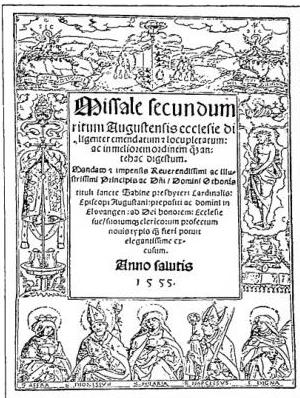
(from Hanns Bohatta, Liturgische Drucke... und liturgische Drucke, Ratisbon [1926], inv. 39)
MESSAGE – Title page of the Missal of Augsburg, printed in Dillingen by Sebald Mayer in 1555.
of the Rites; 2) to revise the rubrics and not the substance of the Missal. Indeed, the text of the Missal was not altered, except for a few corrections or additions of secondary importance (e.g., the Prefaces of St. Joseph and of the dead, prescribed on 9 April 1919: AAS, 11 [1919], pp. 190-91). The rubrics were reviewed but there was no courage to recast them, which is why the rubricae generales Missalis remained those of the typical edition of Leo XIII of 1900, followed—as in the Breviary—by the Additiones et variationes in rubricis Missalis ad normam bullae « Divino afflatu » et S. R. C. subsequentum decretorum. Votive Masses were reduced, and the formularies of the three Masses for the dead on 2 November were added, granted by Benedict XV with the brief Incruentum Altaris sacrificium of 10 August 1915 (AAS, 7 [1915], pp. 401-404). The typical edition of the Masses for the dead was published separately in 1919 under the title Missae defunctorum ex Missali Romano desumptae. The calendar was also harmonized, in content and rite, with that of the Breviary. The edition was promulgated and declared typical by Benedict XV with a decree of the Sacred Congregation of Rites on 25 July 1920 (cf. L. Barin, Il Missale romano riformato da Pio X e promulgato da Benedetto XV. Commento e note illustrative alle modificazioni introdotte dalla ed. tipica MCMXX, Rovigo 1920).
V. CONTENTS
1) Pontifical documents. The decree of the Sacred Congregation of Rites (25 July 1920); the briefs of St. Pius V, Clement VIII, and Urban VIII already mentioned; the bull Divino afflatu of Pius X. 2) The short treatise De anno et eius partibus, essential elements of the ecclesiastical computation with Paschal and temporary tables for movable feasts. The first paragraphs were added by Urban VIII. 3) The Calendar now corresponds exactly to the Sanctorale, whereas in manuscript Missals and editions prior to Pius V, it did not always do so. It is one of the oldest elements of the Missal and very often serves to identify the origin and determine the date of manuscript Missals, depending on local saints and other details that appear therein.(cf. Leroquais [V. BIBLICA.], I, pp. XVII-XIX). 4) The Rubricae generales Missalis, compiled on the basis of the Ordo Missae of Burchard by the commission of St. Pius V and harmonized with those of the Breviary published in 1568, revised by Clement VIII, Urban VIII, and Leo XIII (v. RUBRICHE). The Additiones et variationes of Pius X follow. 5) The Ritus servandus in celebratione Missae, derived from Burchard, and the De defectibus in celebratione Missarum occurrentibus, a compilation already included in the Missal published in Venice in 1557 (cf. B. Gavanto, Thesaurus Sacrorum Rituum, ed. by G. M. Merati, I, Venice 1769, p. 201). 6) The Praeparatio ad Missam, the Orationes dicendae cum sacerdos induitur sacerdotalibus paramentis, and the Gratiarum actio post Missam. In the Missal of St. Pius V, there were only the psalms with the verses and the usual oremus; the other prayers were inserted later. 7) The Ordo incensationis with the relevant illustrations. 8) The Proprium de Tempore (v. TEMPORALE), which begins with the first Sunday of Advent. Between Holy Saturday and Easter Sunday appears the Ordinarium Missae with the Prefaces and the Canon. 9) The Proprium de Sanctis (v. SANTORALE), which begins on 28 November; in manuscript Missals, it often contains valuable elements for determining their origin. 10) The Commune sanctorum, beginning with the vigil of an Apostle and ending with the Masses of the Virgin. 11) Missae sanctae, far more numerous in manuscript Missals. 12) Orationes diversae. 13) The Ordo ad faciendum aquam benedictam, which in the editio princeps of 1474 appears at the beginning of the Missal. 14) Benedictiones diversae. 15) The Proprium sanctorum pro aliquibus locis where it has been granted by indult of the Holy See. 16) Proprium diocesanum.
and the evolution of Roman euchology). For the rubrics, cf. F. X. Hecht, Rubricae generales Missalis, Rome 1940 (Pro manuscripto: and a new edition is in preparation). V. AMBROSIA, LITURGIA; MOZARABICA, LITURGIA; SACRAMENTARIO. A. Pietro Frutaz
VI. ART
The decoration of the Missal naturally undergoes, from a stylistic standpoint, the same evolution as in other illuminated manuscripts [V. MINIATURA]. However, in the earliest examples from the 7th to the 11th century, which mark—as previously noted—the transformation of the Sacramentary into the Missal proper, interesting observations can be made regarding the origin and development of certain illustrations that became fundamental to the Missal. This origin and development are particularly linked to the evolution of the initial letters with which the "Praefatio" and the "Canon" begin. Thus, the P with which the first formula of the preparatory dialogue begins: Per omnia saecula saeculorum; the intertwined letters V and D of the first two words of the "Praefatio": Vere Dignum; the letter T of the first words of the "Canon": Te igitur. These letters, after the earliest examples of the 8th century (v. ill. and col. 794), gradually became enriched with complex ornaments featuring interlace, anthropomorphic and floral images, eventually forming true standalone illustrations. Meanwhile, the early intertwined group of V and D was soon dominated and then replaced by the complex image of the Majesty, the Majestas Domini, while the T of Te igitur quickly became a true Cross, eventually giving rise to that composition of the Crucifixion placed opposite the beginning of the Canon, which is fundamental to every Missal. In this scene, it is only in the second half of the 14th century that other figures are added to the Crucified Christ, while the city of Jerusalem is depicted in the background. Furthermore, the Christ in Glory of the Majesty is sometimes replaced, as early as the 13th century, by the Christ the Judge.On the other hand, beyond the two aforementioned representations—almost always similarly originating from the decoration of initials—Missals may also feature Gospel scenes or images of Saints accompanying the text in the Masses for the principal feasts of the year.
Among the oldest examples of illuminated Missals, the following are noteworthy: that of Robert of Jumièges (Rouen Library), a work of the 11th century by an artist from the Winchester school; the Bobbio Missal (11th century; Ambrosian Library of Milan, D. 84 inf.), with full-page initials clearly influenced by Germanic illumination of the preceding century. An example of an Emilian Missal is the Missale ad usum Ecclesiae Mutinensis (12th century; Palatine Library of Parma, ms. Parm. 996); while a work of the central Italian school is the Missale monasticum (13th century; Library of the Abbey of Subiaco, ms. XVIII). Among foreign schools, the Missal of Henry of Chichester (ca. 1260, Manchester) by an English artist influenced by contemporary French illumination is notable for its characteristic drôleries. Among works from the 14th–15th centuries, the Missale Ambrosianum (Ambrosian Library, C. 170 inf.), possibly illuminated by a Lombard artist for Roberto Visconti, later Archbishop of Milan, deserves mention; the Missal of the coronation of Gian Galeazzo Visconti (Milan, Library of the Cathedral of S. Ambrogio), illuminated by Anovelo da Imbonate; and Lombard works of the 15th century include the Missal of the cathedral of Fermo, illuminated by Giovanni di Maestro Ugolino, and that of the cathedral of Mantua, illuminated by Belbello da Pavia. Probably Paduan is the rich Book of Hours and Franciscan Missal of the National Library of Paris (lat. 757 – 1380), a combination of a Missal and a Book of Hours, with 73 full-page miniatures in addition to many historiated initials; and from the late 14th century in England, the Missal of Abbot Lyington (1383–84) and the Sherborne Missal, largely the work of John Siferwas (Alnwick Castle), are notable. Among works from the late 15th and early 16th centuries, the Missale secundum consuetudinem Romanae Curiae (1474–76; Florence, National Museum), with many miniatures revealing Flemish influences by Gherardo and Monte del Fora, is worth mentioning; the Missale Romanum of the Trivulzio Library of Milan (cod. n. 2165), finely illuminated for Cardinal Ippolito d'Este in the late 15th century by Martino da Modena; the Missale Romanum of the Braidense Library of Milan (AE X 30), by a Venetian illuminator of the early 16th century; and the Missale speciale Romanum (Rome, Casanatense Library, ms. 458), illuminated by artists of the Lombard school for Cardinal Francesco Cornaro, Bishop of Brescia in 1532–43. - See plates L-LIII.