
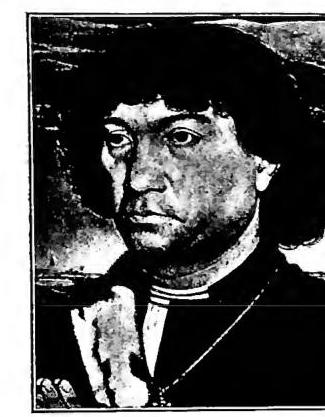
MEMLINC (MEMLING), HANS
Painter of Flemish origin, born in the area of Mainz, probably in Möblingen, c. 1433, died in Bruges on 11 August 1494. He worked in Bruges for the Hospital of St John, for the guilds, and also for the Italian agents of the Medici (c. 1470–1472): a Last Judgement for Angelo Tani, now in the church of Santa Maria in Gdańsk, and the portraits of Tommaso Portinari and his wife, now in the Metropolitan Museum of New York.
His early works: Madonna and Child with Angels, Saints and Donors (collection of the Duke of Devonshire at Chatsworth), of 1466; the Virgin with Donor (collection Liechtenstein at Vaduz), of 1472, reveal him as an artist already formed, with a personal vision, expressive of inner life, calm and contemplative. From 1475 to 1490 Memling worked especially for the Hospital of St John and for the municipal magistrates of Bruges: the Morel family, the Nieuwenhove family, Van Noort. The Morel Portraits (1478, Museum of Brussels), the Morel Portraits of the Church of St John, the Mystic Marriage of St Catherine, and the Adoration of the Magi (1479, Hospital of St John), the Seven Joys of the Virgin (1480, Pinacoteca of Munich), leading up to what is considered his masterpiece, the triptych with St Christopher, St Maurus and St Giles (Municipal Museum of Bruges), completed in 1484 for G. Morel. Then again the diptych with the Virgin and the donor Martin Van Nieuwenhove (1487, Hospital of St John), the Triptych with the Floreyns Family at the Feet of the Virgin (1489, Paris, Louvre), and his most famous work, the Reliquary of St Ursula (1489, Hospital of St John in Bruges), a fascinating narrative rendered with a miniaturist’s technique; works which make of Memling an artist so close to his Italian contemporaries as Giovanni Bellini and Perugino. On the other hand, Italian influences are certainly present in his portraits, where, starting from Rogier van der Weyden (see the Portinari Portraits), he generally sets the figure, slightly in three-quarter view, against a landscape background (Portrait of a Man in the Kaiser Friedrich Museum in Berlin, twin with the Portrait of a Woman in the Louvre; Portrait of a Man in the Museum of Brussels; Portrait of an Italian in the Museum of Antwerp). Since there is no evidence of the influence of Antonello, it has been thought that the painter knew the busts sculpted in 15th-century Italy for these portraits. From the repertoire of Italian art he also derived the motifs of garlands and putti which appear in some of his later Madonnas (Florence, Uffizi; Vienna, Museum).
He had many pupils and his influence is felt not only on those anonymous artists of his time known as the Master of the Legend of St Ursula and the Master of the Legend of St Lucy, but also on the great Gérard David, who in Bruges was truly his successor. — See pl. XL.
MEMMI, LIPPO DA SIENA
Sienese painter, son of Memmo di Filippuccio, also a painter, and brother-in-law of Simone Martini (q.v.), cited and documented between 1317 and 1347.
In 1317 on a wall of the Palazzo Comunale of San Gimignano he executed the fresco of the Maestà, which had been entrusted to his father, drawing inspiration from the analogous composition by Simone Martini, but weighing down its features, in the transformation of details, with a soft and opaque chiaroscuro and a monotonous, drowsy typology. Related characteristics, accompanied by a careful and polished colouring, distinguish the few panels bearing his name, such as the Madonna in the church of Santa Maria dei Servi in Siena and that in the Museum of Berlin. Finer and more lively, certainly under the influence of Simone Martini, is his style in the parts assigned to him in the triptych of the Annunciation in the Uffizi (1333), signed by him and by the Sienese master: the prophets in the roundels of the frame (cf. payments of 1333) and most probably also the lateral figures of SS Quiricus and Julietta. Within these stylistic limits is summed up the activity of Lippo Memmi—which, chronologically, extends at least until 1347: lost frescoes in San Francesco in Avignon—so completely absorbed within the overarching personality of the master as to make it difficult to recognise his hand in those parts of Simone’s works in Pisa, Orvieto (political figures) and Assisi (frescoes in the lower church), where inequalities of quality and slight stylistic divergences suggest a collaboration. As regards other works, such as the Madonna in the Palazzo Venezia and the St Gregory in the Parry Collection in Gloucester, their heterogeneous characteristics have recently led critics to remove them from Lippo Memmi and assign them to anonymous personalities within that circle.