
DIPTYCH. -
I. ART
From δίς = twice and πύσσειν = to fold. This name was given to two tablets or panels joined on one side by means of a hinge, a cord, or rings, so that they could be folded one over the other. They served for writing: consequently, the inner faces were smooth and coated with wax, while the outer faces often bore ornaments carved, sculpted, or embossed, according as the tablets were made of ivory, wood, or metal.In a later period the inner faces of the d., which had become objects of devotion, bore relief or painted representations of sacred images.
During the late imperial period it became customary to give d. as gifts on the occasion of auspicious events, and especially to celebrate the election of the emperor and the entry into office of the consuls. Naturally, in such cases the d. were made of precious material, almost always ivory (v.) and decorated in the finest possible manner.
The widespread use of d. intended for consuls, in addition to being attested by a restrictive provision of the year 384, is testified by the considerable number of examples that have survived. The consul for whom the d. was intended, dressed in the garments proper to his dignity, generally dominates the center of the principal face and is depicted either standing or seated on the «sella curulis», with the scepter in his left hand and the «mappa circensis» in his raised right hand, in the act of giving the signal for the beginning of the games. On the two sides, especially on the d. of the 6th century, are personifications of Rome and Constantinople; above, in a «tabula», usually «ansata», is the name of the consul; below, generally, is a scene with a varied subject. It seems that this type of d. had Alexandria in Egypt as its original center of production.
Many consular d. belonging to cathedral churches owe their preservation to having been given, beginning in the 5th century, by magistrates to bishops, who used them either as covers for Gospel books or for writing series of names on them for liturgical purposes.
Among the oldest ivory d. is that of the Nicomachi and Symmachi, executed perhaps in Rome between 376 and 394 in a technique that reflects the traditional methods of Hellenistic sculpture; its panels are now divided between the Musée de Cluny in Paris and the Victoria and Albert Museum in London. Stylistically related to it, but perhaps somewhat later, is the d. of Rufius Probianus, vicar of Rome, preserved in the Royal Library of Berlin. The d. of Anicius Probus, consul in 406, preserved in the cathedral of Aosta, that with the Marys at the Tomb in the Trivulzio collection in Milan, and the other with Stories of St. Paul in the Bargello in Florence, likewise from the 5th century, also reflect the methods of Hellenistic sculpture, whereas the d. of Felix, consul in 420 (Paris, National Library), displays in its execution certain pictorial aims characteristic of the more advanced Roman sculpture of that period. In the d. of Asturius, consul in 449 (Darmstadt), the same stylistic aims pursued in the d. of Rufius Probianus are instead evident. While the d. of Boethius, consul in 487, preserved in the Christian Museum of Brescia, shows a more decisive departure from the ancient formal decorum in a desire for a new expressiveness, the latter, on the other hand, is not attained.
The d. just mentioned were all worked in Italian workshops and show with sufficient clarity the development of the sculpture of those times in our country.
The d. preserved in the cathedral of Monza, however, is almost certainly an Oriental product. It should be assigned to the end of the 5th or the beginning of the 6th century and is said to represent Galla Placidia, Aetius, and the young Valentinian. The consular d. of the 6th century reflecting the methods of the late Oriental sculptural tradition likewise all belong to Oriental workshops, with the exception of that of Orestes (Victoria and Albert Museum, London): such are that of Areobindus (506), the other of Clementinus (513), and that of Anastasius (517), consuls at Constantinople at the beginning of the 6th century.
The ivory d. of Rambona, made in Italy and dating from the end of the 9th century (Vatican Christian Museum), clearly reflects the methods of the sculpture of that period in the uncertainty of its carving and its labored composition.
At that time, as has been said, the d. became above all objects of devotion, and it should therefore cause no surprise that the figures on some consular d. were transformed into Christian representations. Thus, for example, a d. is preserved in the cathedral of Monza (6th century) in which it is clearly visible that, probably in the 9th century, the scepter of one of the two represented figures was transformed into a staff surmounted by a cross; above is the inscription SCS Gregor(ius); the right hand, however, still supports the mappa. The figure represented on the other panel did not undergo as many adaptations, but was identified by the words DAVID REX.
Highly richly carved d. were also used in the 12th and 13th centuries in the Byzantine East; later they assumed the form of icons, eventually being considered genuine objects of devotion, according to a practice continued in Europe by sculptors of the Gothic period.
During the Romanesque period and thereafter up to the 15th century, the use of sacred images, and thus also of painted portraits, on tablets joined together by hinges was likewise widespread in Europe. Flemish art has left us numerous examples, but they were also frequent in the Eastern Italian school of painting (Marche-Rimini-Venice) and in the Sienese school (Simone Martini: d. of the Madonna with the Child Jesus and the Pietà, Horne Museum, Florence).
Donati, De d. degli antichi profani e sacri, libri III, Lucca 1753; A. Billet, Dissertation sur les diptyques, in Mémoires de la Soc. Acad. de Savoie, 12 (1846), pp. 559-604; A. Chabouillet, Dissertation sur les diptyques consulaires, in Revue des Sociétés savantes, 6 (1863), pp. 272-303; H. Grøven, Heidnische Diptychen, in Röm. Mitt., 28 (1913), p. 246 sgg.; H. Leclercq, Diptyques (archéologie), in DACL, IV, coll. 1004-1170; R. Delbrück, Die Consulardiptychen, Berlin-Lipids 1926; E. Capps, The Style of the Consular diptychs, in The Art Bulletin, 10 (1927), pp. 61-101; E. Weigand, Zur spätantiken Elfenbeinshauptur, in Kritische Berichte, 1930-31, pp. 33-57; L. Becherucci, s. V. ENOCH. Ital., XIII (1932), pp. 55-56. Giuseppe Bovini
II. LITURGY
The inner leaves of the d. were used in the liturgy to record the names of saints, bishops, benefactors of the Church, living and deceased, who were to be recited in the Memento of the living or of the de-ceased. For a living person, being inscribed in the d. was proof of communion with the Church and at the same time a great honor. Being struck from them, on the other hand, was a sign of excommunication or separation from the Church. In certain periods, as in the time of s. Atanasio, of Crisostomo, etc., the inscription of a disputed name in the d. caused prolonged disputes. Inscription in the d. was regarded as a symbol of inscription in the Liber vitae: consequently,
ancient liturgy, especially the Gallican, abounds in allusions to inscription in the Liber vitae, in the oration super nomina which was said during or after the reading of the names.
The reading aloud of these d. during Mass was performed not by the celebrant but by the deacon or some cleric. The original place for the reading of the d. was probably the Offertory, a place retained in most liturgies; nevertheless, the proclamation of the names of the offerers, who had made their offering at the Offertory, gave rise to inconveniences and protests; in some places, indeed, the names of the offerers were read first, and the prayer over the offering was said afterward; therefore Innocent I (Epist. ad Decentium, 2: PL 56, 514) ordered: «... ut inter sacra mysteria nominentur, non inter alia quae ante praemittimus, ut ipsis mysteriis viam futuris precibus aperiamus». The text of Innocent shows that around 410 the d. were read at the time of the present Memento of the living. It is therefore certain that from
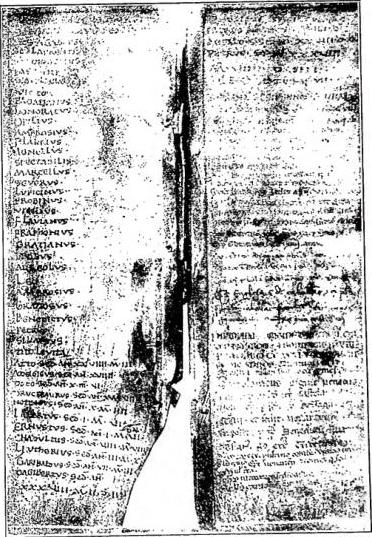
DITTICO - Internal panels of the d. of S. Gaudenzio bearing the names of the bishops, partly written ca. 1070.
For several years, then, the d. had already been introduced into the Canon at Rome. It seems that the Memento of the living and the Memento of the dead were joined together. Since, however, when the list of names was very long, the celebrating priest did not wait until the reading was finished but continued with the Canon, the deacon paused during the Consecration and then resumed reading: this explains why some of the names are read before the Consecration and the remainder afterward. In the course of time, the living and some of the saints were commemorated before the Consecration, while the dead and other saints were commemorated afterward. Since the names were written in the d. and read by the deacon, the indication of the names N. N., as found in the Roman Missal, is absent from the Gelasian and Gregorian Sacramentaries. But since, in the Roman-Carolingian liturgy, the names began to be read by the celebrant,
they were inserted into the text of the Canon. The purpose of such a commemoration is to bring the persons dearest to us closer to the source of every grace, since Christ is present on the altar in the state of a victim, as s. Cyril of Jerusalem explains (Catech. myst 5,8; PG 33, col. 1115): « maximum iuvamen pro quibus offertur precatio sancti illius ac tremendi Sacrifici »; and s. Thomas (Opusc. 57) later expressed it incisively: « Ut omnibus prosit, quod est pro salute omnium institutum ». - Vedi tavv. CI-CIII.