
DAVID (Heb. Dāwīdh “cherished, beloved”). – Second king of the people of Israel (ca. 1000–960 B.C.), whom he brought to the height of prosperity; he remained in the Bible as the ideal of the Yahwist king. No one else in the Bible bears his name: no one, Jesus excepted, is spoken of as much as he is (especially from I Sam. 16 to I Kings 2; I Chron. 10–29).
I. THE LIFE. 1. Until the death of Saul (I Sam. 16–31). – The last son of Isai (Jesse), D. was a young shepherd when he was secretly anointed king of the people of God by Samuel (v.), following Saul’s transgression (I Sam. 16).
He lived, perhaps for months, perhaps for several years, first temporarily as a harpist, then (after the killing of Goliath) permanently as an officer and son-in-law at Saul’s court; Saul, however, soon passed from the most enthusiastic love to the most frenzied hatred out of jealousy. Repeatedly sought for death, and always emerging unharmed through manifest divine assistance, he finally had to flee. He thought of going to the Philistines, powerful enemies of his people; there Saul would not have been able to reach him. But the attempt failed, since the memory of Goliath, killed by him, was still too vivid. He then took up a wandering life in the desert regions of the south, accompanied by a band of 400–600 men. Pursued even there, he had Saul within reach of his sword twice, but spared him. After perhaps a year or more of this life, in order to free himself from the unceasing persecution, he attempted once again to enter Philistia, and this second LACHIS (v.), king of Geth, together with his band. Regarded as an exile, he was given the village of Siceleg, with the obligation of contributing from the booty of his raids. He had been in Philistine territory for several years when, war having broken out between the Philistines and Israel, he too had to set out with his men against Saul; but, owing to the justified fears of Achis’s associates, he was sent back. At Gelboe (ca. 1000) Saul perished with his son Jonathan, D.’s intimate friend; he sincerely mourned the two dead men and Israel’s catastrophe in a celebrated song.
2. D., king of Judah (II Sam. 2–4). – At Saul’s death D. was 30 years old (II Sam. 5:4). In order immediately to draw close again to his people, following divine direction he came with his men to Hebron (the tribe of Judah), where, as a Judean by birth and benefactor of the Judean groups during the exile, he was enthusiastically received and anointed king: there they had no particular reasons for remaining loyal to Saul’s half-destroyed dynasty, and on the other hand an authority had by now become necessary.
3. D., king of all Israel (II Sam. 5 – I Kings 2). – The union between the northern kingdom and that of Judah was peaceful: the initiative came from the north, as soon as it had dis-
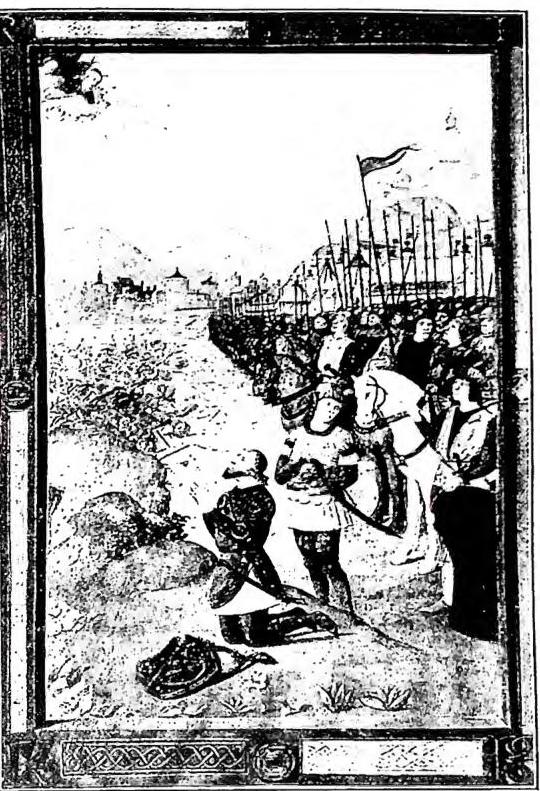
DAVID - D. gives thanks to the Lord after a victory, Diurnal and Breviary of Renato II of Lorraine (late 15th century) - Paris, National Library, ms. lat. 10491, fol. 147.
… Isbaal had disappeared, and D. welcomed it gladly (II Sam. 5:1-5): it was approximately 993. The Philistines, wishing to bring the rebellious vassal back to obedience, invaded the territory of Judah several times; but D. did not accept battle, contenting himself with skirmishes and dealing hard blows to the attackers. After two decisive victories won over the Philistines in the valley of the Réphâ'im near Jerusalem, definitive superiority was achieved over the age-old enemy, who from the Mediterranean Pentapolis had persistently pressed forward in order to open a route toward the great trade arteries of Damascus and Mesopotamia. It was probably immediately afterward that D. carried out his most famous undertaking, which fully revealed his political prudence and strategic skill: he chose Jerusalem as his capital and conquered it, a highly central fortress that until then had remained in the hands of a surviving Canaanite group, the Jebusites; he established his residence there, enriching it with buildings and fortifying its walls (II Sam. 5:6-25). The new capital, however, still lacked becoming the religious center of the nation. The Holy Ark was far away, while nearby stood the ancient and venerated sanctuary of Gabaon, served by the priest Sadoc. A compromise was reached: a new tabernacle was built in Jerusalem and the Ark was brought there; it was attended by the family of Abiathar, the priest who, having escaped the massacre of his family (v. ACHIMELER), had followed D. in the wilderness; the Mosaic tabernacle of Gabaon continued to be served by the family of Sadoc: a strange situation (two pontiffs
(phot. Sannini)
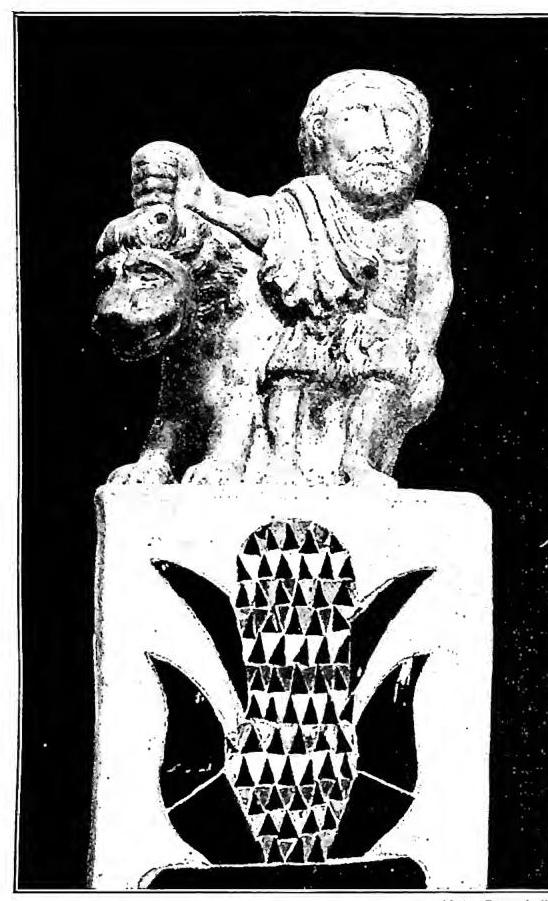
DAVID - D. subduing the lion. Fragment of an ambo (early 13th century) - Amalfi.
(simultaneous) which would be resolved at the accession of Solomon with the fall of Abiathar: Sadoc would pass to Jerusalem with the Mosaic furnishings of Gabaon, and this sacred place would fall into disuse.
Without chronological order, the biblical sources give us information about several other wars waged by D. against the neighboring peoples (II Sam. 8-12; I Par. 18-20). Just as the war with the Philistines brought about Israel’s independence in its own land, so these wars consolidated and extended its power. An insult inflicted upon his ambassadors gave D. the occasion Ammonites (v.), who allied themselves with various Aramaean chieftains of the north. Within two years the campaign ended with the Ammonite kingdom’s submission to tribute. He then turned north against the Aramaeans, former allies of Ammon: he defeated them and, besides securing great booty in metals and horses, placed an Israelite garrison in Damascus to ensure the annual payment of tribute and the conduct of his commerce. Other Aramaean princes declared themselves his allies, offering gifts. Then came the turn of the Moabites in the southeast, apparently subjected to tribute after severe decimation. The most difficult campaign was perhaps that against the Edomites in the south, also because of the distance from the Israelite centers and the desert terrain: it lasted several months and was a war of extermination. Its greatest result was to clear the way—vital for commerce and later traveled by Solomon—toward the southern seas (v. ASIONGABER). Those peoples were defeated, but not subdued; Israel had reached for the first time the boundaries of the Promised Land fixed by God: from the Pass of Emath to the Torrent of
Egypt. Having then allied himself with Tyre, Israel obtained the foremost position among the small states of Syria. Having attained such power, D. conceived the plan of erecting a sumptuous temple to the Lord: for this purpose he gathered precious materials and apparently drew up a detailed plan of the construction. But God, through the prophet Nathan, disapproved this plan, promising D. instead an everlasting kingdom (a clear prophecy of the Messianic kingdom: II Sam. 7).
The organization of worship was also important, and D. devoted himself to it twice, immediately after the Ark had been brought to Jerusalem (I Par. 16) and at the end of his life (I Par. 23-26). At Gabaon the two daily sacrifices were to be offered, and the rites were solemnized by chants entrusted to a body of musicians; other Levites were assigned to guard the sanctuary gates. The same arrangement was made in Jerusalem. On the second occasion D. ordered a twofold general census of the Levites, following which all those who had reached the age of twenty were registered; the priests were divided into 24 courses of service; secondary Levitical groups were established to assist the priests; three groups of singers were selected; and various maintenance and custodial duties of the sacred place were entrusted to others. Thus the great plan of Moses was beginning to be realized, although the worship had not yet been restricted to a single place. For the time in which it was instituted, such a liturgical reform may be called imposing. The prophets Samuel, Gad, and chiefly Nathan exerted great influence upon D.; unlike Saul, D. always followed their indications with docility.
Like every Oriental king, in an age when polygamy was permitted, D. had about twenty wives. After Michol, Saul’s daughter, some had served to connect him by marriage with foreign princes or to make him a member of powerful southern clans from the time when he was an outlaw (such was the prudent Abigail). But the most famous was Betsabea, whom D. wrongfully took from her own officer Uria during the Ammonite war, later having him treacherously killed. From his many sons, whom D. loved to the point of weakness, came his troubles; Absalom (v.) in particular placed the entire great constructive work of the king in jeopardy. These disturbances occurred during the last fifteen years of D.’s life. Absalom had killed his brother Ammon at a country banquet to avenge Thamar, his uterine sister, whom Ammon had violated two years earlier. Having fled to the king of Gessur, his maternal grandfather, he obtained permission to return after three years and, after another two, to be readmitted into the king’s presence. But after four years of highly skillful propaganda, he proclaimed himself king in Hebron and marched against his father, who hastily abandoned the capital and took refuge in Transjordan, where he succeeded in forming an army; in the encounter Absalom was defeated and killed (II Sam. 13-18). Immediately afterward, the northern tribes rebelled; but after Seba, their leader, was betrayed by his own men, everything was restored to order. Only the rivalries among his sons remained. D. died of old age at the age of 70, after having had Solomon, the son born to him by his beloved Betsabea, consecrated king.
(phot. Anderson)
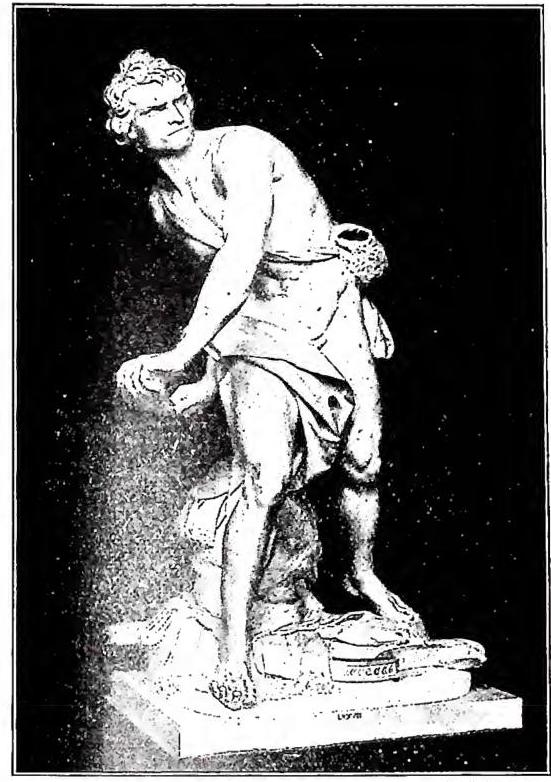
DAVID — D. by G. L. Bernini — Rome, Galleria Borghese.
II. THE THEOCRATIC KING, TYPE OF THE MESSIAH
The successes of D. in every field certainly find their ultimate explanation in the divine will; but among the natural causes, the principal one is to be discerned in his powerful and fascinating personality. His exceptional courage and skill in military undertakings, his magnanimity toward his enemies, his genius for command and organization, his perspicacity and eloquence—all set within an exterior of manly beauty—gave him an irresistible hold over even the most turbulent subjects. As a statesman he possessed a profound and far-sighted vision: if it was God who led him to the throne, he helped events along with exceptional prudence. His chief virtue was sincere religious piety: he lived his entire life, despite the sad interlude of his sin, religiously, always animated by the same unshakable faith in the Lord that had already moved him against the Philistine giant; profoundly humble, he sometimes stooped to offices (such as dancing before the Ark) that the proud Michol considered unworthy of a king; but where he poured out his whole soul, full of love and gratitude to God, was in the Psalms (we possess about seventy of them), with such depth of expression that after thirty centuries they have lost nothing of their relevance and freshness. In short, he was a true saint, for whom the crisis of sin became an occasion for prolonged penance. Rightly, therefore, D. remained the ideal of the Israelite king, to such an extent that, in passing judgment on his successors, the sacred historiographers limit themselves to saying whether or not they walked in the ways of the “servant of God D.”D. was a type of the Messiah. He prefigured his gentleness and generosity in forgiving (a virtue unknown in his time), the glory of the kingdom, and the mission of peacemaking. Of the Messiah, he foretold devotion to the sublime mission, unspeakable sufferings, resurrection from the dead, the throne enduring forever despite the fiercest opposition, and divinity itself (Ps. 2; 15; 21; 68; 108). The idea that D. and the Messiah were one and the same became so deeply ingrained that Jeremiah and Ezekiel would go so far as to use the name D. as a synonym for Messiah (Ez. 34, 23 etc.). The act of faith in the messianic character of Jesus (born of the Davidic line; cf. Mt. 1, 1) was expressed in the cry: “Son of D.!” (Mc. 10, 48; 11, 10).
The rabbinic literature of the post-Christian period is filled with the name and work of D.; the Qur’an mentions him several times, assigning him a splendid place in Paradise. The episodes of his life, so rich in moral instruction, frequently recur in the writings of the Fathers of the Church. The Jews celebrate his birth and death on the second day of Pentecost; Greeks and Maronites commemorate him on the Sunday after Christmas; the Armenians on 22 Dec.; the Copts on 19 Dec.; the Melchites on 26 Dec.; the Roman Martyrology on 29 Dec.
In it D. celebrates his election as king, alluding to his former life as a young shepherd and emphasizing the mercy of God, who preferred him to his brothers, endowed with better physical qualities. Verses 7–8 briefly recall the encounter with the giant Goliath (cf. I Sam. 17, 4 ff.). The psalm offers nothing distinctive, since its various details are drawn from biblical texts. Regarding its origin, only very vague conjectures can be made. It was probably composed between the 2nd century B.C. and the time of Christ, the most prolific period for Jewish apocrypha. The psalm has been transmitted not only in Greek, perhaps its original language, but also in Syriac, Coptic, Ethiopic, Armenian, and Latin. Verses 3–4 entered the liturgy (responsory to the sixth lesson of the 4th–11th Sundays after Pentecost).
IV. CHRISTIAN ARCHAEOLOGY
In places of worship, the oldest representation of D. fighting Goliath is found in Dura Europos (v.) in Mesopotamia. A painting on the vault of cubiculum III in the cemetery of Domitilla in Rome, dated to the first half of the 3rd century, shows D. in an exomis tunic, armed with a sling in his right hand. With regard to its symbolic meaning, Wilpert places this representation among those concerning the invocation of God for assistance for the souls of the departed. «Libera, Domine, animam eius (defuncti) sicut liberasti D. de manu regia Saul et de manu Goliath» (from the Ordo commendationis animae). This symbolism is confirmed by certain Christian sarcophagi from Gaul with the scene of the combat between the biblical hero and Goliath, also depicted in the precious reliquary of the museum of Brescia (4th century). A fresco in the presbyteryof the church of S. Maria Antiqua in Rome, executed during the pontificate of Giovanni VII (705-707), shows D. cutting off the head of the fallen giant. Other moments and episodes from the history of D. are represented on a sarcophagus from Marseille, with the offering of Goliath’s head to Saul, and on a panel of the door of the church of S. Ambrogio in Milan, attributed to the 4th century, with the scene of D. receiving Saul’s messenger. A group of 6th-century Cypriot silver plates offers a rich repertory of scenes from the history of D., among which the following are noteworthy for the novelty of their subjects: D. killing the bear, D. killing the lion, D. and a warrior, the anointing of D., the presentation of D. to Saul, D. clad in armor, and the marriage of D. In the paintings of the burial chapels of Bāwīṭ (Middle Egypt) dating from the 6th or 7th century, but with motifs from the early Christian repertory, D. appears amid scenes from his youth (the sole example is the type of D. as cupbearer) and in his royal majesty. The principal events in the hero’s life up to his coronation are represented on twelve plaques of an ivory casket from Sens Cathedral, of Byzantine imitation but late in date (12th century). His figure as shepherd and king also appears in the miniatures of 10th- and 11th-century codices. In the field of epigraphy, mention should be made of an inscription on a bronze basin of Visigothic workmanship, from the 6th-7th century, commemorating the victory of D. — Vedi tav. LXXXII.