
CORAN. – The most common name of the sacred book of the Muslims.
SUMMARY:
I. Name
II. The C. as a work of God. –III. Author
IV. Compilation
V. Content
VI. Divisions
VII. Language
VIII. Commentaries, text, translations.I. NAME
al-Qur’an derives from the root qr’, meaning “to read,” “to declaim aloud.” Qur’an therefore means first of all “declamation,” then “the recitation” of passages of the revelation, then those passages themselves or even the whole body of all the revelations of the prophet Maometto, and finally the book that we call C. According to many scholars (F. Schwally, G. Wellhausen, Horovitz, etc.), in its particular meanings it would be a loanword from the Syriac qerjānā “lectio,” from the same root. In the C. itself, the word qur’an is used as a technical term for individual revelations and also (17, 107; 25, 34) in the sense of the revelation as a whole.Synonyms of qur’ān are al-kitāb (“the book” par excellence), furqān “distinction” (between good and evil) or “salvation,” “victory” (in this semantic sense derived from Syriac), ḍikr “admonition,” al-muṣḥaf “the book,” “the codex,” and others less common.
II. THE C. AS THE WORK OF GOD. — All Muslims consider the C. to be the work not of Muhammad but directly of God and, unlike what, for example, the inspiration (v.) of the Scriptures, they hold that the Qur’anic revelation “descended upon Muhammad” through the archangel Gabriel, who dictated it to him from a “well-guarded tablet” (al-lawḥ al-maḥfūẓ) preserved in heaven. Thus everything in the C. is the direct word of God, and when citing any Qur’anic passage one says: “the Most High God said...”. The C. itself nevertheless admits that the heavenly archetype descended in clear Arabic upon the prophet Muhammad over a determined period of time, and that even the preceding revelations (Tōrāh, Gospel, etc.), corrupted by Christians and Jews, likewise represent a version of the heavenly book. In any case, the distinction between the heavenly archetype and the C. gradually disappears. Muslim theologians have spilled rivers of ink especially over two questions concerning the C. One is that of the sacred book’s inimitability (i'ḡāz). According to orthodox Sunni theory, the C. is the prophet’s greatest miracle (nu'ḡizah), as is moreover explicitly stated in the C. itself: “Even if men and the jinn (ḡinn) were to join together to produce something like this C., they could not do so, even if they helped one another” (27, 90; V. also 11,16). Nevertheless, in the religious history of Islām there is more than one instance of impious men who wished to imitate the C., such as, according to certain traditions, the famous poet al-Mutanabbī (d. 955); and the witty statement attributed to the great skeptical poet Abū l-'Alā al-Ma'arīf (d. 1058) is well known: he is said to have remarked concerning one of his own C.s: “Let it be polished for four centuries by the tongues of men in the mosques, and then we shall speak of it again!” The Muʿtazilite an-Naẓẓām asserted that the C., even if miraculous in its content, is not miraculous at all in its style and that, theoretically, were it not for God’s impediment, men could quite well have produced one equal to it in literary beauty. Naturally, this assertion too is considered heretical; and the same is true with regard to the second question, namely, the assertion, particularly characteristic of the Muʿtazilites, that the C. is created, and therefore a body and, the opponents reason, theoretically capable even of being transformed into a human being or an animal. According to orthodox Sunni doctrine, however, the C. is “uncreated.” The prince of Sunni theologians, al-Gazzālī (v.), declares succinctly: “The C. is recitable by the tongue, writable in volumes, and preservable in hearts; nevertheless, it is eternal, subsisting in the essence of God, and is not subject to separation or division through its transference into the memory of men and onto the pages of codices.” “That which lies between the two covers of the volume is the word of God,” the most rigid orthodoxy would finally declare.
III. AUTHOR
For anyone who does not accept Islamic dogma, Muhammad (v.) is the author of the celebrated book, the object of veneration for nearly 400 million human beings. It is not equally easy to establish scientifically how, when, and to what extent Muhammad produced the C. In the C. itself, in two passages (7:156 and 158), the mysterious adjective ummī is applied to Muhammad; the majority of Muslim scholars interpret it to mean “illiterate” before the divine revelation (for the most part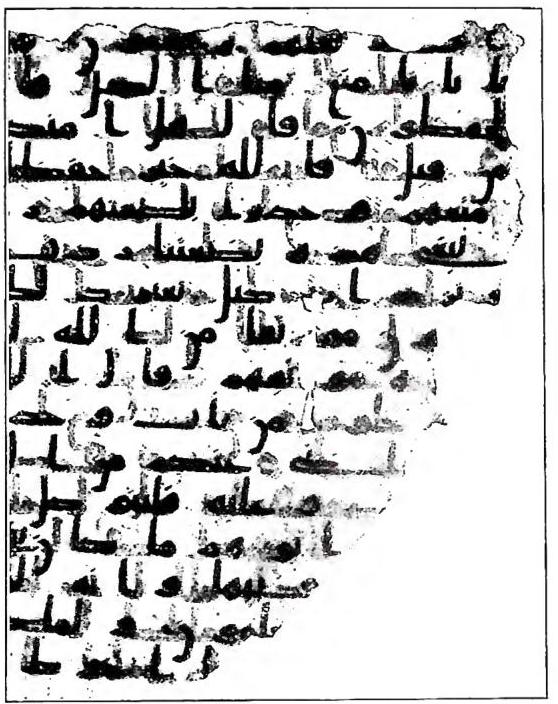
IV. REDACTION
The present recension of the C. is thus, according both to Muslim tradition and to the most common opinion among Western scholars, later than the death of the prophet (632). According to the most widespread tradition, it was Abū Bakr, the first caliph, who, on the advice of 'Omar, ordered Zajd b. Ṭābit, Muhammad’s secretary, to gather everything from the sacred book that had been written down or entrusted to memory. Zajd arranged the chapters according to length, and at the death of Abū Bakr they were entrusted to Ḥafṣah, one of the prophet’s wives. After copies had been sent to various provinces and the text had become somewhat corrupted, the third caliph 'Uṯmān (644–55), in order to prevent disputes over the authenticity of the various texts, is said to have commissioned four scholars, among them Zajd himself, to write a certain number of authorized copies and destroy all the others. According to information supplied by Muslim texts (the Filhīr of an-Nadīm and the Itqān of Sujūṭī), the pre-'utmānic recension of Ibn Mas'ūd lacked the first and the two final chapters, while that of Ubajj contained two additional short ones: the added or omitted sūras are all eulogies and prayers that have nothing specifically Islamic about them. Both recensions differed considerably from the 'utmānic one in the order of the sūras. It also appears that, at the time of the compilation, there existed small groups of chapters already perceived as units. The hypothesis of Casanova and A. Mingana, according to which the C. attained its present arrangement only through the work of al-Ḥaqqāq in the time of the Umayyad caliph 'Abd al-Malik (685–705), is not generally accepted, although it seems that a revision and fixation of the text did take place at that time. Nevertheless, for various reasons (imperfections in the Arabic script of the period, the negligence of copyists, etc.), variants in the sacred text continued—and continue—to exist, for the most part, though not always, of little importance. Orthodoxy resolves the question, in agreement with a somewhat obscure tradition according to which the C. was revealed in sevenaḥruf (“letters”), a term to which it assigned the meaning of “versions,” by declaring equally orthodox the readings of first ten and then seven celebrated scholars chosen arbitrarily. At present, the two authorized versions in use are the Kūfan, used in Egypt and in the countries east of it, and the Medinan, used in the rest of the Muslim world.
See CONTENT. — Regarding the content of the C., one may well repeat what Marracci wrote in the seventeenth century: «Vix dici potest quid determinate contineat Alcoranus: est enim miscella et farrago innumerarum rerum» (Prodr., I, Rome 1691, 225). It is interesting to note that the C. itself (3:5) admits that in the book «there are verses firmly established which are the foundation of the book, and others ambiguous», and accuses those inclined toward evil of attaching greater importance to the ambiguous ones, although these too were revealed by God. This is one of the first distinctions that Muslims make regarding the content of the C.: mutakābih, “ambiguous,” and mutakākhim, “solid.” They generally divide the material into aḥkām (“judgments,” the juridical and normative section), qīṣaṣ (“stories,” the legendary section), and mawā'īz (“parenesis,” “exhortations”), the whole often being inextricably mixed together. Among the aḥkām are precepts concerning prayer, fasting, pilgrimage, marriage, the division of inheritance, criminal law, and so forth, but in a disconnected form that would later give commentators much to do. The legendary section contains, besides biblical stories sometimes distorted (e.g., Maria, the mother of Jesus, is confused with Maria, the sister of Arone), legends of Talmudic or Christian-apocryphal origin (e.g., the Seven Sleepers of Ephesus) and profane origin (the legend of Alessandro Magno and the mysterious Ḥidr); the parenetic section includes passages perhaps among the finest in the C., in the oldest chapters, exhorting to monotheism and penance and depicting the horrors of the “striking hour,” that is, the end of the world and the Last Judgment. The protagonist of the text also changes very frequently: sometimes God speaks in the first person, sometimes Maometto speaks, sometimes Gabriele converses with the prophet, and sometimes criticisms are placed in the mouths of his opponents. Particularly interesting is the fact that Muslims themselves, beginning with the prophet, noticed genuine contradictions between one passage and another of the sacred book and remedied them by applying their somewhat anthropomorphic but robustly personalist concept of the divinity, and asserting (2:100; 16:103) that God can abrogate one or more verses. Entire treatises exist on this question, known as that of “the abrogating and the abrogated” (an-nāsīh wa 'l-manṣūḥ). A typical example of the progressive development of Allāh’s precepts is the prohibition of wine. In 16:69 it is still permitted, indeed cited as proof of God’s generosity; in 2:216, “there is more evil than good” in it; in 4:46 the faithful are advised not to pray while intoxicated; in 5:92 wine is an abomination and the work of Satan. A glance at these citations is sufficient to give a vivid impression of the chronological disorder of the current redaction of the C. In this disorder, a Muslim commentator such as ar-Rāzī discerns a coherence of supernatural origin (one must not forget the profound Islamic sense of the personal arbitrariness of the Divine). In any event, in studying the C. one must divest oneself of the mentality of modern Europeans: probably we should not have found a much better arrangement in a C. personally composed by Maometto.
VI. DIVISIONS
The present C., externally speaking, is divided into 114 chapters (sūrah, pl. suwar, a term whose etymology is disputed), of greatly varying length (from 3 to 286 verses), arranged, as stated, in an approximate order of length, with the exception of the first sūrah, a brief and beautiful prayer. Each sūrah is divided into a certain number of more or less lengthy verses called djah, pl. djat (literally “signs,” “miracles,” cf. Hebr. 'āth), whose division and numbering vary according to the schools. At the beginning one finds the formula Bismi 'llāhi 'r-raḥmāni 'r-raḥm (“in the name of God, the clement and merciful”); the ninth sūrah is an exception, probably because it was originally joined to the eighth. In 29 süre, immediately after the aforementioned formula, numerous letters are read, such as, for example, khj's, etc. Neither Muslim nor Western scholars, despite their shrewd efforts, have succeeded in providing a definitive explanation of them. Among the few hypotheses that have not been proposed is the not altogether improbable one that, if the prophet’s paranormal condition at the moment of the revelations is admitted, they may have been meaningless sounds or cries, similar to those of glossolalists in every age, which were recorded with religious care and with varying degrees of precision by the listeners. Each sūrah has a name, not originally given by the prophet himself, except perhaps in a few cases, a name that alludes to some thing, event, or significant word contained in the sūrah itself. Less important, later, and varying from country to country are the broader divisions of the C. into 30 guz' and 60 hizb for psalmodic recitation, the rules of which constitute an auxiliary “science.” From the standpoint of the place where they were revealed, the sūre were distinguished from ancient times into Meccan, that is, revealed or “sent down” during the Meccan period of the prophet’s activity (609–22), and Medinan, revealed after the Hijra (622–32). The Islamic treatises on Qur’anic studies already provide a rudimentary critical method of distinction: wherever it says “O you who have believed!” the passage belongs to a sūrah that is Medinan; Meccan are those in which the prophet addresses his interlocutors with the words “O people!” Many other divisions, often external and mechanical, are found in Muslim treatises (sūre or verses revealed while travelling, by day, at night, etc.), on which it is not worth dwelling. The treatises also provide a more or less reliable list of the titles of the sūre in chronological order: since the earliest, Meccan ones, are generally shorter, they are found toward the end of the book. The best, although not absolutely certain, chronological arrangement of the Qur’anic sūre is that resulting from the patient and penetrating investigations of T. Nöldeke in his Geschichte des Qur'an. It should be noted that even the longest sūre themselves often do not constitute a chronological unity.VII. LANGUAGE
The language of the C. is 'arabī mubīn, clear Arabic (26, 195), a language which the prophet seems to have possessed to perfection in all its richness. Once the idea that Muhammad “composed” the C. in a popular dialect later adapted to the Arabic literary koinē had been dismissed, scholars have debated and continue to debate the relationship between the language of the C. and that of pre-Islamic classical poetry.The C., a unique work in Arabic literature, is among the most untranslatable books in world literature. Like many great artists, Muhammad detested professional poets, those beings who “roam through every valley and say what they do not do” (26, 225-26), and was particularly sensitive to the accusations, repeatedly made by the Meccans, that he was “a mad poet” (37, 35). Nevertheless, through his work of enthusiastic renewal of the people’s spiritual life, he was a true “revolutionary artist,” dealing a mortal blow to the enclosed and elaborate verbal classicism of pre-Islamic poetry and leaving, in the rhythmic prose of the finest passages of the Meccan sūre, perhaps the sole monument of “romantic art” (the term must be taken cum grano salis) in the literatures of the East. Sole, because the Qur’anic style, owing to the sacred character of the book, found no imitators. Despite this, the enthusiasm and pathos of the C., which, as the Indian Muslim modernist Sir Muhammad Iqbal (d. 1938) rightly wrote, emphasizes action rather than ideas, even when transposed onto a purely religious plane, were among the most important forces at work in the development of the various Islamic literatures.
The style of the C. varies considerably according to the periods: a clear distinction, perceptible even to those who read it in translation, can be made between the Meccan and Medinan styles. The form of the oldest Meccan sūre seems to reflect the influence of the divinations of pre-Islamic Arab soothsayers (kāhin). They are brief, impassioned passages in more or less regular rhymed prose (saq'), sometimes preceded by strange oaths such as: “By the fig and the olive! By the late morning! By the night when it darkens! By the double and the single! By that which comes by night!” The expression is extremely dynamic, and continuously narrative passages are rare. Typical of the Medinan sūre, by contrast, is the greater length of the verses, in which rhyme becomes a purely external and mechanical means of linkage; the expression is calm and at times awkward, and legal regulations abound. These are among the C.’s literarily poorest passages, full of repetitions and naïve arguments, although some of them are not without a certain majestic solemnity, as in the famous “Throne Verse” (2, 256) and others. The transition between the two styles evidently takes place through intermediate stages: the sūre of the second Meccan period, rich in stories of prophets, already differ from those of the first. Comparisons are fairly frequent throughout the C., some of them very beautiful (v. p. es. 77, 30-32); in many of them God speaks of natural phenomena as means of imparting moral instruction. The singular “Verse of Light” (24, 35) stands apart for its mystical symbolism. Despite everything, even on a first reading one cannot fail to notice that the same personal imprint pervades the entire book. One might well say that the best proof—not, certainly, of the C.’s divinity but of its authenticity—is the substantial unity and uniqueness of its style. The influence of the style of the C., read, reread, and meditated upon daily in Arabic by virtually all Muslims, has been incalculable, though not precisely measurable, in all the cultural expressions of the Islamic peoples, who, even when furthest removed from the Arabs, have been profoundly Semitized by II.
VIII. COMMENTARIES, TEXT, TRANSLATIONS
The C. possesses, as is easy to imagine, an enormous number of commentaries, called tafsīr, among which are particularly renowned those of Tabarī (d. 923), orthodox and traditionalist, in no fewer than 30 vols.; of Zamahārāt (d. 1144), tending toward mu'tazilita (v. above); of ar-Rāzī (d. 1209); of al-Bajdāwī (d. 1291), al'arita; and finally, more manageable and extremely widely used, that “of the two Ġalāl” (tafsīr al-šaldāh), namely, by Sujūṭī (d. 1505) and Mahallī (d. 1459).An excellent introduction to the Muslim “Qur’anic sciences” is Sujūṭī’s own Itqān fī 'ulūm al-Qur'ān.
A very good and elegant Arabic text of the C. is that printed in Egypt by order of King Fu'ād (Cairo 1923). The edition of Flügel (Leipzig 1841 and repeatedly stereotyped) was universally used in Europe and reproduced by L. Bonelli in Il C. arabo con tavole di concordanza..., Milan 1937.
Orthodoxy generally prohibits translations of the C. into foreign languages. In recent discussions (1925) in Egypt and Turkey, a relaxation of this prohibition was noted, although it is based only on certain traditions. The first European translation was that of Pietro il Venerabile, abbot of Cluny (1092-1156), published only in 1543 by the Swiss humanist T. Buchmann (Bibliander). Among recent Western translations, perhaps the best scientifically is the Italian one by Bonelli (1st ed., Milan 1929; 2nd, improved ed., ibid. 1940). The best French one is that of M. Kasimiraki (Paris 1840 and subsequently reprinted). One is currently being prepared by R. Blachère, with the sūre arranged chronologically. E. H. Palmer’s English translation is excellent (Oxford 1880, then 1900 and 1928). Henning’s German translation is good (Leipzig 1901).
Nor should the major work of L. Marracci (Alcorani textus universus, Padua 1698) in two substantial volumes be forgotten. The second contains the text and the Latin translation, while the first contains the Prodromus ad Refutationem Alcorani, very rich in accurate quotations from Arab authors (a more correct edition of the Prodromus alone is the earlier one from Rome, 4 vols., 1691). Marracci’s translation, although superseded in various respects, can still be consulted usefully.
A useful Qur’anic anthology for those who do not feel able to undertake an integral reading is V. Vacca, Antologia del C., Florence 1944.