
DELLA VALLE, FAMIGLIA. - An illustrious Roman house, whose most ancient member was a certain RUSTICO made cardinal by Honorius II in 1219.
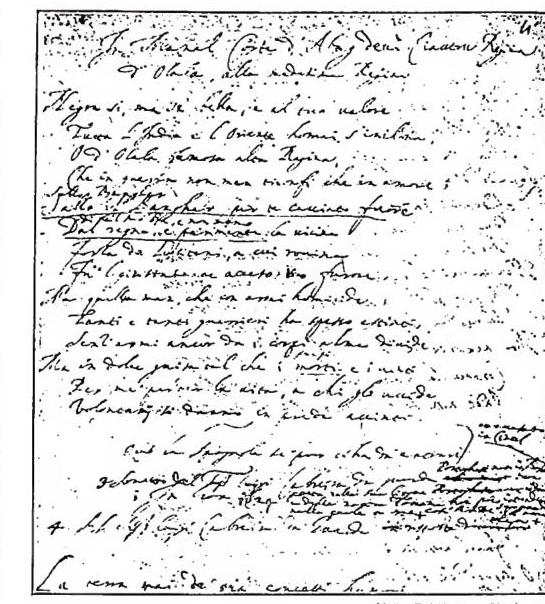
DELLA VALLE, FAMIGLIA - Autograph manuscript of some sonnets by Pietro D. V. inspired by his travels in the East. Vatican Library, cod. Vat. lat. 10383, f. 4° (17th century).
The family originally had its homes near the Forum of Trajan and from there moved in the 15th century to Via Papale (now Corso Vittorio Emanuele), where the original palace, destroyed by the Landsknechts of Charles V during the Sack of Rome (1527), was rebuilt in its present form by Lorenzo Lotti, known as Il Lorenzetto.
The most distinguished members of this family are: ANDREA, cardinal, born in Rome on Dec. 30, 1463, died there on Aug. 3, 1534. After traveling in Europe and Persia, he returned to Rome in 1495 and was bishop of Crotone (Dec. 2, 1496), then of Mileto (1508), and in that capacity participated in the Fifth Lateran Council (1512). He was appointed regent of the Apostolic Chancery by Leo X and later cardinal of the title of S. Agnese in Agone (July 1, 1517). He held various abbeys and numerous bishoprics in commendam, sometimes simultaneously. Clement VII entrusted him with the legation of Naples (1523). During the Sack of Rome in 1527, although he sided with the Colonnas and the imperial forces, in accordance with his family's tradition, his palace was sacked and he had to pay a heavy sum to ransom himself.
In 1532, commissioned by Clement VII, he re-examined with Card. A. del Monte the controversy that had arisen between the Observants and the Franciscan Hermits (Capuchins) (cf. Wadding, Annales, XVI, II, p. 335). In April 1533 he received the sees of Albano and Palestrina. He was a man of great good sense and prudence, as well as a connoisseur and collector of antiquities.
PIETRO, traveler, born in Rome on April 11, 1586, died there on April 21, 1652. After the literary and artistic pursuits of his youth, he left his city, and after brief overseas escapes, stayed in Naples until 1614, where he met M. Schipano, to whom he dedicated the 54 letters concerning his travels, rich in precious information and used by geographers and other travelers.
On June 8, 1614, he began his long itinerary from Venice: after a stop in Zante and among the places he believed to be the ruins of Troy, he landed in Constantinople; from there to Alexandria and Cairo. He climbed Sinai and from Suez made his way to Jerusalem (Easter 1616). Observing and taking notes, he continued his pilgrimage toward Damascus, Aleppo, Baghdad, and Persia, touching at various cities there. In 1621 he was in Persepolis and was the first to describe its cuneiform inscriptions. He headed to India, partly coasting along it, as far as Calcutta, and partly venturing inland, as far as Gujarat. Further stops in Arabia, and finally he returned to Rome on March 28, 1626, received with great honors by Urban VIII.
D. V., among other things, copied the inscriptions of the mosque of at-Tajjibah (Syria); he acquired many manuscripts which he left to the Vatican Library, where his apologetic epistle (rindish) of the Catholic religion in Persian is preserved, translated into Latin an â'ita catechism, and translated into Persian the treatise of the former Jesuit C. Borri on the Tycho Brahe system. - See Plate LXXXIX.