
DORIA, FAMIGLIA. — Genoese lineage whose earliest records date back to the beginning of the 12th century: a MARTINO promoted and brought about the construction of the church of S. Matteo. The D. distinguished themselves through their outstanding maritime virtues and their staunch Ghibelline spirit. ANSALDO was the commander of the fleet in the war against the Moors of Spain (1147–49). His son SIMONE distinguished himself at the siege of S. Giovanni d’Acri. Among Simone’s descendants was PIETRO, a leading figure in the technical preparation of the Crusades of Luigi IX. The family’s most illustrious representative is undoubtedly ANDREA (v. below). The role played in the battle of Lepanto by another D., GIAN ANDREA (1539–1606), was a matter of debate. The first cardinal of the house was GIROLAMO (v. below), the second GIOVANNI, created cardinal by Clement VIII (1604), bishop of Palermo, d. in 1642. Other cardinals were: SINIBALDO (1664–1733), archbishop of Benevento; GIORGIO (1708–59), legate in Bologna; and GIUSEPPE MARIA, Secretary of State to Pius VI. The Doria Pamphili Landi family originated in the 18th century from the marriage of GIOVANNI ANDREA D. to Anna Pamphili Landi: cardinals of this house were GIUSEPPE (1751–1816, v.); ANTON MARIA (1749–1821), GIORGIO (1772–1837). V. PAMPHILI, famiglia.
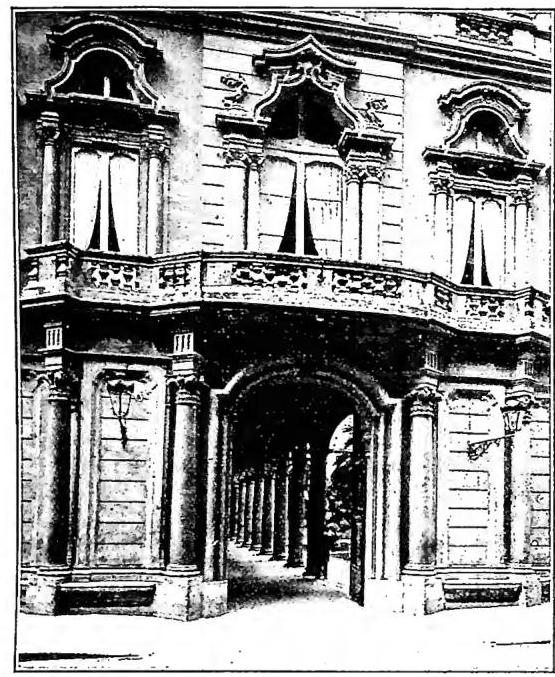
DORIA – Exterior of the D. Palace. Work by G. Valvassori and Raguzzini (early years of the 18th century) – Rome.
I. D. ANDREA. — Admiral, born at Oneglia on 30 November 1466, died at Genoa on 25 November 1560. He began his military career in Rome, in 1483, as captain of the guards of Innocent VIII, then entered the service of the duke of Urbino and the king of Naples. After a journey to the Holy Land, he entered the service of the governor of Rome, Giovanni della Rovere. Returning to Genoa, in 1504 he suppressed the uprising of the Corsicans. In 1513, with the Genoese galleys, he drove the French from occupied Genoa and forced it to surrender. After Marignano, in the service of France, he dispersed the Barbary pirates at Bizerte. In 1521 he defeated the papal and Spanish galleys that were attempting a surprise attack against Genoa. When that city fell into the power of Charles V, he established his base at Marseille, which he defended against the Imperial forces. In the service of Clement VII after Pavia, he returned to the French side in 1527.
But in the following year he came into conflict with Francis I, and, when his contract expired on 2 July, in August he entered the service of Charles V. In addition to personal advantages, he obtained the independence of Genoa and the two Rivieras under Caesarean protection, together with freedom of maritime commerce. With the fortunes turned in favor of the Imperial forces, D., having occupied Genoa, reorganized its government, refusing the rank of prince. In 1535 he fought against Barbarossa, from whom he took La Goulette and Tunis. In 1538, when a Christian league had been formed at the appeal of Venice, attacked by the Turks in its eastern possessions, D.’s galleys allowed the enemy fleet to escape near Prevesa. In 1541 D. directed the expedition to Algiers, which ended in serious failure because of the troops’ hasty landing and a storm that destroyed a considerable number of ships. Having withdrawn to Genoa, in 1547 D. suppressed the revolt of Gian Luigi Fieschi and reformed the Constitution of the Republic. In his final years D. again directed an expedition to Corsica, where the French had fomented a new rebellion, and secured, through the Treaty of Cateau-Cambrésis, the island’s return to the Republic of Genoa. — Vedi tav. CXVI.
At a very young age he was nuncio in Paris (1773), where he remained until 1785, when he was elected (11 February) cardinal of the title of S. Prisca. He was then legate to Urbino (1790), and, after the Treaty of Tolentino, Secretary of State to Pius VI (April 1797), but his attitude, excessively submissive toward the French, was the cause of harsh criticism (J. Gendry, Pie VI, II, Paris [1907], pp. 287–38). By Pius VII, whose election he took part in, he was appointed prefect of the Congregation of the Council, and was a member of the commission of twelve cardinals for the Concordat of 1801 between the Holy See and the French government, as well as of those who ultimately proposed ratification of the complete text (cf. E. Silvestre, L'histoire, le texte et la destinée du Concordat de 1801, 2nd ed., Paris [1905], p. 22, nos. 1 and 37, n. 1; and I. Rinieri, La diplomazia
Renata Orazi Ausenda