
SPINOLA, FAMIGLIA. — One of the four principal families of Genoa. In the city it held power in the name of the Obertenghi marquises, whom it gradually supplanted. Guido was consul between 1102 and 1121, and from him descended numerous branches, the principal ones being those of Lucoli and S. Luca, where the S. family had towers and houses. In the internal factions they supported the Ghibellines against the Fieschi and Grimaldi, and around 1265–66 they established a diarchy with the Dorias, sharing their fortunes in the struggles that followed; they fought against Venice and later against Filippo Maria Visconti, providing admirals and commanders for the Republic. Among them were chosen biennial doges, senators, and ambassadors.
From the branch of S. Luca came AMBROGIO S., considered the greatest man-at-arms of his age; born in Genoa in 1569, he fought for Spain, first in the Netherlands against Maurice of Nassau (1602–1609; then 1621–27), and subsequently in Italy in the war of the Mantuan succession, and was governor of Milan; he died at Castelnuovo Scrivia on 25 September 1630.
The S. family provided the Church with illustrious prelates; the first among them was AGOSTINO, bishop of Perugia from 19 December 1509 until 1529, when he resigned in favor of his brother CARLO; created cardinal on 3 May 1527, on the eve of the sack of Rome, he was appointed camerlengo on 8 June 1528, and in 1529 was given the government of the City in the Pope’s absence, accompanying him to Bologna in 1532; he administered the dioceses of Savona (from 17 July 1528) and Alatri (10 May 1535) until his death, which occurred in the Curia on 18 October 1537.
FILIPPO was a referendary of the Segnatura, bishop of Bisignano (8 February 1566), then of Nola (9 March 1569), which he resigned when he was created cardinal on 12 December 1583, on the recommendation of the Emperor Rudolf II, and joined the Spanish party; he died in Rome on 20 August 1593.
ORAZIO, also of the Spanish party, was appointed archbishop of Genoa on 20 December 1600 while a referendary, and legate of Ferrara in 1606; he was created cardinal on 11 September 1606 and died in Genoa on 24 June 1616, renowned for his great severity.
AGOSTINO II, born in Genoa, was created a cardinal deacon by Paul V on 11 January 1621, while a protonotary apostolic; he was subsequently bishop of Tortosa (5 March 1623), of Granada (7 September 1626), archbishop of Compostela (23 October 1630), and of Seville (16 January 1645), where he died in February 1649.
GIAN DOMENICO, an Auditor of the Camera, was created cardinal by Urban VIII on 19 January 1626; archbishop of Acerenza and Matera on 13 November 1630, then bishop of Luni-Sarzana (26 April 1632), and subsequently of Mazara (1 December 1636), where he died on 11 August 1646.
GIULIO, a referendary of the Segnatura, was appointed nuncio to Naples on 4 October 1653, archbishop of Laodicea on 14 January 1658, and nuncio to the Emperor on 10 July 1665; created cardinal on 15 February 1666, he was published only on 7 March 1667; he was bishop of Nepi and Sutri (on 2 June 1670), then of Lucca (8 November 1677), and died in the Curia in March 1691.
His nephew GIOVANNI BATTISTA, born in Madrid on 21 September 1615, was nuncio at Nimega, archbishop of Matera in 1648, and then of Genoa in 1664, which he resigned when Innocent XI created him cardinal of S. Cecilia on 1 September 1681; he was still governor of Rome when, at the beginning of 1687, disputes with France over the privileges of the French quarter intensified. He died in Rome on 4 January 1704. His nephew was NICCOLÒ, born in Spain on 20 February 1659, cleric of the Camera under Innocent XII, nuncio at Florence and then in Poland, Auditor of the Camera, created cardinal by Clement XI on 16 December 1715; he died in Rome on 12 April 1735. His contemporary was GIORGIO, a Genoese, born on 16 June 1667, vice-legate of Ferrara, governor of Civitavecchia, Viterbo, and Perugia, inquisitor of Malta in 1703, commendatory abbot of S. Spirito, archbishop of Caesarea, and nuncio at Barcelona from 1711 to 1713 and then at Vienna (1713–20), where he was present during the war against the Turks in 1715–16; he was created cardinal by Clement XI on 29 November 1719. Innocent XIII made him Secretary of State; the French opposed his serving in that capacity under Clement XII. He was legate to Bologna and died in Rome on 17 January 1739.
GIOVANNI BATTISTA II, born in Genoa on 6 July 1681, cleric of the Camera in 1722, governor of Rome for six years, was created cardinal deacon by Clement XII on 28 September 1733; he died as bishop of Albano on 21 August 1753.
GIROLAMO, born in Genoa on 15 October 1713, was nuncio at Madrid, which he left after being created cardinal on 24 September 1759, leaving written reports on the ecclesiastical conditions of that Kingdom. At the Conclave of 1775 he was vehemently opposed by Vienna and Madrid. He died in Rome on 22 July 1784.
UGO PIETRO, born in Genoa on 23 June 1791, was apostolic delegate at Macerata (1823–26), and nuncio at Vienna, from which he returned after being created cardinal in July 1832. He was legate to Bologna in 1833 and then in 1842–44, and on the occasion of the political disturbances, to suppress which he established an extraordinary commission presided over by Colonel Freddi. He was subsequently pro-datary until his death, which occurred in Rome on 24 January 1858 (E. Michel, in Div. Ris. naz., IV, Milan 1937, p. 332).
Pio Paschini
AGOSTINO, born in Genoa in 1677; having completed his early education at the S. Giorgio College of Novi Ligure of the Somaschans, he embraced their Rule and soon held the most important offices in the Order, in addition to teaching philosophy and theology.
He was theologian to Cardinal Giuseppe Renato Imperiale, legate to Charles III, King of Spain; rector of the Clementine College in Rome and vice-procurator general in the Roman Curia. In 1716 he was elected bishop of Ajaccio, and in 1722 transferred to the see of Savona. He died on 16 October 1755. In 1718 he convened the Synod at Ajaccio, at which he promulgated many wise laws. In Savona he firmly defended ecclesiastical liberties, earning the praise of Benedict XIII; he reformed the Seminary, issuing the Constitutiones pro seminario episcopali (Milan 1738), modeled on those of s. Carlo Borromeo but enriched by personal experience and sound criteria of relevance to the present. For all the clergy he published various pastoral notifications, collected in the Monitum spirituale (ibid. 1740), directed above all toward organizing the teaching of Christian doctrine to children, the administration of the Sacraments, and the sanctification of feast days.
CARLO, blessed. — Jesuit, missionary, and martyr, born in Genoa in 1564, from the branch of the S. family of Tassarolo; he died at Nagasaki on 10 September 1622.
He entered the Order in 1564 and was sent to Japan in 1597, but succeeded in reaching his destination only after seven years of adventures. Having arrived, in fact, at the Cape of Good Hope, a breakdown of the ship induced the captain to retrace his course toward Lisbon; but, having been attacked by English pirates, the travelers were taken to England. From there, S. managed to board a ship in disguise for Lisbon, whence, after a year’s wait, he sailed again and reached Japan in 1602. He worked there continuously for 20 years, with great success in conversions, until he was arrested in 1618 under the anti-Christian edict of the Emperor Dailusama and transported with other companions to the prisons of Omura. After four years of hardship and illness, he suffered martyrdom by fire at Nagasaki, on the hill called that of the martyrs, where another group had preceded him in 1597. He was beatified with 204 other Japanese martyrs. Feast day: 11 September.
(Int. Enc. Catt.)
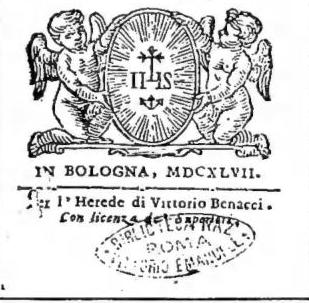
SPINOLA, FAMIGLIA — Frontispiece of the Vita del P. Carlo S., written by Fr. F. Ambrogio S., Bologna 1647 — Rome, copy in the National Library.
royal crown, delivered in Genoa in the church of S. Caterina in the presence of the Doge and the authorities (1638).
He wrote the biography of Fr. Carlo S., martyr for the faith in Japan (Rome 1628), later beatified; of the venerable Mother Maria Vittoria, foundress of the Order of the Annunciation (Genoa 1649); and of Fr. Sopranis, a Jesuit. But his fame is due above all to his books of meditations, especially those on the life of Jesus, arranged for every day of the year, from Advent to the feast of the Most Holy Trinity and from the Most Holy Trinity until the first Sunday of Advent (Genoa 1652, 1653), and those on the feasts of Our Lady and the principal saints throughout the year. These meditations were subsequently abridged (Venice 1673) and achieved wide circulation. His Lenten sermons, too, were published in Genoa in 1667, dedicated to the Empress Eleonora.