
ACERENZA AND MATERA, ARCHDIOCESE OF. — A. rises on the ruins of Acheruntia, called “celsa” by Horace (Carm., III, 4, 13–16). Because of its position on the frontier between Apulia Daunia and Lucania, it was regarded as the most important defensive point of the two regions. It later became one of the strongholds of Byzantine rule in southern Italy and a garrison of Totila
in the struggle between Greeks and Goths. Incorporated into the Duchy of Benevento, the lands of its gastaldate were divided in 849 between Benevento and Salerno, but everything drew it toward the sphere of Greek influence, to such an extent that the Lombard officials themselves eventually came to collaborate with the Byzantine government. In 1041 it was conquered by the Normans, and Robert Guiscard made it an offensive bastion and a center of resistance for the reconquest of Lucania and Apulia. It was one of the few royal cities that sided with Manfred against the Pope and, later, with René of Anjou against Alfonso of Aragon.
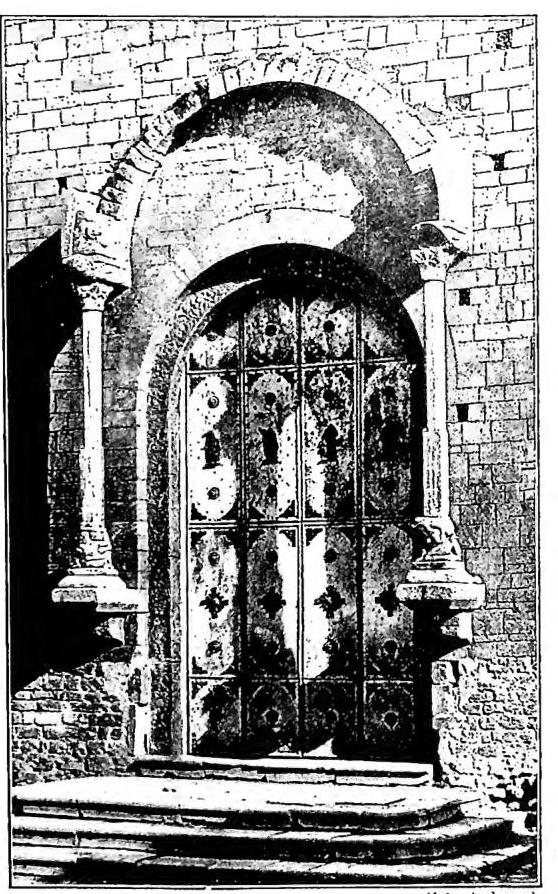
The city gradually declined, and in 1561 had only 2,000 inhabitants; the strong currents of emigration prevented it from flourishing again. A. covers an area of 77 sq km and belongs to the province of Potenza, from which it is 42 km distant. Major works to consolidate the built-up area have recently been undertaken in order to remedy the serious landslides caused by the rains. The Cathedral is particularly noteworthy: it was erected toward the end of the 8th century by Bishop St. Leone II, with three circular apses, a portal in Apulian Romanesque style, and a Roman bust of Julian the Apostate, formerly venerated because it was believed to represent St. Canio, whose body was transported to A. in 799. Destroyed by fire, it was rebuilt around 1082.
M. a city of Greek origin, was a Roman colony (Mateola), occupied by Pyrrhus and Hannibal. Devastated
The Cathedral is a magnificent construction in Apulian Romanesque style from the first half of the 13th century. The two churches of S. Pietro Caveoso and S. Maria d'Idris are interesting; both are situated on the Sasso Caveoso, and the latter is excavated almost entirely within the heart of the cliff. Numerous and noteworthy underground Byzantine churches, scattered throughout the Materan territory, attest to the flourishing of the Greek rite in the region. M. also possesses the remains of an ancient unfinished castle and an interesting paleontological museum with furnishings from the necropolis of Timmari. Capital of the province, M. has 20,243 inhabitants; the province covers 3,793 sq km and has a population of 157,002 inhabitants, distributed among 32 municipalities.
The diocese of A. was founded in the 4th century, and its first bishop is said to have been Romano; but the first prelate known with certainty is s. Giusto, who took part in the Roman Synod of 499. In the 10th century, the emperor and the archbishop of Constantinople improperly incorporated A. into the Greek archbishopric of Otranto, and this transfer marked another victory for the Greek rite in Italy. In 993 it was again united with Salerno, and at the Council of Melfi in 1059 it was raised to an archdiocese; Alessandro II confirmed the measure in 1068, and Pasquale II, in 1106, assigned to it as suffragans Venosa, Gravina, Tricarico, Anglona-Tursi, and Potenza. In 1203, since A. had almost disappeared, Innocenzo III raised the church of S. Pietro in M. to cathedral rank so that the bishop might reside there with due dignity; but only in 1440 was M. raised to a diocese by Eugenio IV, and later united with A. aeque principaliter. To allay local disputes and sensitivities, in 1471 Sisto IV decreed that the archbishop should be called of A. and M. when he was in the territory of A., and of M. and A. when he was in the territory of M. In 1599 Clemente VIII decreed the precedence of A. on account of its ancient foundation and established the residence in M. The diocese of M. was suppressed in 1818, but, acceding to the pleas of the Archbishop and the King, Pio VII restored it in 1822.
The archdiocese now has Anglona-Tursi, Potenza, Tricarico, and Venosa as suffragans. It has incorporated the abbey title of S. Michele Arcangelo di Montescaglioso. The archbishop resides in A. from May to October and in M. from November to April. In all, there are currently 168,794 Catholics out of 169,069 inhabitants; 185 churches, 31 parishes, 88 diocesan priests, and 7 religious priests.