
ALESSANDRIA, DIOCESE OF. - In Piedmont, at the confluence of the Bormida and the Tanaro, in a strategic position of great importance. A. was founded in 1168, with the approval of the rectors of the Lombard League, by deliberation of the Ligurian towns that wished to escape the yoke of the Marquis of Monferrato and of the Del Bosco, and it had the support of Alexander III, from whom it took its name. Since it was intended to be made the stronghold of the Guelphs against Frederick Barbarossa, Milanese, Cremonese and Piacentine troops helped and defended the Ligurian conspirators against the disturbers, and Genoa itself lent valuable aid to the foundation. In 1174 it was besieged by Barbarossa, but in vain. It sustained lively struggles against the Marquises of Monferrato, succeeding in withdrawing durably from their dominion with the peace of 1306. In the 14th and 15th centuries it was subject to the Visconti and from 1495 to the peace of Cambrai to the French.
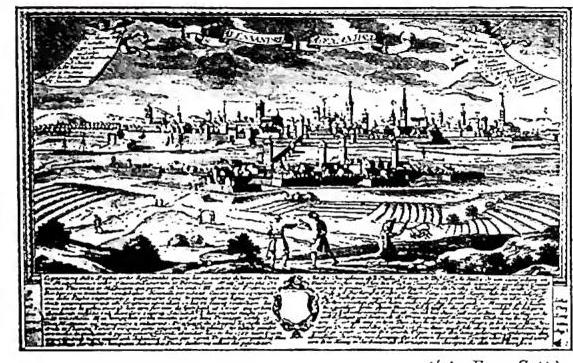
It then passed under Spanish dominion until 1706, when it became part of the possessions of the House of Savoy.
A. is the most populous city of Piedmont after Turin, with 270 communes, and is the capital of a rich province.
The diocese of A., included among those of Casale, Vigevano, Turin, Acqui and Asti, was created as a suffragan of Milan around 1175. Its principal protector is St. Baudolino, a hermit who lived at Villa del Foro. His body was transported to A. when the inhabitants of Villa del Foro transplanted themselves there to begin the new city, where a church was erected in his honor. The primitive diocese would have been formed by Rovereto or Roboreto, a castle that constituted the nucleus of the new city, and by seven other lands that aided its foundation. The first bishop, Arduino, was not consecrated. In 1180 Alexander III established that the bishop of Acqui, who was to be called Alessandrine, should have the government of the diocese. The union did not take place because it was painful to the people of Acqui. Restored in 1206, in name but not in fact, it was dissolved in 1240 by Gregory IX, who restored to A. its autonomy. There was, however, no bishop, and the episcopal government was held for some time by the archdeacon as representative of the chapter. In 1405 the diocese was reorganized by Innocent VII. With the annexation of Piedmont to France, Pius VII confirmed, by a brief of 1805, the imperial decree of suppression of the diocese, which was incorporated into Casale. It was re-established in 1817 and declared a suffragan of Vercelli.
The cathedral, dedicated to St. Peter, built in 1178, rebuilt toward the end of the 13th century, was demolished in 1803 by the French authorities who occupied A. The new one was built between 1808 and 1810. The ancient church of S. Maria Castello, of the 12th century, has been preserved in its fundamental lines, recently brought to light by restorations, and presents an interesting and picturesque apse side.
Among the numerous monasteries of the diocese are the Benedictine abbeys of S. Michele and S. Giustina and S. Maria di Castello. At Bosco Marengo, in the vicinity of A., St. Pius V (Michele Ghislieri) was born.
The patroness of the city is the Madonna delle Salve. Until the end of the 18th century a solemn religious ceremony of Good Friday called "the mortorio of Christ" took place in A.
The diocese has an area of 754 sq. km., with 138,000 inhabitants, of whom 137,750 are Catholics; it comprises 26 communes of the province of A., 198 churches, 66 parishes, 135 diocesan priests.
Bibliography10 works
Noemi Crostarosa Scipioni