Machine translation of the 1948–1954 Italian original. The original text is authoritative.
ALBENGA, diocese of. — It is the ancient Album Ingaunum or Albinganum, situated on the Gulf of Genoa (Riviera di Ponente). Capital of the Ligurian Ingauni, who, having allied themselves with Hannibal, were subdued by the Romans after bitter wars, A. became a Roman municipium, received privileges from the Senate, and was enriched with monuments, of which numerous vestiges still remain today, as does the great ten-arched bridge, partly buried, on the Via Aurelia. It was the birthplace of the Emperor Proculus.
Destroyed once by the Goths, rebuilt and embellished by Honorius, it again suffered looting and destruction at the hands of the Saracens and the Pisans, yet always succeeded in regaining its freedom and continued to govern itself with its own laws and parliaments until 1805, although dependent on the Republic of Genoa from 1250. Twenty-two ancient defensive towers still bear witness to its struggles. From the fifteenth to the eighteenth century it endured sieges and occupations, beginning with that of the Milanese in 1436 and ending in 1814, when it was definitively reunited with the Sardinian State. In 1796, during the first Italian campaign, it was the headquarters of
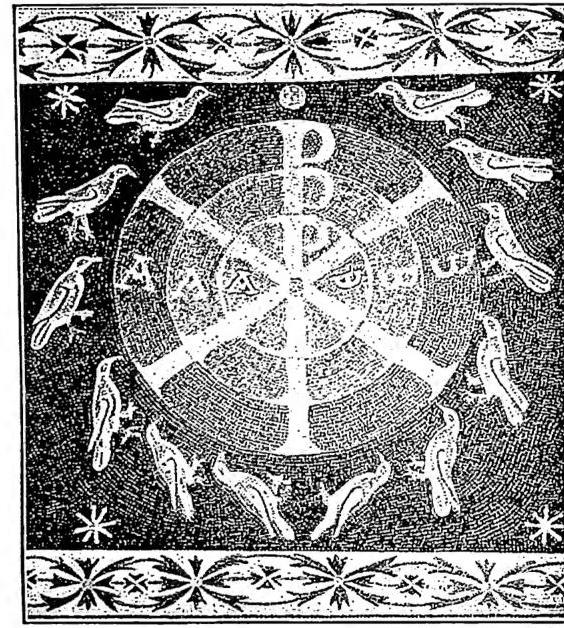
ALBENGA - Baptistery, mosaic (5th century).Bonaparte. It forms part of the province of Savona, established in 1927 with the suppressed districts of A. and Savona. It is of considerable agricultural importance and has a population of 5,179 inhabitants, and 12,000 in the municipality.
The first bishop of whom there is certain information is Quinzio, who in 451 signed a synodal letter of Eusebius, archbishop of Milan, addressed to Leo I and concerning the condemnation of Nestorius and Eutyches. In 1159 the diocese of A., a suffragan of Milan, was assigned by Alexander III to Genoa, but this took effect only in 1213 following a bull of Innocent III.
The Benedictines had numerous monasteries in the diocese, among them S. Romolo, Taggia, Triora and Villa Regia, and in A. two important abbeys: S. Maria and S. Martino di Gallinaria, in addition to S. Pietro di Toirano, which passed to the Carthusians in 1317.
A. has a cathedral begun in the 8th century, with a Gothic bell tower from the 15th century, and an adjoining baptistery. A beautiful church from the 13th century is S. Maria in Fontibus.
The diocese, whose patron is St Michael the Archangel, has 132,500 inhabitants and comprises 170 parishes, 236 diocesan priests and 51 religious priests, 17 religious houses for men and 58 for women.
BIBL.: In general, reference should be made to the work of A. Manno, Bibliografia storica degli Stati della monarchia di Savoia, II, Turin 1891, pp. 100-108; in particular cf.: Ughelli, IV, pp. 910-924; G. Casalis, Dizionario storico, statistico, commerciale degli Stati di S. M. il Re di Sardegna, I, Turin 1833, p. 138 ff.; G. Rossi, Storia della città e diocesi di A., Albenga 1870; P. B. Gams, Series episcoporum ecclesiae catholicae, Ratisbona 1873, p. 810; F. Savio, S. Calocero e i monasteri di A. e di Civate, in Rivista storica Benedettina, 9 (1914), pp. 44-59, 103-108; Lanzoni, pp. 841-42. Noemi Crostarosa Scipioni
THE BAPTISTERY. – From the Early Christian period A. has preserved a most valuable monument: the baptistery, unanimously attributed to the 5th century. It has an octagonal plan, with the sides recessed into alternating round and square niches; each pillar between the niches is adorned with a column, and the columns bear arches supporting the upper part of the baptistery, which is itself octagonal and contains large windows closed by pierced marble screens. In the centre is the baptismal basin; a smaller basin stands in one of the niches, for the lotio pedum of the Milanese baptismal liturgy. This niche still displays striking remains of a rich mosaic decoration, whose most important details are a large Constantinian monogram within a triple halo (the Holy Trinity?), around which twelve doves hover, and a large jewelled cross toward which two lambs are turned. The baptistery was roofed, not domed. In the 9th century it underwent various alterations, of which noteworthy sculptural traces remain, especially in the windows. Two tombs of high-ranking personages were installed in two arcosolia, important examples of the architecture and minor sculpture of that period. In 1900–1901 the entire baptistery underwent careful restoration.
Also worthy of mention are a Christian sarcophagus discovered recently and a brick bearing the imprint of a large cross formed by two crossed fasces, perhaps belonging to the ancient little church of S. Calocero (4th–5th century), destroyed long ago.
BIBL.: G. De Angelis-d'Ossat, I battisteri di Albenga e di Ventimiglia, in Bollettino della R. Deputazione di storia patria per la Liguria. Sezione Inganna e Intemelia, 2 (1926), pp. 207–50. For the decoration: P. Toesca, La pittura e la miniatura nella Lombardia, Milano 1912, pp. 22–27. For the sarcophagus: N. Lamboglia, in Rivista Inganna e Intemelia, 3 (1937), pp. 58–61. For the brick with the cross: A. Ferrua, in La Civiltà Cattolica, (1944, II), pp. 169–71. In general: N. Lamboglia, Albenga Romana, Albenga 1935. Antonio Ferrua
Cite this article
“ALBENGA, DIOCESI DI.” Enciclopedia Cattolica, vol. I (1948), p. 405. Azione Romana digital edition, https://azioneromana.com/article/albenga-diocesi-di.